
Should I Roll Over My 401(k) to a Gold IRA? Pros and Cons
If you’ve been researching ways to broaden what your retirement savings are exposed to, you’ve likely come across the idea of moving some or all of your 401(k) into a Gold IRA. It’s a question many retirement-focused investors are asking — and it deserves a thorough, honest answer.
This article won’t tell you what to do with your money. That decision belongs to you and any qualified financial professional you work with. What we will do is walk you through exactly how a 401(k) to Gold IRA rollover works, what it genuinely costs, what the IRS rules require, and what factors are worth weighing carefully before you make any moves. Think of this as your starting point for an informed conversation.
What Is a Gold IRA, and How Does It Differ From a 401(k)?
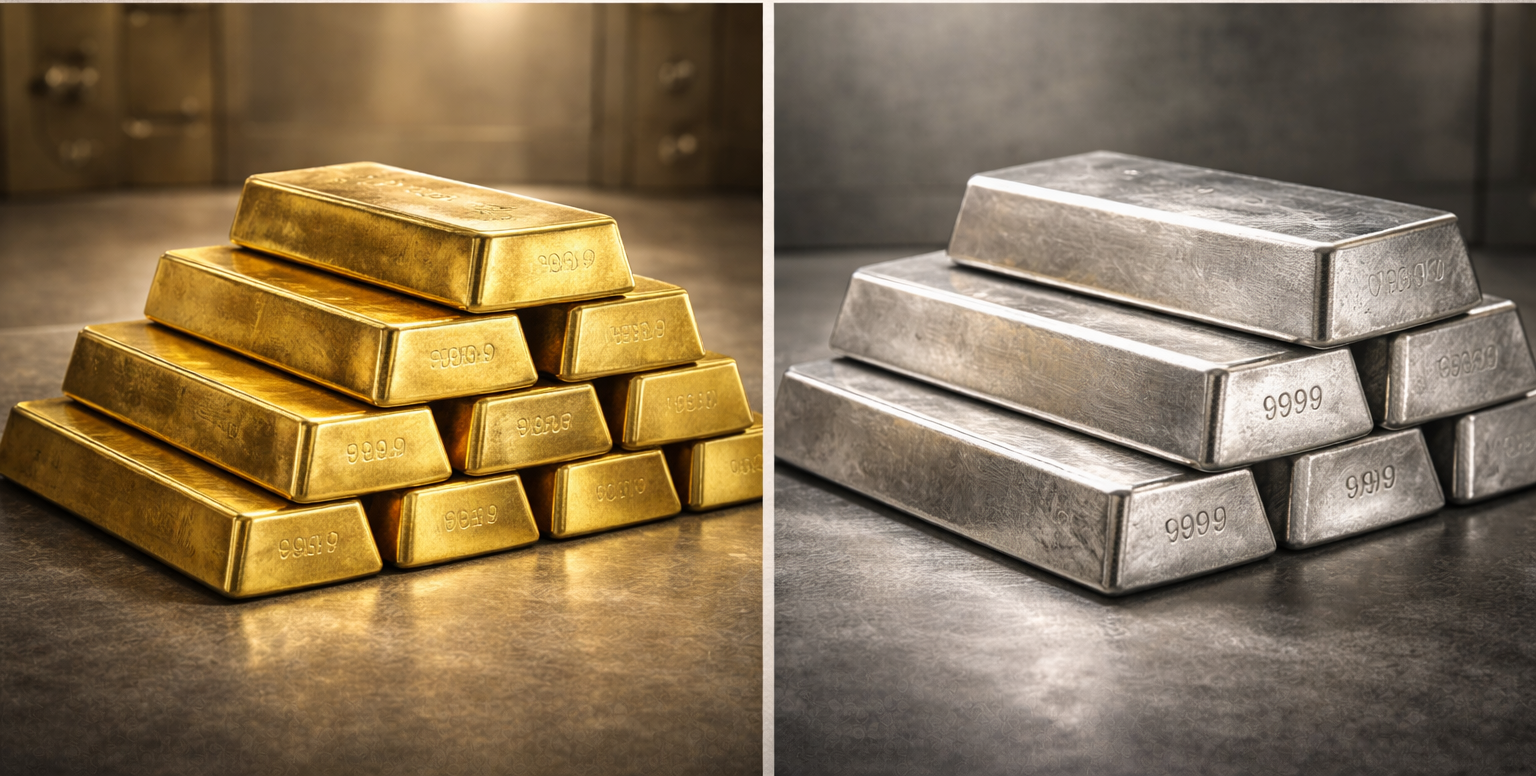
Before you can assess whether a rollover makes sense for your situation, it helps to understand what you’d actually be moving into. A Gold IRA is a self-directed individual retirement account that holds physical precious metals — typically gold, silver, platinum, or palladium — rather than conventional assets like mutual funds, ETFs, or company stock.
You can explore what a Gold IRA is in full detail on our dedicated hub, but the short version is this: a Gold IRA is still an IRA in every legal sense. It follows the same IRS contribution limits, tax treatment, and distribution rules as a traditional or Roth IRA. The key difference is what sits inside the account.
A 401(k), on the other hand, is an employer-sponsored retirement plan. It’s funded through payroll deductions, often with employer matching contributions, and typically offers a menu of investment options selected by your plan administrator. Once you leave an employer — whether through retirement, a job change, or another life event — you generally have the option to roll those funds into an IRA.
For a side-by-side breakdown, our Gold IRA vs 401(k) comparison covers the structural differences in more detail.
How Does the Rollover Process Actually Work?
The mechanics of a 401(k) to Gold IRA rollover are more straightforward than many people expect, but they do require careful attention to IRS rules at each step.
Direct vs. Indirect Rollovers
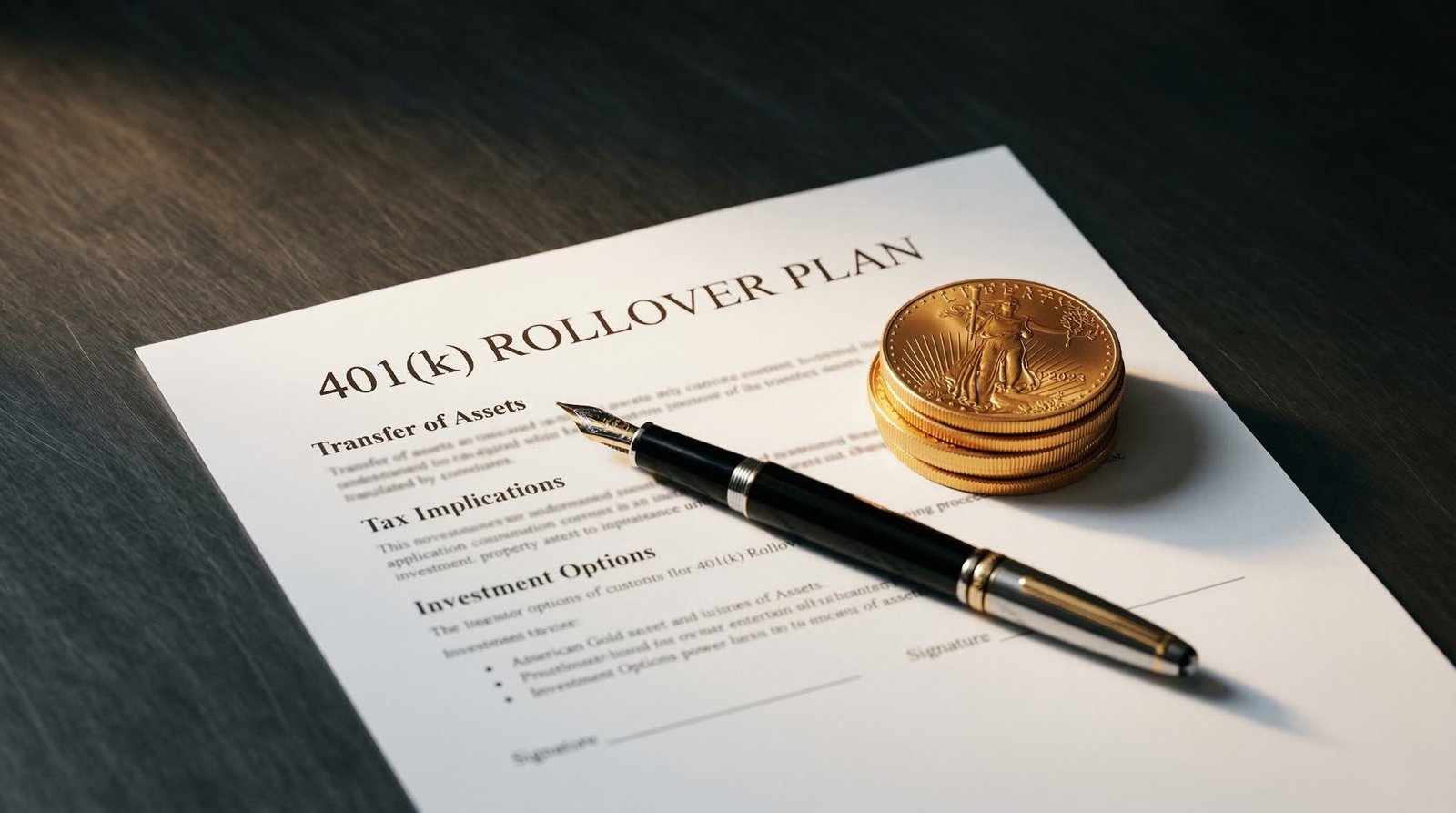
There are two ways to move funds from a 401(k) to an IRA: a direct rollover and an indirect rollover. In a direct rollover, your 401(k) plan sends the funds straight to your new Gold IRA custodian. No money passes through your hands, which means no withholding and no immediate tax consequences. This is typically the cleaner and more reliable method.
In an indirect rollover, the funds are distributed to you first, and you then have 60 days to deposit them into your new IRA. Your plan is required to withhold 20% for federal taxes upfront, which means you’d need to replace that withheld amount out of pocket if you want to roll over the full balance. Miss the 60-day window, and the IRS treats the distribution as ordinary income — potentially triggering taxes and a 10% early withdrawal penalty if you’re under 59½.
Our full 401(k) to Gold IRA rollover guide walks through both methods step by step.
Opening a Self-Directed IRA
Because a Gold IRA holds physical metals, it must be a self-directed IRA (SDIRA) held by a custodian approved by the IRS to handle alternative assets. Not every financial institution offers this service. You’ll need to identify a qualified custodian — banks, trust companies, or other IRS-approved entities are the usual options. FINRA’s guidance on self-directed IRAs is worth reading if you’re new to the concept.
IRS-Approved Metals and Storage Requirements
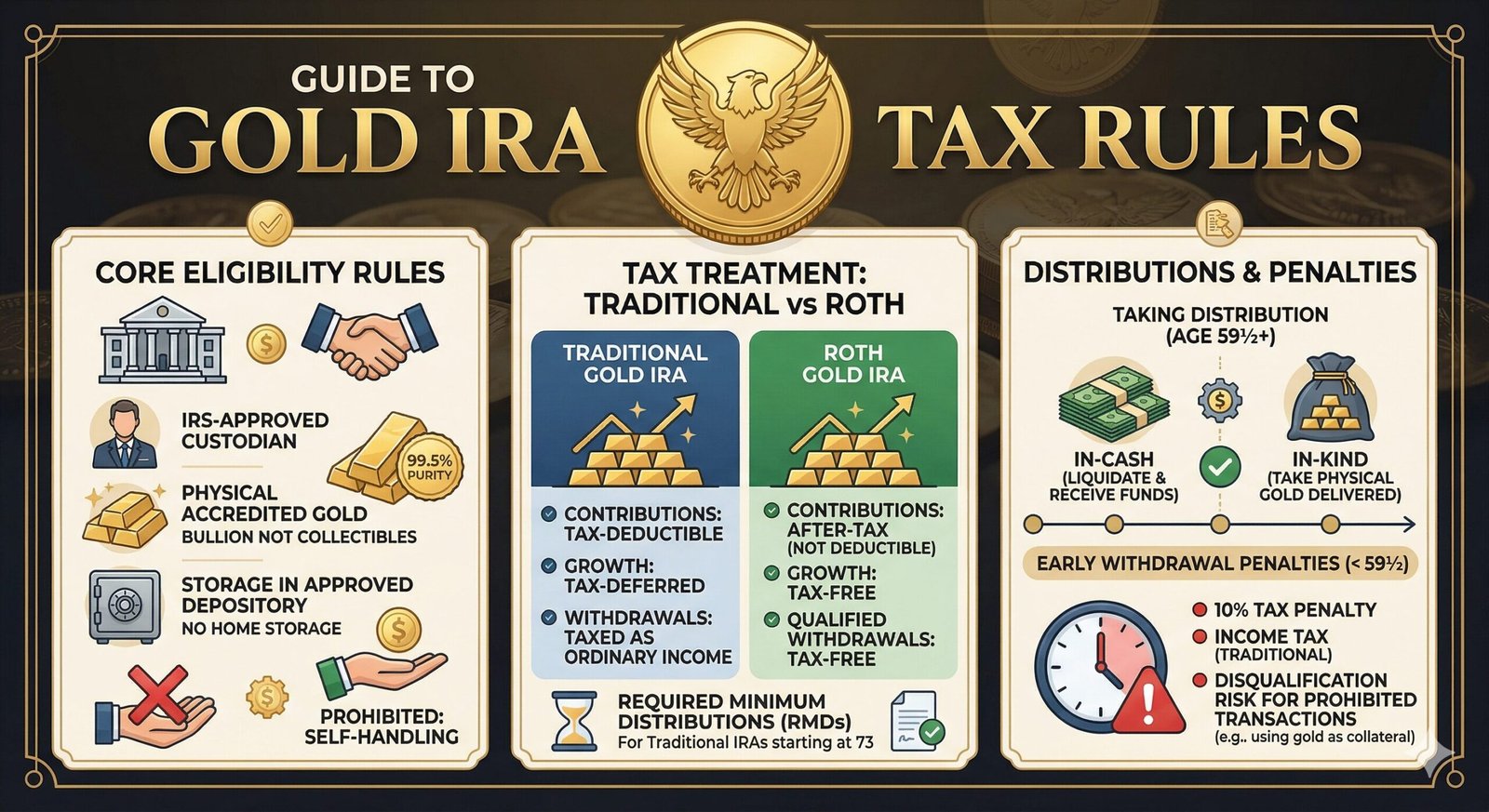
Not all gold qualifies. The IRS sets strict purity standards — gold must meet a minimum fineness of .995 to be held in an IRA. Only certain coins and bars are eligible. Our guide to IRA-eligible gold coins outlines what meets the standard and what doesn’t.
Critically, the physical metal must be stored in an IRS-approved depository — not in your home safe or a safe deposit box. This is a firm rule. Any arrangement that gives you personal possession of the metal while it’s inside the IRA is considered a distribution by the IRS, with all the tax implications that follow.
The Costs Involved: What You Should Know Upfront
One of the most important and often underappreciated aspects of a Gold IRA is that it comes with a distinct fee structure compared to a typical 401(k) or conventional IRA. Before making any decisions, understanding these costs is essential.
Our detailed Gold IRA fees guide covers this comprehensively, but here’s an overview of the main cost categories:
These costs can add up meaningfully over time. A smaller account balance may bear a heavier proportional fee burden than a larger one, which is one reason many custodians set minimum investment thresholds. You can review typical minimums in our Gold IRA minimum investment guide.
The IRS IRA investment FAQ also provides useful context on how alternative-asset IRAs are governed.
Key Rules and Compliance Considerations
Contribution Limits and Eligibility
Once funds are rolled over from a 401(k), they sit within the Gold IRA and are not subject to the annual IRA contribution limits for that year — rollovers are treated separately. Ongoing contributions you make each year, however, are subject to standard IRS limits. You can find current figures at the IRS contribution limits page.
Required Minimum Distributions
Gold IRAs — like all traditional IRAs — are subject to Required Minimum Distributions (RMDs) starting at age 73 under current law. This can create a practical consideration: if you need to take an RMD but your IRA holds physical metal rather than cash, you’ll need to either sell some of the metal or arrange an in-kind distribution. It’s worth understanding this in advance. The IRS RMD FAQ has official guidance on how distributions work.
Rollover Rules and the One-Per-Year Limit
The IRS limits individuals to one indirect IRA-to-IRA rollover per 12-month period across all IRAs. Direct rollovers from a 401(k) are not subject to this restriction, which is another reason many investors and custodians recommend the direct method. Our Gold IRA rollover rules page covers these requirements in depth.
Factors Worth Thinking Through Carefully
A rollover from a 401(k) to a Gold IRA is not inherently good or bad. What matters is how well it aligns with your individual circumstances. Here are some honest considerations to weigh.
The nature of physical assets. Unlike stocks or bonds, physical gold doesn’t pay dividends or interest. Its value is determined entirely by market price, which fluctuates. Past performance is not a guarantee of future results, and gold’s price history — however interesting — does not predict future outcomes.
Liquidity differences. Selling physical gold from an IRA involves coordinating with your custodian and dealer, which takes more time than selling a mutual fund. If liquidity is a priority, this is worth factoring in.
Complexity and administration. Self-directed IRAs require more active oversight. You’re responsible for ensuring metals meet IRS purity standards, storage requirements are maintained, and all rules are followed. Errors can have tax consequences.
Existing 401(k) features. Some 401(k) plans — particularly those from large employers — offer institutional-rate investment options with very low fees. It’s worth comparing what you’d give up in your current plan against what the Gold IRA offers.
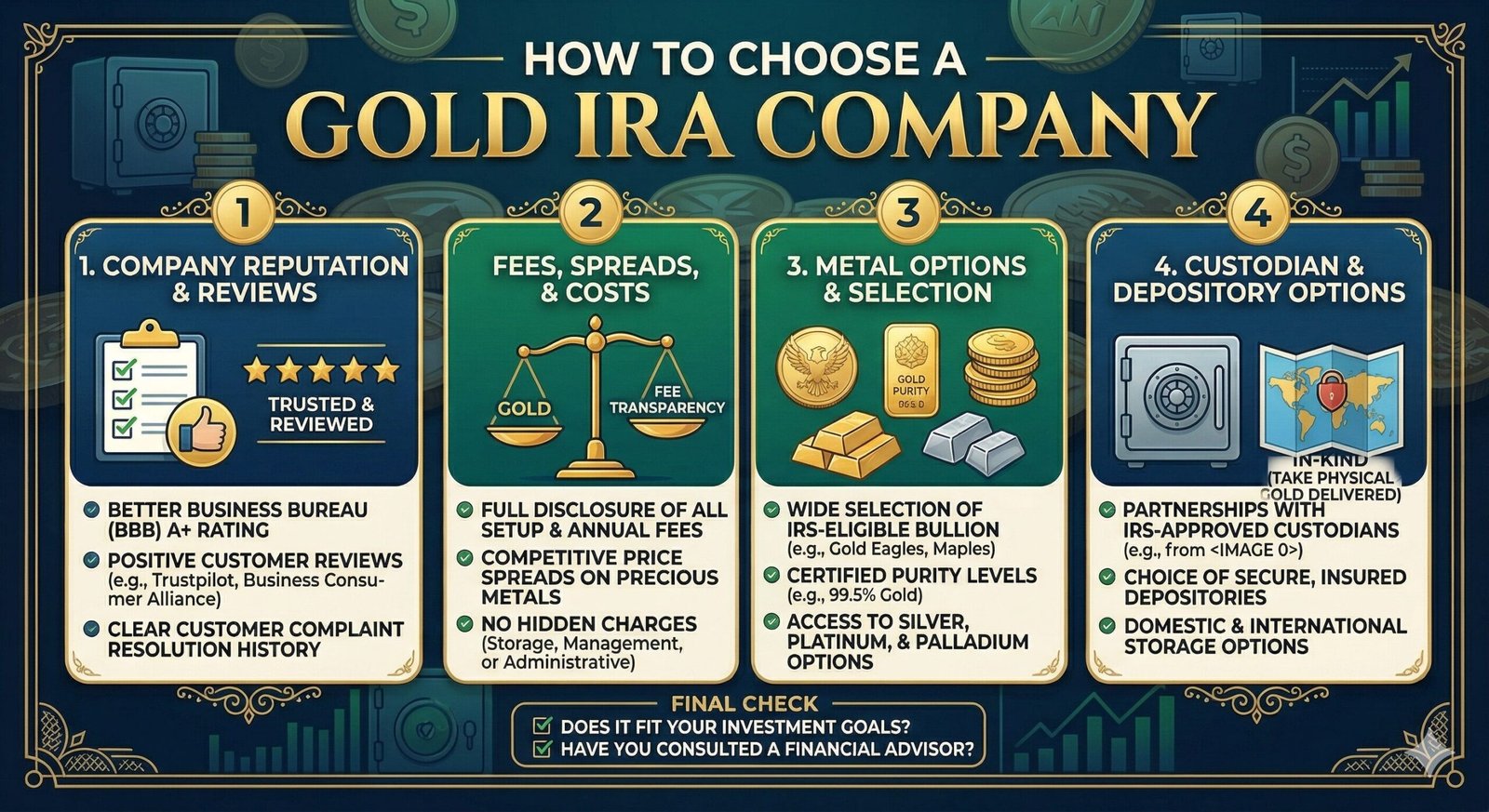
Fraud risk. The self-directed IRA space attracts some bad actors. FINRA BrokerCheck and bbb.org are useful tools for vetting any company you’re considering. Our Gold IRA scams guide outlines common warning signs to watch for.
For a broader perspective on whether this type of account is appropriate for your situation, our article on is a Gold IRA a good idea may be a useful next step.
A Note on Partial Rollovers
It’s worth knowing that rollovers don’t have to be all-or-nothing. Many investors choose to roll over only a portion of their 401(k) balance into a Gold IRA, leaving the remainder in conventional accounts. IRS rules generally permit partial rollovers in this way, though your specific 401(k) plan’s rules may impose additional conditions. Always confirm the terms with your plan administrator before initiating any transfer.
If you’d like to understand how a Gold IRA compares with keeping funds in a traditional IRA structure, our Gold IRA vs Traditional IRA comparison addresses that question directly. And for a deeper dive into the mechanics and regulations involved, Gold IRAs Explained in Detail is a thorough reference. The IRS Publication 590-A also remains the authoritative source on IRA contribution and rollover rules.
Frequently Asked Questions
Can I roll over my entire 401(k) balance into a Gold IRA?
In most cases, yes — provided you are eligible to take a distribution from your 401(k), typically because you’ve left the sponsoring employer or reached the plan’s distribution age. However, your specific plan may have its own rules, and a partial rollover is also an option. Speak with your plan administrator before initiating any transfer.
Will I owe taxes on a 401(k) to Gold IRA rollover?
If you use a direct rollover and move the funds into a traditional Gold IRA (not a Roth), there are typically no immediate tax consequences. Taxes are deferred until you take distributions in retirement. An indirect rollover that misses the 60-day window can trigger taxes and penalties. This article is not tax advice — consult a qualified tax professional for guidance specific to your situation.
How long does the rollover process take?
Timelines vary, but a direct rollover typically takes anywhere from two to six weeks from start to finish, depending on how quickly your 401(k) plan processes the request and how promptly your new Gold IRA custodian can receive and apply the funds.
What types of gold can I hold in a Gold IRA?
The IRS requires gold held in an IRA to meet a minimum fineness of .995. Eligible options include certain bullion bars and coins — for example, the American Gold Eagle (which has a special exception to the fineness rule), Canadian Gold Maple Leaf, and American Gold Buffalo. Gold jewelry, collectibles, and numismatic coins generally do not qualify.
Is it possible to roll a Gold IRA back into a conventional IRA or 401(k)?
You can roll a Gold IRA into a conventional IRA, though the process involves liquidating the physical metals first. Rolling funds back into a 401(k) is generally only possible if a new employer’s plan accepts incoming rollovers from IRAs, which not all plans do. Check with the plan administrator before assuming this is an option.
Ready to Explore Your Options?
Understanding the structure, costs, and rules of a Gold IRA rollover is the first step toward making a genuinely informed decision. If you’re ready to look at which custodians and dealers are worth considering, our team has reviewed the leading providers in the space. Visit our Best Gold IRA Companies of 2026 guide to compare your options based on transparency, fee structures, customer service, and regulatory standing.
This article is for informational purposes only and does not constitute financial or tax advice. Investing in precious metals involves risk including possible loss of principal.
Related guides
- Gold IRA Consumer Affairs Reviews: What to Look For
- Gold IRA Trustpilot Reviews: What Real Customers Say
- Gold IRA BBB Complaints: What Consumer Reports Reveal
- Is a Gold IRA Worth the Fees? A Cost-Benefit Analysis
- Are Gold IRA Fees Too High? Breaking Down the Real Costs
- Gold IRA Mistakes to Avoid: 10 Common Errors Investors Make