
FTC Affiliate Disclosure: GoldInvesting.net may earn a commission from purchases made through links on this page. This compensation does not influence our editorial content. See our full disclosure policy for details.
If you hold — or are thinking about holding — physical gold inside a retirement account, the tax rules matter as much as the metals themselves. Getting them wrong can mean unexpected tax bills, IRS penalties, or even the full disqualification of your account.
Understanding the Gold IRA Tax Rules can help you navigate your investments more effectively.
This guide breaks down everything you need to know about gold IRA taxes and the Gold IRA Tax Rules: how Traditional and Roth accounts are taxed differently, what the IRS requires before you can even put gold inside an IRA, how required minimum distributions (RMDs) work, and the most common mistakes account holders make. We cover the rules as they stand in 2026, incorporating changes from the SECURE Act 2.0.
Traditional Gold IRA vs. Roth Gold IRA: How Each Is Taxed
A gold IRA is simply a self-directed IRA that holds IRS-approved physical precious metals instead of (or alongside) conventional assets like stocks and bonds. The tax treatment depends entirely on whether the account is structured as a Traditional IRA or a Roth IRA.
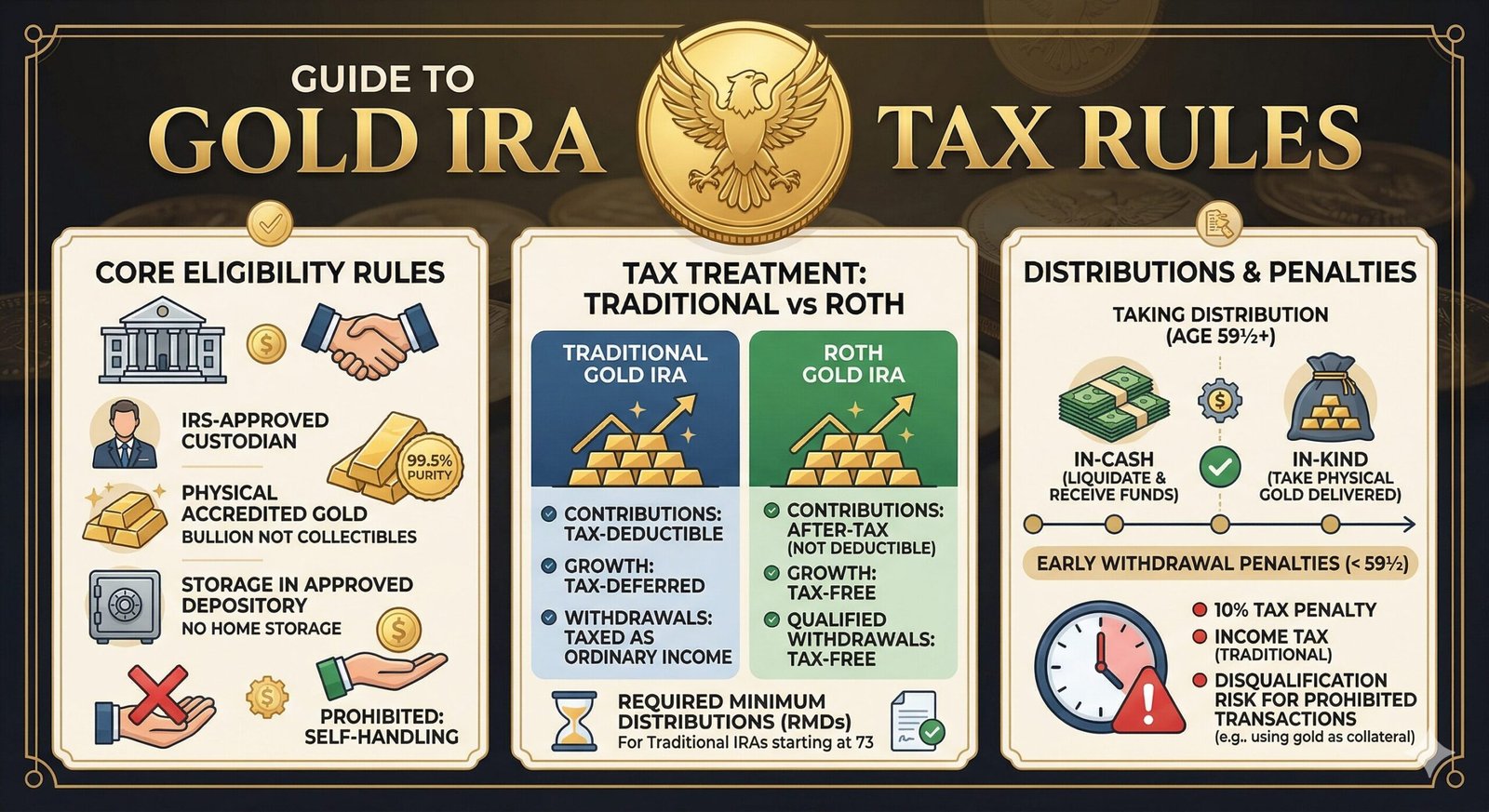
Traditional Gold IRA
- Contributions are generally tax-deductible (subject to income limits discussed below).
- Growth inside the account is tax-deferred — you pay nothing until you take money out.
- Withdrawals in retirement are taxed as ordinary income at your marginal federal rate.
- Required minimum distributions (RMDs) must begin at age 73 (age 75 starting in 2033 for those born in 1960 or later — see below).
A Traditional gold IRA gives you a potential tax break today, but every dollar you eventually withdraw is fully taxable.
Roth Gold IRA
- Contributions are made with after-tax dollars — no deduction.
- Qualified withdrawals in retirement are completely tax-free, including any gains from appreciation in the metals’ value.
- No RMDs are required during the account owner’s lifetime.
- Eligibility to contribute phases out at higher income levels (see limits below).
A Roth gold IRA costs more in taxes upfront but can be significantly more valuable over time, especially if you expect to be in a higher tax bracket later or if you want to avoid mandatory withdrawals.
| Feature | Traditional Gold IRA | Roth Gold IRA |
|---|---|---|
| Contribution tax treatment | Pre-tax (deductible) | After-tax (not deductible) |
| Tax on growth | Deferred | None (qualified distributions) |
| Tax on withdrawals | Ordinary income | Tax-free (if qualified) |
| RMDs required? | Yes, beginning at age 73 | No (during owner’s lifetime) |
| Early withdrawal penalty | Yes, before age 59½ | Varies by contribution type |
2026 Contribution Limits
For 2026, the IRS has set the following annual contribution limits for IRAs — including self-directed gold IRAs — as confirmed by IRS Retirement Topics: IRA Contribution Limits:
| Age | 2026 IRA Contribution Limit |
|---|---|
| Under 50 | $7,500 |
| Age 50 and older (catch-up) | $8,600 |
These limits apply to your total contributions across all of your Traditional and Roth IRAs combined — not per account. Contributions are also capped at your taxable compensation for the year if that figure is lower.
Tax-Deductibility of Traditional IRA Contributions
Whether your Traditional gold IRA contributions are deductible depends on two factors: whether you (or your spouse) are covered by a workplace retirement plan, and your modified adjusted gross income (MAGI).
If you are covered by a workplace plan in 2026:
| Filing Status | Full Deduction MAGI | Partial Deduction MAGI | No Deduction MAGI |
|---|---|---|---|
| Single / Head of Household | Up to $81,000 | $81,000–$91,000 | $91,000 or more |
| Married Filing Jointly | Up to $129,000 | $129,000–$149,000 | $149,000 or more |
If you are not covered by a workplace plan but your spouse is (2026):
| Filing Status | Full Deduction MAGI | Partial Deduction | No Deduction |
|---|---|---|---|
| Married Filing Jointly | Up to $242,000 | $242,000–$252,000 | $252,000 or more |
If neither you nor your spouse participates in a workplace retirement plan, your Traditional IRA contributions are fully deductible regardless of income.
Roth IRA eligibility also phases out at higher incomes. For 2026, the phase-out range for single filers is $153,000–$168,000 MAGI, and for married filing jointly it is $242,000–$252,000. Above these thresholds, Roth contributions are not permitted.
IRS-Approved Metals: What Can Go in a Gold IRA?
Not all gold qualifies for an IRA. IRC Section 408(m)(3) defines the metals that are exempt from the “collectibles” prohibition. The rules are strict:
Minimum purity standards:
| Metal | Required Purity |
|---|---|
| Gold | 99.5% (0.995 fineness) |
| Silver | 99.9% (0.999 fineness) |
| Platinum | 99.95% (0.9995 fineness) |
| Palladium | 99.95% (0.9995 fineness) |
One important exception: The American Gold Eagle coin is approved for IRAs despite having a purity of only 91.67%. Congress specifically carved it out in the Taxpayer Relief Act of 1997 because it is an official U.S. government-minted bullion coin. Other popular approved coins include the Canadian Gold Maple Leaf, American Buffalo, Austrian Philharmonic, and Australian Kangaroo.
Collectible coins, numismatic coins, jewelry, and any gold that does not meet the purity threshold are not permitted. Placing a non-qualifying asset into your IRA triggers an immediate taxable distribution — the IRS treats it as if you withdrew the full purchase amount.
No Home Storage — Period
A gold IRA’s metals must be held “in the physical possession of a trustee,” as required under IRC Section 408(m). That means your gold cannot be stored at home, in a personal safe, or in a safety deposit box you control.
Your IRA custodian (a bank, trust company, or IRS-approved non-bank trustee) is responsible for arranging storage at a qualified third-party depository. Keeping IRA metals at home — regardless of any LLC structure or marketing claims to the contrary — is treated as a distribution. You would owe income tax on the entire IRA value, plus a 10% early withdrawal penalty if you are under 59½.
Gold IRA RMD Rules
Required minimum distributions are mandatory annual withdrawals that the IRS requires from Traditional IRAs (and other tax-deferred retirement accounts) once you reach a certain age. Roth IRA owners are not subject to RMDs during their lifetime.
When Do RMDs Begin?
Under the SECURE Act 2.0, the RMD starting age depends on your birth year, per IRS Publication 590-B and the IRS RMD FAQs page:
| Born | RMD Begins At Age |
|---|---|
| 1950 or earlier | Already underway |
| 1951–1959 | 73 |
| 1960 or later | 75 (beginning 2033) |
Your first RMD can be delayed until April 1 of the year after you reach your RMD age. All subsequent RMDs must be taken by December 31 of each year. If you delay your first RMD into the following April, you will effectively take two RMDs in one tax year — which could push you into a higher bracket.
How to Calculate Your Gold IRA RMD
The calculation is straightforward, per IRS Publication 590-B, Appendix B:
RMD = Prior December 31 account balance ÷ IRS Uniform Lifetime Table factor
Understanding Gold IRA Tax Rules
Most account owners use Table III (Uniform Lifetime Table). The factor corresponds to your age in the year you are taking the distribution.
Example: An account holder turns 73 in 2026 and has a gold IRA balance of $200,000 as of December 31, 2025. The Uniform Lifetime Table factor for age 73 is 26.5.
$200,000 ÷ 26.5 = $7,547 RMD for 2026
Selected life expectancy factors from Table III:
| Age | Uniform Lifetime Factor | Example RMD on $200,000 Balance |
|---|---|---|
| 73 | 26.5 | $7,547 |
| 75 | 24.6 | $8,130 |
| 80 | 20.2 | $9,901 |
| 85 | 16.0 | $12,500 |
| 90 | 12.2 | $16,393 |
Note: If your sole beneficiary is a spouse who is more than 10 years younger than you, you may use the Joint and Last Survivor Table (Table II), which produces a lower RMD amount.
RMD Options: Cash or Physical Metals?
When your RMD comes due, you have two ways to satisfy it:
1. Sell the metals for cash. Your custodian liquidates enough gold (or other metals) in your account to cover the RMD amount, then transfers cash to you. This is the simpler path for most people — it leaves no question about valuation, and cash is easy to deploy elsewhere.
2. Take an in-kind distribution of physical metals. You can satisfy your RMD by taking actual possession of the metal. The IRS treats the fair market value of the metals on the distribution date as the distribution amount. You pay ordinary income tax on that value. Note that once you take physical possession, the metals are no longer IRA assets — you own them outright and can store them however you choose.
In-kind distributions require careful coordination with your custodian and a professional appraisal or market valuation on the distribution date. Make sure the value satisfies the full RMD amount to avoid a penalty.
Penalty for Missed or Insufficient RMDs
If you fail to take your full RMD by the deadline, the IRS charges an excise tax of 25% on the amount you did not withdraw, per IRS Publication 590-B. This is reported on Form 5329.
The penalty drops to 10% if you correct the shortfall within the allowed “correction window” — generally by the tax filing deadline (plus extensions) for the year the error occurred. You can also request a waiver if the missed RMD was due to a reasonable error and you have taken steps to remedy the situation.
If you have multiple IRAs, you must calculate each RMD separately, but you can withdraw the combined total from any one account (or a combination).
Early Withdrawal Rules: Before Age 59½
Taking money out of a Traditional gold IRA before age 59½ triggers two separate costs:
- Ordinary income tax on the full amount of the withdrawal (at your marginal rate).
- 10% early withdrawal penalty on top of the income tax.
These rules are the same whether you withdraw cash or take an in-kind distribution of physical metals.
Example: You are 52 years old and withdraw $30,000 from your gold IRA. If you are in the 22% federal tax bracket, you owe $6,600 in income tax plus a $3,000 early withdrawal penalty — a combined $9,600 cost before you touch the money.
Exceptions to the 10% Penalty
Per IRS Publication 590-B, the 10% additional tax does not apply in certain situations, including:
- Disability (as certified by a physician)
- Death (distributions to a beneficiary or estate)
- Unreimbursed medical expenses exceeding 7.5% of your adjusted gross income
- Substantially equal periodic payments (SEPP / 72(t) distributions)
- First-time home purchase (up to $10,000 lifetime limit)
- Qualified higher education expenses
- Health insurance premiums while unemployed
- IRS levy on the IRA
The penalty exception does not eliminate the income tax owed — it only removes the additional 10% charge.
Roth Gold IRA: Tax-Free Growth and No Lifetime RMDs
A Roth gold IRA operates under meaningfully different rules once you understand the qualified distribution requirements.
Qualified distributions are entirely tax-free if: – The account has been open for at least 5 years (counted from January 1 of the year you first contributed), and – You are age 59½ or older, disabled, or the distribution goes to a beneficiary after your death.
No RMDs during the owner’s lifetime. Unlike a Traditional gold IRA, a Roth account has no mandatory withdrawal schedule while you are alive. You can leave the account untouched indefinitely, letting any appreciation compound without interference from the tax code.
Early withdrawal of contributions: Because Roth contributions are made with after-tax dollars, you can withdraw your original contributions (not earnings) at any time, at any age, tax-free and penalty-free. The ordering rules matter: the IRS treats Roth distributions as coming from contributions first, then conversions, then earnings.
Early withdrawal of earnings: Earnings withdrawn before the account is 5 years old or before age 59½ are subject to the 10% penalty and ordinary income tax.
A Roth gold IRA is particularly well-suited for account holders who expect their tax rate to increase over time, who want to preserve flexibility in retirement, or who want to pass a tax-advantaged account to heirs.
Common Tax Mistakes with Gold IRAs
1. Buying Non-Qualifying Metals
Gold coins or bars that do not meet the IRS purity threshold, or that are classified as collectibles, cannot be held in an IRA. Placing them there triggers a deemed distribution. Always confirm eligibility before purchasing.
2. Home Storage
As outlined above, any arrangement where you personally take possession of IRA-owned metals — including schemes marketed as “checkbook IRAs” or LLC structures — is considered a prohibited transaction. The IRS has successfully challenged these arrangements in Tax Court.
3. Missing RMD Deadlines
The 25% excise tax penalty compounds the financial pain of a missed RMD. If you own multiple IRAs, calculate each separately and confirm with your custodian well before year-end.
4. Confusing RMD Amounts With In-Kind Valuations
If you take an in-kind distribution to satisfy an RMD, the value of the metals on the distribution date determines whether the RMD threshold is met. Under-valuing the metals (or taking less than required) still triggers the penalty on the shortfall.
5. Ignoring the 5-Year Rule on Roth Conversions
If you convert a Traditional gold IRA to a Roth and then withdraw within five years, the converted amount may be subject to the 10% penalty (even if you are over 59½). The five-year clock resets on each separate conversion.
6. Overlooking State Taxes
Federal rules get most of the attention, but your state may also tax IRA withdrawals. Some states exempt retirement income entirely; others tax it at the full income rate. Check your state’s rules before planning large distributions.
Frequently Asked Questions
Yes — but your total contributions to all IRAs combined (Traditional and Roth) cannot exceed the annual limit: $7,500 (under age 50) or $8,600 (age 50 and older) for 2026. Roth eligibility is also subject to income phase-out limits.
A direct rollover (where funds move directly from your 401(k) custodian to your gold IRA custodian) is generally not a taxable event. An indirect rollover — where you receive the funds first — must be completed within 60 days, or the distribution becomes taxable and subject to the early withdrawal penalty if you are under 59½.
You are still required to take the RMD, even if you reinvest the proceeds immediately in a taxable brokerage account. There is no option to skip an RMD for a Traditional gold IRA. The only accounts exempt from RMDs during the owner’s lifetime are Roth IRAs (and, starting in 2024, designated Roth accounts in qualified plans).
No. Distributions from a Traditional gold IRA — whether in cash or in kind — are taxed as ordinary income, not capital gains. The preferential long-term capital gains rates do not apply to IRA distributions. The metals’ cost basis inside the IRA is irrelevant; the full fair market value on the distribution date is what you report as income.
For individuals born in 1960 or later, the SECURE Act 2.0 sets the RMD starting age at 75, effective January 1, 2033. Until then, the current rules require RMDs beginning at age 73. Anyone born in 1960 will turn 73 in 2033, meaning the higher threshold takes effect exactly when it applies to that birth year.
Contributions for a given tax year can be made up until the tax filing deadline for that year — typically April 15 of the following year. This deadline applies to both Traditional and Roth gold IRA contributions.
Most non-spouse beneficiaries who inherit a Traditional gold IRA after December 31, 2019, must distribute the entire balance within 10 years of the original owner’s death (the “10-year rule”). Spouses, minor children, disabled individuals, and beneficiaries who are no more than 10 years younger than the deceased owner qualify as “eligible designated beneficiaries” and may stretch distributions over a longer period. RMD rules for inherited Roth IRAs differ — consult a qualified tax professional for guidance specific to your situation.
IRS Resources Referenced in This Guide
- IRS Publication 590-A: Contributions to Individual Retirement Arrangements — Covers contribution limits, deductibility, and Roth eligibility.
- IRS Publication 590-B: Distributions from Individual Retirement Arrangements — Covers RMDs, early withdrawal penalties, exceptions, and life expectancy tables.
- IRS Retirement Plans FAQs: Required Minimum Distributions — Answers common RMD questions including calculation methods and deadlines.
- IRS: Investments in Collectibles (IRC Section 408(m)) — Defines which precious metals qualify for IRA ownership.
For tax advice specific to your situation, consult a qualified CPA or tax attorney.
More on Gold IRAs
Looking to learn how a gold IRA works before diving into the tax details? Our core gold IRA guide covers account types, custodian selection, setup costs, and storage options in plain language.
Investment Risk Disclaimer: Investing in physical precious metals through an IRA involves risk, including the possible loss of principal. The value of gold, silver, platinum, and palladium fluctuates based on market conditions and is not guaranteed. Past performance of any asset — including precious metals — is not indicative of future results. Nothing in this article constitutes personalized investment, tax, or legal advice. Before making any decisions about your retirement accounts, consult a licensed financial advisor, CPA, or tax attorney who can evaluate your individual circumstances. IRA rules are subject to change; always verify current requirements with the IRS or a qualified professional.