
FTC Affiliate Disclosure: GoldInvesting.net may earn a commission if you open an account through links on this page. This does not affect our editorial standards. We evaluate companies independently and recommend only those that meet our criteria for transparency, reputation, and compliance. See our full disclosure policy for details.
Adding physical precious metals to a self-directed IRA is a legitimate retirement strategy, but only if you choose the right gold IRA company to handle it. The gold IRA space includes highly reputable firms — and a small number that use high-pressure tactics, hide fees, and misrepresent IRS rules. To help you with this important decision, we provide insights on how to Choose the Right Gold IRA Company.
This guide walks you through exactly what to look for, what to avoid, and the questions to ask before you sign anything. Whether you’re rolling over a 401(k) or opening a new account, this checklist will help you make an informed, confident decision.
Why Choosing the Right Company Matters
A gold IRA involves more moving parts than a standard brokerage account. You’re working with a precious metals dealer, an IRS-approved custodian, and an approved storage depository — all in coordination. If any one of those relationships is poorly structured, you could face:
- Unexpected fees that erode your account value over time
- IRS compliance problems that trigger taxes and penalties
- Difficulty selling your metals when you need liquidity
- Outright fraud, which regulators have actively prosecuted in this space
The Federal Trade Commission has brought multiple enforcement actions against precious metals companies that misled consumers — in some cases draining customers’ retirement accounts through undisclosed fees and markups. Choosing carefully from the start is the single most important step you can take. For a full breakdown of the top-rated providers we’ve vetted, see our gold IRA company comparison guide.
The 10-Point Gold IRA Company Checklist
1. BBB and BCA Ratings — and the Complaint History Behind Them
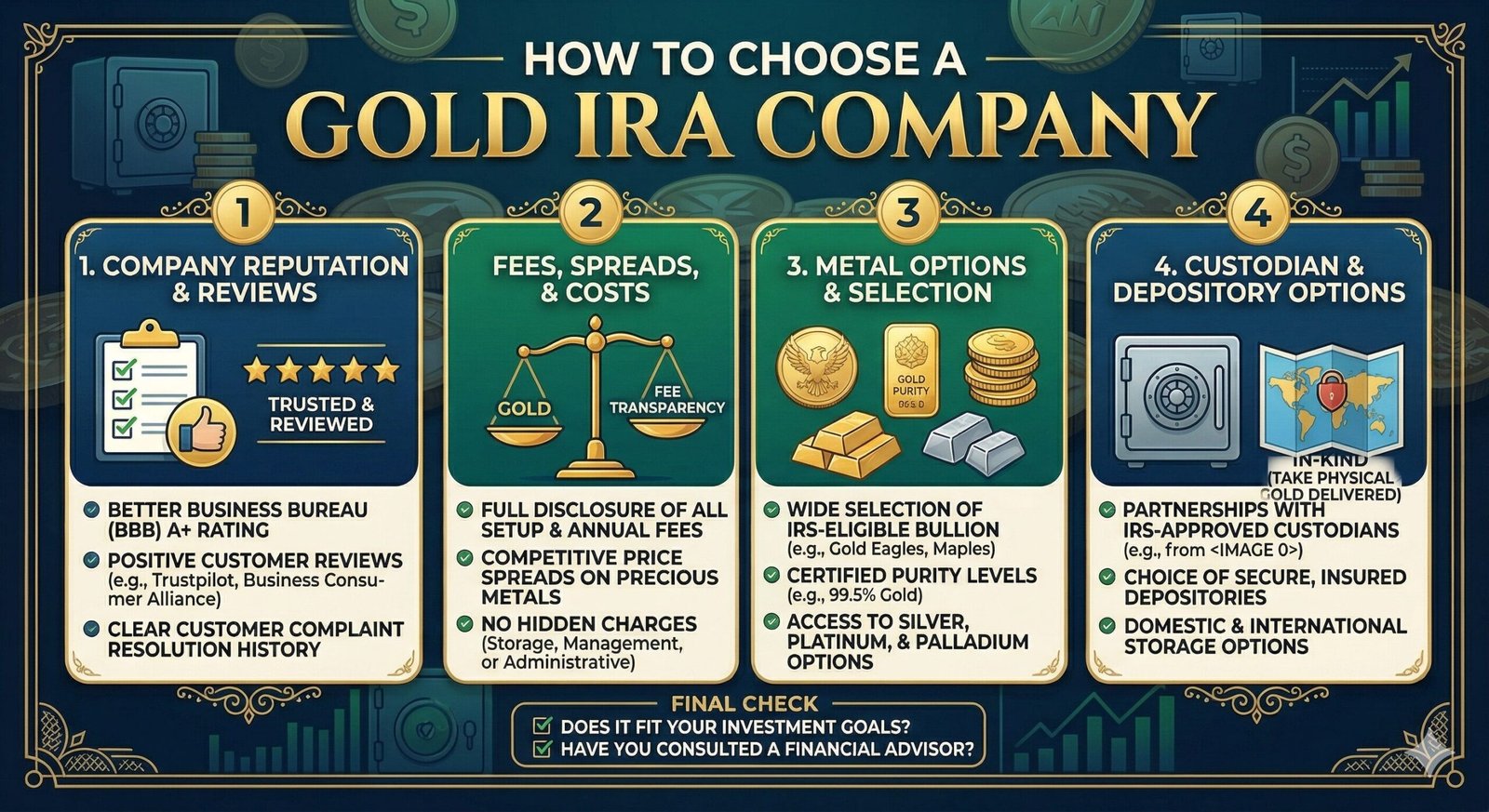
The Better Business Bureau (BBB) and the Business Consumer Alliance (BCA) are the two most widely cited third-party rating bodies in the gold IRA space. An A+ rating from either is a meaningful signal — but the rating alone tells only part of the story.
What to look for:
To help you navigate this intricate process, we present our guide titled: Choose the Right Gold IRA Company: 10 Essential Tips. By following these tips, you can ensure a secure and profitable investment.
- BBB accreditation status — Accredited businesses have agreed to meet the BBB’s standards for honesty, transparency, and responsiveness to complaints. Non-accredited companies can still receive a letter grade, but they haven’t voluntarily committed to those standards.
- Complaint volume and resolution — A company with an A+ rating and zero unresolved complaints over several years is meaningfully different from one with the same rating but a pattern of unresolved disputes. Read through the complaint summaries, not just the score.
- BCA ratings — The BCA focuses specifically on business-consumer relations. Top-tier gold IRA companies consistently hold an AAA rating from the BCA.
A company with both an A+ BBB rating and an AAA BCA rating, combined with a clean complaint record over multiple years, sets a high bar for accountability and consumer trust.
To help you navigate the complexities of investing in precious metals, this article outlines how to Choose the Right Gold IRA Company: 10 Essential Tips. Following these guidelines will empower you to make informed decisions about your retirement investments.
2. Fee Transparency: Setup, Annual, Storage, and Premiums
Fees are where many gold IRA companies obscure the true cost of ownership. Before you commit to any company, you should be able to get a complete, written breakdown of every charge — upfront.
Typical fee structure across the industry:
| Fee Type | Typical Range |
|---|---|
| Account setup (one-time) | $0–$75 |
| Annual maintenance/admin | $75–$150 |
| Storage (non-segregated) | $100–$150/year |
| Storage (segregated) | $150–$300/year |
| Metal premium over spot price | 2%–20%+ depending on product |
The most overlooked cost is the premium over spot price — the markup you pay above the market value of the metal. This can range from modest (2%–5% on standard bullion) to substantial (10%–20% or more on premium coins). Companies that quote only their custodian fees while burying metal premiums in fine print are not being fully transparent.
Ask any company you’re considering for a complete, itemized fee schedule in writing before opening an account.
3. Minimum Investment Requirements
Gold IRA minimums vary widely — from no minimum to $50,000 or more. There’s no right or wrong amount, but the minimum tells you something about which type of customer the company serves.
- No minimum or low minimum ($0–$10,000): Accessible to a wider range of investors, but verify that the company still provides attentive service at smaller account sizes.
- Mid-range ($10,000–$25,000): Common among established providers. Usually includes a reasonable onboarding experience.
- High minimum ($50,000+): Typically indicates a focus on high-net-worth clients and often comes with more personalized service. These firms may also cover first-year fees for qualifying accounts.
Make sure the minimum fits your situation — and don’t let a high minimum pressure you into rolling over more than is appropriate for your portfolio.
4. Educational Resources and Sales Approach
How a company treats you during the sales process tells you almost everything you need to know about how they’ll treat you afterward.
Signs of a genuinely educational company:
- Offers webinars, written guides, or one-on-one informational sessions focused on helping you understand your options — not just pushing you to open an account
- Representatives explain the risks of precious metals alongside the potential benefits
- No pressure to “act now” or warnings of imminent economic collapse designed to trigger urgency
- Gives you time to review the paperwork and consult your own financial advisor
Warning signs:
- High-pressure calls or scripts designed to get you to commit on the first call
- Representatives who downplay the risks of holding metals in a retirement account
- Vague or evasive answers when you ask about fees
The CFTC and FINRA have both issued warnings that most precious metals salespeople are not licensed financial advisors and are not qualified to give investment or tax advice. Be cautious of anyone who steers rather than educates.
5. IRS Compliance Expertise
A gold IRA is a self-directed IRA governed by specific IRS rules. The company you choose needs to understand those rules — and communicate them clearly to you.
Key IRS requirements to understand:
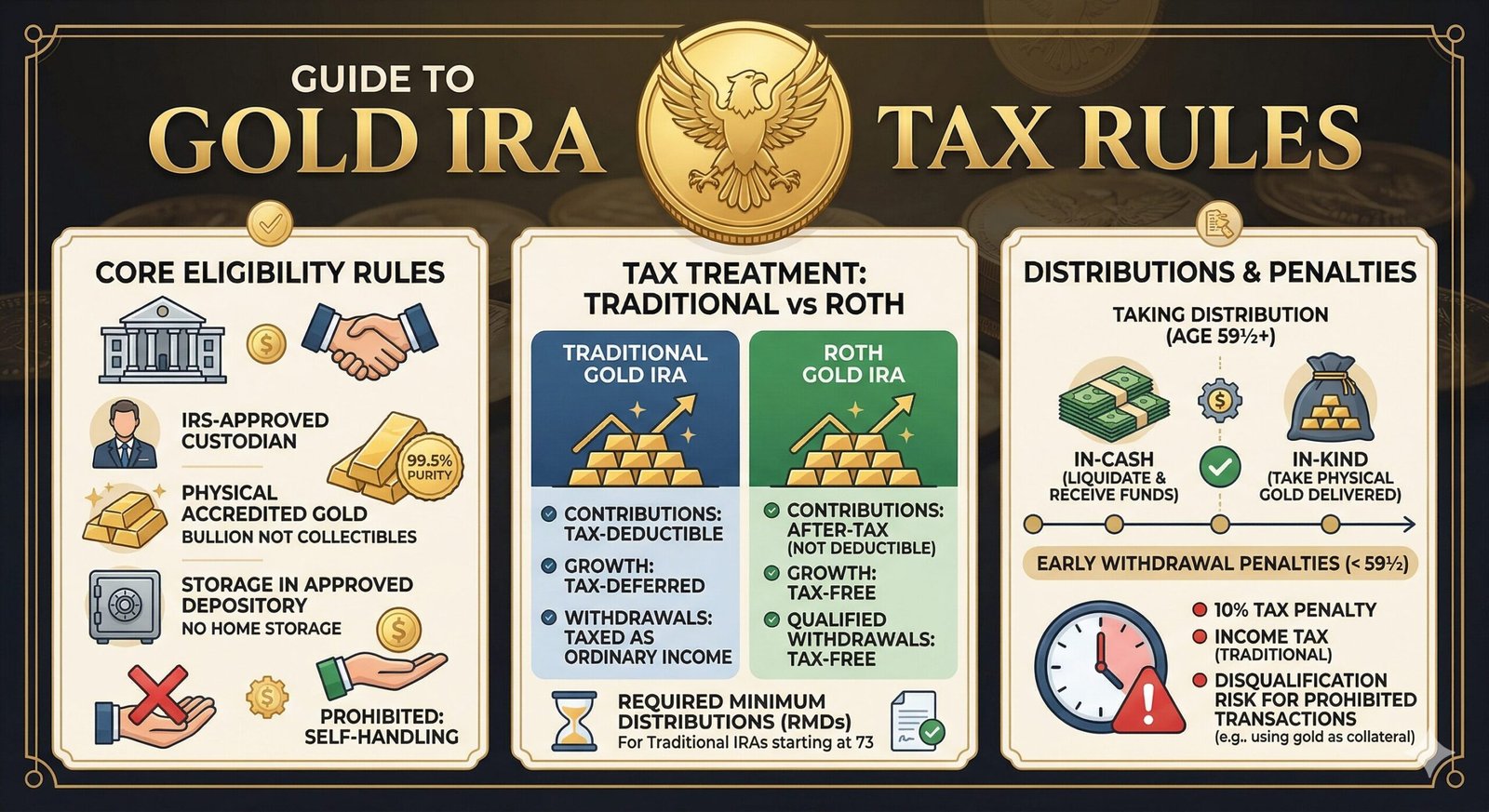
Under IRC Section 408(m), precious metals held in an IRA are not treated as prohibited collectibles — but only when they meet strict conditions:
- Purity standards: Gold must be at least 99.5% pure (0.995 fineness). Silver must be 99.9% pure. Platinum and palladium must each be 99.95% pure. (Note: American Gold Eagle coins are a specific IRS exception to the gold purity rule.)
- Approved sources: Metals must be produced by an accredited government mint or approved refiner.
- Custodian possession: All metals must be held by an IRS-approved custodian or trustee — not by you personally.
Any company that can’t clearly explain these rules, or that tries to sell you products that don’t meet the IRS purity thresholds, is a company to avoid. Non-compliant metals in your IRA can trigger taxes and early-withdrawal penalties on your entire account balance.
6. Custodian and Depository Partnerships
The gold IRA company you work with is typically the precious metals dealer — a separate company serves as your IRS-approved custodian, and a third party operates the storage depository. Understanding these relationships is essential.
Questions to ask:
- Who is the custodian? Verify that the custodian is IRS-approved. Some well-known custodians in this space include Equity Trust Company, STRATA Trust Company, and Midland IRA.
- Where is the depository? Reputable depositories include the Delaware Depository, Brinks Global Services, and International Depository Services (IDS). These facilities carry appropriate insurance and security.
- Segregated or commingled storage? Segregated storage means your metals are stored separately under your name — a higher level of accountability. Commingled (pooled) storage is less expensive but means your metals are stored alongside other investors’ holdings. Both are legal; the choice is yours.
- What happens if the dealer closes? Your metals held at an IRS-approved depository under the custodian’s oversight are separate from the dealer’s business. A reputable custodian relationship protects your assets even if the dealer ceases operations.
7. Buyback Program Terms
At some point, you’ll want to liquidate some or all of your holdings — either to rebalance, take required minimum distributions (RMDs), or convert to cash in retirement. The buyback program terms determine how easy and cost-effective that process will be.
What to look for:
- A clear, published buyback policy — not just a verbal promise
- Buyback prices close to the current spot price, with reasonable and disclosed spreads
- No penalties or account closure requirements tied to selling
- A streamlined process for executing sales without excessive delays
A company that makes it easy to buy but difficult or expensive to sell is not acting in your interest. Ask for the current buyback price on a specific product before you open an account — the answer will tell you a lot.
8. Customer Reviews Across Multiple Platforms
No single review platform tells the full story. A company with glowing reviews on one site but poor feedback elsewhere is a signal worth investigating.
Platforms to check:
- BBB.org — Look at both the rating and the complaint text. How were complaints resolved?
- Trustpilot — Large sample sizes and harder to manipulate than some platforms; look for verified purchase reviews
- BCA (bcaonline.org) — Specialized in business-consumer relations; AAA is the top rating
- Google Reviews — Useful for real customer sentiment
- ConsumerAffairs — Often catches issues that don’t surface on other platforms
Look for consistency. A company with hundreds of positive reviews across BBB, Trustpilot, and BCA has earned a more reliable reputation than one with a perfect score on a single platform. Also read the negative reviews — how the company responds to criticism is as revealing as the reviews themselves.
9. Length of Time in Business
Longevity in the gold IRA industry is a meaningful signal. Companies that have been operating for 10, 15, or 20+ years have navigated multiple economic cycles, regulatory changes, and market downturns. They’ve also had more opportunity to either build or damage their reputation.
This doesn’t mean newer companies can’t be reputable — but a strong track record over many years, combined with consistent ratings and a clean complaint history, provides a higher level of confidence.
When evaluating tenure, look for:
- The year the company was founded (not just the year they began marketing gold IRAs)
- Whether key leadership has remained consistent
- How the company has evolved its services and compliance over time
10. Red Flags to Watch For
Knowing what to avoid is just as important as knowing what to look for. These are the clearest warning signs that a company is not acting in your best interest:
Guaranteed return claims. No legitimate company guarantees that precious metals will increase in value. Metals prices fluctuate, and any promise of guaranteed gains or “risk-free” outcomes is a misrepresentation. The FTC has explicitly warned that marketing precious metals as a “safe” investment with assured returns violates consumer protection law.
Home storage IRA claims. Some companies market “home storage” or “checkbook IRA” arrangements as a way to keep your metals personally. This misrepresents IRS rules. The IRS requires that metals held in a self-directed IRA be in the physical possession of an approved custodian or trustee — not the IRA owner. Violating this rule can cause your entire IRA to be treated as a taxable distribution, triggering taxes and potential penalties.
High-pressure urgency tactics. Legitimate companies don’t pressure you to act immediately, warn of imminent financial collapse, or tell you a window is closing. As the CFTC and FINRA advise, no reputable investment professional should push you into an immediate decision.
Aggressive “free silver” or “bonus metals” promotions. These promotions often come with significantly inflated prices on the metals you’re actually purchasing. The “free” metal isn’t free — its cost is embedded in the markup you pay on the rest of your order.
Pushing numismatic or collectible coins for an IRA. Rare, graded, or collector coins are generally not IRS-eligible for IRAs and often carry markups far in excess of their metal content. A company steering you toward these products for your retirement account is either uninformed about IRS rules or acting against your interests.
How to Compare Gold IRA Companies Side by Side
Once you’ve narrowed your list to two or three companies that pass the checklist above, build a simple comparison table:
| Criteria | Company A | Company B | Company C |
|---|---|---|---|
| BBB Rating / Accredited? | |||
| BCA Rating | |||
| Setup Fee | |||
| Annual Maintenance Fee | |||
| Storage Fee (segregated) | |||
| Metal Premium Over Spot | |||
| Account Minimum | |||
| Custodian Partner | |||
| Depository Partner | |||
| Years in Business | |||
| Buyback Policy | |||
| Trustpilot Score |
Fill in every row from the companies’ written disclosures — not from their marketing materials. If a company won’t provide a number in writing, treat that as a red flag.
For a pre-built comparison of leading providers, see our gold IRA reviews and rankings.
Questions to Ask Before You Open an Account
Before you commit, get written answers to these questions from any company you’re considering:
- What is your complete fee schedule? (Setup, annual, storage, wire fees, transaction fees)
- What is the current premium over spot for your most commonly purchased gold product?
- Who is your custodian, and can I verify their IRS-approved status independently?
- Which depository do you use, and do you offer segregated storage?
- What is your buyback policy, and what spread do you charge when I sell?
- Do you have an account minimum, and are any first-year fees waived?
- Can I review a sample account statement before opening?
- What is your process if I need to take a required minimum distribution in metal or cash?
- How long has your company been in operation?
- Are your representatives licensed financial advisors, or are they precious metals specialists?
If any of these questions are met with evasion, vague language, or pressure to skip ahead and “just get started,” walk away.
FAQ: How to Choose a Gold IRA Company
Yes. Physical gold must be held in a self-directed IRA (SDIRA). Standard IRAs offered by brokerage firms like Fidelity or Schwab typically don’t allow physical metals. You’ll need to open an SDIRA with a specialized custodian.
Yes, in most cases. A direct rollover from a 401(k) or a trustee-to-trustee transfer from an existing IRA to a self-directed IRA is not a taxable event. You should consult a tax professional before initiating any rollover to confirm the treatment in your specific situation.
Gold must meet a minimum purity of 99.5% (with a specific exception for American Gold Eagle coins, which are IRS-approved despite being 91.67% pure). Eligible products include American Gold Eagles, American Gold Buffalos, Canadian Gold Maple Leafs, and bars from accredited refiners. Numismatic, collectible, or rare coins generally do not qualify. For the full IRS rule, see IRC Section 408(m).
Most investors pay between $150 and $300 per year in combined annual maintenance and storage fees, depending on the custodian and storage type. The larger and often overlooked cost is the metal premium — the markup above spot price charged at the time of purchase, which typically ranges from 2% to 20% depending on the product.
A higher rating is a positive signal, but it must be considered alongside complaint volume, complaint resolution, and how long the company has held that rating. An A+ rating with zero complaints over five years is more meaningful than an A+ rating with a pattern of resolved disputes. Always read the complaint text, not just the score.
You can file a complaint with the FTC at ReportFraud.ftc.gov, with the CFTC at CFTC.gov/complaint, or with your state’s securities regulator. For concerns about custodian conduct, contact your state’s banking or financial regulator.
Ask the company for the name of the depository and verify it independently. Reputable depositories include the Delaware Depository, Brinks Global Services, and IDS Group. Your custodian should be able to provide you with third-party verification of the depository’s insurance and security credentials.
Final Thoughts
Choosing a gold IRA company is a decision that deserves serious due diligence. The 10 criteria in this checklist — ratings, fee transparency, minimums, education, IRS compliance, custodians, buybacks, reviews, tenure, and red flags — cover the full picture.
The companies that perform well across all 10 criteria share a common profile: they’re transparent about costs, they educate rather than pressure, they have clean complaint records, and they’ve maintained those standards over years of operation.
Use this checklist as your filter, ask the hard questions, and get everything in writing.
For a detailed look at the companies we’ve evaluated using these exact criteria, visit our complete gold IRA company guide and comparison.
Investment Risk Disclaimer: Investing in precious metals, including through a self-directed IRA, involves substantial risk. The value of gold, silver, platinum, and palladium fluctuates and can decline. Past performance of any precious metal is not indicative of future results. Physical precious metals held in an IRA are not covered by SIPC protections. Rolling over retirement savings into a self-directed IRA may result in fees, tax consequences, and reduced liquidity. This article is for informational purposes only and does not constitute investment, tax, or legal advice. Consult a qualified financial advisor, tax professional, or attorney before making any investment decision. GoldInvesting.net is not a registered investment advisor.
Related guides
- Gold IRA Consumer Affairs Reviews: What to Look For
- Gold IRA Trustpilot Reviews: What Real Customers Say
- Gold IRA BBB Complaints: What Consumer Reports Reveal
- Is a Gold IRA Worth the Fees? A Cost-Benefit Analysis
- Are Gold IRA Fees Too High? Breaking Down the Real Costs
- Gold IRA Mistakes to Avoid: 10 Common Errors Investors Make