
Moving retirement savings from a 401(k) into a Gold IRA is a process governed by specific IRS rules. Get it right, and the transfer is tax-free. Get it wrong, and you could face income taxes and penalties on the entire distribution. This guide explains exactly how a 401(k) to gold IRA rollover works, who qualifies, and what steps to follow to stay compliant.
What Is a 401(k) to Gold IRA Rollover?
A 401(k) to Gold IRA rollover is the process of moving funds from an employer-sponsored 401(k) plan into a self-directed Individual Retirement Account (IRA) that holds physical precious metals. The Gold IRA operates under the same tax rules as a traditional IRA — contributions grow tax-deferred, and withdrawals in retirement are taxed as ordinary income.
The key difference is what the account can hold. A conventional 401(k) is generally limited to stocks, bonds, and mutual funds. A self-directed Gold IRA allows you to hold IRS-approved physical gold, silver, platinum, and palladium instead of (or in addition to) paper assets.
This type of rollover is popular among investors who want to complement an existing retirement portfolio with physical metals, or who simply want more control over what their retirement account holds. However, the IRS imposes strict rules on how the rollover must be executed, what metals qualify, and how those metals must be stored. Understanding these rules is essential before you begin.
For a broader overview of what Gold IRAs are and how they work, visit our Gold IRA guide.
Who Is Eligible to Do a 401(k) to Gold IRA Rollover?
Not everyone with a 401(k) can roll it over at any time. Eligibility depends primarily on your employment status and your plan’s rules.
You Have Left Your Employer
The most straightforward path to eligibility is separation from service — meaning you have left the employer that sponsors the 401(k). Once you leave a job (through resignation, termination, or retirement), you are generally free to roll over your entire vested balance into an IRA without penalties, regardless of age.
You Are Age 59½ or Older (In-Service Rollover)
If you are still employed with the company sponsoring your 401(k), you may still qualify through what is called an in-service rollover. Most plans permit in-service rollovers for participants who have reached age 59½. Some plans allow limited in-service distributions of specific contribution types (such as employer matching or profit-sharing contributions) at younger ages. Check your plan’s Summary Plan Description (SPD) or contact your plan administrator to confirm whether your plan allows this.
Required Minimum Distributions Are Not Eligible
One important restriction: Required Minimum Distributions (RMDs) cannot be rolled over. If you are age 73 or older and your plan requires you to take an RMD for the current year, that RMD amount must be distributed and reported as taxable income — it cannot be included in your rollover. Per IRS Publication 590-A, RMDs are specifically excluded from eligible rollover distributions.
Direct vs. Indirect Rollover: Which Should You Choose?
There are two methods to transfer your 401(k) funds to a Gold IRA. The method you choose has significant tax and logistical consequences.
| Account Type | Eligible for Gold IRA Rollover? | Notes |
|---|---|---|
| 401(k) | Yes | Most common source; pre-tax funds move to traditional Gold IRA |
| 403(b) | Yes | Covers teachers, non-profit employees, and healthcare workers |
| TSP (Thrift Savings Plan) | Yes | Available to federal employees and military personnel |
| 457(b) – Governmental | Yes | State and local government employees |
| 457(b) – Non-governmental | Generally no | IRS rules are more restrictive for non-government 457(b) plans |
| Traditional IRA | Yes | Trustee-to-trustee transfer; subject to one-per-year rollover rule if indirect |
| SEP IRA | Yes | Self-employed plans roll over cleanly |
| SIMPLE IRA | Yes (after 2 years) | Must have participated for at least 2 years before rolling to a non-SIMPLE IRA |
If your account is a Roth 401(k), you can roll it into a Roth Gold IRA. Because Roth contributions are made after-tax, the rollover itself is not a taxable event — but the rules about which metals are eligible and how they must be stored still apply.
IRS-Approved Metals: Purity Standards You Must Meet
Not all gold or silver qualifies for a Gold IRA. The IRS sets specific purity thresholds, and only metals produced by approved mints or refiners are permitted. Holding a disqualified metal in your IRA would be treated as a distribution — meaning it becomes immediately taxable.
| Metal | Minimum Purity Required | Example Approved Products |
|---|---|---|
| Gold | 99.5% (0.9950 fineness) | American Gold Buffalo, Canadian Gold Maple Leaf, PAMP Suisse bars |
| Silver | 99.9% (0.9990 fineness) | American Silver Eagle, Canadian Silver Maple Leaf |
| Platinum | 99.95% (0.9995 fineness) | American Platinum Eagle, Canadian Platinum Maple Leaf |
| Palladium | 99.95% (0.9995 fineness) | Canadian Palladium Maple Leaf, PAMP Suisse palladium bars |
Important exception: The American Gold Eagle coin (which is 91.67% pure, or 22-karat) is specifically exempted by the IRS and qualifies for Gold IRAs despite not meeting the standard 99.5% threshold. This exception is written directly into the tax code because Gold Eagles are government-minted legal tender coins.
Prohibited metals: Jewelry, collectible coins, numismatic coins, and any gold that does not meet the purity threshold are not eligible. Per IRS Publication 590-B, investing in collectibles through an IRA is treated as a taxable distribution.
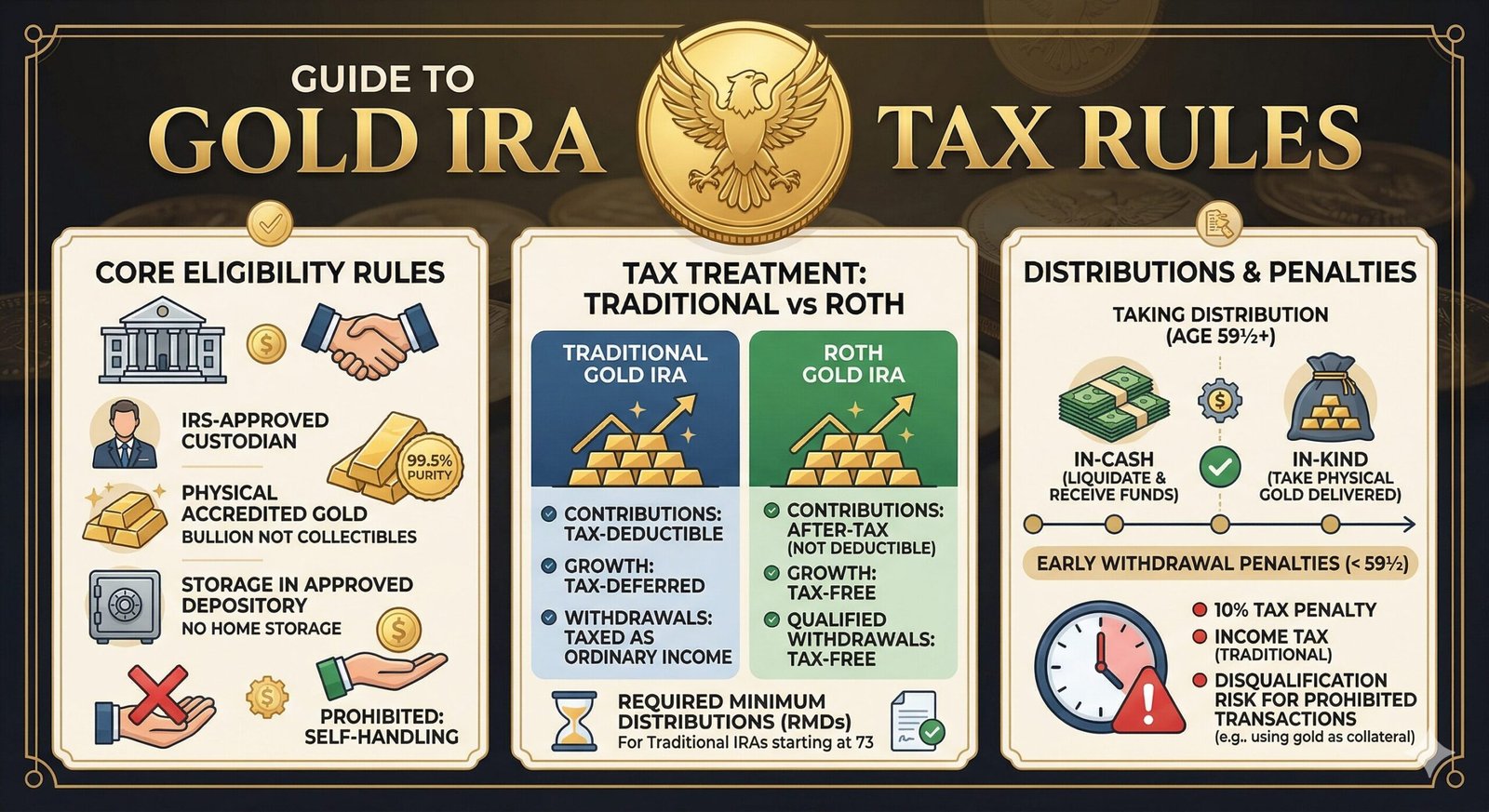
Storage requirement: All IRA-held metals must be stored in an IRS-approved depository. You cannot store them at home, in a personal safe, or in a safe-deposit box controlled by you. Taking physical possession of your IRA metals is treated as a distribution — triggering income tax and, if applicable, a 10% early withdrawal penalty.
Step-by-Step: How to Rollover a 401(k) to a Gold IRA
Here is how to convert a 401(k) to gold through a compliant, straightforward process:
Step 1: Confirm Your Eligibility
Review your 401(k) plan documents or contact your HR department to confirm that a rollover is permitted. Determine whether you qualify through separation from service or through an in-service rollover provision. Confirm that you are not required to take an RMD from this account first (relevant if you are age 73 or older).
Step 2: Select a Gold IRA Custodian
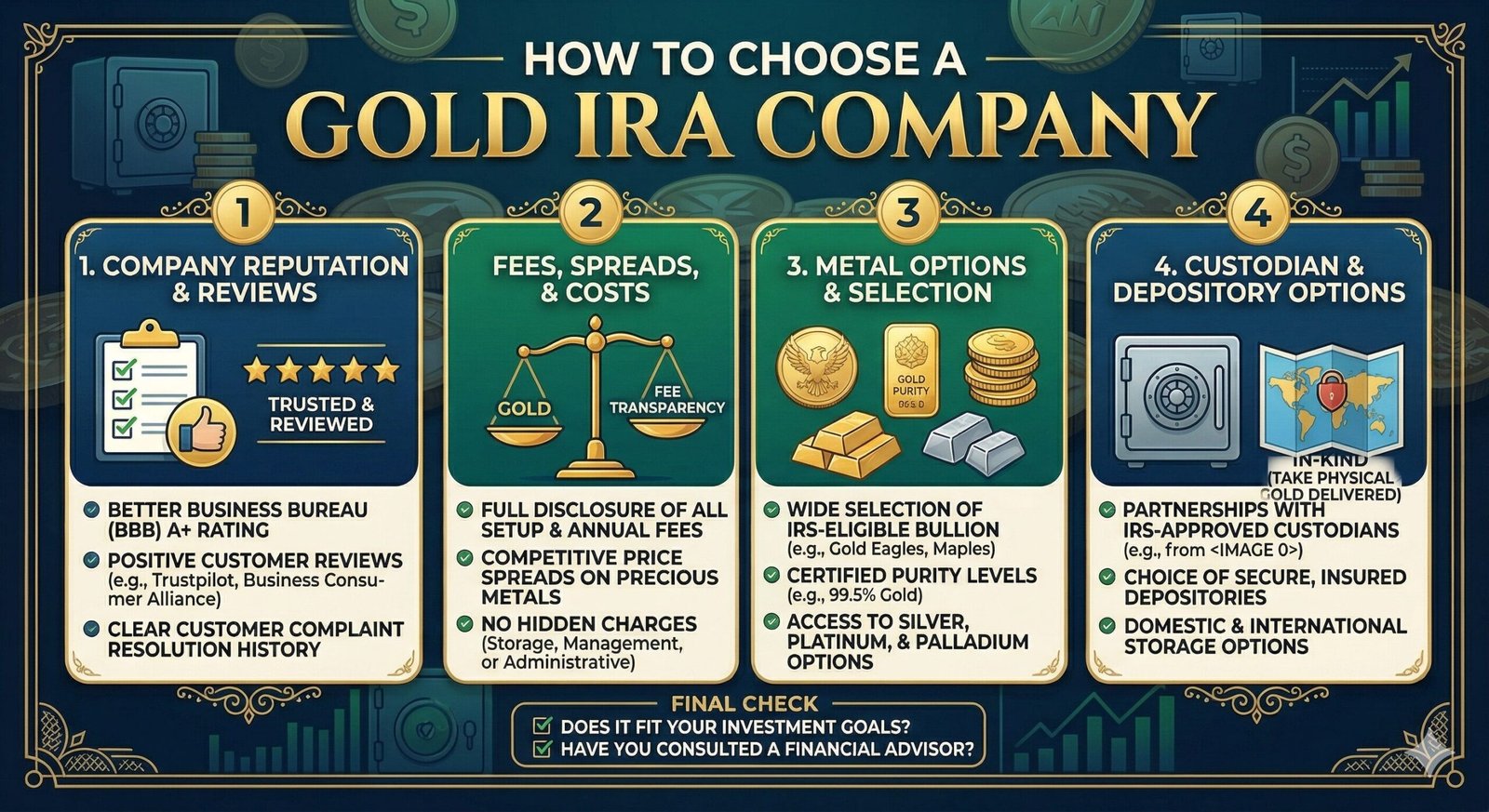
A Gold IRA must be held by an IRS-approved custodian — typically a trust company, bank, or specialty financial institution authorized to hold alternative assets. Compare custodians based on: – Setup fees and annual maintenance fees – Storage fees and choice of depositories – Selection of IRS-approved metals – Customer service reputation and transparency.
Your custodian will open your new self-directed IRA account and handle the paperwork for the transfer. For guidance on evaluating custodians, see our Gold IRA resources section.
Step 3: Open Your Self-Directed Gold IRA
Complete the custodian’s account application. You will provide personal identification, select a traditional or Roth Gold IRA (depending on your source account), and designate beneficiaries. The account setup is usually completed within a few business days.
Step 4: Initiate the Direct Rollover
Contact your 401(k) plan administrator and request a direct rollover to your new Gold IRA custodian. Provide the custodian’s account details and mailing information. Your plan administrator will send the funds directly to your custodian — you do not receive a check, and no withholding applies. Ask your plan administrator for confirmation that the transfer has been processed.
Step 5: Fund the Gold IRA
Once your custodian confirms receipt of the funds, they will be held in cash within your self-directed IRA, ready for investment. Work with your custodian to select specific IRS-approved metals to purchase. The custodian will execute the purchase on your behalf.
Step 6: Arrange Secure Storage
Your custodian will coordinate storage of the purchased metals at an IRS-approved depository. You will choose between segregated storage (your metals are stored separately from other investors’ holdings) and commingled storage (your metals are pooled with others of the same type). Segregated storage typically costs more but provides direct allocation.
Step 7: Keep Records and Monitor
Keep all rollover documentation — confirmation letters from your 401(k) administrator, IRA account statements, and metal purchase confirmations. Report the rollover on your tax return for the year it occurs (Form 1099-R will be issued by your former plan). Although a properly executed direct rollover is not taxable, it still must be disclosed to the IRS.
The 60-Day Rule and the One-Per-Year Rule
Two IRS rules deserve particular attention:
The 60-Day Rule
If you receive funds from an employer plan or IRA and do not roll them over to a new account within 60 calendar days, the distribution is treated as taxable income. If you are under 59½, a 10% early withdrawal penalty also applies. The IRS has limited authority to waive the 60-day rule in cases of natural disaster, serious illness, or other circumstances outside your control, but waivers are not automatic — you may need to self-certify using IRS Rev. Proc. 2020-46 or apply for a private letter ruling. The simplest way to avoid the 60-day issue entirely is to use a direct rollover, as described in IRS Publication 590-A.
The One-Per-Year Rollover Rule
The IRS limits taxpayers to one IRA-to-IRA indirect rollover per 12-month period, regardless of how many IRAs you own. This rule aggregates all your traditional, Roth, SEP, and SIMPLE IRAs as a single pool. If you receive a distribution from one IRA and roll it over to another, you cannot make another indirect IRA-to-IRA rollover from any of your IRAs for 12 months from the date of the first distribution.
This rule does not apply to: – Direct trustee-to-trustee transfers between IRAs – Rollovers from employer plans (401k, 403b, TSP, 457b) to an IRA – Roth conversions.
Because the one-per-year limit does not restrict direct transfers or rollovers from employer plans, most people converting a 401(k) to a Gold IRA are unaffected — as long as they use the direct rollover method.
Tax Implications
A correctly executed direct rollover from a pre-tax 401(k) to a traditional Gold IRA is not a taxable event. Your funds continue to grow tax-deferred inside the Gold IRA. You will owe income tax only when you take distributions in retirement, at which point withdrawals are taxed as ordinary income.
Key tax points to understand:
- Pre-tax → Traditional Gold IRA: No immediate tax. Distributions taxed as ordinary income.
- Roth 401(k) → Roth Gold IRA: No immediate tax. Qualified distributions in retirement are tax-free.
- Pre-tax → Roth Gold IRA (conversion): The converted amount is taxable income in the year of conversion. No early withdrawal penalty applies to conversions, but income tax is due.
- Early withdrawal (before 59½): Any amount that is not properly rolled over is subject to a 10% additional tax under IRS rules, plus ordinary income tax on the distributed amount.
- RMDs: Beginning at age 73, you must take required minimum distributions from a traditional Gold IRA. The RMD amount is taxable income. RMDs cannot be rolled over. See IRS Publication 590-B for RMD calculation tables.
Fees to Expect
Gold IRAs carry costs that standard IRAs typically do not. Budget for the following:
| Fee Type | Typical Range | Notes |
|---|---|---|
| Account setup fee | $50–$150 | One-time charge to open the account |
| Annual administration fee | $75–$300/year | Covers IRS reporting, recordkeeping, compliance |
| Storage fee | $100–$250/year | Paid to the depository; segregated storage costs more |
| Wire transfer fee | $25–$50 | Charged for incoming/outgoing transfers |
| Transaction fee | $25–$50 per trade | Applies when buying or selling metals |
| Metal premiums | Varies (often 2–8%) | Markup above spot price on coins and bars |
Total first-year costs on a $100,000 Gold IRA can run approximately $5,000–$5,500 when metal premiums are included. Annual recurring costs after the first year typically run $200–$300, excluding transaction fees.
Always request a full fee schedule in writing from any custodian before opening an account. Transparency in pricing is a baseline indicator of a reputable provider.
Common Mistakes to Avoid
Taking an Indirect Rollover When a Direct Rollover Is Available
Indirect rollovers trigger 20% mandatory withholding and introduce a hard 60-day deadline. Unless there is a specific reason you cannot use a direct rollover, always request a direct trustee-to-trustee transfer.
Missing the 60-Day Deadline
If you opt for an indirect rollover, mark your calendar immediately. The 60-day clock starts on the date you receive the funds, not when you open the Gold IRA account. Once the window passes, there is no self-correction option — the distribution is taxable.
Purchasing Non-Eligible Metals
Not all gold is IRS-approved. Buying metals that fail purity requirements, or purchasing from unapproved refiners, can cause the IRS to treat your entire IRA investment as a distribution. Always confirm eligibility with your custodian before purchasing any metal.
Attempting Home Storage
Several companies have marketed “home storage” Gold IRA arrangements. The IRS does not recognize these as legitimate. Taking physical possession of IRA metals is treated as a distribution — subject to income tax and early withdrawal penalties. All IRA metals must be held by an approved custodian at an approved depository.
Rolling Over Your RMD
If you are age 73 or older, the RMD for the current calendar year must be distributed before completing a rollover. Rolling over an RMD amount is an excess contribution to the receiving IRA, which carries its own penalty (6% per year on the excess amount).
Ignoring the Tax Impact of a Roth Conversion
If you are rolling a pre-tax 401(k) into a Roth Gold IRA rather than a traditional Gold IRA, the entire converted amount is taxable income in the year of the conversion. This can push you into a significantly higher tax bracket. Consult a tax professional before choosing this route.
Frequently Asked Questions
Yes — if you execute a direct rollover from a pre-tax 401(k) to a traditional Gold IRA, no taxes or penalties are triggered. The funds remain in a tax-deferred account and are simply changing custodians. Taxes only apply when you take distributions in retirement.
Most direct rollovers complete within 2–4 weeks. The timeline includes opening your Gold IRA account (typically 3–5 business days), processing the outgoing transfer from your 401(k) administrator (1–2 weeks), and settling the metal purchase. Some plan administrators process distributions faster than others.
Possibly, depending on your plan. Many 401(k) plans allow in-service rollovers for participants who are age 59½ or older. Some plans also permit limited in-service distributions of specific contribution types (such as after-tax or employer contributions) at younger ages. Review your plan’s Summary Plan Description or speak with your HR department.
Rollovers are not subject to the annual IRA contribution limits. You can roll over the entire balance of your 401(k) regardless of size. The annual contribution limit ($7,000 in 2025, or $8,000 if you are age 50 or older) applies only to new contributions you make directly to the IRA from earned income.
After-tax (non-deductible) contributions to a 401(k) can generally be rolled over to an IRA. You must track the basis carefully using Form 8606 to avoid paying tax twice on those amounts at distribution. Some plans allow you to roll after-tax contributions to a Roth IRA directly — consult your plan administrator and a tax advisor for guidance.
No. IRS rules require that all precious metals held in a Gold IRA be stored in an IRS-approved depository. Taking personal possession of your IRA metals — even temporarily — is treated as a taxable distribution. This applies regardless of how the arrangement is marketed or structured.
Despite the common name, a self-directed precious metals IRA can hold gold, silver, platinum, and palladium, provided each metal meets the IRS purity standards (gold: 99.5%; silver: 99.9%; platinum and palladium: 99.95%) and is produced by an approved mint or refiner.
Next Steps
If you are ready to explore a 401(k) to gold IRA rollover, the first practical step is reviewing your existing plan documents for rollover eligibility and comparing Gold IRA custodians. Our Gold IRA guide covers what to look for in a custodian, how storage works, and what questions to ask before opening an account.
Always consult a licensed financial advisor and a qualified tax professional before initiating any rollover. The rules described in this guide are based on IRS publications current as of this writing, but tax law can change and individual circumstances vary widely.
Disclaimer: This article is for educational purposes only and should not be considered financial advice. All investments carry risk, including the potential loss of principal. Past performance does not guarantee future results. Gold IRA rollovers involve complex IRS rules; errors can result in taxes and penalties. Please consult a licensed financial advisor and tax professional before making any investment decisions.
Sources: IRS Publication 590-A (2025) — Contributions to Individual Retirement Arrangements; IRS Publication 590-B (2025) — Distributions from Individual Retirement Arrangements; IRS Topic No. 413 — Rollovers from Retirement Plans; IRS Rollovers of Retirement Plan and IRA Distributions
Related guides
- Gold IRA Consumer Affairs Reviews: What to Look For
- Gold IRA Trustpilot Reviews: What Real Customers Say
- Gold IRA BBB Complaints: What Consumer Reports Reveal
- Is a Gold IRA Worth the Fees? A Cost-Benefit Analysis
- Are Gold IRA Fees Too High? Breaking Down the Real Costs
- Gold IRA Mistakes to Avoid: 10 Common Errors Investors Make