Is a Gold IRA Worth the Fees? A Cost-Benefit Analysis
If you’ve spent any time researching Gold IRAs, you’ve probably noticed something that doesn’t come up as often with a regular brokerage account: the fees. There are setup fees, annual custodian fees, storage fees, and sometimes transaction fees layered on top of each other. For retirement investors who are used to low-cost index funds or a straightforward 401(k), this cost structure can feel jarring.
So the natural question becomes: is a Gold IRA worth the fees?
This article won’t tell you what to do with your money — that’s a conversation for a qualified financial advisor who knows your full picture. What we will do is lay out exactly what you’re paying, what you’re getting in return, and what questions you should ask before committing. That way, you can make a genuinely informed decision rather than one driven by either enthusiasm or fear.
What Makes a Gold IRA Different — and Why It Costs More
A Gold IRA is a self-directed individual retirement account that holds physical precious metals rather than paper-based assets like stocks or mutual funds. To understand why the fees are higher, it helps to understand what’s actually happening behind the scenes.
With a conventional IRA, your custodian is holding digital records of securities on your behalf. With a Gold IRA, someone has to physically store actual bars or coins in an IRS-approved depository. There are vaults involved. There is insurance. There are compliance requirements. There is a chain of custody that has to be maintained and audited. None of that is free, and it’s why the fee structure looks so different from what you might be used to.
To understand the full framework, it’s worth reading through Gold IRAs Explained in Detail before diving too deep into the cost side of things. If you’re newer to the concept, our Gold IRA hub covers the fundamentals in plain English.
Breaking Down the Fees You’ll Encounter
Account Setup Fees
Most Gold IRA custodians charge a one-time setup fee when you open your account. This typically ranges from $50 to $150, though some companies waive it as a promotional incentive, particularly for larger initial deposits. It’s a relatively minor cost in the overall picture, but it’s worth noting because it’s often the first fee that appears — and it sometimes sets the tone for everything else.
Annual Custodian Fees
This is the ongoing administrative fee for maintaining your IRA. It covers recordkeeping, IRS reporting, account statements, and customer service. Annual custodian fees generally fall somewhere between $75 and $300 per year, depending on the provider. Some charge a flat fee regardless of account size; others scale with the value of assets held.
Storage Fees
This is where Gold IRA costs diverge most sharply from traditional retirement accounts. Because your metals must be held in an IRS-approved third-party depository — you cannot store them yourself at home — you’ll pay a storage fee. These fees typically range from 0.5% to 1% of the total asset value per year, though some depositories charge flat fees instead.
You’ll also encounter two storage options: segregated and non-segregated (sometimes called commingled) storage. Segregated storage means your metals are physically separated from other clients’ holdings. Non-segregated means your metals are stored alongside others, with ownership tracked by weight and type rather than individual bars. Segregated storage costs more — often meaningfully so — but some investors prefer the additional specificity it provides.
Transaction and Liquidation Fees
When you buy or sell metals within your Gold IRA, you’ll typically pay a spread — the difference between the buy and sell price — along with any transaction fee the dealer charges. These can vary considerably, which is one reason it pays to read the fine print carefully before choosing a provider. Our detailed Gold IRA fees guide walks through these costs more thoroughly and what to watch for.
Putting the Numbers in Context
To make this concrete, let’s look at a simplified cost comparison.
On a $50,000 Gold IRA, annual fees — custodian plus storage — could realistically run between $375 and $800 per year before any transaction activity. On a $100,000 account, that same range could reach $800 to $1,300 annually. These are meaningful costs, and they compound over time like any recurring expense.
For context on how this compares structurally (not in terms of performance) to other account types, you might find our Gold IRA vs Traditional IRA comparison useful.
What You’re Actually Getting for Those Fees
Fees aren’t inherently bad — they’re bad when they’re excessive relative to what you receive. So what does the Gold IRA fee structure actually buy you?
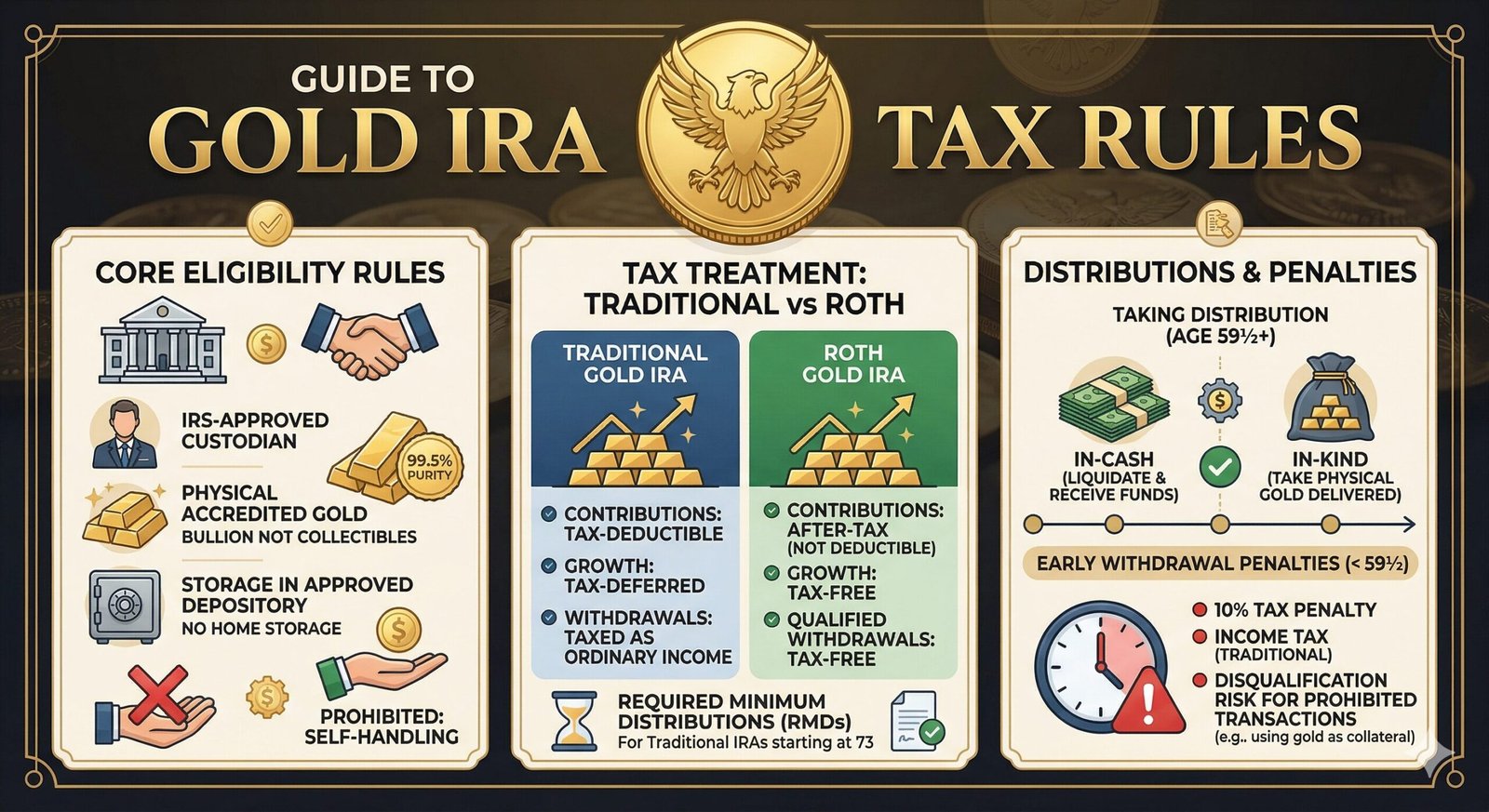
Physical ownership within a tax-advantaged structure. A Gold IRA gives you legal ownership of physical precious metals — actual gold, silver, platinum, or palladium — held inside an IRS-compliant retirement account. The tax treatment mirrors that of a Traditional or Roth IRA, depending on the account type you choose. Contributions to a Traditional Gold IRA may be tax-deductible; a Roth Gold IRA offers potential tax-free growth. You can explore the IRS rules on this directly through IRS Publication 590-A.
IRS-compliant custody and storage. The IRS has strict rules about which metals qualify, how they must be stored, and who can hold them. The fees you pay are partly for the custodian and depository handling this compliance burden on your behalf. If you tried to replicate this structure independently, you’d face the same underlying costs — plus significant legal and administrative complexity.
Audited, insured storage. The depositories used by reputable Gold IRA custodians maintain insurance on their holdings and undergo regular third-party audits. This is a meaningful operational infrastructure that doesn’t exist in a standard home safe.
The Questions Worth Asking Before You Open an Account
Whether or not a Gold IRA is worth the fees depends significantly on which provider you choose and how the account is structured. FINRA has published guidance on self-directed IRAs that’s worth reviewing before you commit, particularly around understanding custodial responsibilities and potential risks.
A few questions worth pressing on:
Are the fees flat or asset-based? For larger accounts, flat fees become proportionally more attractive. For smaller accounts, a percentage-based model might be cheaper in the early years.
Is segregated storage included or an upgrade? Some providers offer only segregated storage; others present it as an optional add-on at extra cost. Know what you’re getting.
How transparent is the dealer spread? Some Gold IRA companies are very upfront about how they price metals; others are less so. Ask for a written quote before committing.
What are the liquidation procedures? When it comes time to take a distribution — whether as physical metals or as cash after a sale — what does the process look like, and what does it cost?
If you’re rolling over an existing 401(k) into a Gold IRA, understanding the rules is essential before you move a single dollar. Our 401(k) to Gold IRA rollover guide and Gold IRA rollover rules page both cover the mechanics in detail. There are timing rules, tax withholding considerations, and IRS reporting requirements that you need to understand upfront.
A Note on Required Minimum Distributions
One cost dimension that often gets overlooked in the fee discussion is the operational complexity of required minimum distributions (RMDs). Once you reach the applicable age threshold, you’ll be required to take distributions from your Traditional Gold IRA — just as you would from any Traditional IRA. With a Gold IRA, that can mean either selling a portion of your physical metals to generate cash or taking an in-kind distribution of actual metal, which has its own logistical and valuation considerations.
The IRS RMD FAQ outlines the rules clearly. The key point here is that liquidity considerations and transaction costs associated with RMDs are part of the total cost picture over the life of the account — not just the annual maintenance fees.
How to Spot a Reasonably Priced Provider vs. an Overpriced One
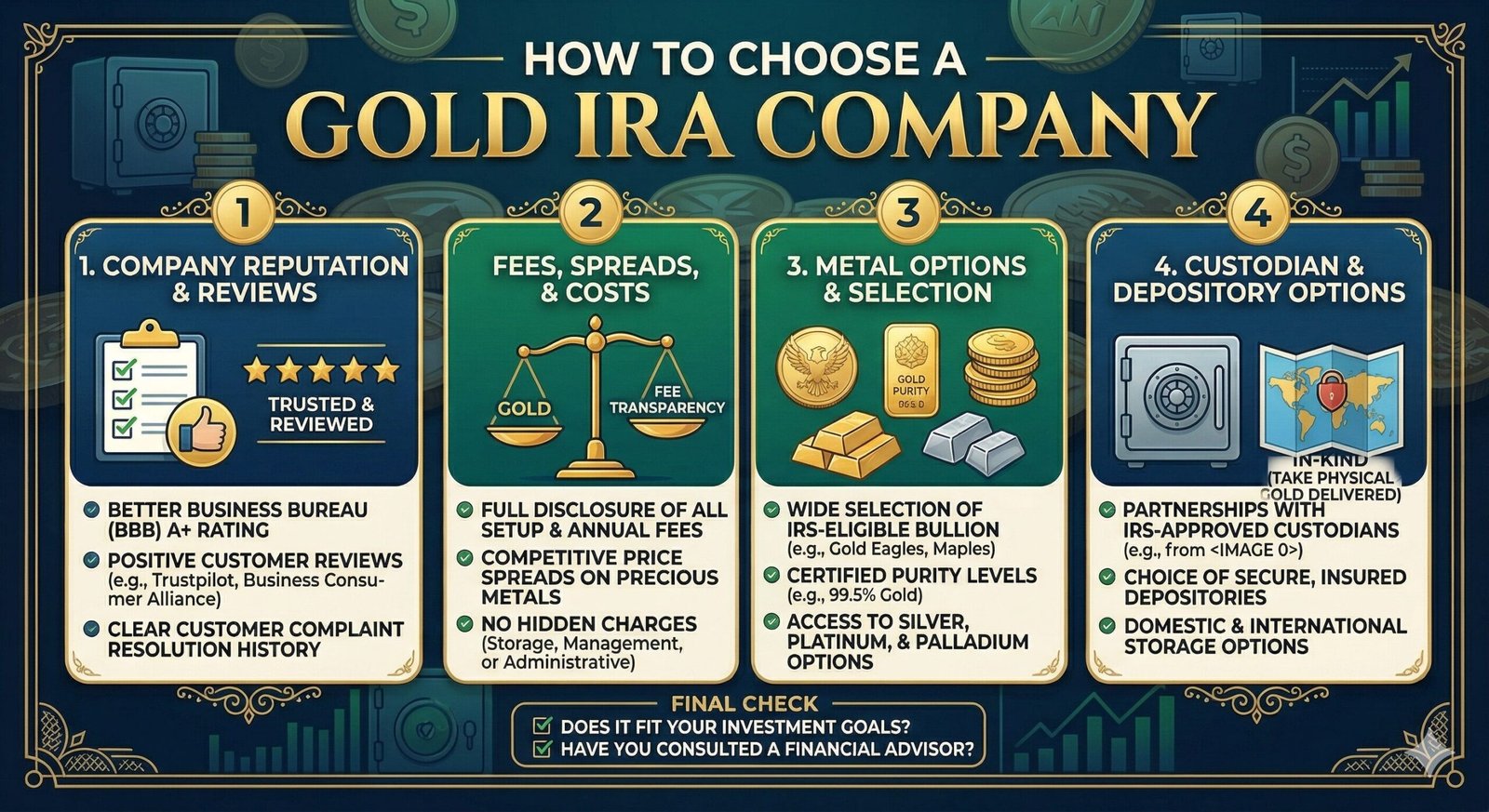
Not all Gold IRA companies charge the same fees, and some of the higher-cost providers are not necessarily delivering proportionally better service. Before choosing a company, it’s worth checking their standing with the Better Business Bureau at bbb.org and looking up any registered representatives through FINRA BrokerCheck.
Our Gold IRA scams guide outlines specific red flags to watch for — including companies that pressure you to act quickly, fail to disclose fees upfront, or make performance promises that no legitimate provider should make. If a company can’t or won’t give you a clear, written breakdown of all fees before you open an account, that alone should give you pause.
Also consider the minimum investment threshold. Some providers set their minimums at $10,000 or lower; others require $25,000 or $50,000 to get started. Our Gold IRA minimum investment page covers this dimension if you’re comparing providers at different account levels. You can also look at the broader question of is a Gold IRA a good idea for a more holistic perspective.
For IRS-eligible metals that qualify for inclusion in a Gold IRA, our page on IRA-eligible gold coins is a useful reference, since choosing the wrong products can create unexpected tax complications.
FAQ
Q: Are Gold IRA fees tax-deductible?
A: Generally, no. Fees paid to maintain a Gold IRA — including custodian and storage fees — are not deductible as investment expenses under current U.S. tax law. However, some investors choose to pay these fees from outside the IRA rather than from the account itself. This is a nuanced area, and you should consult a qualified tax professional rather than relying on information from a dealer or this article.
Q: Can I negotiate Gold IRA fees?
A: In some cases, yes. Some custodians and dealers will waive setup fees or offer reduced annual fees for larger accounts or longer commitments. It’s always reasonable to ask before signing anything.
Q: How do Gold IRA storage fees compare to holding gold in a private vault?
A: The fee structures are broadly similar in terms of what they cover — secure vault storage, insurance, and auditing. The key difference is that IRA-held metals must be stored in a specific type of IRS-approved depository with qualifying custodial oversight. You can’t use just any private vault.
Q: What happens to the fees if gold prices fall and my account value drops?
A: If your storage fee is percentage-based, it will fall along with the account value, which is one argument in favor of percentage-based structures. If it’s a flat fee, you’ll pay the same dollar amount regardless of what the metals in your account are worth. Past performance is not a guarantee of future results, and the relationship between fee structures and account values over time is worth modeling before you choose a provider.
Q: Is a Gold IRA more expensive than a standard self-directed IRA holding other alternative assets?
A: That depends heavily on the asset. Some alternative assets held in self-directed IRAs — such as real estate — carry their own substantial administrative, valuation, and compliance costs. Gold’s fees are higher than a stock-based IRA but are not uniquely excessive compared to other physical-asset self-directed accounts. The SEC’s investor resources page provides a helpful broader overview of retirement account structures.
Whether or not a Gold IRA makes sense for your retirement plan is a decision only you can make — ideally in consultation with a financial advisor who has no stake in the outcome. What this analysis should give you is a clear-eyed view of what the costs actually are, what they fund, and what to look for in a provider. To compare the leading providers currently available to U.S. investors, visit our full review of the Best Gold IRA Companies of 2026.
This article is for informational purposes only and does not constitute financial or tax advice. Investing in precious metals involves risk including possible loss of principal.
Related guides
- Gold IRA Consumer Affairs Reviews: What to Look For
- Gold IRA Trustpilot Reviews: What Real Customers Say
- Gold IRA BBB Complaints: What Consumer Reports Reveal
- Are Gold IRA Fees Too High? Breaking Down the Real Costs
- Gold IRA Mistakes to Avoid: 10 Common Errors Investors Make
- Gold IRA: 15 Questions to Ask Before Opening an Account