
Gold Price in 2024: Record Highs and What Drove Them
The gold price in 2024 was a story that commanded attention across financial media, retirement planning circles, and central bank boardrooms alike. For much of the year, gold climbed steadily before breaking through price levels that had never been seen before in the metal’s long market history. For retirement investors trying to understand the role precious metals might play in a long-term financial strategy, the 2024 gold market offers a useful case study in how multiple economic forces can converge to move a commodity in a sustained and significant way.
This article unpacks what actually happened to gold prices in 2024, what drove those movements, and what the year’s price history might mean for retirement investors considering a Gold IRA. As always, past performance is not a guarantee of future results, and nothing here should be read as investment advice.
How Gold Performed in 2024: A Year-by-Year Overview
Gold began 2024 trading in the range of approximately $2,000 to $2,050 per troy ounce — already elevated by historical standards after years of gradual appreciation. What followed was a year of persistent upward movement punctuated by milestone after milestone.
By March 2024, gold had crossed $2,100 per ounce, a level that had briefly been touched but never sustained in prior years. Then, through the second quarter, prices pushed higher still. By mid-May, gold was trading above $2,400 per ounce. The summer months brought some consolidation and modest pullbacks, but the metal resumed its climb in the third quarter. By late October, gold crossed the $2,700 mark, and by year’s end it was trading in the $2,600 to $2,650 range after a slight cooling.
The net result: gold delivered one of its strongest annual performances in recent memory, with year-over-year price gains that surprised even seasoned commodities analysts. Again, past performance is not a guarantee of future results — but understanding what drove 2024’s movement can help retirement investors ask better questions about whether a Gold IRA fits their situation.
What Drove the Gold Price in 2024
No single factor explains gold’s 2024 performance. Instead, several distinct forces converged to create sustained demand for the metal throughout the year. Understanding each one separately gives a clearer picture of how gold markets actually work.
Central Bank Buying at Historic Levels
One of the most consequential developments in the gold market over recent years has been the sustained and accelerating pace of central bank gold purchases. In 2024, this trend continued at levels that commanded serious attention from analysts.
Central banks — particularly those in emerging market economies including China, India, Poland, and several Middle Eastern nations — continued adding gold to their official reserves at a pace rarely seen in modern financial history. The motivations cited by economists and analysts vary, but they generally point to a broader desire among these institutions to hold a portion of reserves outside the U.S. dollar system.
When central banks buy gold in volume, it removes significant supply from the open market and places sustained upward pressure on prices. This institutional demand was a meaningful contributor to gold’s price trajectory throughout the year.
Federal Reserve Policy and Interest Rate Expectations
The relationship between interest rates and gold prices is widely discussed, and 2024 illustrated it clearly. Heading into the year, financial markets were anticipating that the U.S. Federal Reserve would begin cutting interest rates after an extended period of elevated rates designed to bring down inflation.
The logic is relatively straightforward: when interest rates fall, the opportunity cost of holding gold — which pays no yield — declines relative to yield-bearing assets. That dynamic makes gold comparatively more attractive to a broader range of investors.
The Fed did begin cutting rates in 2024, and each policy shift or signal toward additional cuts tended to correspond with upward pressure on gold prices. For retirement investors, this is a useful example of how macroeconomic policy decisions ripple through precious metals markets in ways that are sometimes predictable in direction, if not in magnitude or timing.
Geopolitical Uncertainty
Ongoing geopolitical tensions in multiple regions contributed to investor demand for gold throughout 2024. Conflicts in Eastern Europe and the Middle East, combined with rising tensions in other parts of the world, kept uncertainty elevated. Historically, elevated geopolitical uncertainty has been associated with increased demand for gold, as investors seek assets that are not directly tied to the financial system of any single nation-state.
This doesn’t mean gold is a guaranteed shield against geopolitical events — it is not, and no investment carries that kind of assurance. But the 2024 data reinforced a pattern that has repeated across many different historical periods.
Dollar Dynamics
The U.S. dollar’s relative strength is another traditional factor in gold pricing. Because gold is priced globally in U.S. dollars, a weaker dollar generally makes gold cheaper for buyers in other currencies, which can increase global demand and lift prices. In 2024, dollar weakness in certain periods — particularly as rate-cut expectations firmed up — added a tailwind to gold’s price movement.
Gold IRA Considerations in the Context of 2024’s Market
For retirement investors, the 2024 gold market raises some practical questions. If you’ve been curious about a Gold IRA — a type of self-directed IRA that holds physical gold and other approved precious metals — understanding how gold prices move is part of that broader education.
Before going further, it’s worth reviewing our Gold IRAs Explained in Detail guide, which covers the mechanics of how these accounts work, the rules governing them, and what to expect in terms of setup and ongoing management.
A few key points for retirement investors to keep in mind:
Timing and price entry. Gold’s 2024 performance means that anyone who established a Gold IRA early in the year or in prior years saw the nominal value of their holdings rise. However, those considering entering the market after a strong run are understandably cautious. That caution is sensible — gold prices can and do fall, sometimes sharply, and no analyst can reliably predict what gold will do next. That’s a decision individual investors need to make with their own financial advisors.
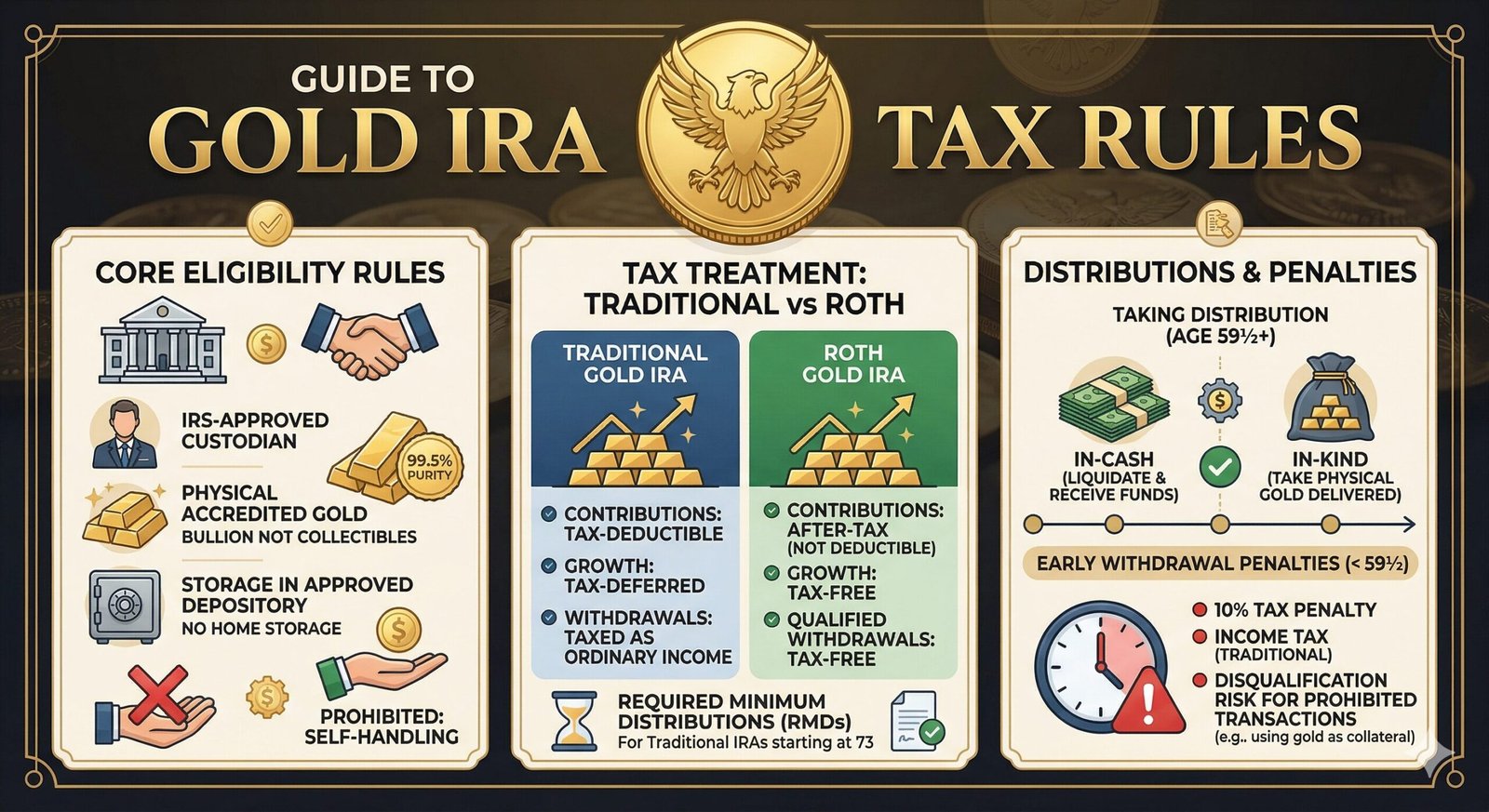
Eligible gold for IRAs. Not all gold qualifies for IRA ownership. The IRS sets strict purity and form requirements — gold held in an IRA must generally meet a fineness of .995 or higher, with specific coins and bars approved. You can explore IRA-eligible gold coins to understand what qualifies. The IRS IRA investment FAQ is also a useful reference for the rules around what IRAs can hold.
Fees and costs. Gold IRAs come with a different fee structure than traditional IRAs. Custodian fees, storage fees, and setup costs are all part of the picture. Our Gold IRA fees guide breaks these down in detail. These costs don’t go away when gold prices rise, and they become proportionally more significant if prices fall.
Rollovers. Many retirement investors fund a Gold IRA by rolling over assets from an existing 401(k) or traditional IRA. If that’s something you’re exploring, our 401(k) to Gold IRA rollover guide walks through the process step by step, and the Gold IRA rollover rules page covers the IRS guidelines you need to follow to avoid penalties. For a broader comparison, the Gold IRA vs Traditional IRA page may also be useful.
FINRA’s guidance on self-directed IRAs — the category Gold IRAs fall under — is worth reading before you make any decisions. You can find it at FINRA’s guidance on self-directed IRAs. The SEC also provides useful background through its SEC investor resources.
2024 Gold Price: Key Milestones at a Glance
Note: All prices are approximate and reflect spot market levels. Past performance is not a guarantee of future results.
A Note on Scams and Due Diligence
Any period of strong gold prices tends to bring an increase in misleading marketing from companies trying to capitalize on investor interest. If you are researching Gold IRA providers, take your time, check company ratings on bbb.org, and verify credentials where possible through FINRA BrokerCheck. Our Gold IRA scams guide covers the red flags to watch for and the questions every investor should ask before opening an account.
Frequently Asked Questions
What was the highest gold price ever recorded in 2024?
Gold reached approximately $2,790 per troy ounce in late October 2024, which represented an all-time intraday high at the time. The metal subsequently pulled back but ended the year significantly above where it began. Past performance is not a guarantee of future results.
Why did gold reach record highs in 2024?
Several forces converged: sustained central bank buying at historically high volumes, expectations and then confirmation of Federal Reserve interest rate cuts, ongoing geopolitical tensions in multiple regions, and periodic U.S. dollar weakness. No single factor fully explains the move — it was the combination that drove gold’s unusual performance.
Does the 2024 gold price increase mean Gold IRAs performed well?
In terms of the nominal value of the underlying metal, yes — investors who held gold through 2024 saw the face value of their holdings rise. However, Gold IRA performance involves more than spot price movement; fees, purchase price, storage costs, and timing all affect real outcomes. Past performance is not a guarantee of future results.
Should I open a Gold IRA based on gold’s 2024 performance?
That’s a decision that depends entirely on your personal financial circumstances, retirement timeline, and goals. We don’t provide investment advice, and strong past performance in any asset does not predict future results. If you’re exploring the question of whether is a Gold IRA a good idea for your situation, that page offers a balanced educational overview to inform your thinking.
Are there IRS rules that govern what gold a retirement account can hold?
Yes. The IRS requires that gold held in an IRA meet specific purity standards — generally .995 fineness or higher — and be stored by an approved custodian in an IRS-compliant depository. You cannot store IRA gold at home. For the official rules, IRS Publication 590-A is the primary reference document.
Next Steps for Retirement Investors
If the gold market’s 2024 story has prompted you to take a closer look at how precious metals might fit into your retirement planning, the right next step is education rather than action. Understanding the mechanics of a Gold IRA, the costs involved, and the regulatory framework that governs these accounts puts you in a much stronger position to have an informed conversation with a qualified financial advisor.
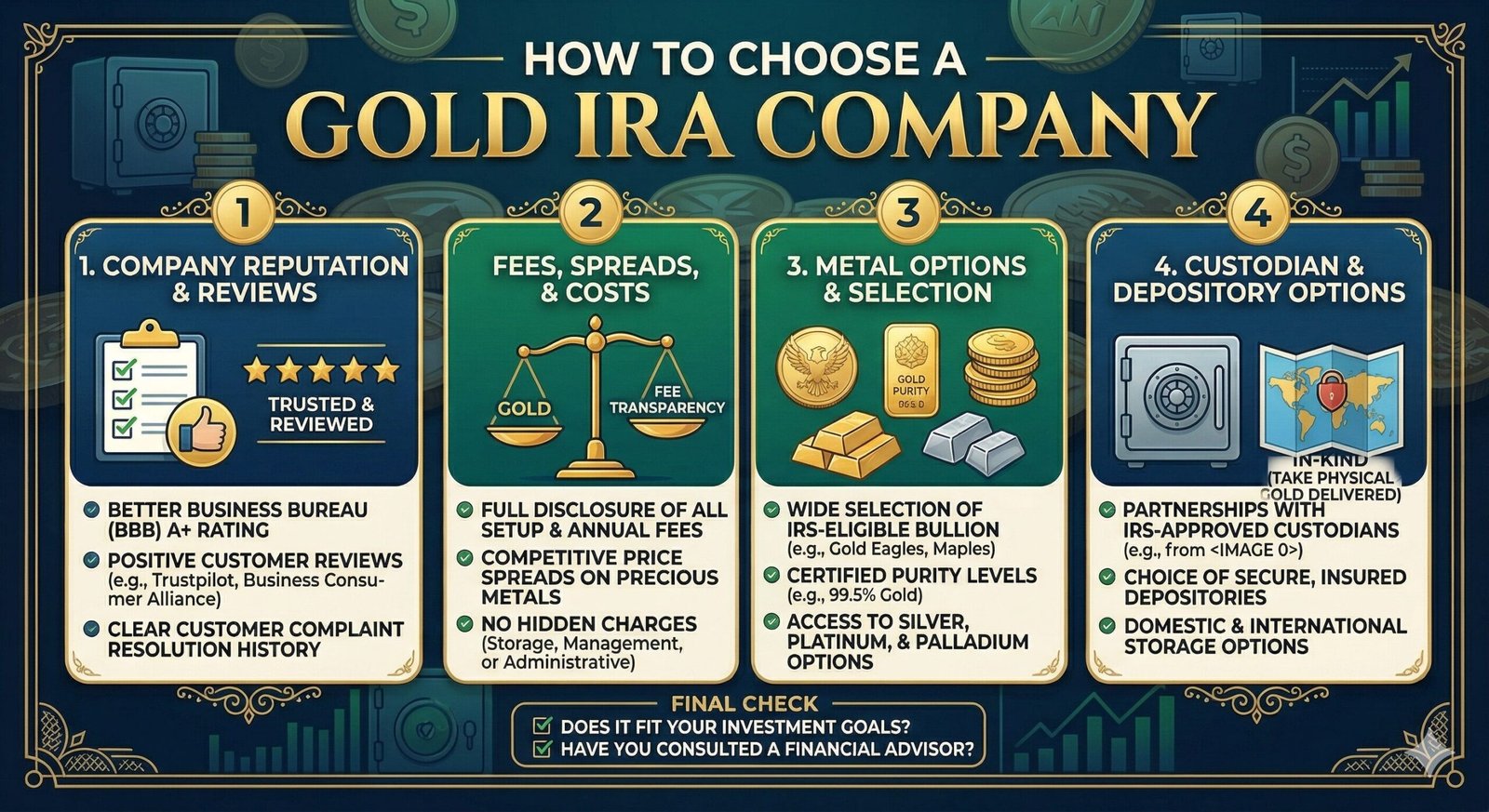
To compare the leading Gold IRA providers in the market today — including account minimums, fee structures, storage options, and customer service track records — visit our guide to the Best Gold IRA Companies of 2026. It’s updated regularly and designed to give retirement investors a clear, unbiased starting point for their research.
This article is for informational purposes only and does not constitute financial or tax advice. Investing in precious metals involves risk including possible loss of principal.