
Is a Gold IRA Better Than a 401(k)? Honest Comparison
When retirement planning conversations turn to Gold IRAs, one question comes up more than almost any other: is a Gold IRA actually better than a 401(k)? It’s a fair thing to wonder, especially as more investors in their 40s, 50s, and 60s start looking beyond conventional workplace retirement accounts.
The honest answer? Neither account is categorically better than the other. They serve different purposes, operate under different rules, and come with different trade-offs. What matters is understanding how each one works — and which features align with your specific financial situation and retirement timeline.
This article breaks down the key differences between Gold IRAs and 401(k)s across the areas that matter most: structure, contribution limits, investment options, fees, and withdrawal rules. No predictions, no investment advice — just a clear-eyed look at how these two account types compare.
What Is a Gold IRA?
A Gold IRA is a self-directed Individual Retirement Account that allows you to hold physical precious metals — gold, silver, platinum, and palladium — as retirement assets. Unlike a standard IRA, which is typically limited to stocks, bonds, and mutual funds, a self-directed Gold IRA uses IRS-approved custodians and accredited depositories to hold physical bullion on your behalf.
For a thorough breakdown of how these accounts are structured, visit our Gold IRA hub, or read Gold IRAs Explained in Detail for a deeper look at the mechanics.
The IRS sets strict requirements for what qualifies as an eligible precious metal inside a retirement account. Gold, for example, must meet a minimum purity standard of 99.5%. A full list of qualifying products is covered in our guide to IRA-eligible gold coins. You can also review the IRS IRA investment FAQ directly for the regulatory details.
What Is a 401(k)?
A 401(k) is an employer-sponsored retirement savings plan that allows employees to contribute a portion of their pre-tax salary toward retirement. Most plans offer a menu of mutual funds, index funds, and sometimes company stock. Many employers match a portion of employee contributions up to a set limit — a benefit that is specific to 401(k) plans and not available with any type of IRA.
401(k) plans are administered by plan sponsors (typically employers) and governed by ERISA — the Employee Retirement Income Security Act — which sets rules around investment options, disclosures, and fiduciary duties.
Key Differences: Gold IRA vs. 401(k)
Understanding how these accounts differ side by side is the clearest way to evaluate which may be appropriate for your situation.
Contribution Limits
For 2025, the IRS allows 401(k) participants to contribute up to $23,500 per year, with a catch-up contribution of an additional $7,500 for those aged 50 and older — bringing the total potential contribution to $31,000. This is a meaningful advantage for higher earners looking to maximize tax-deferred savings.
Gold IRAs — like all IRAs — are subject to significantly lower annual contribution limits. For 2025, the limit is $7,000, or $8,000 for those aged 50 or older. You can verify current figures directly through the IRS contribution limits page.
This is one area where the 401(k) holds a structural advantage for anyone with the income and intention to make large annual contributions.
Investment Options
This is where the two accounts diverge most sharply. Standard 401(k) plans offer a pre-selected menu of investment options determined by your employer’s plan administrator. Most plans include mutual funds, target-date funds, and index funds. Some offer a self-directed brokerage window with broader access, but physical precious metals are almost never available inside a conventional 401(k).
A Gold IRA, by contrast, is specifically designed to hold physical metals. This opens access to an asset class that simply isn’t available in most workplace plans. If holding physical gold as part of your retirement strategy appeals to you, a Gold IRA is the only IRS-approved account structure that makes it possible.
Employer Matching
This is exclusively a 401(k) feature. If your employer matches contributions — even partially — that match represents additional compensation that you forfeit by not participating in the plan. No IRA, Gold or otherwise, offers an employer matching component.
For most employees with access to a matching 401(k), capturing that match before considering other retirement account types is a commonly cited priority among financial professionals.
Tax Treatment
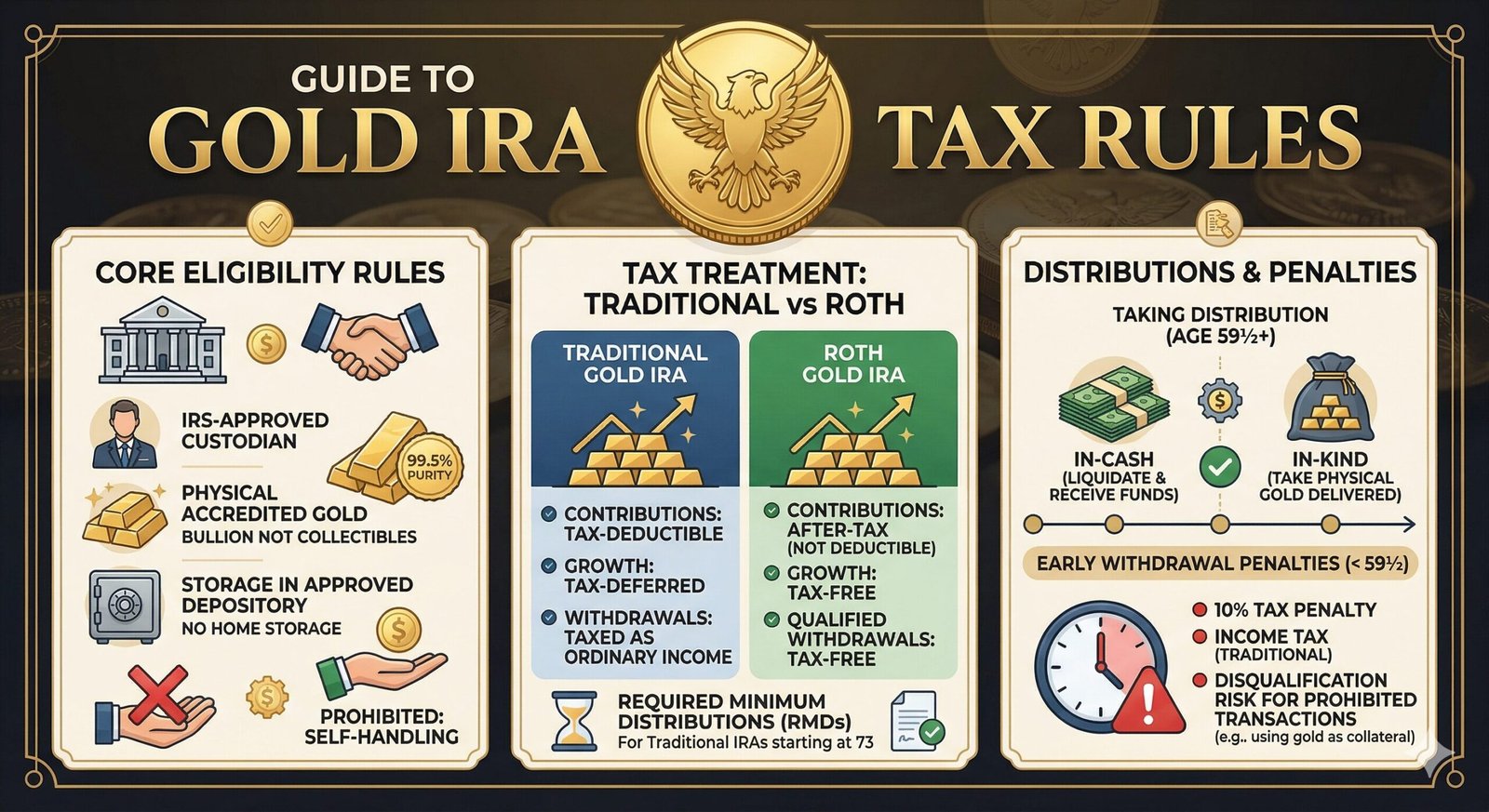
Both accounts can be structured on a pre-tax basis (traditional) or an after-tax basis (Roth), depending on the plan and eligibility rules. The underlying tax structure — contributions, growth, and distributions — is broadly similar between a traditional 401(k) and a traditional Gold IRA.
One nuance worth noting: Gold IRAs, like all IRAs, are subject to income-based eligibility rules for Roth contributions. 401(k) Roth contributions have no income ceiling. IRS Publication 590-A covers IRA eligibility and contribution rules in detail.
For a more detailed breakdown of how a Gold IRA compares to a standard IRA on tax structure, see our Gold IRA vs Traditional IRA article.
Fees
401(k) plans carry their own fee structure — typically expense ratios embedded in the funds offered, plus potential administrative fees. These vary by plan but can be difficult to identify without careful review of your plan’s fee disclosure documents.
Gold IRAs carry a distinct and often more visible fee structure that includes setup fees, annual custodian fees, storage fees for the physical metal, and sometimes transaction fees when buying or selling metals. Our Gold IRA fees guide walks through what to expect and how to evaluate whether the costs are reasonable.
FINRA’s guidance on self-directed IRAs also highlights the importance of understanding fee structures before opening any self-directed account.
Withdrawal Rules and RMDs
Both account types follow broadly similar withdrawal rules. Distributions before age 59½ generally trigger a 10% early withdrawal penalty plus ordinary income tax (with limited exceptions). Required Minimum Distributions (RMDs) apply to traditional versions of both accounts beginning at age 73 under current law.
One practical distinction with a Gold IRA: because the assets are physical metals, satisfying an RMD may require selling a portion of the metal or taking an in-kind distribution — a process that requires coordination with your custodian and the depository. The IRS RMD FAQ covers the technical requirements.
Side-by-Side Comparison Table
Can You Roll Over a 401(k) Into a Gold IRA?
Yes — and this is a path many investors explore when they leave an employer or retire. Rolling over an existing 401(k) into a Gold IRA is a recognized IRS process, but it must be done correctly to avoid triggering taxes or penalties. Our 401(k) to Gold IRA rollover guide covers the step-by-step process, and our Gold IRA rollover rules article explains the regulatory guardrails you need to stay within.
The short version: a direct rollover (where funds move custodian-to-custodian without passing through your hands) is generally the cleanest approach. An indirect rollover gives you 60 days to redeposit the funds, but withholding and timing risks make it more complicated.
What Kind of Investor Considers a Gold IRA?
A Gold IRA tends to attract investors who already have meaningful retirement savings in conventional accounts and want access to an asset class that isn’t available through their workplace plan. It also appeals to those who are philosophically drawn to owning a tangible, physical asset as part of their long-term retirement strategy.
It is not a substitute for a 401(k) if you have access to one with employer matching, and it is not a vehicle for short-term trading. It is a retirement account — with all the rules, restrictions, and long time horizons that implies.
Whether a Gold IRA makes sense for your situation is a question worth exploring carefully. Our article on is a Gold IRA a good idea walks through the practical considerations in plain terms.
A Note on Due Diligence
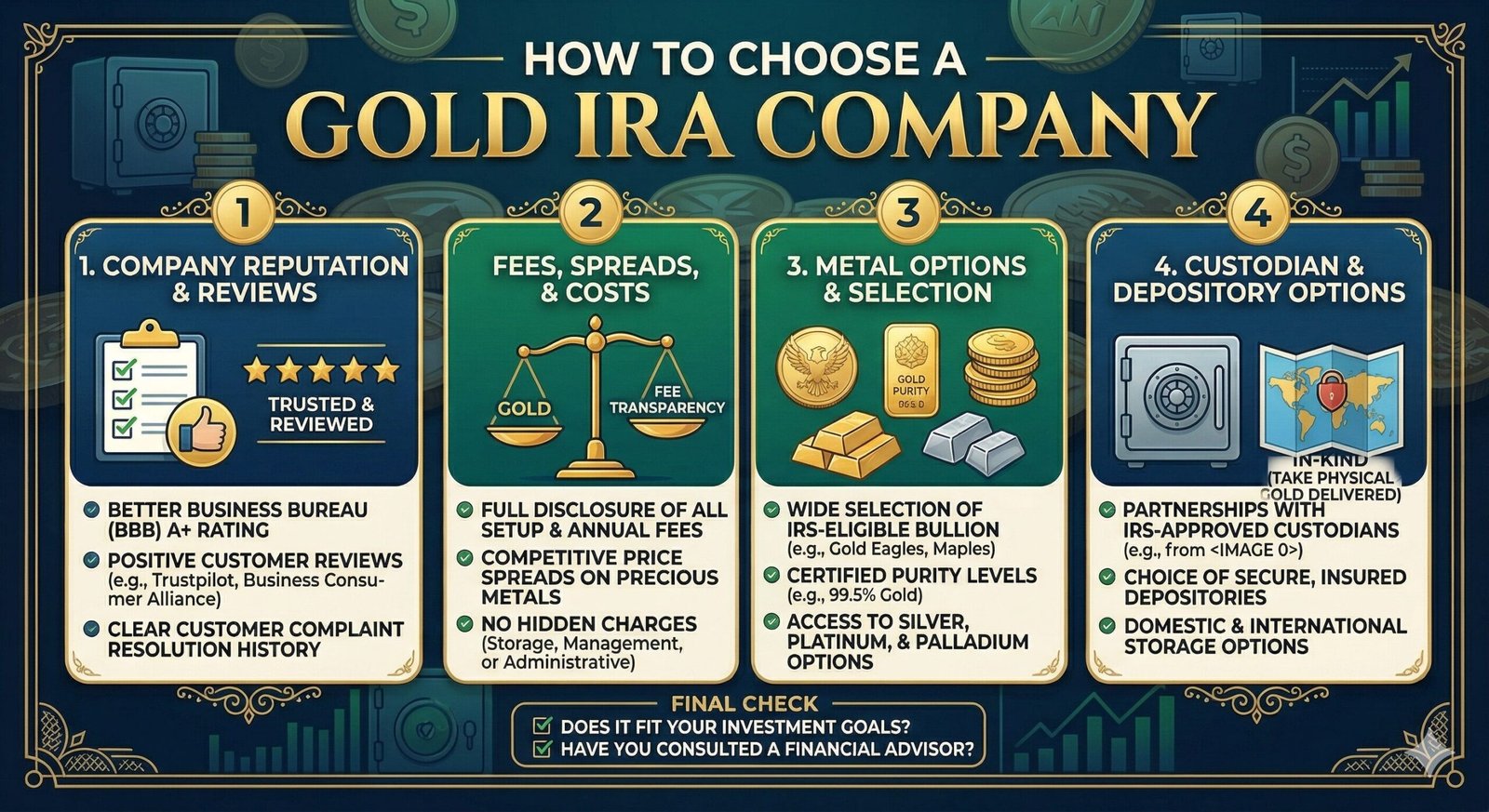
If you’re researching Gold IRA providers, it pays to be thorough. The self-directed IRA space — and precious metals specifically — has attracted its share of bad actors. Before opening an account with any company, verify their credentials, check their rating at bbb.org, and look up any registered representatives through FINRA BrokerCheck. Our Gold IRA scams guide outlines the warning signs to watch for.
Also review any minimum investment requirements before committing. Our Gold IRA minimum investment guide explains what different providers typically require to open an account.
Frequently Asked Questions
Can I have both a Gold IRA and a 401(k) at the same time?
Yes. There is no IRS rule preventing you from contributing to both a workplace 401(k) and a self-directed IRA in the same tax year, subject to the respective contribution limits and income eligibility rules.
Is a Gold IRA subject to the same contribution limits as a regular IRA?
Yes. A Gold IRA is a type of IRA, so it falls under the same annual contribution limits — $7,000 for 2025, or $8,000 if you are aged 50 or older. The IRS does not give Gold IRAs a separate or higher contribution ceiling.
Can I hold gold inside my existing 401(k)?
In most cases, no. Standard 401(k) plans do not offer physical precious metals as an investment option. Some plans with a self-directed brokerage window may offer gold ETFs, but these are paper products — not physical metal held in your name.
What happens to a Gold IRA when I take Required Minimum Distributions?
Like any traditional IRA, a Gold IRA requires minimum distributions beginning at age 73. Because the assets are physical metals, you can either sell a portion to satisfy the distribution in cash, or take an in-kind distribution of the physical metal itself. Both options require coordination with your custodian.
Is it possible to roll over only part of my 401(k) into a Gold IRA?
Yes. Partial rollovers are permitted. You do not need to move your entire 401(k) balance — you can roll over a portion while leaving the remainder in your existing plan or moving it to a different account.
Ready to Learn More?
Neither a Gold IRA nor a 401(k) is inherently superior to the other — they are different tools with different strengths, and many investors use both as part of a broader retirement strategy. If you’re weighing your options, start by understanding each account type thoroughly before making any decisions.
To compare the top-rated providers in the Gold IRA space, visit our Best Gold IRA Companies of 2026 page, where we’ve evaluated the leading companies across transparency, fees, customer service, and regulatory standing.
This article is for informational purposes only and does not constitute financial or tax advice. Investing in precious metals involves risk including possible loss of principal.
Related guides
- Gold IRA Consumer Affairs Reviews: What to Look For
- Gold IRA Trustpilot Reviews: What Real Customers Say
- Gold IRA BBB Complaints: What Consumer Reports Reveal
- Is a Gold IRA Worth the Fees? A Cost-Benefit Analysis
- Are Gold IRA Fees Too High? Breaking Down the Real Costs
- Gold IRA Mistakes to Avoid: 10 Common Errors Investors Make