
Gold IRA in Wisconsin: Rules and Top Providers
If you live in Wisconsin and have started exploring ways to include physical gold or other precious metals in your retirement savings, you are not alone. Across the state — from Milwaukee to Madison, Green Bay to La Crosse — more retirement savers in their 40s, 50s, and 60s are asking what a Gold IRA is, how it works under federal law, and which companies are worth considering.
This guide walks through everything Wisconsin residents need to understand about Gold IRAs: the federal rules that govern them, how the setup process works, what costs to expect, and how to identify providers who operate with transparency and integrity.
What Is a Gold IRA?
A Gold IRA is a type of self-directed Individual Retirement Account that holds IRS-approved physical precious metals — most commonly gold bullion or gold coins — rather than conventional assets like stocks or mutual funds. The account functions under the same broad framework as a traditional or Roth IRA, including the same contribution limits and distribution rules, but it requires a specialist custodian and an approved storage facility.
For a thorough breakdown of how these accounts are structured, see our Gold IRA hub or read Gold IRAs Explained in Detail for a more comprehensive overview.
The IRS governs all IRAs under the Internal Revenue Code, and it sets specific standards that Gold IRAs must meet. Wisconsin does not impose additional state-level IRA regulations beyond those set by federal law, so the rules Wisconsin residents follow are the same rules that apply in every other state.
How Federal Rules Apply to Wisconsin Residents
IRS Requirements for Gold in an IRA
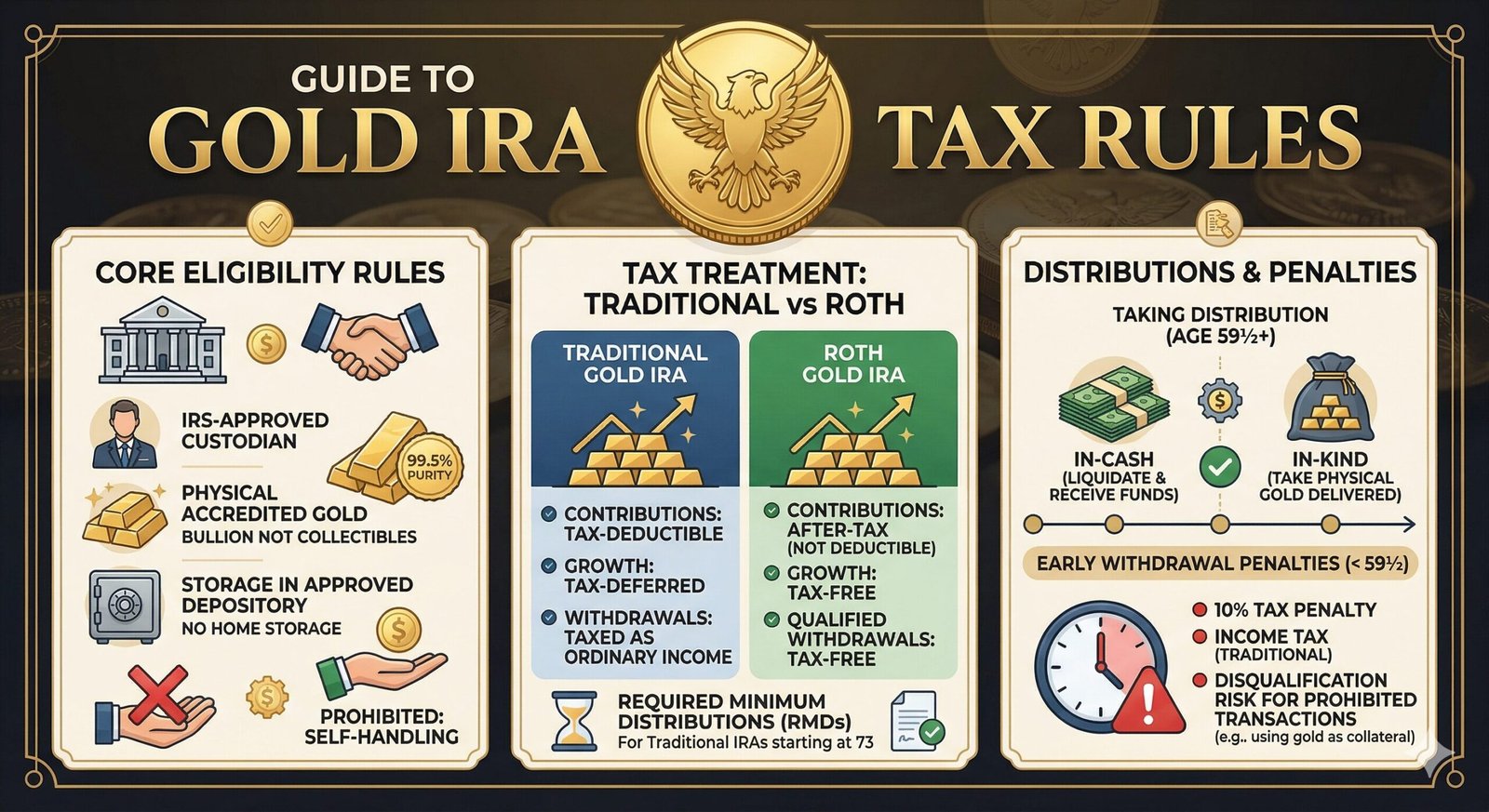
The IRS is explicit about which metals may be held inside a self-directed IRA. According to the IRS IRA investment FAQ, physical gold included in an IRA must meet a minimum purity of 99.5%. This applies to gold bars and coins alike. Coins must also be produced by a national government mint or meet other specific criteria outlined in the Internal Revenue Code.
Popular examples of IRS-compliant gold include American Gold Eagle coins, American Gold Buffalo coins, and gold bars produced by approved refiners. If you want to explore eligible options in more detail, our guide to IRA-eligible gold coins covers this in depth.
One rule that catches many new investors off guard: you cannot take personal possession of the gold held in your IRA. The metal must be stored in an IRS-approved depository — a secure, insured facility. This is a federal requirement, not a Wisconsin-specific one, and it applies regardless of where you live.
Contribution Limits
Contribution limits for Gold IRAs are the same as those for traditional and Roth IRAs. For 2025, the IRS allows contributions of up to $7,000 per year, with a catch-up contribution of an additional $1,000 for account holders aged 50 and over — bringing the total to $8,000 annually. You can confirm current figures directly at the IRS contribution limits page.
Required Minimum Distributions
If your Gold IRA is structured as a traditional IRA, Required Minimum Distributions (RMDs) apply once you reach age 73. Because your account holds physical metal rather than cash, some planning is required when RMD time arrives — you will generally need to either liquidate a portion of the metal or take an in-kind distribution. The IRS RMD FAQ explains the rules in detail.
Rolling Over an Existing Retirement Account
Many Wisconsin residents who open a Gold IRA do so by rolling over funds from an existing 401(k), 403(b), or traditional IRA rather than making new annual contributions. This is a common and legitimate path, but it requires following IRS rollover rules precisely to avoid triggering a taxable event or early withdrawal penalties.
Our 401(k) to Gold IRA rollover guide walks through the process step by step. The key distinction to understand is the difference between a direct rollover and an indirect rollover. In a direct rollover, funds move straight from your existing plan to the new custodian without passing through your hands. In an indirect rollover, you receive the funds personally and must deposit them into the new account within 60 days. Failing to meet that deadline can result in the entire amount being treated as a taxable distribution.
For a full summary of what to watch for during this process, consult our Gold IRA rollover rules guide before taking any action.
Understanding the Costs Involved
Gold IRAs are not free to operate. There are several layers of fees that Wisconsin residents should understand and compare before choosing a provider.
Fees vary significantly between providers, and they can meaningfully affect the long-term value of your account. Our Gold IRA fees guide provides a detailed breakdown of how to evaluate and compare costs across companies. Pay particular attention to whether a provider uses flat-rate fees or scaled fees based on account value, as this can have a real impact depending on the size of your holdings.
Choosing a Gold IRA Provider in Wisconsin
Wisconsin residents have access to the same national pool of Gold IRA custodians as investors elsewhere in the country. There is no requirement to use a Wisconsin-based company — and in practice, most well-established Gold IRA providers are headquartered in states like Texas, California, or Delaware and serve clients across all 50 states.
What to Look For
When evaluating a Gold IRA company, the following factors are worth prioritising.
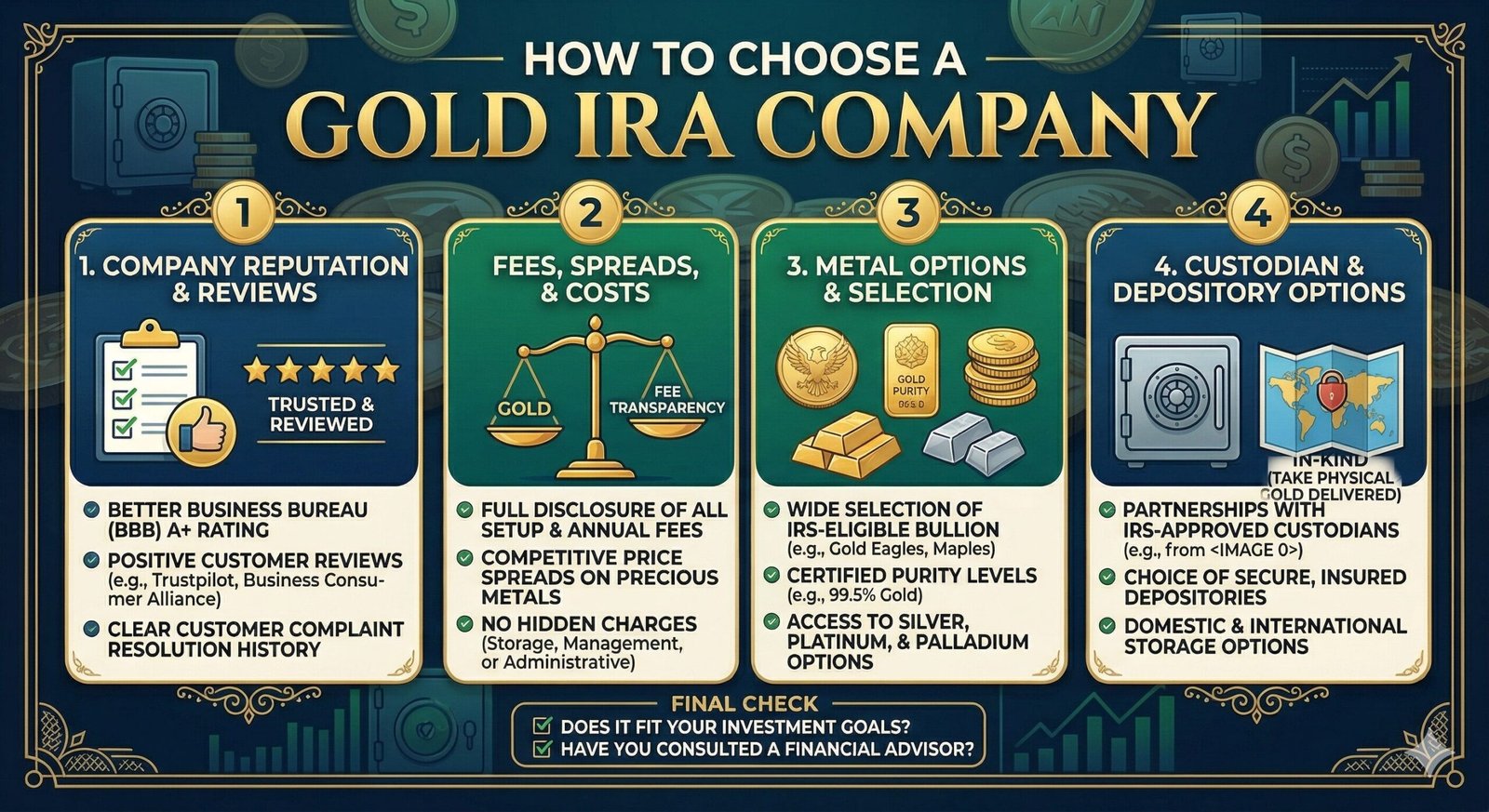
Custodian credentials. A Gold IRA custodian must be an IRS-approved financial institution. Confirm that any company you are considering uses a licensed, regulated custodian — not just a dealer or broker acting informally. FINRA’s guidance on self-directed IRAs explains the role custodians play and why oversight matters.
Storage arrangements. Ask specifically which depository is used to store your metal, whether the storage is segregated or commingled, and how the facility is insured. Segregated storage means your metal is stored separately from other clients’ holdings — some providers offer this at an additional cost.
Reputation and ratings. Check the company’s record with the Better Business Bureau at bbb.org and look for any disciplinary history or investor complaints. You can also research associated brokers through FINRA BrokerCheck.
Pricing transparency. Reputable companies provide clear, written disclosures of all fees before you open an account. Be cautious of companies that are vague about costs or pressure you toward a quick decision.
Educational resources. The best Gold IRA companies invest in helping their clients understand what they are purchasing and why. If a company is more focused on closing a sale than answering your questions, consider that a warning sign.
To protect yourself from unscrupulous operators, our Gold IRA scams guide is essential reading before you commit to any provider.
Minimum Investment Requirements
Different Gold IRA companies set different minimum investment thresholds, and this can vary widely. Some providers will open an account for $5,000 or less; others require $25,000 or more to get started. Our Gold IRA minimum investment page covers what to expect and how minimums affect your choices.
Comparing Gold IRAs to Other Account Types
It is worth understanding how a Gold IRA fits alongside other retirement account structures before making any decisions. Our Gold IRA vs Traditional IRA comparison and Gold IRA vs 401(k) overview both lay out the structural differences clearly — including how contribution limits, tax treatment, and eligible assets differ between account types.
One important note: this article does not constitute financial or tax advice, and the decision about whether a Gold IRA is an appropriate choice for your situation is one you should make with the help of a qualified financial or tax professional who knows your full circumstances. You may also find our article on is a Gold IRA a good idea useful for framing that conversation.
IRS-Approved Depositories Serving Wisconsin Residents
While Wisconsin does not have a major IRS-approved precious metals depository within its borders, this poses no practical problem. Gold IRA holders do not visit their depository in person, and most providers work with a small number of nationally recognized facilities. Common choices include the Delaware Depository, Brinks Global Services facilities, and IDS (International Depository Services) locations. When reviewing providers, ask specifically which depository they use and confirm it is IRS-approved.
Frequently Asked Questions
Q: Do Wisconsin residents face any state-specific rules when opening a Gold IRA?
No. Wisconsin follows federal IRS rules for IRAs without imposing additional state requirements. The same rules that apply to Gold IRA holders in any other state apply to Wisconsin residents.
Q: Can I store my Gold IRA metal at home in Wisconsin?
No. IRS rules prohibit IRA holders from taking personal possession of metals held in their IRA. The metal must be held in an IRS-approved depository. Storing IRA gold at home — regardless of your state — is a prohibited transaction that can result in the entire account being treated as a taxable distribution.
Q: How do I roll over my 401(k) to a Gold IRA without triggering taxes?
The safest method is a direct rollover, where funds transfer directly from your 401(k) administrator to the new Gold IRA custodian without passing through your hands. This avoids withholding and any risk of a taxable event. See our full 401(k) to Gold IRA rollover guide for step-by-step details.
Q: How do I know if a Gold IRA company is legitimate?
Check their BBB rating and history of complaints at bbb.org, research associated individuals through FINRA BrokerCheck, and verify that the company uses a properly licensed custodian. Transparency about fees and storage arrangements is also a strong indicator of legitimate operations.
Q: What happens to my Gold IRA when I reach RMD age?
At age 73, if your Gold IRA is a traditional account, you will be required to begin taking minimum distributions. Because the account holds physical metal, distributions typically involve either selling the required amount of metal and distributing the cash, or taking an in-kind distribution of the metal itself. Your custodian can walk you through the options. The IRS RMD FAQ provides official guidance on how RMDs work.
Ready to Research Your Options?
If you are a Wisconsin resident and want to compare the most reputable Gold IRA providers currently operating in the market, our independently researched list is a good place to start. Visit our Best Gold IRA Companies of 2026 page for detailed profiles, fee comparisons, and what to ask before you open an account.
This article is for informational purposes only and does not constitute financial or tax advice. Investing in precious metals involves risk including possible loss of principal.
Related guides
- Gold IRA Consumer Affairs Reviews: What to Look For
- Gold IRA Trustpilot Reviews: What Real Customers Say
- Gold IRA BBB Complaints: What Consumer Reports Reveal
- Is a Gold IRA Worth the Fees? A Cost-Benefit Analysis
- Are Gold IRA Fees Too High? Breaking Down the Real Costs
- Gold IRA Mistakes to Avoid: 10 Common Errors Investors Make