
Gold IRA in Vermont: Rules and Provider Guide
Opening a Gold IRA in Vermont follows the same federal framework that applies to every American retirement saver, but there are a few state-specific details worth knowing before you take your first step. Whether you live in Burlington, Montpelier, or a quieter corner of the Green Mountain State, this guide walks you through how a Gold IRA actually works, what the IRS requires, how to find a trustworthy provider, and what costs to expect along the way.
What Is a Gold IRA?
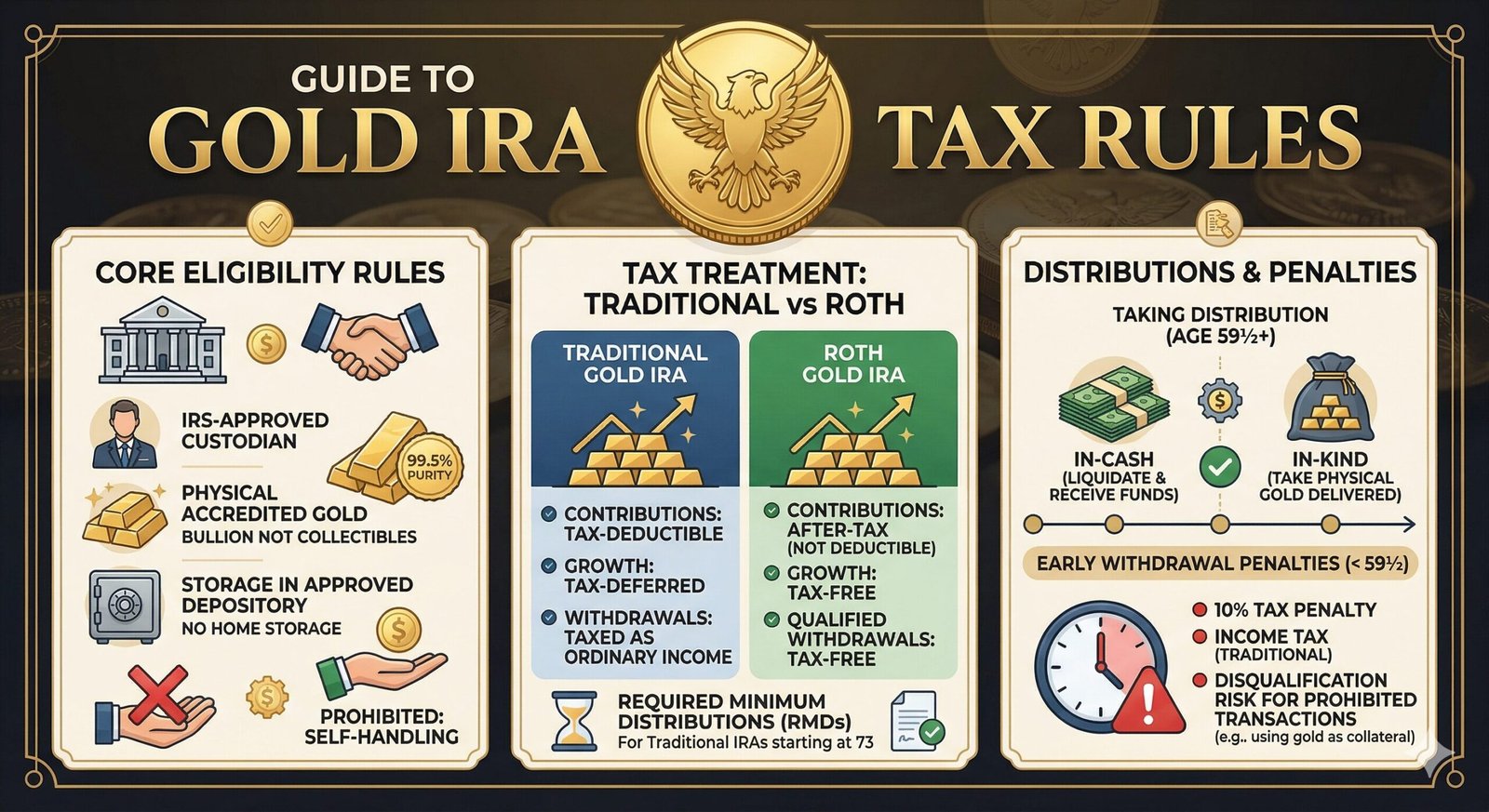
A Gold IRA is a self-directed individual retirement account that holds physical precious metals — gold, silver, platinum, or palladium — rather than the stocks, mutual funds, or ETFs found in a conventional IRA. The account is governed by the same IRS rules that apply to traditional and Roth IRAs, including contribution limits, distribution rules, and required minimum distributions (RMDs).
The key distinction is that a Gold IRA requires a few additional structural components: a specialized IRS-approved custodian to administer the account, and an approved depository to store the physical metal. You cannot simply take physical delivery of your gold at home — the IRS requires it to be held in a qualified facility while it remains inside the IRA wrapper. For a thorough walkthrough of how these accounts function, visit our Gold IRA hub.
Is a Gold IRA Legal in Vermont?
Yes, entirely. Gold IRAs are federally regulated retirement vehicles, which means Vermont residents access them under exactly the same federal rules as any other American. There is no Vermont state law that restricts, modifies, or adds special requirements to Gold IRA ownership.
Vermont does have its own income tax rules that apply to IRA distributions, and we’ll touch on that below. But the structure, eligibility requirements, and operation of a Gold IRA are determined by the IRS, not the State of Vermont. For the full federal framework, IRS Publication 590-A is the primary reference document.
How Does a Gold IRA Work for Vermont Residents?
Setting Up the Account
Vermont residents open a Gold IRA through a self-directed IRA custodian — a company specifically authorized by the IRS to administer alternative-asset retirement accounts. This is different from a standard brokerage or bank. Once the custodian account is established, you fund it either through a direct contribution, a rollover from an existing IRA, or a rollover from a workplace plan such as a 401(k). If you’re considering moving funds from a workplace plan, our 401(k) to Gold IRA rollover guide explains the process in plain terms.
Buying the Gold
Once funded, your custodian works with an approved precious metals dealer to purchase the metal on your behalf. The gold is then shipped directly to an IRS-approved depository — not to your home address. Vermont residents can use any federally approved depository in the United States; your choice of depository is typically arranged through your custodian.
Purity and Eligibility Standards
Not all gold qualifies for IRA inclusion. The IRS mandates a minimum fineness of 0.995 (99.5% pure) for gold held inside an IRA. This rules out many collector coins but includes widely traded products such as the American Gold Eagle (which is specifically exempt from the standard purity requirement due to its legal tender status), the American Gold Buffalo, and bars produced by LBMA-approved refiners. For a broader look at qualifying products, see our guide to IRA-eligible gold coins.
Contribution Limits and Rollover Rules
Gold IRA contribution limits are set by the IRS and apply equally to all Americans regardless of state. For 2024, the combined contribution limit for traditional and Roth IRAs is $7,000 per year, with a $1,000 catch-up contribution available to those aged 50 and older. These limits apply to cash contributions — rollovers from existing retirement accounts do not count against your annual limit and have no ceiling of their own. The current IRS figures are published on the IRS contribution limits page.
Rollovers are subject to their own set of rules. The key distinction is between a direct rollover (where funds move directly from one account to another without touching your hands) and an indirect rollover (where funds are distributed to you first, and you have 60 days to deposit them into the new account). Missing the 60-day window on an indirect rollover can trigger taxes and early withdrawal penalties. Our Gold IRA rollover rules page goes into this in depth.
Vermont State Tax Considerations
Vermont taxes IRA distributions as ordinary income, conforming broadly to federal treatment. The state has a graduated income tax structure, with rates currently ranging from 3.35% to 6.75% depending on your income level. There is no special Vermont tax exemption for IRA distributions beyond federal deductions already available under IRS rules.
Vermont does offer a partial exemption on Social Security income for qualifying taxpayers, and the state allows a modest deduction on retirement income for taxpayers meeting certain thresholds — but these rules are subject to annual legislative changes and individual circumstance. Because tax treatment varies from person to person, this article cannot advise on how any of this applies to you specifically. For current Vermont state tax guidance, the Vermont Department of Taxes is the appropriate resource, and a qualified CPA or tax advisor familiar with Vermont law can help you understand your personal situation.
Fees to Expect With a Gold IRA
Gold IRAs carry a different fee structure than conventional IRAs. Understanding these costs upfront helps you make a more informed decision. Our dedicated Gold IRA fees guide covers this comprehensively, but here is a summary of the typical charges involved.
Fees vary meaningfully between custodians, and it’s worth comparing several providers before making a decision. Some companies offer flat annual fees while others use a scaled structure tied to account value — both models exist and have different implications depending on your account size.
Finding a Reputable Gold IRA Provider in Vermont
Vermont residents do not need to use a locally headquartered company. Gold IRAs are structured as national products, and the best providers operate across all 50 states. What matters is not where the company’s office is, but how it’s licensed, regulated, and reviewed.
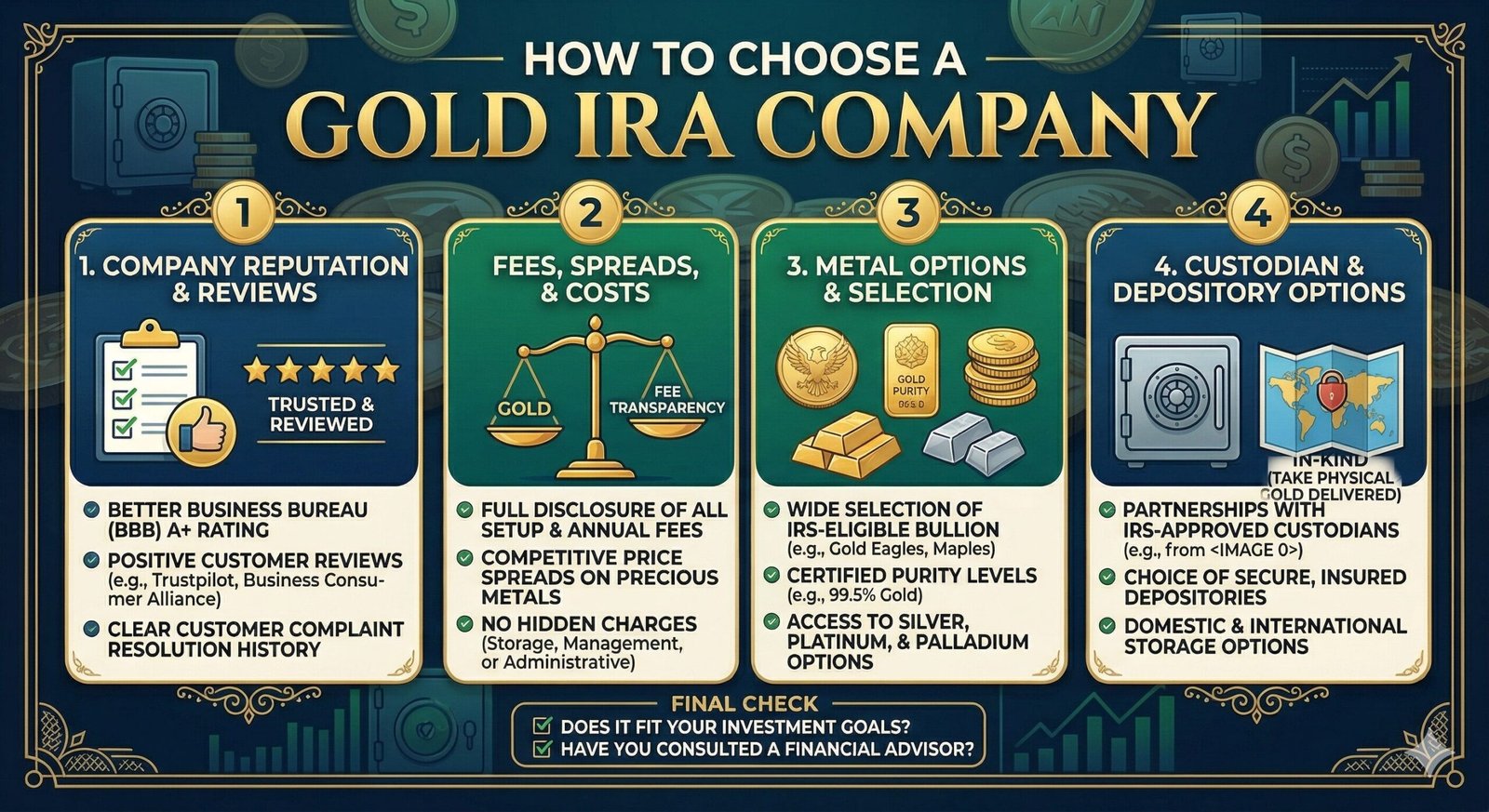
Here are the key factors to evaluate when assessing any Gold IRA company:
Custodian licensing. Your custodian must be an IRS-approved, non-bank trustee or a federally or state-chartered bank. You can verify this through the IRS or look up company credentials through FINRA BrokerCheck.
Depository quality. Your metal should be stored in a fully segregated or allocated account at an approved depository. Leading facilities include Brinks, Delaware Depository, and International Depository Services Group.
Reputation and complaints. Check company ratings on bbb.org, as well as independent review platforms. Look for patterns in complaints, not just the existence of any complaint — any large company will have some negative reviews.
Transparency. A reputable company discloses all fees clearly before you open an account. If a provider is vague about costs or applies pressure to act quickly, that is a warning sign. Our Gold IRA scams guide outlines the most common tactics to watch out for.
FINRA also publishes guidance on self-directed IRAs that is worth reading before you commit to any provider.
Gold IRA vs. Traditional IRA: A Quick Comparison
If you’re still weighing whether a Gold IRA structure fits your retirement approach, it helps to understand how it differs from a conventional account. Our Gold IRA vs Traditional IRA comparison covers the structural differences in detail. The short version: both types use the same IRS contribution limits and tax treatment, but a Gold IRA requires a self-directed custodian, an approved depository, and is limited to IRS-eligible physical metals. The fees are higher, the account is less liquid than a stock-based IRA, and the management process involves more coordination between parties. Whether that structure aligns with your retirement plan is a question only you and a qualified advisor can answer — see the SEC investor resources page for a useful starting point on understanding retirement account types.
For more depth on eligibility, structure, and setup, Gold IRAs Explained in Detail is a thorough resource on this site.
Required Minimum Distributions
Like all traditional IRAs, a traditional Gold IRA is subject to required minimum distributions beginning at age 73 under current IRS rules. RMDs require you to withdraw a minimum amount each year based on your account balance and IRS life expectancy tables. Because your Gold IRA holds physical metal rather than cash, meeting an RMD may require selling a portion of your metal holdings or taking an in-kind distribution — receiving physical metal rather than cash. Either approach has tax implications. The IRS publishes its own RMD FAQ that explains the general rules in plain terms.
Frequently Asked Questions
Can I open a Gold IRA in Vermont if I already have a 401(k)?
Yes. Vermont residents with existing 401(k) accounts from a current or former employer may be eligible to roll over some or all of those funds into a Gold IRA. The rules around this vary depending on whether you are still employed with the plan sponsor. Our Gold IRA rollover rules page explains when rollovers are permissible and how to execute them without triggering taxes.
Do I need a Vermont-based custodian for a Gold IRA?
No. Gold IRA custodians are federally chartered or IRS-approved entities that operate nationally. There is no requirement to use a custodian headquartered in Vermont, and in practice, most Gold IRA custodians have no physical presence in individual states at all.
What is the minimum investment for a Gold IRA?
This varies by provider. Some custodians have no formal minimum, while others set minimums of $10,000, $25,000, or higher. Our Gold IRA minimum investment guide walks through what to expect across the market.
Is a Gold IRA a good idea for Vermont retirement savers?
That depends on your individual financial situation, goals, and time horizon — and it’s a question a qualified financial advisor is best placed to help you answer. For a balanced look at the considerations involved, our page on is a Gold IRA a good idea presents the key factors to think through. Past performance of any asset is not a guarantee of future results.
How is my physical gold stored if I’m in Vermont?
Your gold is stored in an IRS-approved depository, which may be located in a different state. This is a standard arrangement — the metal is held in your name within the IRA structure, but physical custody sits with the depository, not with you or your custodian. Facilities typically offer both segregated and non-segregated storage options.
Ready to Learn More?
If you’re researching Gold IRA providers and want a structured comparison of the most prominent companies in the space, our editorial team has reviewed and compiled a shortlist of providers based on fees, transparency, reputation, and customer service. Visit our Best Gold IRA Companies of 2026 guide to see the full breakdown.
This article is for informational purposes only and does not constitute financial or tax advice. Investing in precious metals involves risk including possible loss of principal.
Related guides
- Gold IRA Consumer Affairs Reviews: What to Look For
- Gold IRA Trustpilot Reviews: What Real Customers Say
- Gold IRA BBB Complaints: What Consumer Reports Reveal
- Is a Gold IRA Worth the Fees? A Cost-Benefit Analysis
- Are Gold IRA Fees Too High? Breaking Down the Real Costs
- Gold IRA Mistakes to Avoid: 10 Common Errors Investors Make