
Gold IRA in Tennessee: What Investors Need to Know
If you live in Tennessee and have been thinking about adding physical gold to your retirement savings, you are not alone. Across the Volunteer State — from Memphis to Knoxville, Nashville to Chattanooga — retirement investors are asking the same questions: How does a Gold IRA actually work? What rules apply to me? And is it worth taking seriously?
This guide walks you through the essentials of opening and holding a Gold IRA as a Tennessee resident, covering the federal rules that govern these accounts, what costs to expect, how rollovers work, and what to watch out for along the way. For a broader foundation, visit our Gold IRA guide before diving in.
What Is a Gold IRA?
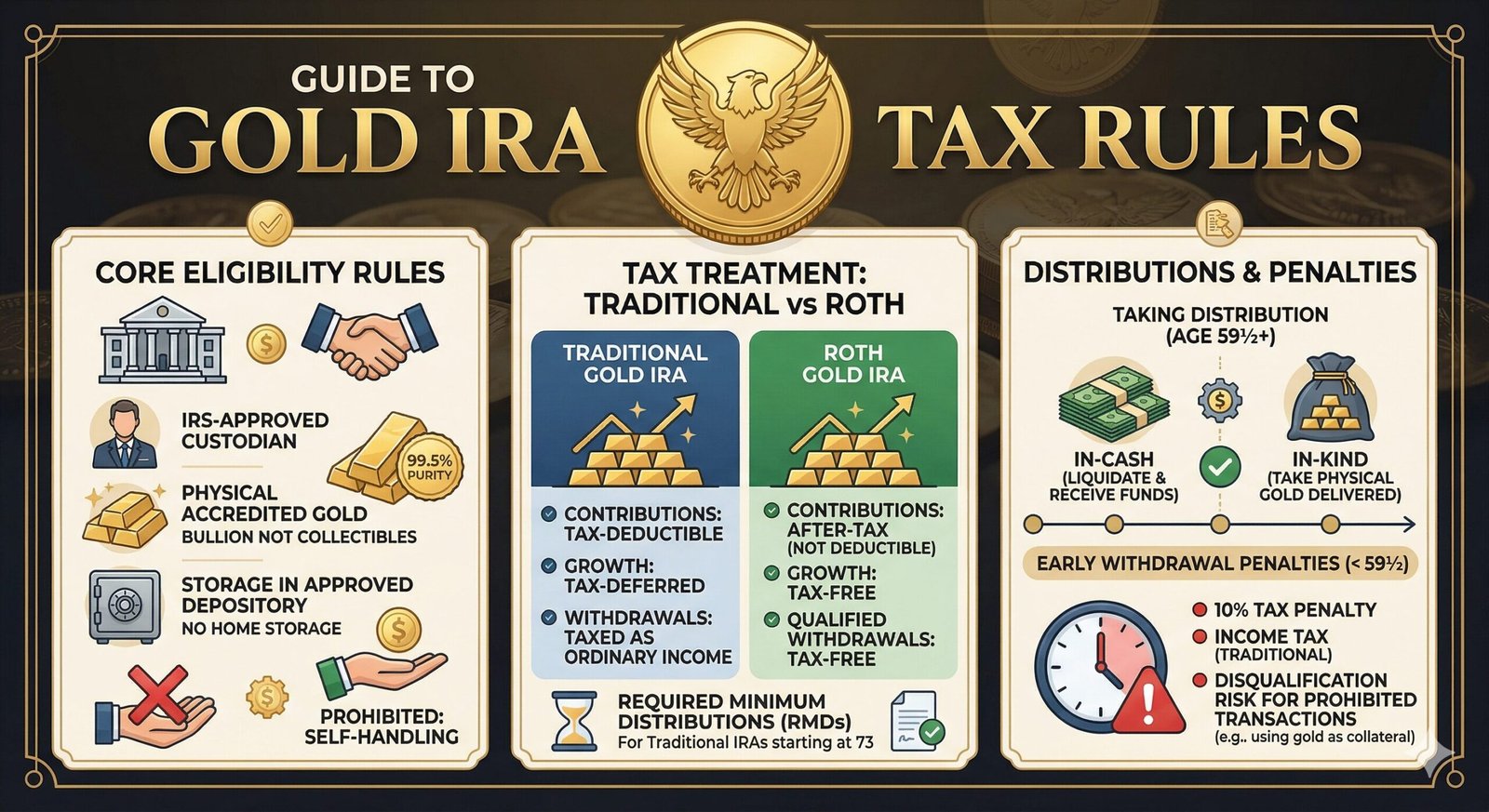
A Gold IRA is a self-directed individual retirement account that holds physical precious metals — typically gold, but also silver, platinum, or palladium — rather than conventional assets like stocks or mutual funds. Like a standard IRA, it comes with IRS-governed tax treatment: contributions may be tax-deductible (for traditional Gold IRAs) or made with after-tax dollars (for Roth Gold IRAs), and assets grow tax-deferred or tax-free depending on which structure you choose.
The critical distinction from a regular IRA is the “self-directed” element. A self-directed IRA gives you the authority to choose non-traditional assets — precious metals in this case — but it also places greater responsibility on you as the account holder to understand the rules. FINRA’s guidance on self-directed IRAs is worth reading before you proceed, as it outlines some of the complexities and risks unique to these account types.
For a thorough breakdown of how these accounts are structured, Gold IRAs Explained in Detail covers the mechanics step by step.
How Tennessee Law Interacts With Gold IRA Rules
Here is the straightforward answer: Gold IRAs are governed by federal law, not state law. The Internal Revenue Code — specifically sections dealing with IRAs — applies uniformly across all 50 states, including Tennessee. Whether you live in Nashville or a small town in the Cumberland Plateau, the same IRS rules apply to your account.
That said, Tennessee does have a few characteristics worth noting for retirement investors.
Tennessee’s Tax Environment
Tennessee has no state income tax on wages or salaries, and while the state previously taxed investment income under the Hall Income Tax, that tax was fully repealed in 2021. As a result, Tennessee residents currently face no state-level income tax on IRA distributions either. This is a meaningful consideration for the overall cost of retirement income planning — though you should always consult a qualified tax professional about your specific situation, as individual circumstances vary and tax laws can change.
From a federal standpoint, IRA distributions (including those from a Gold IRA) are subject to ordinary income tax in a traditional account structure, and the IRS’s rules on this are detailed in IRS Publication 590-A.
No State-Specific Gold IRA Licensing Requirements
Tennessee does not impose any special licensing requirements on Gold IRA custodians operating within the state. Custodians must be IRS-approved, and the metals must be stored in an IRS-approved depository — but neither of these facilities needs to be located in Tennessee. In practice, most Gold IRA depositories are located in states like Delaware, Texas, and Utah.
The Core Federal Rules Every Tennessee Investor Must Know
Because Gold IRAs are creatures of federal law, the rules are the same for you as they are for investors in any other state. Understanding these rules clearly before opening an account will save you from costly mistakes.
Contribution Limits
For 2025, the IRS allows annual IRA contributions of up to $7,000 if you are under age 50, and $8,000 if you are 50 or older (the additional $1,000 is the “catch-up” contribution). These limits apply across all your IRAs combined — so if you also hold a traditional IRA, your combined annual contributions cannot exceed the limit. The IRS maintains current figures on its IRS contribution limits page.
IRS Metal Purity Standards
Not just any gold coin or bar qualifies for a Gold IRA. The IRS requires that gold meet a minimum fineness of 99.5% purity (0.995). Certain government-minted coins, including the American Gold Eagle, are exceptions to the purity standard and are explicitly permitted. For a full list of what qualifies, see our guide to IRA-eligible gold coins.
The Custodian Requirement
You cannot hold the physical gold yourself. IRS rules require that a qualified custodian — an IRS-approved financial institution or trust company — administer your account. The metals must then be stored in an IRS-approved third-party depository. Attempting to take personal possession of the metals while they are still designated as IRA assets is treated by the IRS as a distribution, which triggers taxes and potentially penalties.
Required Minimum Distributions (RMDs)
If you hold a traditional Gold IRA, you must begin taking required minimum distributions (RMDs) once you reach age 73. Because your assets are physical gold rather than cash, you have two options: take the distribution as cash (the custodian liquidates the required amount) or take an in-kind distribution of actual metal. Either way, the IRS expects you to comply with RMD deadlines. The IRS RMD FAQ explains the mechanics in detail.
Rolling Over an Existing Retirement Account Into a Gold IRA
One of the most common ways Tennessee investors fund a Gold IRA is through a rollover from an existing 401(k), 403(b), or traditional IRA. This is a straightforward process when done correctly, but there are rules to follow carefully.
Direct vs. Indirect Rollovers
A direct rollover (also called a trustee-to-trustee transfer) moves funds directly from your old account to your new Gold IRA custodian. This is the cleanest approach: no taxes are withheld, and there is no 60-day deadline to worry about.
An indirect rollover means the funds are paid to you first, and you have 60 days to deposit them into your new account. If you miss the 60-day window, the IRS treats the amount as a taxable distribution. Your old plan administrator is also required to withhold 20% for federal taxes on an indirect rollover from a 401(k), which means you’d need to make up that amount from other funds to roll over the full balance.
For a complete walkthrough of the rollover process, our 401(k) to Gold IRA rollover guide and Gold IRA rollover rules page cover each step in detail.
Fees: What to Expect With a Gold IRA in Tennessee
Gold IRAs carry costs that standard IRAs do not. Tennessee residents should account for these when evaluating whether this type of account fits their retirement approach. Our full Gold IRA fees guide breaks down every category in detail, but here is a summary of typical cost structures:
These fees compound over time, so it is worth comparing custodians carefully before committing. The SEC’s investor resources include useful general guidance on evaluating retirement account costs.
Choosing a Custodian: What Tennessee Investors Should Look For
Your choice of custodian matters enormously. Because Gold IRAs operate as self-directed accounts, the burden falls on you to vet the companies you work with. Here is what to look for:
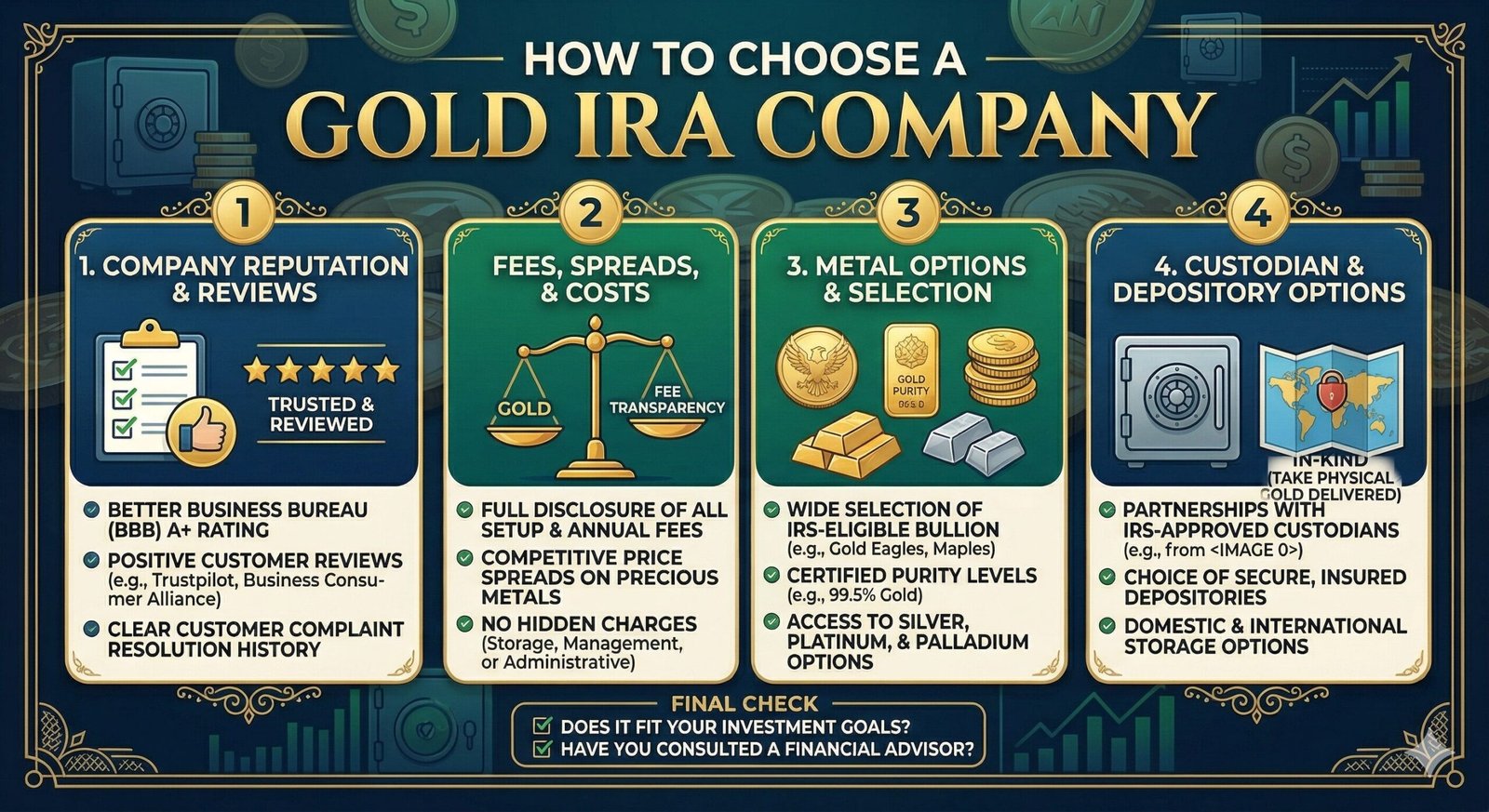
Regulatory standing. Custodians must be approved by the IRS and are typically chartered as trust companies. Check whether the company is in good standing with the IRS IRA investment FAQ requirements and verify their track record with the Better Business Bureau at bbb.org. For broker-dealers involved in the transaction, use FINRA BrokerCheck to check registration and complaint history.
Transparency on fees. Reputable custodians disclose all fees upfront in writing. Be cautious of any company that is vague about its fee structure or pressures you to act quickly.
Storage options. Confirm whether segregated storage is available, and ask which depositories the custodian works with. You should be able to request a statement of your specific holdings at any time.
Customer service and education. A custodian that invests in educating its clients is generally a better long-term partner. For guidance on red flags and how to spot misleading practices, our Gold IRA scams guide is essential reading before you open any account.
For Tennessee investors evaluating their options, you may also find it useful to compare account structures: our Gold IRA vs Traditional IRA article explores how these accounts differ in practical terms.
Is a Gold IRA Right for Tennessee Investors?
Tennessee’s favorable tax environment means residents may retain more of their IRA distributions than investors in states with income taxes — a meaningful factor when thinking about total retirement income. But the more fundamental question is whether a Gold IRA fits your individual financial situation.
The answer requires honest self-assessment. Gold IRAs involve real costs, specific rules, limited liquidity compared to stock-based accounts, and the inherent uncertainty of any asset whose value can rise or fall. Past performance of gold as an asset class is not a guarantee of future results, and no one can tell you what gold will be worth when you need it most.
For a thoughtful and balanced exploration of this question, read our article on is a Gold IRA a good idea before making any decisions. And if you’re weighing a Gold IRA against leaving funds in an employer plan, our Gold IRA vs 401(k) comparison may help you think through the trade-offs — without telling you which way to go.
Frequently Asked Questions
Q: Do Tennessee residents pay state income tax on Gold IRA distributions?
A: As of 2025, Tennessee does not impose a state income tax on wages, salaries, or retirement distributions. The Hall Income Tax was fully repealed in 2021. However, federal income tax still applies to traditional Gold IRA distributions. You should consult a qualified tax professional for advice specific to your situation.
Q: Can I store my Gold IRA metals at home in Tennessee?
A: No. IRS rules require that Gold IRA metals be held by an IRS-approved custodian and stored in an approved third-party depository. Taking personal possession of the metals while they remain in the IRA is treated as a taxable distribution and may also incur penalties.
Q: Is there a minimum amount required to open a Gold IRA?
A: The IRS does not set a minimum investment amount for IRAs, but most Gold IRA custodians impose their own minimums — often ranging from $5,000 to $25,000. Our Gold IRA minimum investment guide explains what to expect across different providers.
Q: Can I roll over my Tennessee-based 401(k) into a Gold IRA?
A: Yes, in most cases. If you have left your employer or your plan allows in-service rollovers, you can transfer funds from a 401(k) into a self-directed Gold IRA. The process works the same for Tennessee residents as anywhere else in the country. A direct rollover is generally the most straightforward approach.
Q: How do I know if a Gold IRA custodian is legitimate?
A: Start by checking the company’s rating and complaint history on the Better Business Bureau at bbb.org. For any broker-dealers involved, use FINRA BrokerCheck to verify registration. Look for full fee disclosure, no high-pressure sales tactics, and clear information about storage arrangements. Our Gold IRA scams guide outlines additional warning signs.
Ready to Learn More?
If you are a Tennessee investor taking your first serious look at Gold IRAs, the most important next step is comparing the companies that provide these accounts. Custodians vary significantly in fees, customer service quality, storage options, and educational resources. To help you evaluate your options, visit our independently researched guide to the Best Gold IRA Companies of 2026.
This article is for informational purposes only and does not constitute financial or tax advice. Investing in precious metals involves risk including possible loss of principal.
Related guides
- Gold IRA Consumer Affairs Reviews: What to Look For
- Gold IRA Trustpilot Reviews: What Real Customers Say
- Gold IRA BBB Complaints: What Consumer Reports Reveal
- Is a Gold IRA Worth the Fees? A Cost-Benefit Analysis
- Are Gold IRA Fees Too High? Breaking Down the Real Costs
- Gold IRA Mistakes to Avoid: 10 Common Errors Investors Make