
Gold IRA With $100K: What to Know Before You Commit
If you have $100,000 earmarked for a Gold IRA, you’re in a position that most providers actively welcome — and that means you’ll have real choices. But having more capital doesn’t simplify the decision. If anything, it raises the stakes. The fees matter more, the custodian choice matters more, and understanding the IRS rules governing your account becomes especially important when a six-figure sum is involved.
This guide walks through what you can realistically expect when opening or funding a Gold IRA with $100,000: what the setup process looks like, what the ongoing costs are, what IRS rules apply, and what questions to ask before you sign anything.
What a Gold IRA Actually Is (and Isn’t)
Before getting into the specifics of a $100,000 commitment, it helps to be clear on the fundamentals. A Gold IRA is a self-directed Individual Retirement Account that holds physical precious metals — gold, silver, platinum, or palladium — rather than stocks, mutual funds, or bonds. The IRS permits this structure, but with strict conditions around which metals qualify, how they must be stored, and who can hold them on your behalf.
If you want a thorough grounding in the mechanics, our Gold IRA hub covers the full landscape. For a deeper technical breakdown, Gold IRAs Explained in Detail is worth reading before you make any commitments.
One important clarification: a Gold IRA is not a brokerage account where you can buy gold ETFs or mining stocks. It holds physical, IRS-approved metal in an approved depository — not in your home, not in a safe deposit box. The IRS is explicit on this point, and FINRA’s guidance on self-directed IRAs reinforces it: self-directed accounts come with greater investor responsibility precisely because the assets are non-traditional.
Why $100K Is a Meaningful Threshold
Most Gold IRA companies publish minimum investment requirements, and $100,000 sits comfortably above most of them. Some providers set their floor as low as $5,000; others require $25,000 or $50,000. A handful — particularly those focused on higher-net-worth retirement investors — set their minimums at $50,000 to $100,000 specifically. If you want to understand where different providers set their bars, our Gold IRA minimum investment page has a useful breakdown.
At $100,000, you’re likely to receive:
- Access to dedicated account representatives rather than general support lines
- Potential fee waivers or reductions during the first year (always confirm this in writing)
- A broader selection of IRA-eligible metals from your provider’s inventory
- More flexible storage arrangement options at certain depositories
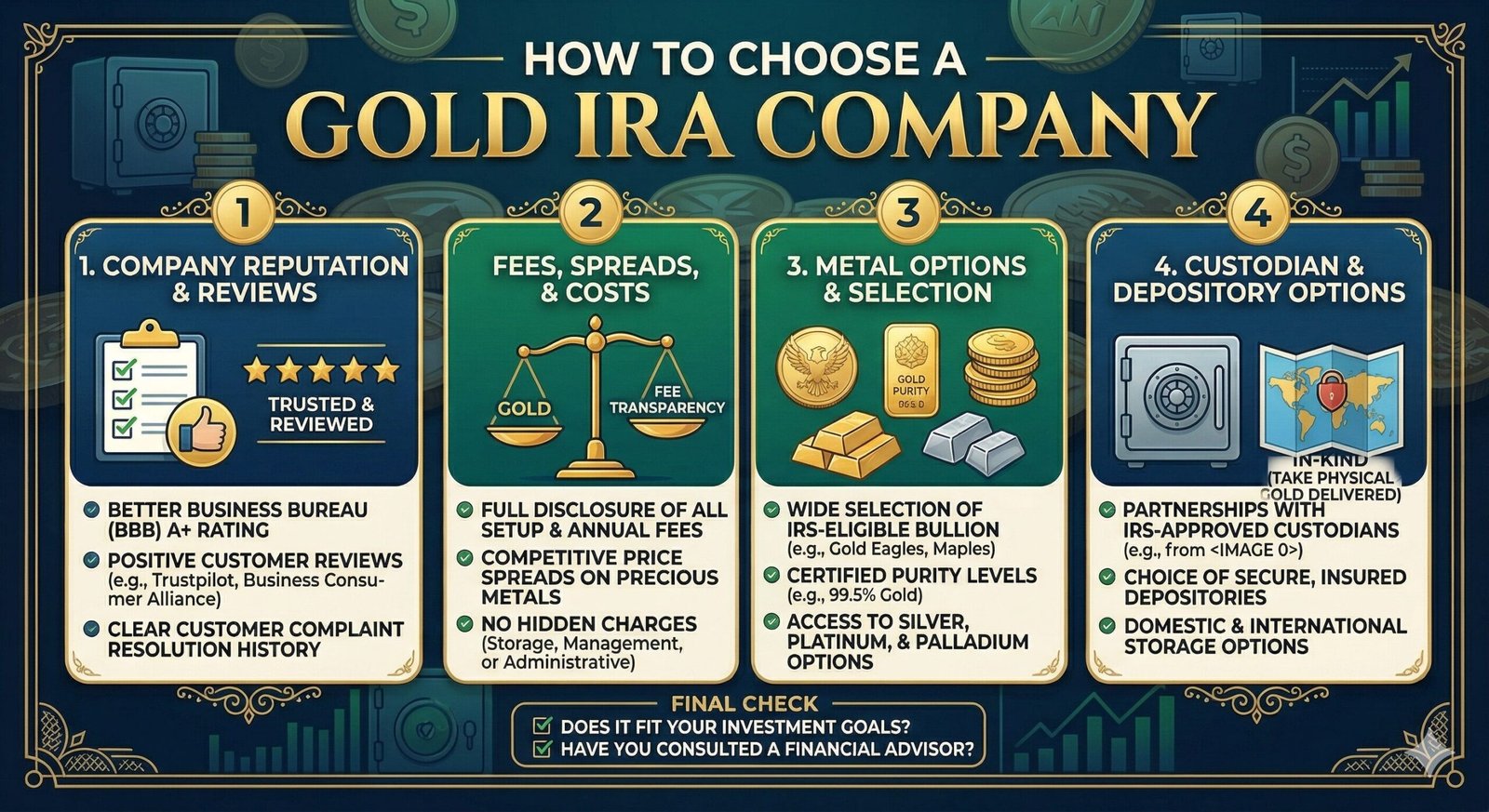
None of these extras are universal, and they should never be the deciding factor. What matters most is the provider’s track record, fee transparency, custodian relationships, and IRS compliance. That brings us to the numbers.
Understanding the Fee Structure at This Investment Level
Gold IRA fees are not standardised across the industry, and at $100,000, understanding the full cost picture is essential. Fees typically fall into several categories.
Setup fees are one-time charges for opening the account. These generally range from $50 to $300, though some companies waive them for accounts above certain thresholds.
Annual custodian fees cover the administrative cost of maintaining your IRA with an IRS-approved custodian. These are often flat fees — typically $75 to $300 per year — rather than percentage-based, which works in your favour at higher investment levels.
Storage fees are charged by the depository where your metals are held. These can be flat annual fees or a small percentage of the total value held, often in the range of 0.1% to 0.5% per year. At $100,000, the difference between flat and percentage-based storage fees becomes financially significant over time.
Seller spreads — the markup between the spot price of gold and what you actually pay — are not always labeled as fees but function as one. These vary by provider and by the specific coins or bars you purchase.
For a comprehensive breakdown of what to watch for, our Gold IRA fees guide covers each category in detail. It’s worth reading in full before comparing providers.
Fee Comparison: Flat vs. Percentage-Based Storage at $100,000
The takeaway: flat fees benefit investors with larger balances. If your account grows over time, a percentage-based structure will cost you progressively more. Always ask providers to confirm whether their storage and custodian fees are flat or asset-based.
How to Fund a Gold IRA With $100,000
There are several paths to funding an account at this level, each with different IRS treatment.
Direct Contributions
For 2025, the IRS annual contribution limit for IRAs is $7,000 per person, or $8,000 if you’re 50 or older (the catch-up contribution). These limits apply across all your IRAs combined. If you want to contribute $100,000 through new money, you would need to spread those contributions across many years. You can review the current figures at the IRS contribution limits page.
This means most people funding a Gold IRA with $100,000 are doing so through a rollover or transfer — not fresh contributions.
IRA-to-IRA Transfers
A direct transfer moves funds from an existing IRA — traditional, Roth, SEP, or SIMPLE — directly to your new Gold IRA custodian. Because the funds never pass through your hands, there are no tax withholding requirements and no 60-day deadline to meet. This is typically the simplest and most administratively clean approach for large sums.
401(k) Rollovers
If your $100,000 is sitting in a former employer’s 401(k), a rollover is the standard route. Our 401(k) to Gold IRA rollover guide walks through the process step by step, including how to avoid the 20% mandatory withholding that applies to indirect rollovers. You’ll also want to review the Gold IRA rollover rules to understand the IRS timing requirements and rollover frequency limitations. For context on how these two account types compare structurally, the Gold IRA vs 401(k) page is a useful reference.
IRS Rules That Specifically Affect Larger Accounts
The IRS doesn’t apply different rules to larger Gold IRA balances per se, but several rules become more practically significant when more money is involved.
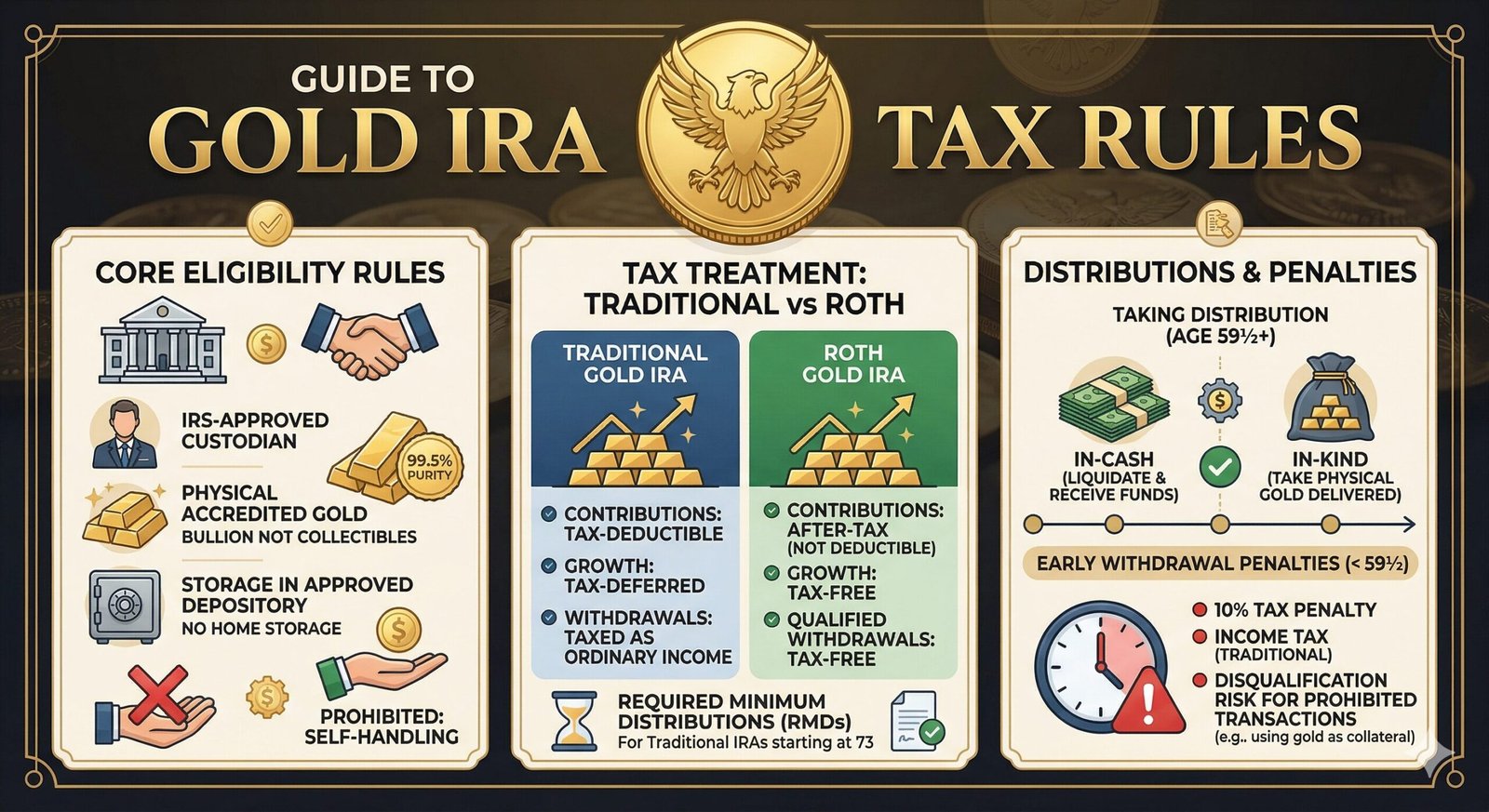
Required Minimum Distributions (RMDs): Once you reach age 73, you’re required to take minimum distributions from traditional IRAs each year. If your Gold IRA holds only physical metal, satisfying an RMD requires either selling some of your metal or taking an in-kind distribution. At $100,000 or more, the annual RMD amount will be meaningful, and your custodian needs a clear process for handling it. The IRS RMD FAQ has the technical detail.
Purity and eligibility standards: The IRS requires that gold held in an IRA meet a minimum fineness of 99.5%. Not all gold coins or bars qualify. Our page on IRA-eligible gold coins lists the products that meet IRS standards. At $100,000, you’ll have enough capital to hold a range of approved products, so it’s worth understanding the landscape before you commit to a single product type.
Prohibited transactions: Self-directed IRAs come with strict rules about what you can and can’t do with the account. The IRS IRA investment FAQ covers prohibited transactions in detail. Violations can result in the entire account being treated as a distribution — a significant tax event at any balance level, but especially at $100,000.
Choosing a Provider at This Investment Level
With $100,000 at stake, provider selection deserves careful attention. A few principles worth applying:
Custodian independence matters. The Gold IRA company you work with for purchasing metals should be separate from your IRA custodian — the company that holds your account for IRS purposes. Some providers in the industry blur this line or steer clients toward preferred custodians in ways that aren’t always in the client’s best interest. Understand who your custodian is and confirm they are IRS-approved.
Verify independently. Check any provider you’re considering through bbb.org and FINRA BrokerCheck. Look at complaint history, not just ratings. For more on evaluating providers critically, our Gold IRA scams guide covers the warning signs that are worth knowing.
Compare account structures. Depending on your existing retirement accounts, it may be useful to understand how a Gold IRA sits alongside other options. Our Gold IRA vs Traditional IRA comparison addresses some of the structural differences, and is a Gold IRA a good idea raises useful questions to consider as part of your research. Additional detail on IRA rules can be found in IRS Publication 590-A.
Frequently Asked Questions
Is $100,000 enough to open a Gold IRA with most providers?
Yes. Most established Gold IRA companies accept accounts starting at $5,000 to $50,000. At $100,000, you meet or exceed the minimum of virtually every major provider in the market. Some companies specifically target investors at this level and above, offering dedicated service teams and additional account support.
Can I move my entire $100,000 into a Gold IRA at once?
If the funds are coming from an existing IRA or eligible 401(k) via a direct rollover or transfer, yes — you can move the full amount in a single transaction without triggering contribution limits. Annual contribution limits only apply to new money being added to an IRA from outside the retirement system.
What happens to my Gold IRA when I need to take Required Minimum Distributions?
Your custodian can handle RMDs either by liquidating a portion of your metals and distributing the cash, or in some cases by transferring metal directly to you. It’s worth asking your custodian how they handle RMDs before you open the account, particularly if you’re approaching age 73.
Are there any tax advantages specific to investing at the $100,000 level?
The tax structure of a Gold IRA — traditional (pre-tax contributions, taxed on withdrawal) or Roth (after-tax contributions, qualified withdrawals tax-free) — is the same regardless of the account balance. The balance itself doesn’t create additional tax benefits or liabilities beyond those that apply to any IRA. If you have specific questions about your tax situation, consult a qualified tax professional.
How do I know if a Gold IRA company is legitimate?
Check their BBB profile, look at consumer reviews across multiple platforms, verify their custodian relationships, and confirm that the custodian is an IRS-approved non-bank trustee or bank. Be cautious of companies that pressure you toward rapid decisions or make specific performance promises. Our Gold IRA scams guide outlines the most common red flags.
If you’re ready to compare providers that accept $100,000 accounts and meet the standards outlined in this guide, the Best Gold IRA Companies of 2026 is the natural next step — it covers fees, minimums, custodian relationships, and company track records in one place.
This article is for informational purposes only and does not constitute financial or tax advice. Investing in precious metals involves risk including possible loss of principal.
Related guides
- Gold IRA With $500,000: What Higher-Balance Investors Should Know
- Gold IRA With $200,000: What to Expect When You're Starting With a Larger Balance
- How to Invest $100,000 in Gold: Complete Strategy Guide
- How to Invest $50,000 in Gold: Strategy for Larger Positions
- How to Invest $10,000 in Gold: Best Options for 2026
- How to Buy Gold With Your IRA: Step-by-Step Guide