
Gold IRA With $500,000: What Higher-Balance Investors Should Know
When you’ve spent decades building a retirement nest egg, the decisions you make about where and how to hold those assets carry real weight. For investors approaching or already carrying a $500,000 balance, a Gold IRA presents a distinct set of considerations — particularly around fee structures, custodian selection, and the mechanics of getting large sums of money properly set up under IRS rules.
This article isn’t about telling you what to do with your money. It’s about making sure that if you’re exploring a Gold IRA at the $500,000 level, you have a clear, accurate picture of how the accounts work, what costs look like at scale, and what questions are worth asking before you commit to anything.
For a broader introduction to how these accounts work, start with our Gold IRA guide before continuing here.
Why the $500,000 Level Is a Different Conversation
At smaller balances, the main Gold IRA questions tend to revolve around minimums and eligibility. At $500,000, the conversation shifts. You’re no longer asking “Can I open one of these accounts?” — you’re asking “Which structure makes the most financial sense at this scale?”
That difference matters because Gold IRA fees are frequently structured as flat annual amounts rather than percentages of your balance. When you understand what that means in practice, you can make a far more informed comparison between providers.
Understanding Gold IRA Fee Structures at Scale
Gold IRA accounts typically carry three main categories of fees: a setup fee charged once when you open the account, an annual administration or custodian fee, and an annual storage fee for the physical precious metals held in an IRS-approved depository.
For many custodians, these fees are flat — meaning they don’t increase as your balance grows. A custodian charging $180 per year in administration fees and $150 per year in storage fees collects that same $330 annually whether your account holds $50,000 or $500,000.
This flat-fee model is what makes the $500,000 level genuinely interesting from a cost-structure perspective. As a percentage of assets under management, fees shrink dramatically as balances grow. It’s worth reading our Gold IRA fees guide to understand what a typical fee schedule looks like and how to compare providers fairly.
Percentage-Based vs. Flat-Fee Custodians
Not every custodian uses flat fees. Some structure their pricing as a percentage of your total account balance. At smaller balances, the dollar difference between the two models may be modest. At $500,000, the gap can become substantial.
Here’s an illustration of how those models compare at scale:
Note: Figures above are illustrative examples only. Actual fees vary by custodian and may change. Always verify current pricing directly with any provider you’re evaluating.
The takeaway here isn’t that percentage-based custodians are bad — it’s that at $500,000, the fee model matters more than it does at $25,000. Doing the arithmetic before choosing a custodian is a reasonable step.
IRS Rules That Apply Regardless of Balance Size
One of the most important things to understand about Gold IRAs is that the IRS rules governing them don’t bend for larger balances. Whether you’re funding an account with $50,000 or $500,000, the same regulations apply.
If you’re new to the structure, our Gold IRAs Explained in Detail resource walks through the full regulatory framework. Here are the most relevant rules for higher-balance investors:
Annual Contribution Limits
Gold IRAs are subject to the same annual contribution limits as traditional or Roth IRAs. For 2024, that limit is $7,000 per year for those under 50 and $8,000 for those 50 and older, as outlined by the IRS contribution limits page.
This means you can’t simply write a $500,000 check and deposit it into a newly opened Gold IRA through annual contributions alone. The more practical route for investors moving large sums is a rollover or transfer — typically from a 401(k), traditional IRA, or other qualified retirement account.
Rollovers and Transfers
A direct rollover from a 401(k) or a trustee-to-trustee transfer from an existing IRA is the standard mechanism for funding a Gold IRA with a large balance. These transactions aren’t subject to the annual contribution limits and are governed by their own set of IRS rules. If this is your situation, our 401(k) to Gold IRA rollover guide covers the process step by step.
It’s also worth reviewing the Gold IRA rollover rules separately, since certain details — particularly around the 60-day rollover window and the one-rollover-per-year limit — can catch investors off guard if they’re not familiar with how the IRS treats these transactions.
The IRS Publication 590-A is the authoritative source on IRA contribution and rollover rules and is worth reading or bookmarking if you’re planning a significant transfer.
Eligible Metals and Purity Standards
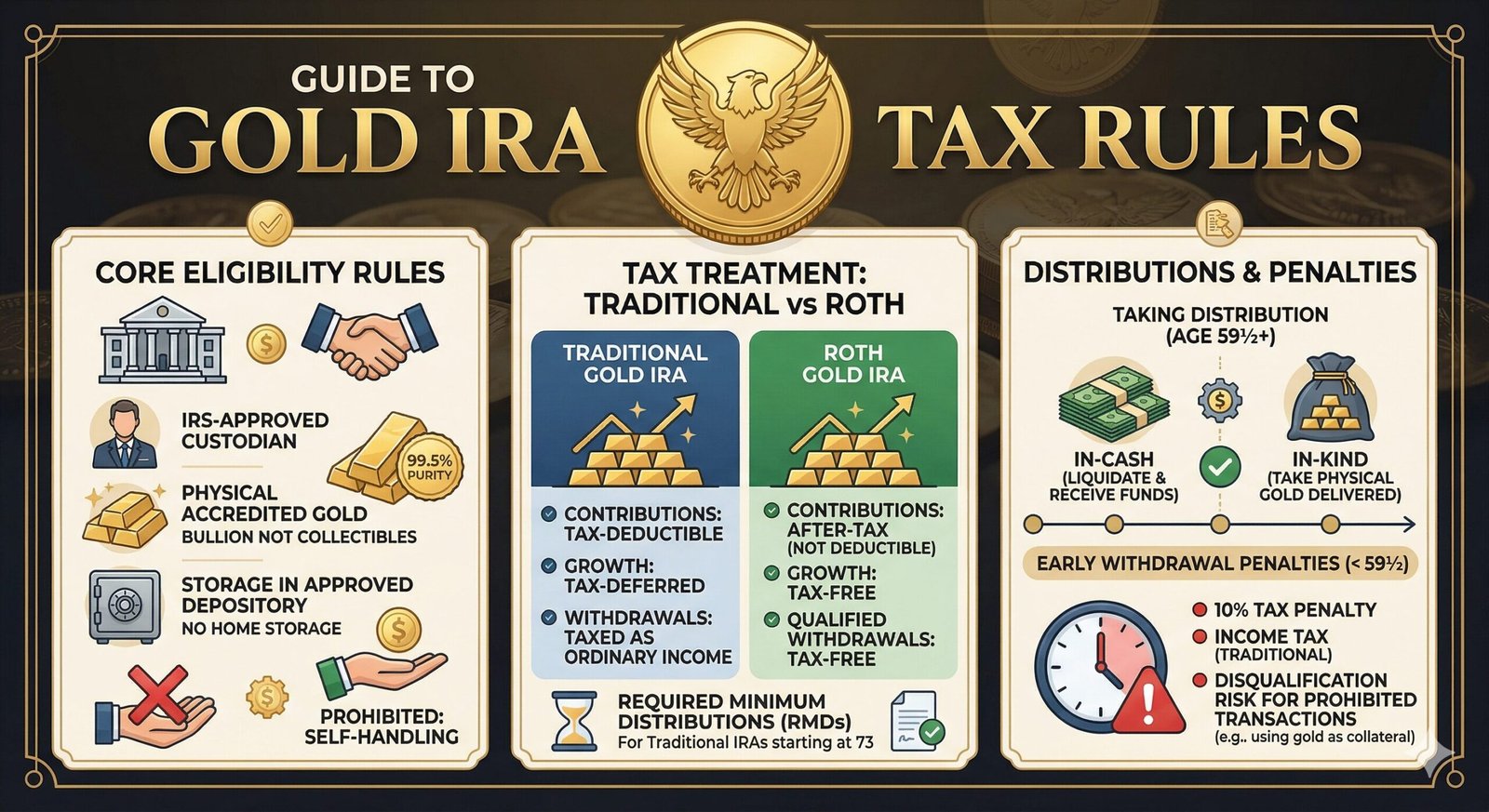
The IRS mandates that only specific coins and bullion meeting minimum purity thresholds can be held inside a Gold IRA. For gold, the standard is .995 fine or better for most bullion bars, with certain government-minted coins — such as the American Gold Eagle — qualifying even at slightly lower fineness. Our guide to IRA-eligible gold coins explains exactly which products meet these standards.
Collectibles, numismatic coins, and many popular retail gold products do not qualify. At a $500,000 balance, ensuring that every purchase is IRS-compliant from the outset matters considerably — both for your account’s tax-advantaged status and to avoid complications at distribution time.
Custody and Storage at the $500,000 Level
All Gold IRA assets must be held by an IRS-approved custodian and stored at an approved depository. You cannot take possession of the physical metal while it remains inside the IRA — doing so is treated as a distribution and may trigger taxes and penalties. FINRA’s guidance on self-directed IRAs addresses this clearly, and it’s a point worth understanding before making any decisions.
For large balances, the depository question is worth asking in detail. Reputable depositories typically offer two forms of storage: segregated storage, where your metals are stored separately from other clients’ assets and inventoried to your account specifically, and commingled storage, where your metals are held alongside others of the same type and quantity.
Segregated storage typically carries a higher fee but provides a more direct claim on the specific bars or coins allocated to your account. For a $500,000 holding, many investors find it worth asking about segregated options.
Vetting Custodians at This Balance Level
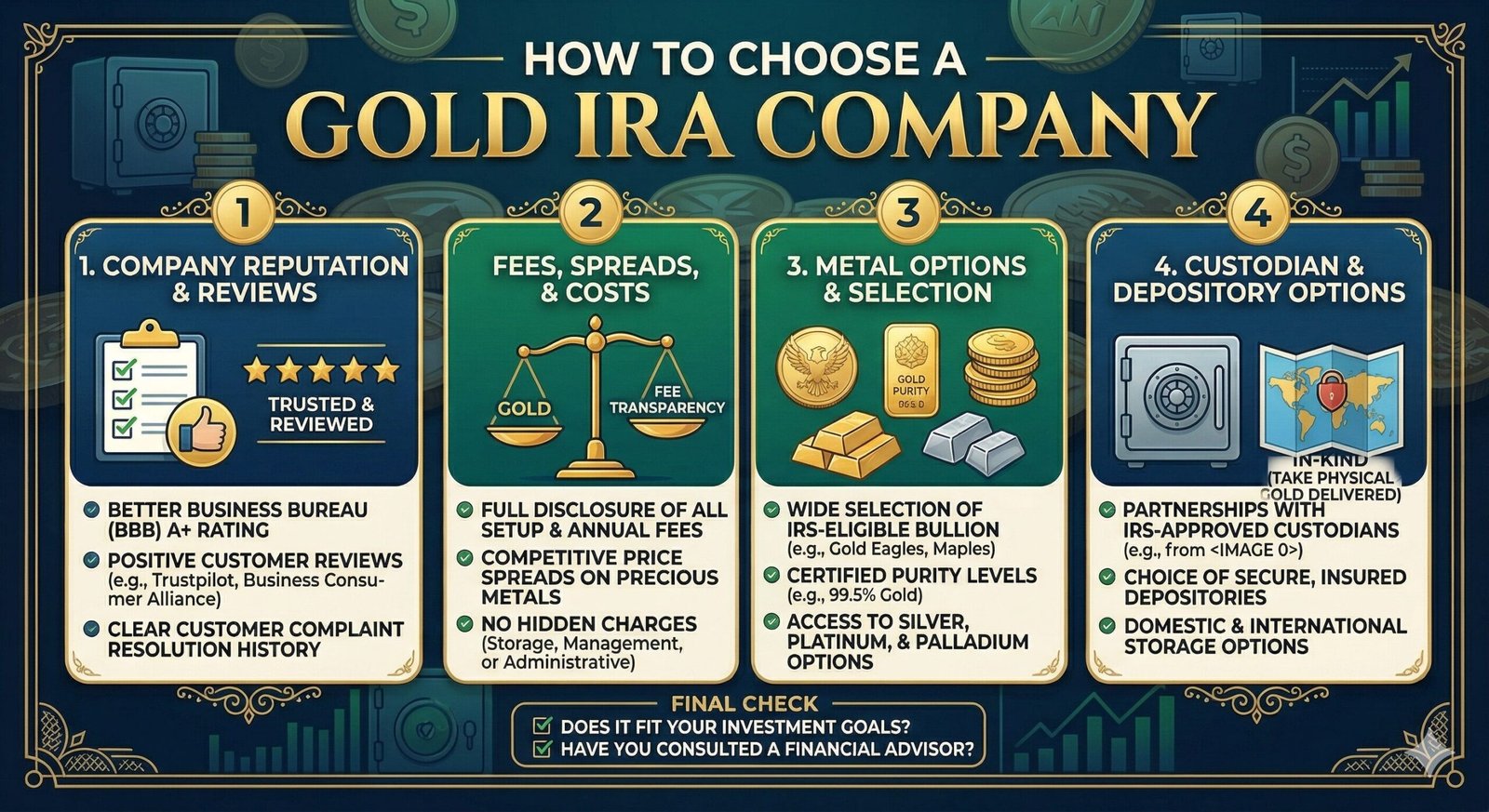
Choosing the right custodian is arguably the most consequential decision in setting up a Gold IRA at any balance. At $500,000, the stakes are simply higher, and the value of doing thorough due diligence increases accordingly.
A few practical starting points:
Check independent ratings. The Better Business Bureau (bbb.org) maintains complaint histories and accreditation records that can flag patterns worth knowing about. Cross-referencing with FINRA BrokerCheck and reading through complaint histories can surface issues that marketing materials won’t reveal.
Ask directly about fee structures. Request a written, itemized fee schedule before opening an account. At $500,000, even a small annual cost difference compounds meaningfully over time.
Understand their rollover process. If you’re transferring a large sum from an existing retirement account, a reputable custodian will walk you through the mechanics clearly and help ensure the transaction is completed correctly. Vague or rushed answers to rollover process questions are worth noting.
For anyone approaching this process for the first time, our Gold IRA scams guide is worth reading before you engage with any provider. The SEC investor resources page also provides useful background on investor protections and self-directed account risks.
Required Minimum Distributions at Higher Balances
If you’re 73 or older, the IRS requires you to take Required Minimum Distributions from your traditional Gold IRA each year. Because your assets are held in physical metal rather than cash, satisfying an RMD from a Gold IRA requires either liquidating a portion of your holdings or taking an in-kind distribution of physical metal — both of which carry administrative and tax implications worth planning for well in advance.
The IRS RMD FAQ explains the rules in detail. At a $500,000 balance, the annual RMD amount will be meaningfully larger than at smaller balances, so this is a planning consideration that deserves attention early.
Comparing Your Options Before Deciding
If you’re weighing a Gold IRA against other retirement account structures, our Gold IRA vs Traditional IRA comparison and our Gold IRA vs 401(k) article both lay out the structural differences in plain terms. These comparisons focus on how the accounts work rather than trying to steer you toward any particular conclusion — the right structure for your situation depends on factors specific to you.
You may also find it useful to read our broader discussion of is a Gold IRA a good idea, which covers the genuine trade-offs involved without the sales framing that often surrounds this topic.
Frequently Asked Questions
Q: Can I fund a Gold IRA with $500,000 all at once?
A: Not through direct annual contributions, which are capped by the IRS at $7,000–$8,000 per year. However, rollovers and trustee-to-trustee transfers from qualifying retirement accounts — such as a 401(k) or existing IRA — are not subject to annual contribution limits and are the standard mechanism for moving large sums into a Gold IRA.
Q: Do Gold IRA fees increase as my balance grows?
A: It depends on the custodian. Many Gold IRA custodians charge flat annual fees for administration and storage, which means the percentage cost decreases as your balance grows. Some custodians use percentage-based pricing, which scales with your balance. At $500,000, this distinction has a material impact on your annual costs, so it’s worth comparing fee structures carefully.
Q: Is my physical gold insured inside a Gold IRA depository?
A: Most IRS-approved depositories carry insurance coverage on the assets they store. The specifics — including coverage limits and what events are covered — vary by depository. This is a reasonable question to ask in writing before selecting a custodian.
Q: What happens to my Gold IRA when I need to take Required Minimum Distributions?
A: If your account is a traditional Gold IRA and you’re 73 or older, the IRS requires annual RMDs. Because your assets are in physical metal, this typically means either selling a portion of your holdings for cash distribution or taking an in-kind distribution of metal. Both options have tax implications and require coordination with your custodian. Planning for this well before you reach RMD age is advisable.
Q: How do I find a reputable Gold IRA custodian for a large account?
A: Checking BBB ratings and complaint histories, verifying registration and background through FINRA BrokerCheck, requesting written fee schedules, and asking detailed questions about their rollover and storage processes are all reasonable starting points. At $500,000, taking the time to compare several providers before committing is well worth the effort.
Ready to Compare Your Options?
If you’re at the research stage and want to see how leading Gold IRA providers stack up on fees, minimum balances, storage options, and customer service, our independent review of the Best Gold IRA Companies of 2026 is a useful next step. It covers the providers we consider worth evaluating, with enough detail to help you ask the right questions before making any decisions.
This article is for informational purposes only and does not constitute financial or tax advice. Investing in precious metals involves risk including possible loss of principal.
Related guides
- Gold IRA With $200,000: What to Expect When You're Starting With a Larger Balance
- Gold IRA With $100K: What to Know Before You Commit
- How to Invest $100,000 in Gold: Complete Strategy Guide
- How to Invest $50,000 in Gold: Strategy for Larger Positions
- How to Invest $10,000 in Gold: Best Options for 2026
- How to Buy Gold With Your IRA: Step-by-Step Guide