
How to Invest $100,000 in Gold: Complete Strategy Guide
Investing a significant sum like $100,000 is never a decision to take lightly — and when gold is involved, the number of options, structures, and considerations can feel genuinely overwhelming. Physical coins or bars? A Gold IRA? ETFs? Storage at home or with a custodian? Each path comes with its own set of rules, costs, and trade-offs.
This guide is designed to walk you through the main ways U.S. investors — particularly those approaching or in retirement — approach a $100,000 gold investment. It won’t tell you what to do. That’s a conversation for a qualified financial advisor who knows your full picture. What it will do is give you a clear, honest framework so you walk into that conversation well-informed.
Why $100,000 Changes the Conversation
At smaller investment amounts, the choice between gold options is relatively simple. But at $100,000, you’re at a scale where fees become materially significant, storage logistics genuinely matter, insurance becomes non-negotiable, and tax structure starts to have real long-term consequences.
It’s also a threshold where most reputable Gold IRA companies will work with you directly and assign dedicated account representatives — which can meaningfully improve the quality of guidance you receive during the setup process.
For more background on the fundamentals before diving into options, our Gold IRA hub is a solid starting point.
Understanding Your Main Options
When you’re looking at how to invest $100,000 in gold, there are four primary vehicles most U.S. investors consider: a Gold IRA, physical bullion held outside a retirement account, gold ETFs or mining stocks, and gold futures or derivatives. This guide focuses primarily on the first two, as they’re the most relevant for retirement-oriented investors.
Gold IRAs: The Tax-Advantaged Route
A Gold IRA is a self-directed Individual Retirement Account that holds physical precious metals — typically gold bullion coins or bars — instead of, or in addition to, conventional paper assets. As with a traditional or Roth IRA, contributions and withdrawals are governed by IRS rules, and the account must be administered by an approved custodian.
At the $100,000 level, a Gold IRA can be funded in one of two main ways: through annual contributions (which are subject to IRS limits) or through a rollover from an existing retirement account such as a 401(k), 403(b), or traditional IRA. For most investors writing a check of this size, the rollover path is the more practical route.
You can read more about the rollover process in our 401(k) to Gold IRA rollover guide, and the rules that govern it are covered thoroughly in our Gold IRA rollover rules article.
According to IRS Publication 590-A, annual IRA contribution limits for 2024 are $7,000 for individuals under 50, and $8,000 for those 50 and older — meaning a $100,000 direct contribution in a single year is not possible through fresh contributions alone. This makes rollovers the realistic funding mechanism for most investors at this level.
Physical Bullion Outside an IRA
The second major option is purchasing physical gold directly — coins or bars — and holding it outside of any retirement account structure. This approach gives you immediate, tangible ownership with no custodial intermediary, but it also comes with meaningful responsibilities around storage, insurance, and eventual capital gains reporting.
At $100,000, those responsibilities become substantial. Home storage at this scale carries real security and insurance complications. Most investors at this level use a third-party vault or bank safety deposit box, which introduces ongoing costs that should be factored into any comparison against an IRA structure.
If you’re weighing these two approaches, our Gold IRA vs Traditional IRA comparison provides useful context on how the structures differ.
Gold ETFs and Paper Gold
Gold exchange-traded funds (ETFs) track the price of gold and trade on stock exchanges like ordinary shares. They’re liquid, low-cost, and simple to manage — but they don’t give you ownership of physical metal. For investors whose primary goal is direct ownership of a tangible asset, ETFs won’t satisfy that requirement. They also carry counterparty risk and are subject to different tax treatment than physical gold.
Key Considerations at the $100,000 Level
Fees Matter More Than You Think
At smaller investment amounts, the annual fees associated with a Gold IRA — typically covering account administration, custodian charges, and storage — represent a minor friction. At $100,000, those same fees represent a more meaningful percentage of your investment, particularly if they’re structured as flat rates rather than proportional ones.
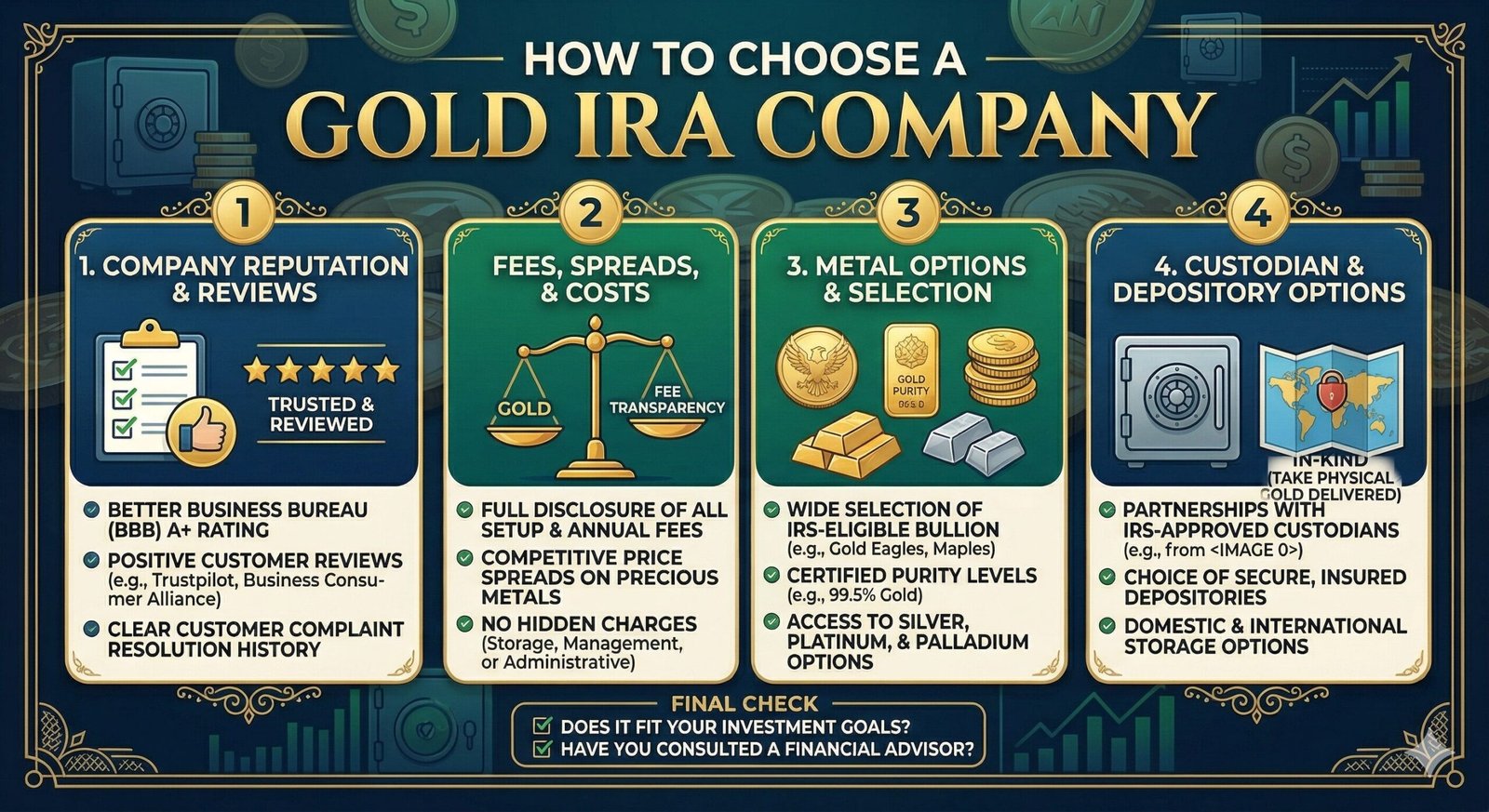
Our Gold IRA fees guide breaks down what to expect and how to compare fee structures across providers. As a general principle: transparency matters. Any provider unwilling to clearly state their fee schedule upfront warrants scrutiny.
IRA-Eligible Gold: What Qualifies?
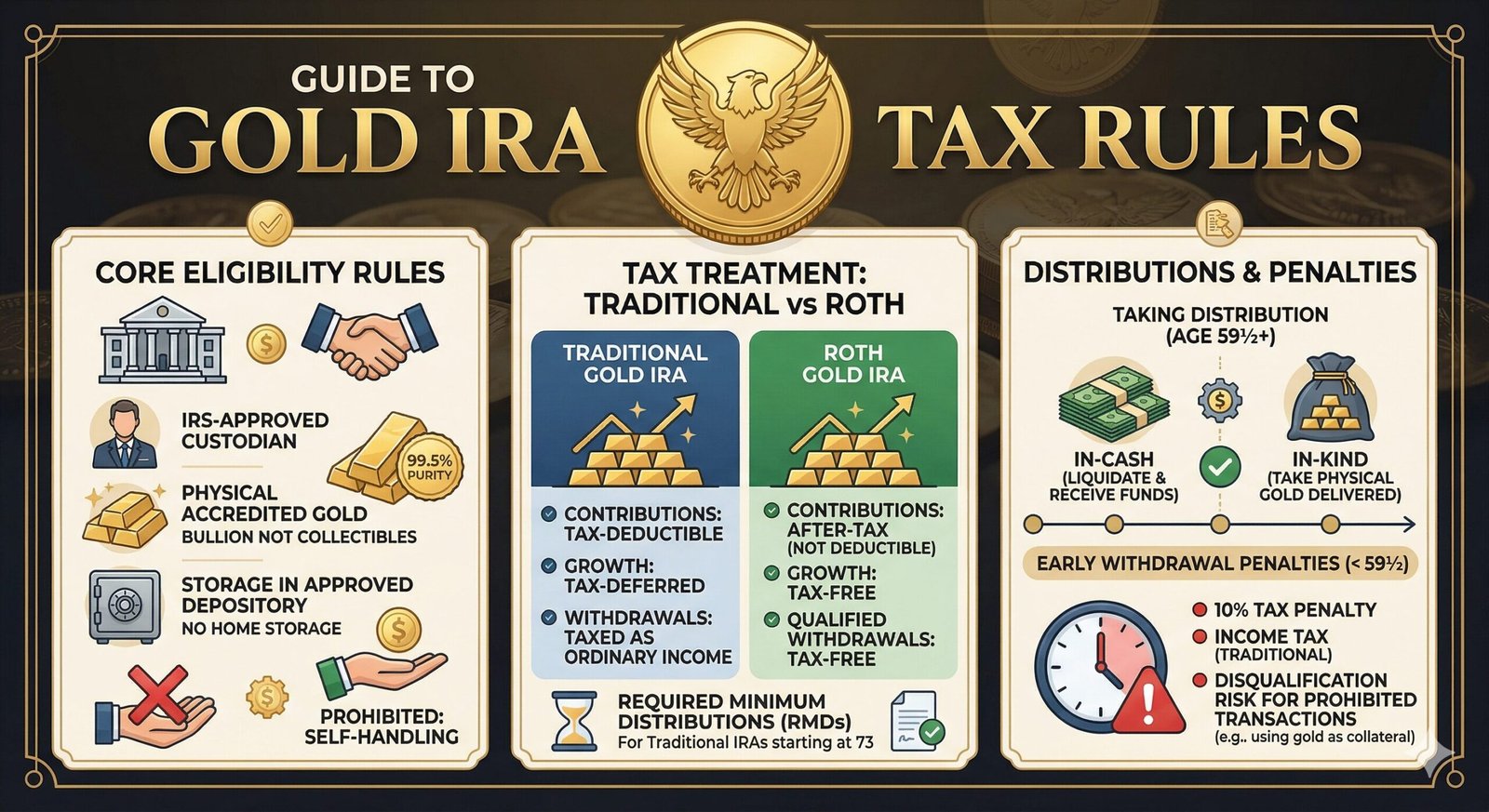
Not all gold qualifies for inclusion in a Gold IRA. The IRS requires that metals meet specific purity standards — gold must be at least 99.5% pure. Common qualifying products include the American Gold Eagle, the American Gold Buffalo, and various internationally minted coins that meet the purity threshold. Collectibles and certain older coins are explicitly excluded.
For a detailed look at what’s eligible, our guide to IRA-eligible gold coins is worth reviewing before you make any purchasing decisions.
The IRS IRA investment FAQ also contains authoritative information on what assets are and aren’t permissible inside a self-directed IRA.
Storage and Custody Requirements
If you’re using a Gold IRA, the IRS requires that physical metals be held by an approved custodian — you cannot store IRA gold at home or in a personal safe. This is a strict rule, and violations can result in the entire account being treated as a distribution, with significant tax consequences.
FINRA’s guidance on self-directed IRAs highlights the importance of understanding these custodial requirements before opening an account, noting that self-directed IRAs carry unique responsibilities that conventional brokerage accounts do not.
Required Minimum Distributions
For investors over 73, Required Minimum Distributions (RMDs) add a layer of complexity to a Gold IRA. Because your account holds physical metal rather than cash, satisfying an RMD may require liquidating a portion of your holdings or taking an in-kind distribution of metal — both of which have tax implications. The IRS RMD FAQ outlines these rules in detail.
Comparing Your Main Approaches
The table below summarizes the key characteristics of the three most common gold investment vehicles for U.S. retail investors.
Vetting Providers: What to Look For
At $100,000, provider selection carries real weight. A poorly run Gold IRA company can expose you to excessive fees, poor service, or — in the worst cases — fraud. Our Gold IRA scams guide outlines the red flags to watch for.
As a baseline, look for companies with strong ratings on bbb.org and check any financial professionals involved through FINRA BrokerCheck. Reputable companies will also be upfront about fee structures, provide clear documentation of your holdings, and work with established, insured vault operators.
You can find vetted, editorially reviewed providers in our list of Best Gold IRA Companies of 2026.
A Note on Minimum Investments
Many Gold IRA companies publish minimum investment thresholds, and these vary considerably — from as low as $5,000 to $50,000 or more for premium service tiers. At $100,000, you’ll typically qualify for most providers’ full service offerings. Our Gold IRA minimum investment guide outlines what to expect across the market.
The Bigger Picture
Whether a Gold IRA or physical bullion outside an account structure is the right fit depends on factors specific to your financial situation — your existing retirement accounts, your tax bracket, your timeline, and your preferences around ownership and liquidity. It’s not a question this article can answer for you, and anyone who claims otherwise without knowing your full situation should be treated with skepticism.
What we can say is that for retirement-focused investors at this investment level, the Gold IRA structure offers meaningful advantages in terms of tax treatment and regulatory clarity — but those advantages come with real rules and ongoing obligations. If you’re still weighing whether this type of account makes sense for you at all, our article on is a Gold IRA a good idea may help frame the question.
For a deeper look at how Gold IRAs compare to other retirement vehicles, see our Gold IRA vs 401(k) comparison, as well as Gold IRAs Explained in Detail for a comprehensive structural overview.
The SEC investor resources page also provides a helpful introduction to retirement account types for investors who want an independent, non-commercial perspective before engaging with any provider.
As with any investment, past performance is not a guarantee of future results.
Frequently Asked Questions
Can I invest $100,000 in a Gold IRA all at once?
Yes — but typically through a rollover from an existing retirement account rather than through fresh annual contributions, which are capped by the IRS at $7,000–$8,000 per year. A rollover from a 401(k), 403(b), or existing IRA is the most common mechanism for funding a Gold IRA at this level.
Is physical gold held in a Gold IRA actually mine?
Yes — the gold is purchased in your name and held in an IRS-approved depository on your behalf. You are the beneficial owner, though you cannot take physical possession of the metal while it remains inside the IRA structure without triggering a taxable distribution.
What fees should I expect on a $100,000 Gold IRA?
Fees typically include a one-time setup charge, annual custodian or administration fees, and storage fees. These can range from a few hundred dollars to over a thousand dollars annually depending on the provider and fee structure. At $100,000, flat-fee structures are generally more favorable than percentage-based ones. See our Gold IRA fees guide for a detailed breakdown.
Are there risks specific to investing $100,000 in gold?
All investments carry risk, and gold is no exception. At the $100,000 level, additional considerations include storage and insurance costs, provider quality, liquidity when you need to access funds, and the tax implications of distributions. Gold prices can and do fall in value, and no return is guaranteed.
How do I find a reputable Gold IRA company?
Start by checking BBB ratings, reading independent reviews, and reviewing fee disclosures carefully. Avoid providers who pressure you to act quickly or who are vague about costs. Our editorial list of Best Gold IRA Companies of 2026 is a good starting point for comparing well-regarded providers.
Ready to take the next step? Browse our independently researched and regularly updated list of Best Gold IRA Companies of 2026 to compare leading providers by fees, reputation, storage options, and customer service standards.
This article is for informational purposes only and does not constitute financial or tax advice. Investing in precious metals involves risk including possible loss of principal.
Related guides
- Gold IRA With $500,000: What Higher-Balance Investors Should Know
- Gold IRA With $200,000: What to Expect When You're Starting With a Larger Balance
- Gold IRA With $100K: What to Know Before You Commit
- How to Invest $50,000 in Gold: Strategy for Larger Positions
- How to Invest $10,000 in Gold: Best Options for 2026
- How to Buy Gold With Your IRA: Step-by-Step Guide