
How to Invest $50,000 in Gold: Strategy for Larger Positions
Investing $50,000 in gold is a meaningful financial decision — one that deserves careful thought, not a rushed phone call or a click-through on an ad that promised “guaranteed returns.” At this level, you have genuine options available to you, and the differences between those options in terms of cost, tax treatment, liquidity, and storage become very real.
This guide walks through the main ways U.S. investors — particularly those in or approaching retirement — can put $50,000 to work in gold. It explains what each approach actually involves, what it costs, and what questions you should be asking before you commit. What it won’t do is tell you what to do. That’s a decision only you can make, ideally with input from a qualified financial advisor who understands your complete situation.
Why $50,000 Changes the Conversation
At smaller amounts — say, a few hundred or a few thousand dollars — the options for buying gold are fairly narrow. You’re mostly looking at small coins or bars from a local dealer, or shares in a gold ETF through a standard brokerage account.
At $50,000, the picture opens up considerably. You have enough capital to establish a meaningful Gold IRA, to purchase a significant quantity of physical bullion, to hold allocated gold through a specialist custodian, or to combine approaches in a way that suits your circumstances. The flip side is that the stakes are higher. Fees that seem minor on a $2,000 position can represent thousands of dollars over time on a $50,000 position. Storage and insurance costs matter. So does the question of how gold fits within your existing retirement accounts.
This is precisely the level at which doing your homework pays off — literally.
Understanding Your Main Options
Gold IRAs
For retirement investors, a Gold IRA is often the first option worth examining. A Gold IRA is a self-directed Individual Retirement Account that holds physical precious metals — gold, silver, platinum, or palladium — rather than the stocks, bonds, and mutual funds found in a conventional IRA.
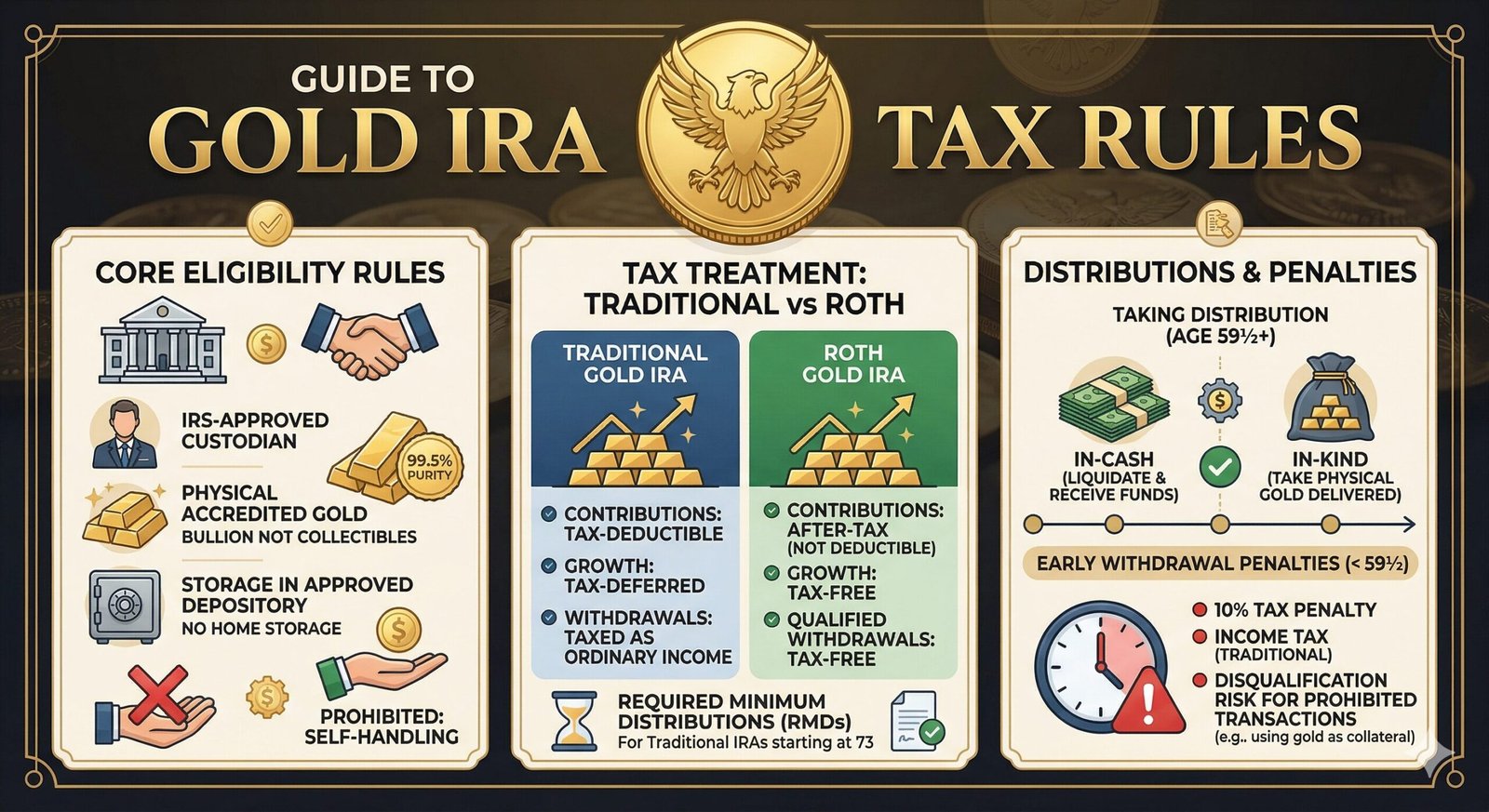
You can read a thorough breakdown of what a Gold IRA is and how the account structure works, but the key points are these: the account must be held by an IRS-approved custodian, the metals must be stored in an approved depository, and the gold itself must meet specific IRS purity standards. For gold, that means .995 fineness or higher in most cases, with limited exceptions for certain coins such as American Gold Eagles.
$50,000 is well above the minimum investment threshold required by most Gold IRA providers — many of which set their floor between $10,000 and $25,000. That means you have genuine leverage when it comes to comparing providers on fees, service quality, and the range of eligible metals they offer.
For a detailed look at how these accounts work from the ground up, Gold IRAs Explained in Detail is a useful starting point.
The IRA Tax Structure
One of the most significant factors at the $50,000 level is how the account is taxed. With a traditional Gold IRA, contributions may be tax-deductible (depending on your income and whether you have access to an employer plan), and your holdings grow on a tax-deferred basis until you take distributions in retirement. With a Roth Gold IRA, contributions are made with after-tax dollars, but qualified withdrawals in retirement are tax-free.
It’s important to note that IRS Publication 590-A governs IRA contribution rules, and contribution limits apply regardless of whether the account holds gold or conventional assets. For 2024, the annual contribution limit is $7,000 for those under 50, and $8,000 for those 50 and older — the catch-up provision. You can verify current figures at the IRS contribution limits page.
This means that if you want to move $50,000 into a Gold IRA, the most practical route for most people isn’t through new annual contributions — it’s through a rollover or transfer from an existing retirement account.
Rolling Over an Existing Retirement Account
If you have funds sitting in a 401(k) from a previous employer, or in an existing traditional IRA, you may be able to roll those funds into a Gold IRA. This is one of the most common ways investors move larger sums into gold within a tax-advantaged structure.
The mechanics matter. A direct rollover — where funds move from one custodian directly to another — avoids any tax withholding or penalties. An indirect rollover, where the funds pass through your hands first, comes with a 60-day deadline and automatic withholding requirements that can create complications if not handled carefully.
Our 401(k) to Gold IRA rollover guide walks through this process step by step. If you want to understand the specific IRS rules that govern rollovers — including the one-rollover-per-year rule — the Gold IRA rollover rules page covers that in detail.
The IRS IRA investment FAQ is also worth bookmarking, as it addresses many of the technical questions that come up during the rollover process.
Physical Gold Outside of an IRA
A Gold IRA is not the only way to hold physical gold. Some investors at the $50,000 level prefer to hold gold directly — either as bullion bars, coins, or both — stored either at home, in a private safe, or through a third-party vault service.
The appeal is simplicity: no custodian, no annual fees tied to an IRA structure, no mandatory distributions in retirement (more on that in a moment). The trade-off is that you lose the tax-deferred or tax-free growth that comes with an IRA, and you take on direct responsibility for security and insurance.
For investors interested in which gold coins meet IRS eligibility requirements if they later want to move assets into an IRA, IRA-eligible gold coins is a helpful reference. Buying non-eligible coins now doesn’t necessarily mean they’re off-limits forever, but it’s worth understanding what qualifies before you spend $50,000.
Gold ETFs and Mining Stocks
For the sake of completeness: some investors gain exposure to gold prices through exchange-traded funds that track the gold price, or through shares in gold mining companies. These are traded through standard brokerage accounts, involve no physical metal, and carry a different risk profile from direct ownership.
This guide focuses primarily on physical gold and Gold IRAs, as these are the options most relevant to retirement investors considering a $50,000 position. The SEC investor resources page provides useful background on the broader landscape of retirement investment products.
Understanding the Costs at the $50,000 Level
Fees are where many investors get caught off-guard, particularly at larger position sizes. With a Gold IRA, you are typically looking at a combination of setup fees, annual custodian fees, and storage fees. Some providers charge flat annual fees; others charge as a percentage of assets under custody.
On a $50,000 account, the difference between a provider charging a flat $200 per year and one charging 0.75% annually is significant — the latter works out to $375 per year and scales upward as your account grows. Over a decade, that difference compounds considerably.
The table below illustrates typical fee categories and what to watch for:
For a thorough comparison of what to expect and how to evaluate provider fee structures, the Gold IRA fees guide goes into this in much greater depth.
Required Minimum Distributions and Longer-Term Planning
One aspect of Gold IRAs that retirement investors must understand — particularly those approaching age 73 — is the requirement for Required Minimum Distributions (RMDs). The IRS mandates that account holders begin taking distributions from traditional IRAs at age 73 (as of current rules). This applies to Gold IRAs just as it does to conventional IRAs.
With a Gold IRA, meeting an RMD can be more complex than with a cash account. You may need to sell a portion of your metals to generate the required distribution, or take an in-kind distribution of physical metal — which involves its own logistics. If you’re close to RMD age, this is an important factor in deciding how much of your retirement savings to hold in a Gold IRA versus other structures.
The IRS RMD FAQ explains the rules in detail.
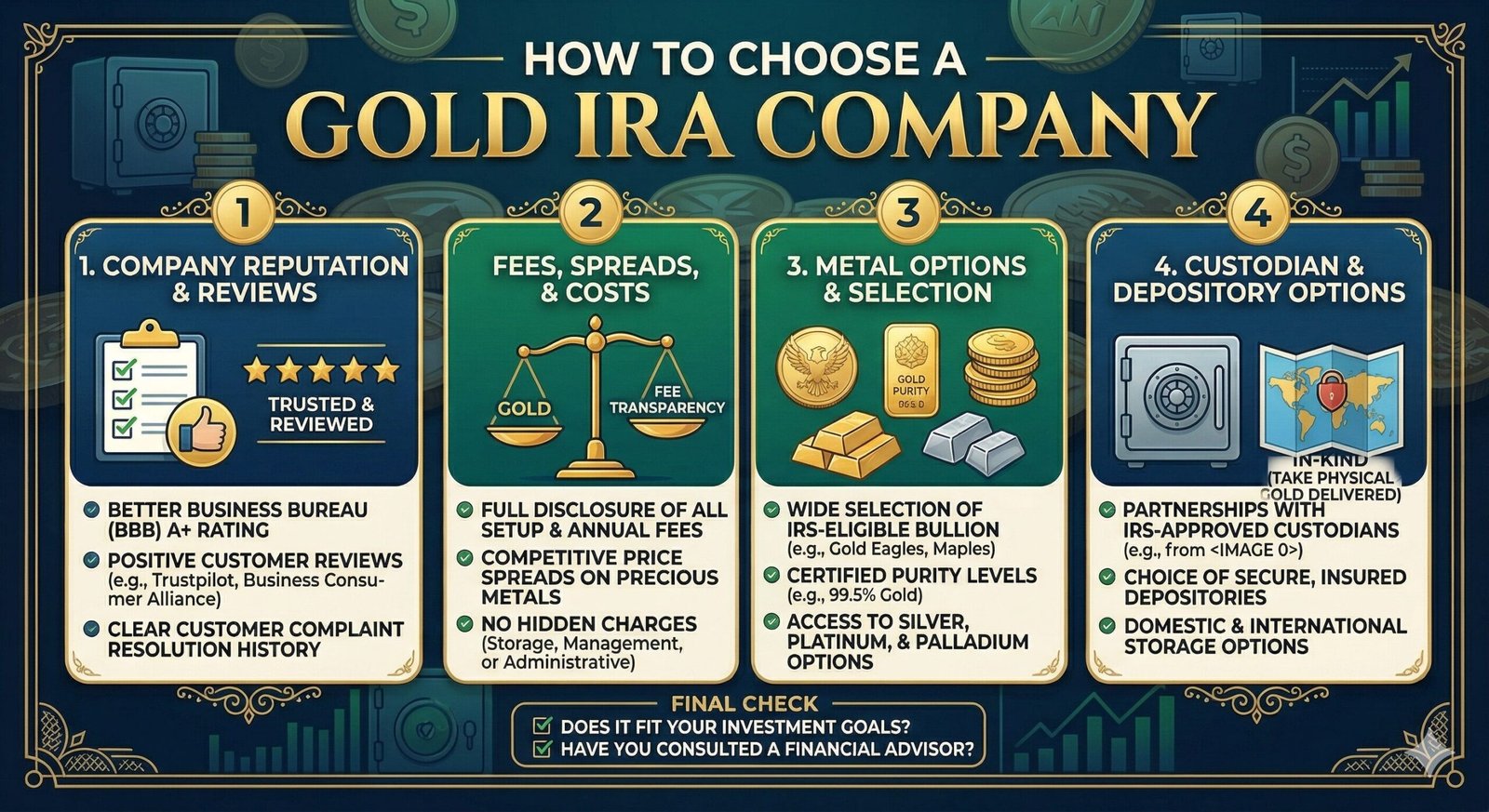
Vetting Providers Before You Commit $50,000
At this investment level, the quality of the company you work with matters enormously. The Gold IRA industry has attracted some firms with high-pressure sales tactics and opaque fee structures — and some that have drawn regulatory scrutiny.
Before committing $50,000 to any provider, check their standing with the Better Business Bureau at bbb.org, review any available regulatory filings, and read FINRA’s guidance on self-directed IRAs to understand the specific risks that come with this account type. Our Gold IRA scams guide outlines the most common red flags to watch for.
Comparing providers side by side — on fees, storage options, eligible metals, customer service, and third-party reviews — is time well spent before you sign anything.
Frequently Asked Questions
Is $50,000 enough to open a Gold IRA?
Yes — $50,000 is above the minimum investment threshold set by most Gold IRA providers, which typically ranges from $10,000 to $25,000. At this level, you should have access to a full range of account types, storage options, and eligible metals. Some providers also waive or reduce setup fees for accounts above certain thresholds.
Can I roll over my 401(k) into a Gold IRA without paying taxes?
A direct rollover from a qualifying retirement account into a Gold IRA is generally a non-taxable event, provided the funds move directly from custodian to custodian and you follow IRS rules. An indirect rollover — where the funds pass through your hands — must be completed within 60 days to avoid taxes and potential penalties. Always consult a qualified tax professional before initiating a rollover.
What gold can I hold in a Gold IRA?
The IRS sets purity requirements for metals held in an IRA. Gold must generally be .995 fine or purer. Eligible products include certain bullion bars from approved refiners and specific coins such as American Gold Eagles, Canadian Gold Maple Leafs, and Australian Gold Kangaroos. Collectibles and numismatic coins are generally not permitted.
How is a Gold IRA different from a traditional IRA?
Both follow the same IRS rules regarding contribution limits, eligibility, and distributions. The key difference is what the account holds: a traditional IRA typically holds stocks, bonds, and mutual funds, while a Gold IRA holds physical precious metals. Both can be structured as traditional (pre-tax) or Roth (after-tax) accounts. For a detailed comparison, see Gold IRA vs Traditional IRA.
What happens to my gold when I need to take a distribution?
When you take a distribution from a Gold IRA, you can either sell the metals and receive cash, or take an in-kind distribution of the physical metal itself. In-kind distributions have their own logistics and cost considerations. If you’re approaching retirement age, it’s worth discussing distribution strategies with your custodian and a financial advisor well in advance.
Take the Next Step
If you’re seriously considering putting $50,000 into gold — whether through a Gold IRA, a rollover from an existing account, or direct physical ownership — the most valuable thing you can do right now is compare the leading providers carefully. Our independently researched guide to the Best Gold IRA Companies of 2026 evaluates the top firms on fees, reputation, eligible metals, and customer experience, so you can make an informed decision before committing a significant sum.
This article is for informational purposes only and does not constitute financial or tax advice. Investing in precious metals involves risk including possible loss of principal.
Related guides
- Gold IRA With $500,000: What Higher-Balance Investors Should Know
- Gold IRA With $200,000: What to Expect When You're Starting With a Larger Balance
- Gold IRA With $100K: What to Know Before You Commit
- How to Invest $100,000 in Gold: Complete Strategy Guide
- How to Invest $10,000 in Gold: Best Options for 2026
- How to Buy Gold With Your IRA: Step-by-Step Guide