How to Invest $10,000 in Gold: Best Options for 2026
If you have $10,000 set aside and you’re considering gold as part of your financial picture, you’re not alone. For many Americans approaching or already in retirement, gold represents a time-tested store of value — and $10,000 is a meaningful starting point for exploring what the gold market has to offer.
The good news is that this amount opens up nearly every major avenue for gold investment available to U.S. investors. The challenge is understanding which of those avenues actually suits your situation, your timeline, and your goals. This guide walks through each option in plain terms so you can make an informed decision — ideally alongside your financial advisor.
Understanding Your Options Before You Commit
Before putting any money to work, it’s worth stepping back and asking a few foundational questions. Are you looking to hold physical gold you can see and touch? Are you interested in a tax-advantaged retirement account? Or would you prefer the simplicity of a brokerage account with paper-based gold exposure?
Each approach carries its own structure, costs, and trade-offs. None of them is universally “best” — the right choice depends on your individual circumstances, and no article can substitute for personalised financial advice. With that said, here’s a clear breakdown of the main options available to someone starting with $10,000.
Option 1: A Gold IRA (Self-Directed Precious Metals IRA)
For investors aged 45 to 70, a Gold IRA is often the first option worth understanding — particularly if you’re thinking about retirement savings. A Gold IRA is a type of self-directed Individual Retirement Account that allows you to hold IRS-approved physical gold (and other precious metals) rather than conventional paper assets.
You can learn more about the fundamentals in our Gold IRA guide, but here’s the short version: a Gold IRA functions under the same general IRS rules as a Traditional or Roth IRA, with the key difference being what it holds. Rather than stocks or mutual funds, the account contains physical gold coins or bars that meet the IRS’s purity requirements.
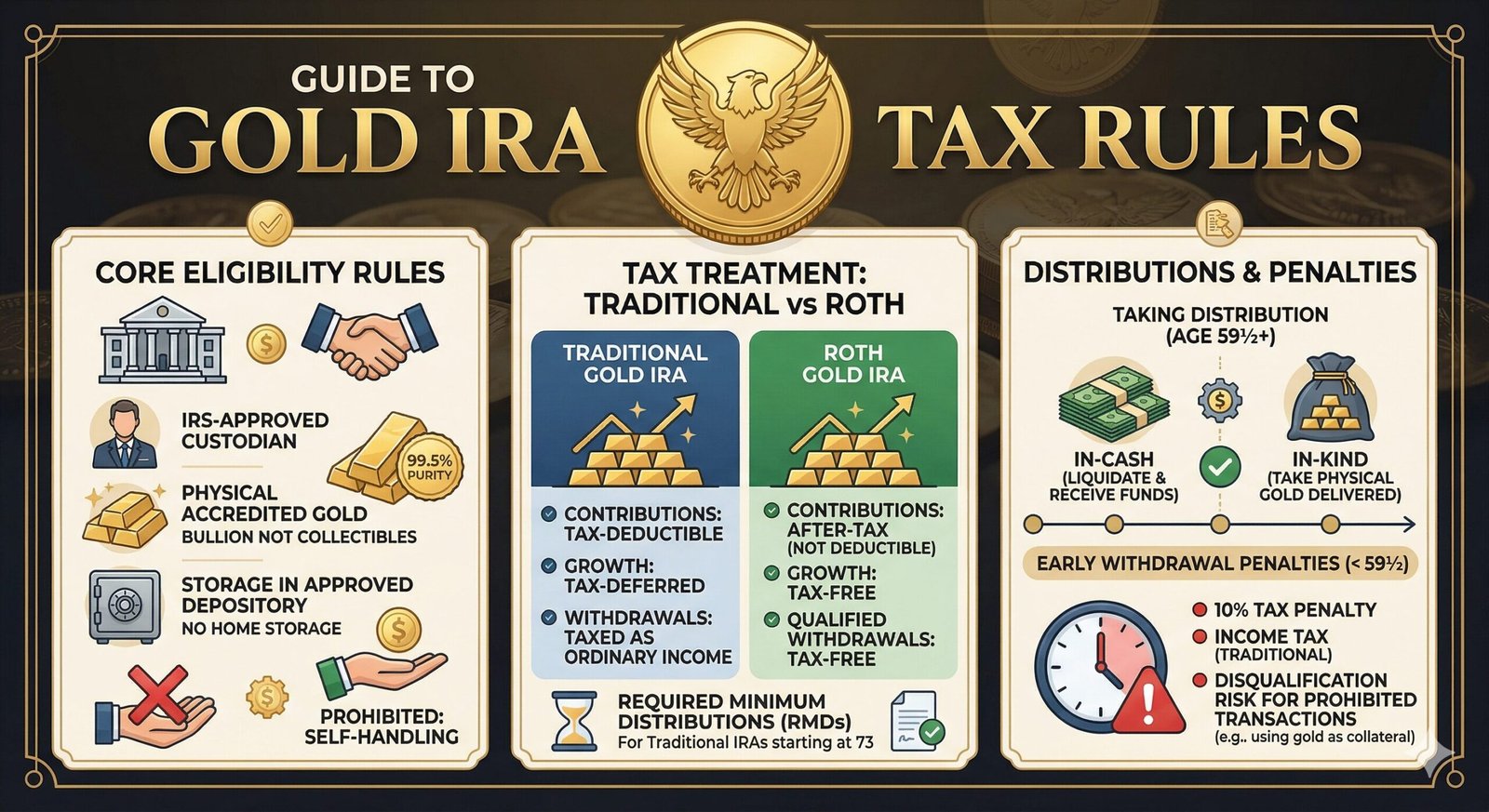
According to IRS Publication 590-A, self-directed IRAs must be established through an IRS-approved custodian, and the assets must be stored in an approved depository — you can’t simply keep the gold at home. This is a critical distinction that many first-time investors miss.
A $10,000 investment can be enough to meet the minimum investment threshold at several reputable Gold IRA companies, though minimums vary. If you’re curious about what different providers require, our Gold IRA minimum investment page breaks this down in detail.
Funding Your Gold IRA: Contributions vs. Rollovers
There are two primary ways to fund a Gold IRA: direct contributions or a rollover from an existing retirement account.
Direct contributions are subject to the same annual limits as any IRA. For 2026, those limits are set by the IRS — you can check the current figures at the IRS contribution limits page. For most investors under 73, $10,000 would exceed the annual contribution limit for a single year, meaning you’d either need to spread contributions over multiple years or fund the account via a rollover.
A rollover — particularly from a 401(k) — is a popular way to move a larger lump sum into a Gold IRA without triggering an immediate tax event, provided the rollover is handled correctly. Our 401(k) to Gold IRA rollover guide explains the mechanics in full, and you should also review our overview of Gold IRA rollover rules before proceeding.
Costs to Be Aware Of
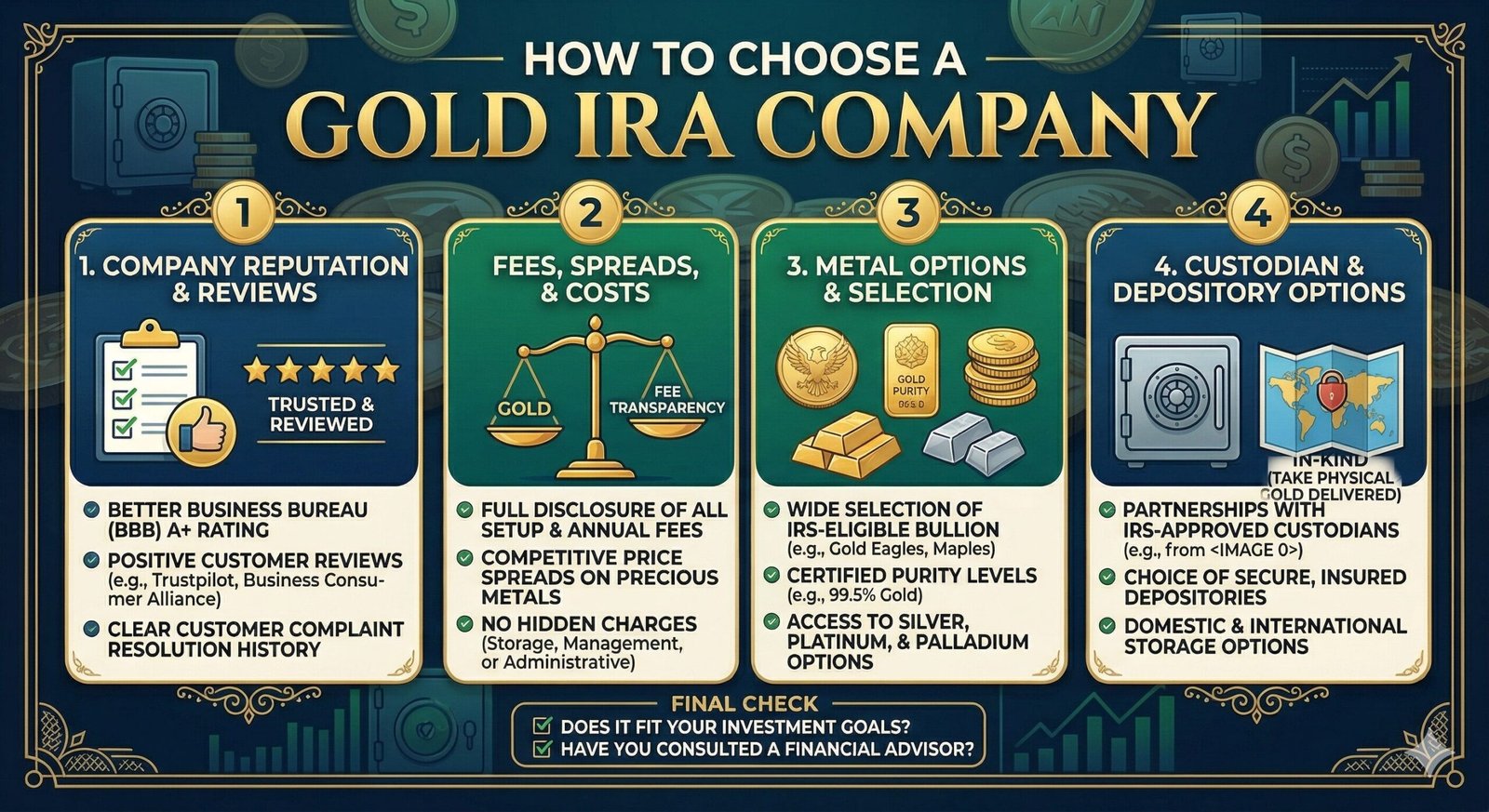
Gold IRAs involve fees that standard brokerage accounts don’t. These typically include account setup fees, annual custodian fees, and storage fees for the depository. Our dedicated Gold IRA fees guide provides a full breakdown of what to expect and how to compare providers. On a $10,000 account, fees can represent a meaningful percentage of your holdings, so this is an area that warrants careful attention.
Option 2: Physical Gold — Bullion Coins and Bars
If the account structure of an IRA doesn’t appeal to you, purchasing physical gold directly is a straightforward alternative. With $10,000, you have enough capital to buy a meaningful quantity of gold bullion — whether in coin or bar form.
Gold coins such as the American Gold Eagle and the American Gold Buffalo are among the most recognisable and liquid options for U.S. investors. If you’re interested in which coins also qualify for inclusion in a retirement account, our guide to IRA-eligible gold coins is worth a read.
Physical gold ownership comes with its own responsibilities, however. Storage and insurance are real costs. If you choose to store gold at home, you’ll need a quality safe and appropriate homeowner’s or standalone insurance coverage. If you use a third-party vault or storage facility, you’ll pay ongoing fees — similar in concept to what a Gold IRA custodian charges for depository storage.
Liquidity is generally good for name-brand bullion products, but selling physical gold isn’t quite as frictionless as clicking a button in a brokerage account. Dealers charge a spread between buy and sell prices, and that spread eats into returns — especially on smaller quantities.
Option 3: Gold ETFs and Mutual Funds
For investors who want gold exposure without taking physical delivery, gold exchange-traded funds (ETFs) offer a relatively simple and low-cost alternative. Gold ETFs typically track the spot price of gold and trade on major exchanges just like a stock. The SPDR Gold Shares (GLD) and iShares Gold Trust (IAU) are two of the most widely held examples.
With $10,000, you can establish a meaningful position in a gold ETF through any standard brokerage account. Expense ratios are generally low — far lower than the annual fees associated with a Gold IRA — and buying or selling can be done during market hours with the same ease as a stock trade.
The key trade-off is that ETF ownership is a paper claim on gold, not ownership of a physical asset. Some investors are entirely comfortable with that; others specifically want the tangibility of metal in hand (or in a vault in their name). The SEC investor resources page has useful background on how investment products like these function within different account types.
Option 4: Gold Mining Stocks
Gold mining stocks represent ownership in companies that extract gold from the ground — not in gold itself. Their performance is influenced by gold prices, but also by company-specific factors like management quality, operational efficiency, geopolitical exposure, and production costs. This means they can amplify both gains and losses relative to the metal’s spot price.
For a $10,000 investment, mining stocks can be accessed through individual shares or through sector-specific ETFs that hold baskets of mining companies. This approach is generally considered more volatile than owning the metal directly, and it requires a willingness to research or outsource that research to a fund manager.
It’s worth noting that FINRA’s guidance on self-directed IRAs cautions investors broadly about the importance of understanding what they’re actually holding in any self-directed account. That principle applies equally to any gold-related investment — always understand the underlying asset.
Comparing Your $10,000 Gold Investment Options
What to Watch Out For
No article about gold investing would be complete without a word on due diligence. The gold investment space — particularly the Gold IRA segment — has attracted its share of bad actors over the years. High-pressure sales tactics, misleading fee structures, and outright fraudulent schemes are real risks.
Before working with any Gold IRA company, check their standing with bbb.org and verify the credentials of any financial professionals through FINRA BrokerCheck. Our Gold IRA scams guide walks through the red flags to watch for so you can approach this process with your eyes open.
Also worth reading before making any decision: our comparison of a Gold IRA vs Traditional IRA and our detailed look at Gold IRAs Explained in Detail — both of which provide context that’s particularly useful for retirement-focused investors.
Frequently Asked Questions
Is $10,000 enough to open a Gold IRA?
It depends on the provider. Many reputable Gold IRA companies have minimum investment requirements that range from $5,000 to $25,000 or more. Some providers will work with $10,000; others will not. Our Gold IRA minimum investment page has a provider-by-provider breakdown to help you narrow your options.
Can I roll over $10,000 from my 401(k) into a Gold IRA?
Yes, rollovers from eligible retirement accounts — including 401(k)s — into a Gold IRA are generally permissible under IRS rules, provided the rollover follows the proper procedures. The IRS IRA investment FAQ covers the basics, and our Gold IRA rollover rules page goes into the specifics.
What are the ongoing costs of a Gold IRA on a $10,000 account?
Costs vary by provider, but you should generally expect to pay an annual custodian fee and an annual storage fee. On a $10,000 account, these fees can represent 1–2% or more of your account value annually — which is notably higher, proportionally, than on larger accounts. Review our Gold IRA fees guide for a detailed cost comparison.
Is it better to buy physical gold or a gold ETF?
There’s no universal answer — this depends on your goals, your comfort with account structures, and how much you value tangible ownership versus ease of access. Physical gold gives you direct ownership of a real asset; a gold ETF gives you price exposure with greater liquidity and lower administrative costs. Neither is objectively superior; each suits different investor profiles.
Are there required minimum distributions (RMDs) for a Gold IRA?
Yes. A Traditional Gold IRA is subject to RMD rules just like any Traditional IRA. This means you’ll be required to take distributions starting at age 73 under current rules. Because your holdings are in physical gold, satisfying an RMD may require selling a portion of your metal or taking an in-kind distribution. The IRS RMD FAQ explains the rules in full.
Ready to Take the Next Step?
Understanding your options is the first step — and you’ve taken it. If you’re ready to explore specific companies that offer Gold IRAs, start with our independent, thoroughly researched rundown of the Best Gold IRA Companies of 2026. We evaluate each provider on fees, transparency, customer service, and track record so you can compare with confidence.
This article is for informational purposes only and does not constitute financial or tax advice. Investing in precious metals involves risk including possible loss of principal.
Related guides
- Gold IRA With $500,000: What Higher-Balance Investors Should Know
- Gold IRA With $200,000: What to Expect When You're Starting With a Larger Balance
- Gold IRA With $100K: What to Know Before You Commit
- How to Invest $100,000 in Gold: Complete Strategy Guide
- How to Invest $50,000 in Gold: Strategy for Larger Positions
- How to Buy Gold With Your IRA: Step-by-Step Guide