
How to Buy Gold With Your IRA: Step-by-Step Guide
Adding physical gold to a retirement account is not as complicated as many investors assume — but it does require following a specific set of rules, working with the right professionals, and understanding exactly how the process works before you commit. If you’ve been researching how to buy gold with an IRA, this guide will walk you through each stage of the process clearly and methodically, without the jargon or the sales pressure.
What Does It Actually Mean to Buy Gold With an IRA?
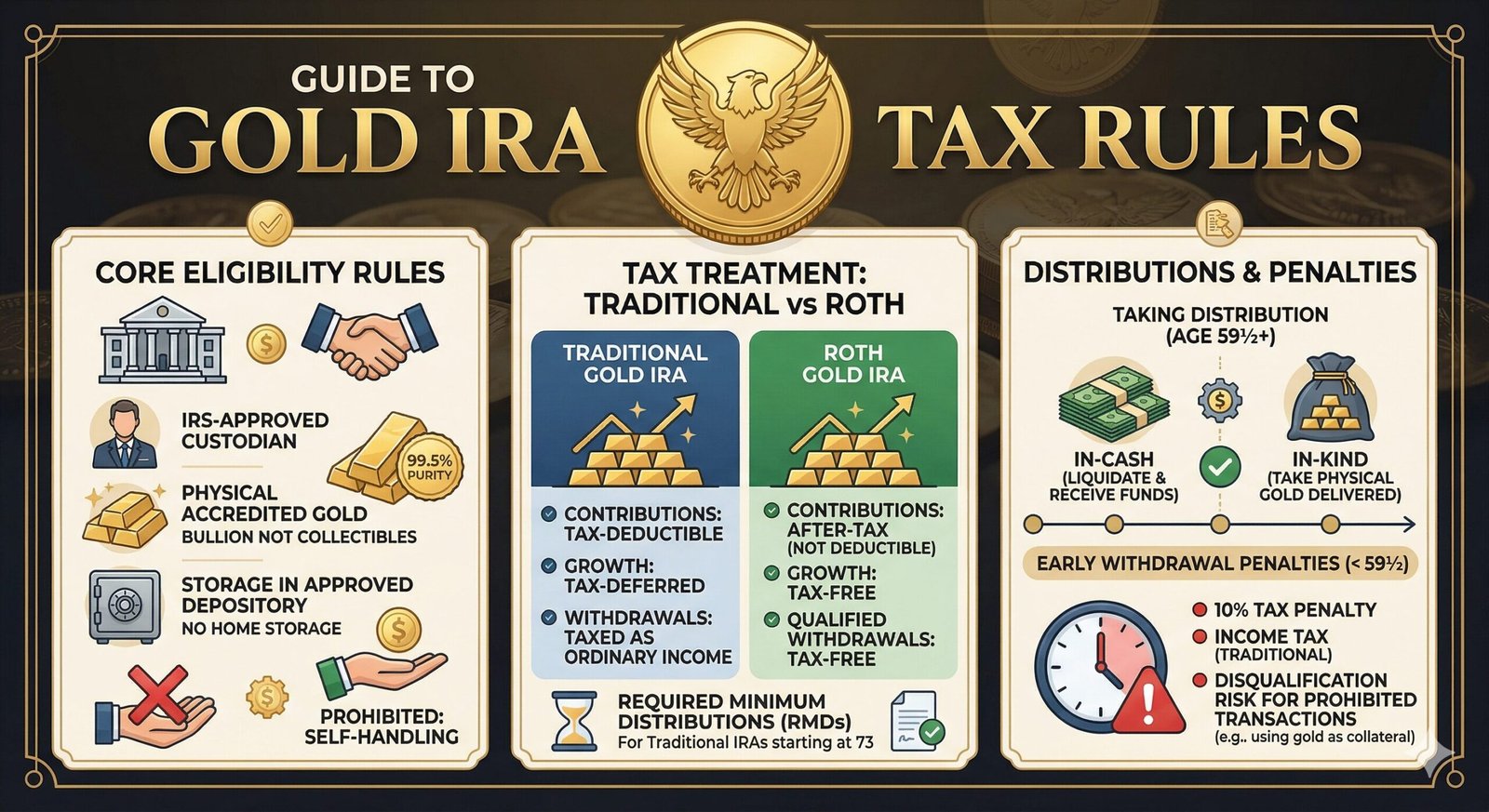
A standard IRA — whether traditional, Roth, or rollover — cannot hold physical gold or other precious metals. These account types are designed around paper-based assets such as stocks, bonds, and mutual funds. To hold physical gold inside a retirement account, you need a specific type of account called a self-directed IRA, and within that category, one structured to hold precious metals.
This is commonly known as a Gold IRA. If you’d like to understand the fundamentals before going further, our Gold IRA hub covers the core concepts in depth, and you can also read Gold IRAs Explained in Detail for a thorough overview of how these accounts function.
What distinguishes a Gold IRA from a conventional IRA is not the tax treatment — which works the same way — but rather the type of asset held inside it and the additional infrastructure required to store and administer that asset. You’ll need a qualified custodian and an approved depository. Those two requirements shape almost everything about the process.
The IRS IRA investment FAQ confirms that IRAs can hold certain alternative assets, including physical precious metals, provided they meet specific purity and product standards.
Step 1: Choose a Self-Directed IRA Custodian
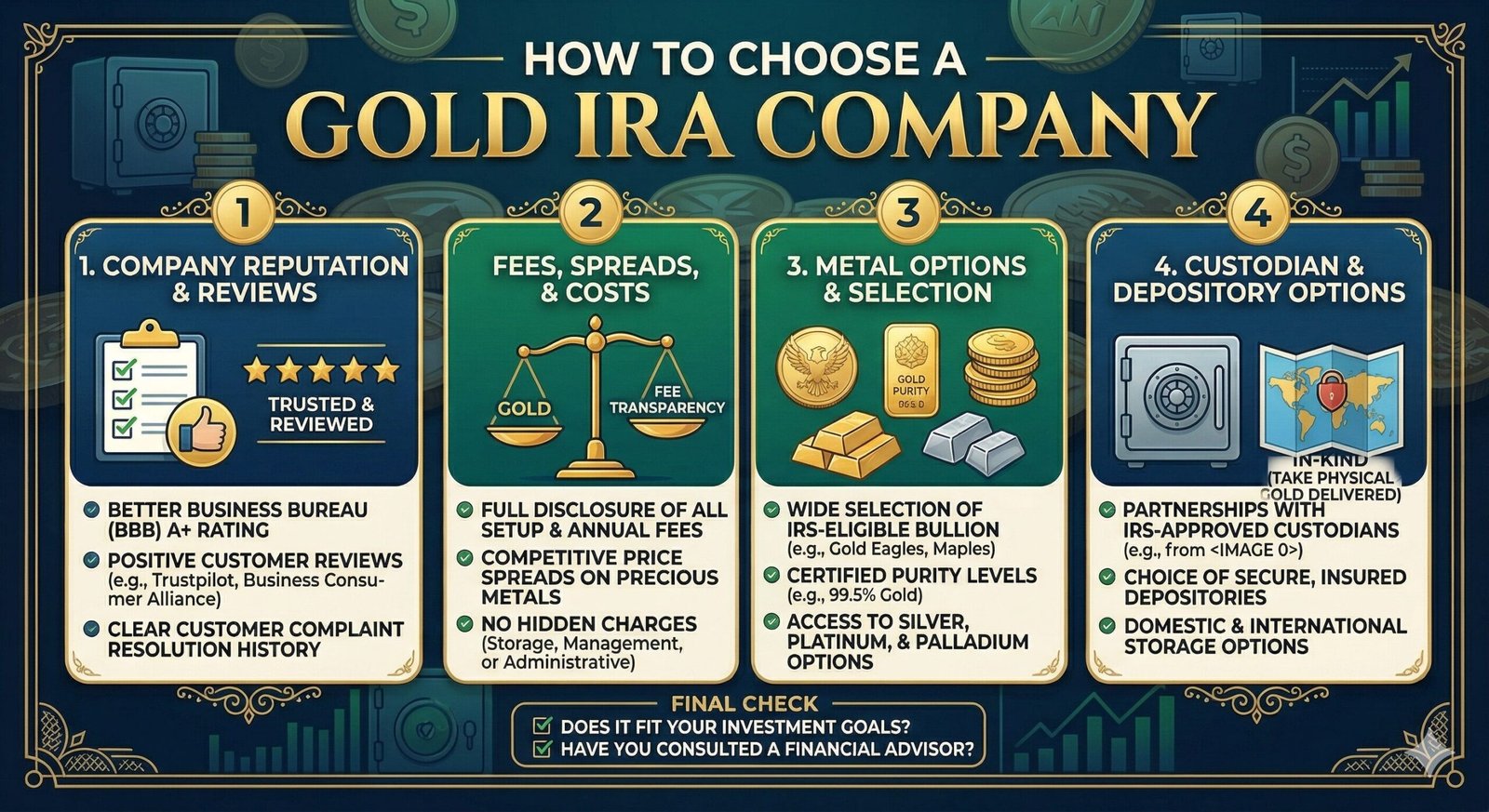
The first practical step in buying gold with an IRA is selecting a custodian who is authorized to administer self-directed IRAs that hold physical metals.
This is not something your existing brokerage or bank can typically do. Standard IRA custodians — like the major online brokerages — only offer traditional paper assets. For a precious metals IRA, you need a custodian that specializes in alternative assets and has the systems in place to manage physical holdings, coordinate with approved depositories, and report to the IRS correctly.
Before selecting a custodian, it is worth reviewing FINRA’s guidance on self-directed IRAs, which outlines the unique responsibilities and risks that come with this type of account structure. You can also verify custodian credentials and complaint history through FINRA BrokerCheck and bbb.org.
When evaluating custodians, pay close attention to their fee structures. Custodians can charge account setup fees, annual administrative fees, storage fees, and transaction fees — and these vary significantly between providers. Our Gold IRA fees guide breaks down the full range of costs you should expect to encounter.
Step 2: Fund Your Gold IRA
Once your self-directed IRA custodian account is established, the next step is funding it. There are three primary ways to do this.
Direct Contributions
You can fund a Gold IRA with a direct cash contribution, subject to the annual IRA contribution limits set by the IRS. For 2025, the limit is $7,000 per year ($8,000 if you are age 50 or older). You can review the current figures at the IRS contribution limits page. This option is straightforward but limits how quickly you can build a meaningful position, particularly if you are starting later in your retirement planning journey.
IRA Transfer
A transfer involves moving funds directly from one IRA to another — for example, from a traditional IRA at your current brokerage to your new self-directed IRA. Because the funds never pass through your hands, this is not a taxable event and there is no IRS deadline to meet. Transfers are generally the lower-risk funding method from a compliance standpoint.
401(k) Rollover
If you have an old 401(k) from a previous employer — or in some cases a current employer plan — you may be able to roll those funds into a Gold IRA. This is one of the most common ways retirement investors fund a precious metals account, and the sums involved are often larger than what annual contributions would allow.
However, rollovers come with important rules around timing and eligibility. Our 401(k) to Gold IRA rollover guide and the Gold IRA rollover rules page explain the distinction between direct and indirect rollovers, the 60-day rule, and how to avoid inadvertently triggering a taxable distribution.
Step 3: Select IRS-Approved Gold Products
Not every gold product qualifies for inclusion in an IRA. The IRS sets strict standards around purity and product type, and purchasing a non-qualifying product can result in a distribution being triggered — meaning you would owe taxes and potentially penalties on the amount.
For gold to be held in an IRA, it must meet a minimum fineness of .995 (99.5% pure). Common qualifying products include the American Gold Eagle coin, the American Gold Buffalo coin, and certain gold bars and rounds produced by approved refiners or manufacturers.
A quick note on the Gold Eagle: it is an exception to the purity rule by specific statutory provision, despite having a fineness of .9167. Most other coins must meet the .995 standard.
For a detailed list of eligible products, our guide to IRA-eligible gold coins is a useful reference. The IRS rules here are specific, and your custodian and dealer should both be able to confirm whether a particular product qualifies before any purchase is made.
IRS Publication 590-A contains the foundational guidance on IRA rules and is worth consulting directly if you want to understand the regulatory framework in full.
Step 4: Work With an Approved Precious Metals Dealer
Your custodian administers the account but typically does not source the gold itself. That role belongs to a precious metals dealer. Some Gold IRA companies combine both functions within a single service offering, acting as a facilitator who coordinates between you, the custodian, and the dealer — but it is important to understand who is performing which role.
When selecting a dealer, look for established businesses with verifiable track records, clear pricing, and transparent buyback policies. Because this is an area where less reputable operators have historically targeted retirement investors, the SEC investor resources page offers useful background on how to approach retirement account decisions with appropriate scrutiny. Our Gold IRA scams guide is also essential reading before engaging with any company.
Step 5: Arrange IRS-Approved Storage
One of the most important rules governing Gold IRAs is that you cannot take personal possession of the gold while it remains inside the IRA. The IRS requires that physical metals be held by an approved depository — a secure, insured facility that meets federal standards for precious metals storage.
Your custodian will typically have established relationships with one or more approved depositories and will coordinate the storage arrangement on your behalf. You will generally have a choice between segregated storage (your metals are stored separately from other clients’ holdings) and commingled storage (your metals are pooled with others’). Segregated storage typically carries a higher fee but provides greater certainty about the specific coins or bars you own.
Attempting to store IRA-held gold at home — in a safe or otherwise — is a violation of IRS rules and can result in the entire account being treated as a distribution, with significant tax consequences.
Gold IRA Funding Methods: A Quick Comparison
Ongoing Considerations After Opening Your Gold IRA
Buying gold is not a set-and-forget exercise. Once your Gold IRA is open and funded, there are ongoing administrative and regulatory realities to stay across.
Required Minimum Distributions (RMDs): If you have a traditional Gold IRA, you will eventually be required to take RMDs — just as you would with any traditional IRA. Because your holdings are physical metal rather than cash, satisfying an RMD may require selling a portion of your gold or taking an in-kind distribution. The IRS RMD FAQ explains the rules in full.
Annual Fees: Gold IRAs carry ongoing costs — storage fees, custodian fees, and potentially insurance fees — that do not apply to conventional IRAs. These are real expenses that factor into the total cost of holding this type of account over time.
Minimum Investment Requirements: Most Gold IRA providers set minimum initial investment thresholds. Our Gold IRA minimum investment guide explains what to expect across different providers and account types.
If you are weighing this structure against other retirement account options, Gold IRA vs Traditional IRA and Gold IRA vs 401(k) provide structured comparisons of the key differences. And if you are still forming your view on whether this type of account suits your circumstances, is a Gold IRA a good idea offers a balanced perspective on what these accounts can and cannot do.
Frequently Asked Questions
Can I buy gold in a regular IRA or 401(k)?
No. Standard IRAs and most employer-sponsored 401(k) plans are limited to paper-based assets. To hold physical gold, you need a self-directed IRA specifically structured for precious metals — often referred to as a Gold IRA.
What types of gold qualify for IRA inclusion?
Gold held in an IRA must meet IRS purity standards — generally .995 fineness or higher. Qualifying products include the American Gold Eagle, American Gold Buffalo, certain gold bars, and rounds from approved refiners. Your custodian and dealer can confirm eligibility for specific products before purchase.
Can I store IRA gold at home?
No. IRS regulations require that physical metals held within an IRA be stored at an approved third-party depository. Home storage of IRA-held gold is considered a distribution under IRS rules and can trigger taxes and penalties.
How is a Gold IRA rollover different from a transfer?
A transfer moves funds directly between two IRA custodians and is not subject to the 60-day rule or mandatory withholding. A rollover — particularly an indirect one — passes funds through your hands temporarily and must be completed within 60 days to avoid a taxable event.
Are there annual contribution limits for a Gold IRA?
Yes, if you are funding via direct contribution. The same limits that apply to conventional IRAs apply here: $7,000 per year for 2025, or $8,000 if you are 50 or older. Rollovers and transfers are not subject to these limits.
If you are ready to explore providers who offer Gold IRA services, our independently researched list of Best Gold IRA Companies of 2026 is a useful starting point for comparing custodians, fees, and service structures side by side.
This article is for informational purposes only and does not constitute financial or tax advice. Investing in precious metals involves risk including possible loss of principal.
Related guides
- Gold IRA With $500,000: What Higher-Balance Investors Should Know
- Gold IRA With $200,000: What to Expect When You're Starting With a Larger Balance
- Gold IRA With $100K: What to Know Before You Commit
- How to Invest $100,000 in Gold: Complete Strategy Guide
- How to Invest $50,000 in Gold: Strategy for Larger Positions
- How to Invest $10,000 in Gold: Best Options for 2026