
Gold IRA in North Dakota: Investor Guide for 2026
North Dakota has built a reputation as one of America’s more financially resilient states — low debt, a sovereign wealth fund, and a population that tends to take long-term planning seriously. For retirement investors in cities like Fargo, Bismarck, Grand Forks, and Minot, that practical mindset naturally extends to how they structure their retirement savings. One option drawing increasing attention across the state is the Gold IRA — a self-directed individual retirement account that holds physical gold and other IRS-approved precious metals instead of, or alongside, paper-based assets.
If you’re a North Dakota investor researching whether a Gold IRA might fit your retirement picture, this guide walks you through exactly how the account works, the federal rules that govern it, what to watch out for, and how to find a reputable provider. There is no investment advice here — only clear, factual information to help you make a more informed decision.
What Is a Gold IRA?
A Gold IRA is a type of self-directed IRA (SDIRA) that allows account holders to invest in physical precious metals — including gold, silver, platinum, and palladium — rather than being limited to the stocks, bonds, and mutual funds found in conventional retirement accounts. For a thorough primer, visit what a Gold IRA is on our hub page, or read our full breakdown at Gold IRAs Explained in Detail.
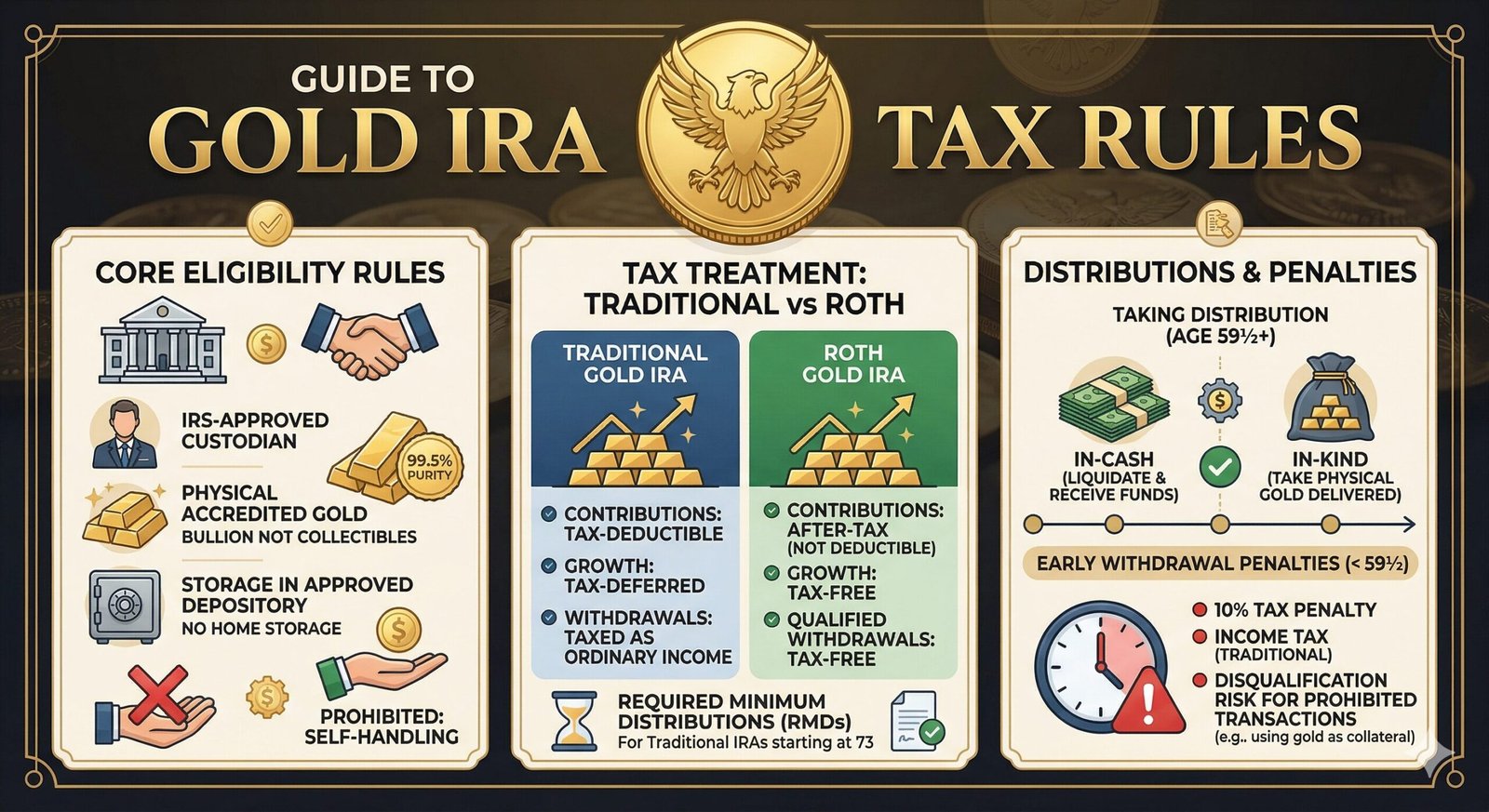
The account itself operates under the same IRS framework as a Traditional or Roth IRA. Contributions follow the same annual limits, distributions follow the same rules, and the tax treatment is identical to its conventional counterparts. What distinguishes a Gold IRA is simply the type of asset held inside it — physical metal, stored in an IRS-approved depository.
The IRS does not allow Gold IRA holders to store their metals at home or in a personal safe. Under IRS Publication 590-A, IRA assets must remain in the custody of a qualified trustee or custodian. For physical metals, this means an approved third-party depository facility.
Is a Gold IRA Available to North Dakota Residents?
Yes — Gold IRAs are governed by federal law, not state law, so any U.S. resident with earned income (or a qualifying rollover source) can open one regardless of which state they live in. North Dakota residents are subject to the same IRS rules as investors in any other state. There are no North Dakota-specific regulations that restrict or alter how a Gold IRA operates.
That said, you’ll want to be aware of North Dakota’s income tax treatment of IRA distributions. The state does tax retirement income, including traditional IRA withdrawals, at ordinary income tax rates. A qualified tax advisor familiar with North Dakota law can help you understand how distributions will be taxed at the state level — that falls outside what this guide covers.
How a Gold IRA Works: The Basics
Opening the Account
To open a Gold IRA, you’ll need to work with a custodian that specialises in self-directed accounts. Standard brokerages like Fidelity or Vanguard do not offer physical metal IRAs. You’ll need an SDIRA custodian specifically approved to hold alternative assets. FINRA’s guidance on self-directed IRAs is a useful starting point for understanding what these accounts involve and the responsibilities they place on the account holder.
Once your account is established with a custodian, you’ll direct them to purchase IRS-approved metals on your behalf from a precious metals dealer. The metals are then shipped directly to an approved depository — not to you.
Funding Your Account
North Dakota investors can fund a Gold IRA in three main ways:
Direct contributions are subject to the annual IRS limits. For 2026, the contribution limit is $7,000 per year ($8,000 if you are age 50 or older). You can confirm current figures at the IRS contribution limits page.
Rollovers allow you to move funds from an existing 401(k), 403(b), 457, or similar workplace plan into a Gold IRA — typically without triggering a taxable event, provided the transfer is handled correctly. Our 401(k) to Gold IRA rollover guide explains the process step by step.
Transfers move funds directly between IRA custodians and are generally the simplest method for existing IRA holders. For a complete breakdown of what’s permitted and what’s not, review our Gold IRA rollover rules page.
IRS-Approved Metals
Not all gold qualifies for inclusion in an IRA. The IRS requires gold to meet a minimum fineness of 0.995 (99.5% pure). Coins and bars that meet this standard include American Gold Eagle coins (which are granted a specific IRS exemption despite their 91.67% purity), Canadian Gold Maple Leafs, and various approved gold bars produced by accredited refiners. Our guide to IRA-eligible gold coins provides a detailed list of qualifying products.
Collectible coins, numismatics, and gold jewellery do not qualify and cannot be held in an IRA.
Fees: What North Dakota Investors Should Expect
One aspect of Gold IRAs that often surprises first-time investors is the fee structure. Unlike a standard brokerage IRA — where fees may be minimal or bundled — a Gold IRA typically involves several distinct charges. Our Gold IRA fees guide provides a full breakdown, but here is a general overview:
These fees vary meaningfully between providers. Before opening an account, request a complete written fee schedule and compare it carefully across multiple companies. Lower minimums don’t always mean lower total cost over time.
For a sense of what different providers require to get started, see our page on Gold IRA minimum investment.
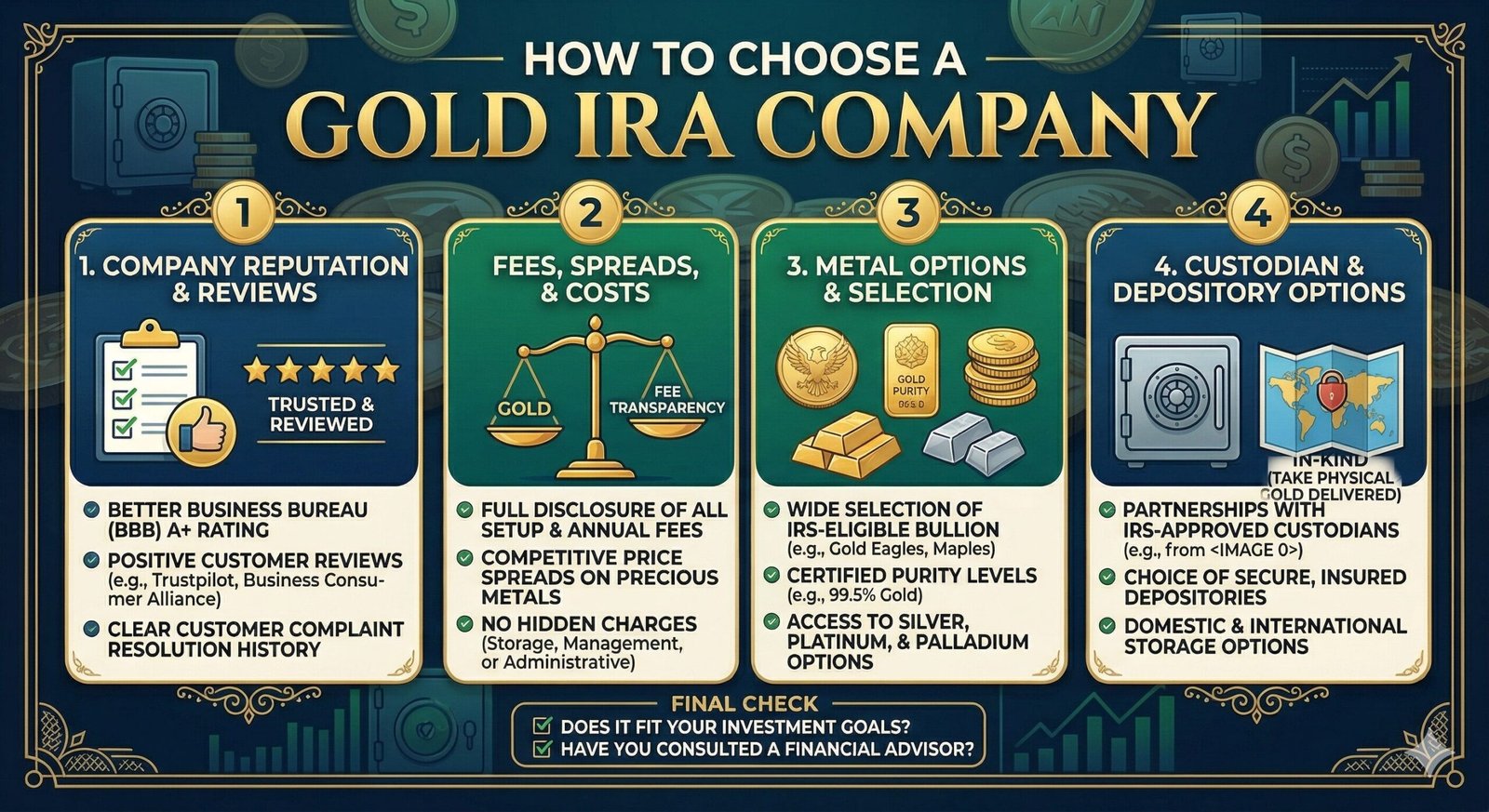
Choosing a Provider: What to Look For
Because Gold IRAs involve self-directed accounts, the responsibility for doing due diligence falls primarily on you — the investor. The SEC investor resources page and FINRA BrokerCheck are both useful tools for verifying the background of any company you’re considering.
When evaluating Gold IRA companies, North Dakota investors should consider the following:
Reputation and accreditation. Look for companies with verifiable track records, strong ratings with consumer review organisations, and no significant complaints. Checking a company’s profile on bbb.org is a reasonable starting point.
Custodian transparency. Understand who is actually serving as custodian — some precious metals dealers partner with third-party custodians, and that relationship should be disclosed clearly.
Depository options. Ask which depositories are used, where they are located, and whether you have any choice between segregated and commingled storage. Segregated storage keeps your metals separate from other clients’ holdings; commingled storage does not.
Pressure-free sales process. Legitimate providers give you time to review documents, ask questions, and seek independent advice. Any company pushing for an immediate decision warrants caution. Read our Gold IRA scams guide before committing to any provider.
Our independently researched rankings are available at Best Gold IRA Companies of 2026.
Required Minimum Distributions and Gold IRAs
If you hold a Traditional Gold IRA, you are subject to Required Minimum Distributions (RMDs) beginning at age 73, consistent with the SECURE 2.0 Act schedule. The IRS RMD FAQ covers the technical requirements in detail.
Taking an RMD from a Gold IRA is slightly more complex than from a paper-based account, because the assets are physical. You generally have two options: liquidate a portion of your metals and take the distribution in cash, or take an in-kind distribution of physical metal (which still creates a taxable event based on the metal’s market value on the distribution date). Planning for RMDs should factor into your decision about account structure from the outset.
Gold IRA vs. Other Account Types
If you’re comparing a Gold IRA to a conventional IRA or your existing 401(k), our Gold IRA vs Traditional IRA and Gold IRA vs 401(k) comparison pages offer a side-by-side look at the structural differences. Each account type has distinct rules, flexibility, and cost profiles. Understanding those differences — not simply which account sounds more appealing — is the appropriate basis for any decision.
You might also find it useful to read is a Gold IRA a good idea for a frank discussion of the considerations involved.
Frequently Asked Questions
Q: Can North Dakota residents open a Gold IRA with any provider in the country?
Yes. Gold IRAs are governed by federal IRS rules, and there is no requirement to use a provider based in North Dakota. You can work with any IRS-compliant custodian and precious metals dealer operating nationally, regardless of where they are headquartered.
Q: Are there any North Dakota state tax advantages specific to Gold IRAs?
North Dakota does not offer state-specific tax advantages for Gold IRAs beyond what federal IRA rules provide. IRA contributions may or may not be deductible depending on your income and whether you participate in an employer-sponsored plan. Consult a licensed tax professional familiar with North Dakota state tax law for advice specific to your situation.
Q: Can I store my Gold IRA metals at home in North Dakota?
No. IRS rules require that IRA-held metals be stored with an approved custodian or depository. Storing metals at home — even temporarily — constitutes a distribution and may trigger taxes and penalties.
Q: What happens to my Gold IRA if I move out of North Dakota?
Nothing changes at the federal level. Your Gold IRA remains intact, and the same IRS rules continue to apply. You may need to update your address with your custodian, and your state income tax obligations will shift based on your new state of residence.
Q: How long does it take to open and fund a Gold IRA in North Dakota?
Account setup typically takes a few business days. Funding via a direct contribution can be completed within a week. Rollovers from a 401(k) or existing IRA typically take two to four weeks, depending on how quickly the sending institution processes the transfer. The metals purchase and depository delivery add additional time after funding is confirmed.
Ready to Take the Next Step?
If you’re a North Dakota investor ready to explore Gold IRA providers, our research team has evaluated the leading companies based on fees, transparency, custodian relationships, and customer experience. Visit our Best Gold IRA Companies of 2026 page to see our current rankings and read detailed company profiles.
This article is for informational purposes only and does not constitute financial or tax advice. Investing in precious metals involves risk including possible loss of principal.
Related guides
- Gold IRA Consumer Affairs Reviews: What to Look For
- Gold IRA Trustpilot Reviews: What Real Customers Say
- Gold IRA BBB Complaints: What Consumer Reports Reveal
- Is a Gold IRA Worth the Fees? A Cost-Benefit Analysis
- Are Gold IRA Fees Too High? Breaking Down the Real Costs
- Gold IRA Mistakes to Avoid: 10 Common Errors Investors Make