
Gold IRA in New Mexico: What Investors Need to Know
If you live in New Mexico and you’re approaching retirement — or you’re already there — you’ve probably started thinking more carefully about how your savings are structured. A Gold IRA is one option that has attracted growing interest among retirement investors across the country, and New Mexico residents are no exception. Whether you’re in Albuquerque, Santa Fe, Las Cruces, or a smaller community, the rules governing a Gold IRA are federal rather than state-specific, which means the experience of opening and managing one is largely the same wherever you live.
That said, there are practical considerations worth understanding before you take any steps. This guide walks you through what a Gold IRA actually is, how the IRS governs these accounts, what the custodian and storage requirements look like, and what questions you should be asking before you commit.
What Is a Gold IRA?
A Gold IRA is a self-directed Individual Retirement Account that holds physical precious metals — most commonly gold — rather than the paper-based assets found in a conventional IRA. To understand what a Gold IRA is at a foundational level, it helps to start with what makes it different from a standard retirement account.
In a traditional IRA or 401(k), your contributions are invested in assets like mutual funds, stocks, and bonds, managed through a conventional brokerage. A self-directed IRA gives the account holder the ability to invest in a broader range of assets that the IRS permits but that standard brokerages don’t offer — including physical gold, silver, platinum, and palladium.
The IRS does not treat Gold IRAs as a separate account category. Instead, they operate under the same legal framework as any other IRA, subject to contribution limits, distribution rules, and tax treatment. The distinction is in what the account holds and how it’s administered. FINRA’s guidance on self-directed IRAs is a useful starting point for understanding the additional responsibilities that come with this structure.
Federal Rules Apply Regardless of Where You Live in New Mexico
One of the most important things to understand as a New Mexico resident is that Gold IRAs are governed entirely by federal law. There is no New Mexico-specific Gold IRA legislation, no state-level precious metals IRA tax treatment that differs from the federal baseline, and no requirement to work with a custodian or storage facility located in-state.
This means the IRS rules that apply to a Gold IRA investor in Texas or Ohio apply equally to you. For a thorough breakdown of those rules, our Gold IRAs Explained in Detail resource covers the structure, eligibility, and mechanics of these accounts in depth.
Contribution Limits
For 2025, the IRS sets standard IRA contribution limits at $7,000 per year, with a $1,000 catch-up contribution available for those aged 50 and over. These same limits apply to self-directed Gold IRAs. You can review current figures directly through the IRS contribution limits page.
Required Minimum Distributions
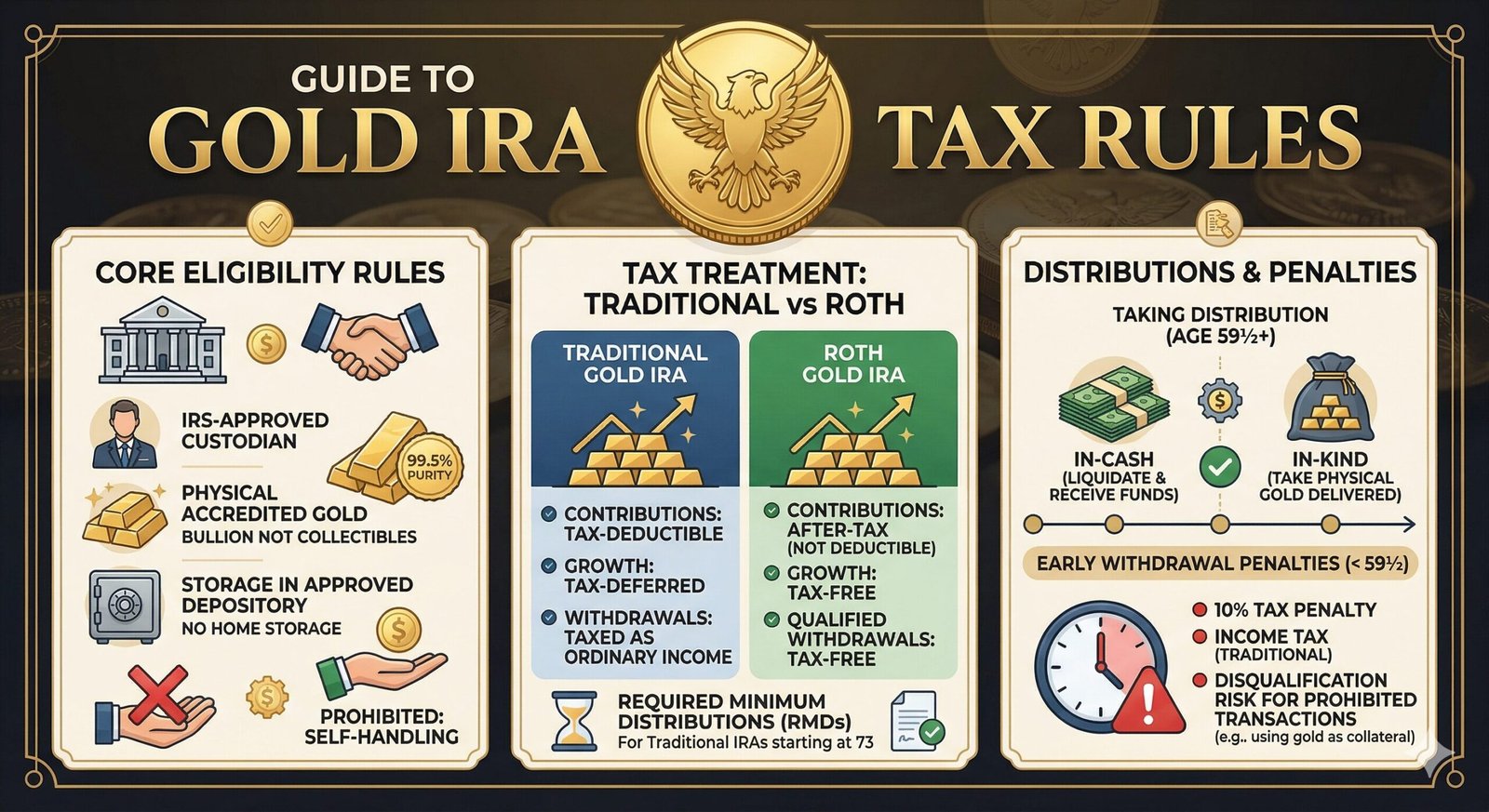
If you hold a traditional (pre-tax) Gold IRA, you are subject to Required Minimum Distributions beginning at age 73. Because your account holds physical metal rather than liquid securities, planning for RMDs requires some additional forethought — either the custodian must liquidate enough metal to satisfy the distribution, or the metal itself may be distributed in-kind, depending on the custodian’s policies. The IRS RMD FAQ provides authoritative detail on how these rules work.
The Custodian Requirement
You cannot hold IRA-approved gold at home or in a personal safe — the IRS requires that all assets in a self-directed IRA be held by a qualified custodian. That custodian must be an IRS-approved trustee: typically a bank, credit union, trust company, or other financial institution that has received approval to act in this capacity.
This means that even though you are the account owner, you do not take physical possession of the gold. The custodian holds the assets on your behalf and handles the administrative side of the account — record-keeping, IRS reporting, and transaction processing. Custodians do not typically provide investment advice; their role is administrative.
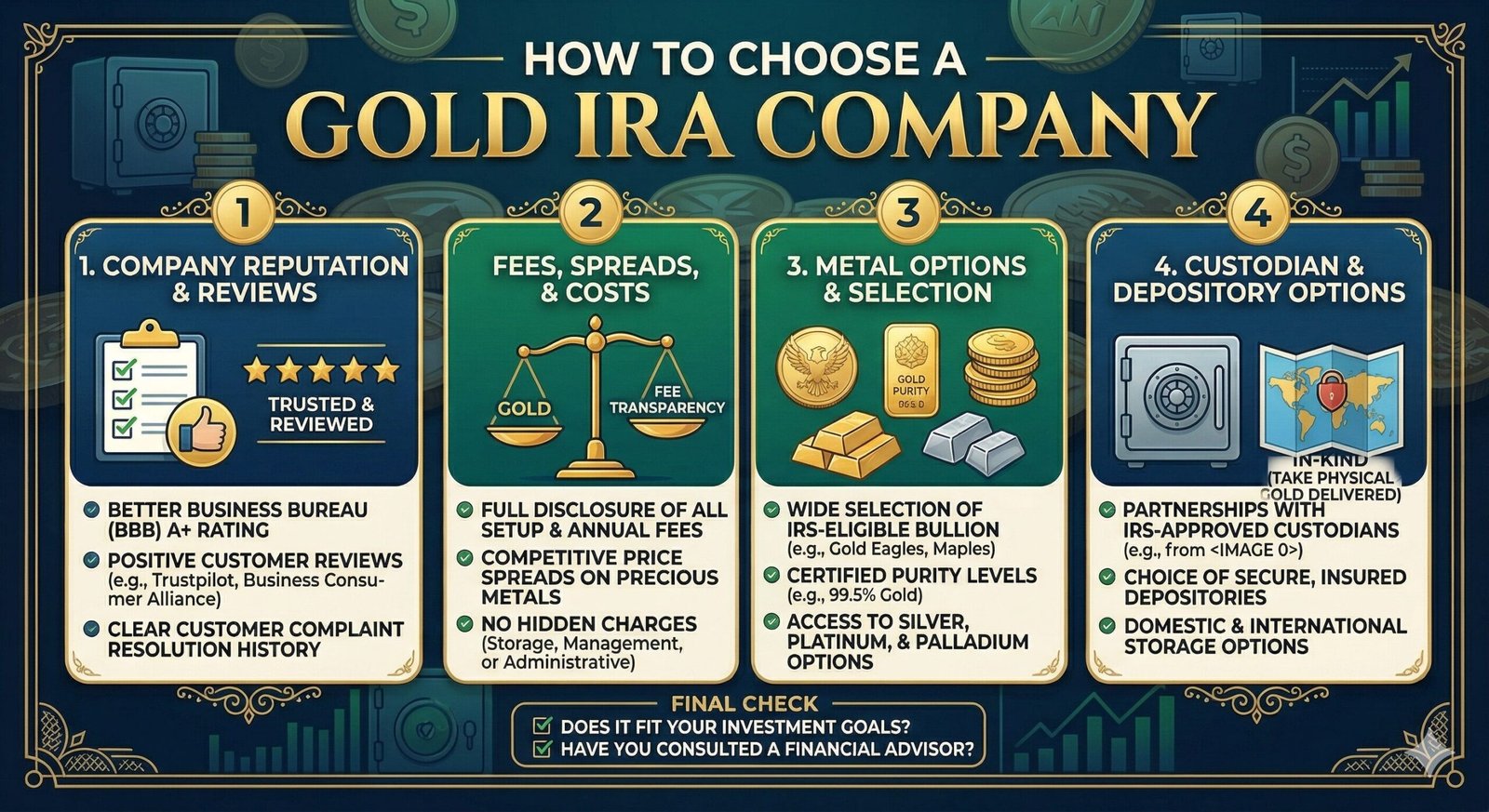
For New Mexico investors, custodians do not need to be based in New Mexico. Many established Gold IRA custodians operate nationally, and working with a reputable one — regardless of their physical location — is what matters most. You can verify custodian credentials through resources like FINRA BrokerCheck and check company records through bbb.org.
IRS-Approved Precious Metals: What Can Your Account Hold?
Not all gold is eligible for a Gold IRA. The IRS sets strict purity and form requirements. Gold must meet a minimum fineness of 0.995 (99.5% pure), and it must be in the form of coins or bars produced by an approved mint or manufacturer.
Commonly held forms include American Gold Eagle coins (which are an exception to the 0.995 fineness rule at 0.9167), American Gold Buffalo coins, Canadian Gold Maple Leaf coins, and bars produced by LBMA-approved refiners. Our guide to IRA-eligible gold coins goes into more detail on which specific products meet IRS standards.
Collector coins, jewelry, and gold bullion that doesn’t meet the fineness threshold are not permitted. Placing a non-qualifying asset into an IRA is treated as a prohibited transaction, which can trigger taxes and penalties.
Storage: Approved Depositories Only
Gold held in a self-directed IRA must be stored at an IRS-approved depository — a secure, insured facility that specializes in the storage of precious metals. Home storage is not permitted, and attempts to work around this requirement by storing IRA gold at home can result in the IRS treating the entire account as a distribution, with corresponding tax consequences.
Approved depositories operate in a small number of locations across the United States. Common examples include facilities in Delaware, Texas, and Utah. New Mexico does not currently host a major IRS-approved precious metals depository, which is not unusual — most states don’t. Your custodian will typically offer a selection of approved depositories for you to choose from.
Rollovers and Transfers from Existing Retirement Accounts
Many New Mexico investors who open Gold IRAs do so by rolling over funds from an existing 401(k), 403(b), or traditional IRA rather than making new cash contributions. This can be a practical way to move toward a self-directed structure without exceeding annual contribution limits.
The mechanics of a rollover involve either a direct transfer (where funds move custodian to custodian without you taking possession) or an indirect rollover (where funds are distributed to you and you deposit them into the new account within 60 days). Failing to complete an indirect rollover within the 60-day window can result in the distribution being treated as taxable income.
For a detailed walkthrough of how this process works, our 401(k) to Gold IRA rollover guide covers the steps involved, and our Gold IRA rollover rules page explains the IRS rules that govern these transactions. You can also find IRS-authoritative detail in IRS Publication 590-A.
Understanding the Fees Involved
Gold IRAs carry a different cost structure than conventional IRAs. Because physical metal must be purchased, stored, and insured, the ongoing expenses are higher than what you’d typically encounter with a standard brokerage account. Understanding these costs upfront is important.
Our Gold IRA fees guide provides a more detailed breakdown of the fee types you’ll encounter and what to watch for when comparing custodians.
How Does a Gold IRA Compare to a Traditional IRA?
The core tax mechanics of a Gold IRA mirror those of a conventional IRA. A traditional Gold IRA offers pre-tax contributions and tax-deferred growth, with distributions taxed as ordinary income in retirement. A Roth Gold IRA involves after-tax contributions and, subject to IRS rules, tax-free qualified distributions.
What differs is what the account holds, how it’s administered, and the cost structure involved. Our Gold IRA vs Traditional IRA comparison goes through the structural differences in more detail for those weighing their options. The SEC investor resources page also offers useful background on retirement account types for those looking for a neutral, educational overview.
Minimum Investment Considerations
Gold IRA custodians and dealers often set minimum investment thresholds that are higher than those associated with a standard IRA. These minimums vary considerably between providers — some start at $5,000, while others require $25,000 or more to open an account. Our Gold IRA minimum investment guide breaks down what to expect across the major custodians and how minimum requirements factor into the selection process.
Avoiding Scams: What New Mexico Investors Should Watch For
As with any financial product, the Gold IRA space has attracted its share of misleading operators. Common warning signs include companies that pressure you to act quickly, make promises about investment returns, or use aggressive direct-mail tactics targeting older investors. Our Gold IRA scams guide covers the specific tactics to watch for and how to vet providers before committing.
Checking a company’s standing with the Better Business Bureau at bbb.org and verifying custodian credentials through FINRA BrokerCheck are reasonable starting points for due diligence.
Frequently Asked Questions
Is a Gold IRA treated differently in New Mexico than in other states?
No. Gold IRAs are governed by federal IRS rules, and there is no state-specific legislation in New Mexico that changes how these accounts work. The rules regarding contributions, distributions, eligible metals, custodian requirements, and storage are the same for New Mexico residents as for investors in any other state.
Can I store my Gold IRA metals at a facility in New Mexico?
New Mexico does not currently host a major IRS-approved precious metals depository. Your custodian will offer a selection of approved storage facilities located elsewhere in the United States. This is normal — most investors store their IRA metals in states like Delaware or Texas.
How do I know if a Gold IRA is right for my situation?
That depends on your individual financial circumstances, retirement timeline, and goals. This article is educational in nature and does not constitute financial advice. We recommend consulting with a qualified, independent financial advisor before making any decisions. You may also find our is a Gold IRA a good idea article useful for thinking through the key questions.
What happens to my Gold IRA when I reach RMD age?
At age 73, traditional IRA account holders must begin taking Required Minimum Distributions. For Gold IRAs, this typically means the custodian liquidates enough metal to satisfy the annual RMD, or the metal is distributed in-kind. The specific mechanics depend on the custodian’s processes. The IRS RMD FAQ explains the underlying rules.
Can I roll over my 401(k) into a Gold IRA without paying taxes?
A direct rollover from a 401(k) into a self-directed IRA is generally a non-taxable event, provided the funds move directly between custodians and the rollover is handled correctly. An indirect rollover that isn’t completed within 60 days may be treated as a taxable distribution. Review our Gold IRA rollover rules for full detail, and consult a tax professional for advice specific to your situation.
Ready to Learn More?
If you’re a New Mexico investor exploring your retirement options, understanding how Gold IRAs work is a sensible starting point. From there, comparing custodians carefully — looking at fees, storage options, minimums, and reputation — is the natural next step. To help with that process, visit our curated list of Best Gold IRA Companies of 2026 for an overview of the leading providers currently operating in this space.
This article is for informational purposes only and does not constitute financial or tax advice. Investing in precious metals involves risk including possible loss of principal.
Related guides
- Gold IRA Consumer Affairs Reviews: What to Look For
- Gold IRA Trustpilot Reviews: What Real Customers Say
- Gold IRA BBB Complaints: What Consumer Reports Reveal
- Is a Gold IRA Worth the Fees? A Cost-Benefit Analysis
- Are Gold IRA Fees Too High? Breaking Down the Real Costs
- Gold IRA Mistakes to Avoid: 10 Common Errors Investors Make