
Gold IRA in New Jersey: Rules and Top Providers
If you live in New Jersey and you’ve been exploring ways to add physical gold or other precious metals to your retirement savings, you’re not alone. Across the Garden State — from Bergen County to Cape May — retirement investors are asking the same questions: How does a Gold IRA actually work? Are there any New Jersey-specific rules I need to know about? And how do I find a provider I can trust?
This guide answers all of those questions in plain English, without the sales pressure or the financial jargon. Whether you’re still in the research phase or ready to take your next step, here’s what every New Jersey investor should understand before opening a Gold IRA.
What Is a Gold IRA?
A Gold IRA is a type of self-directed Individual Retirement Account that holds physical precious metals — such as gold bullion bars or IRA-eligible coins — rather than the stocks, bonds, or mutual funds you’d find in a conventional IRA. Despite the different asset type, a Gold IRA operates under the same broad federal framework as any other IRA.
If you’d like a thorough introduction before going deeper, our Gold IRA hub covers the fundamentals clearly, and you can also find a more detailed breakdown in Gold IRAs Explained in Detail.
The key distinction is the “self-directed” structure. A self-directed IRA gives you, the account holder, authority to choose from a wider range of permitted asset classes — including IRS-approved precious metals. However, that additional control also comes with additional responsibility. You’ll need to work with a qualified custodian and understand IRS requirements closely. FINRA’s guidance on self-directed IRAs is a useful starting point for understanding the oversight structure of these accounts.
Federal Rules That Apply to Every Gold IRA — Including New Jersey
Before looking at anything New Jersey-specific, it’s worth establishing the federal baseline. These rules apply to every American regardless of which state they live in.
IRS Purity Standards for Precious Metals
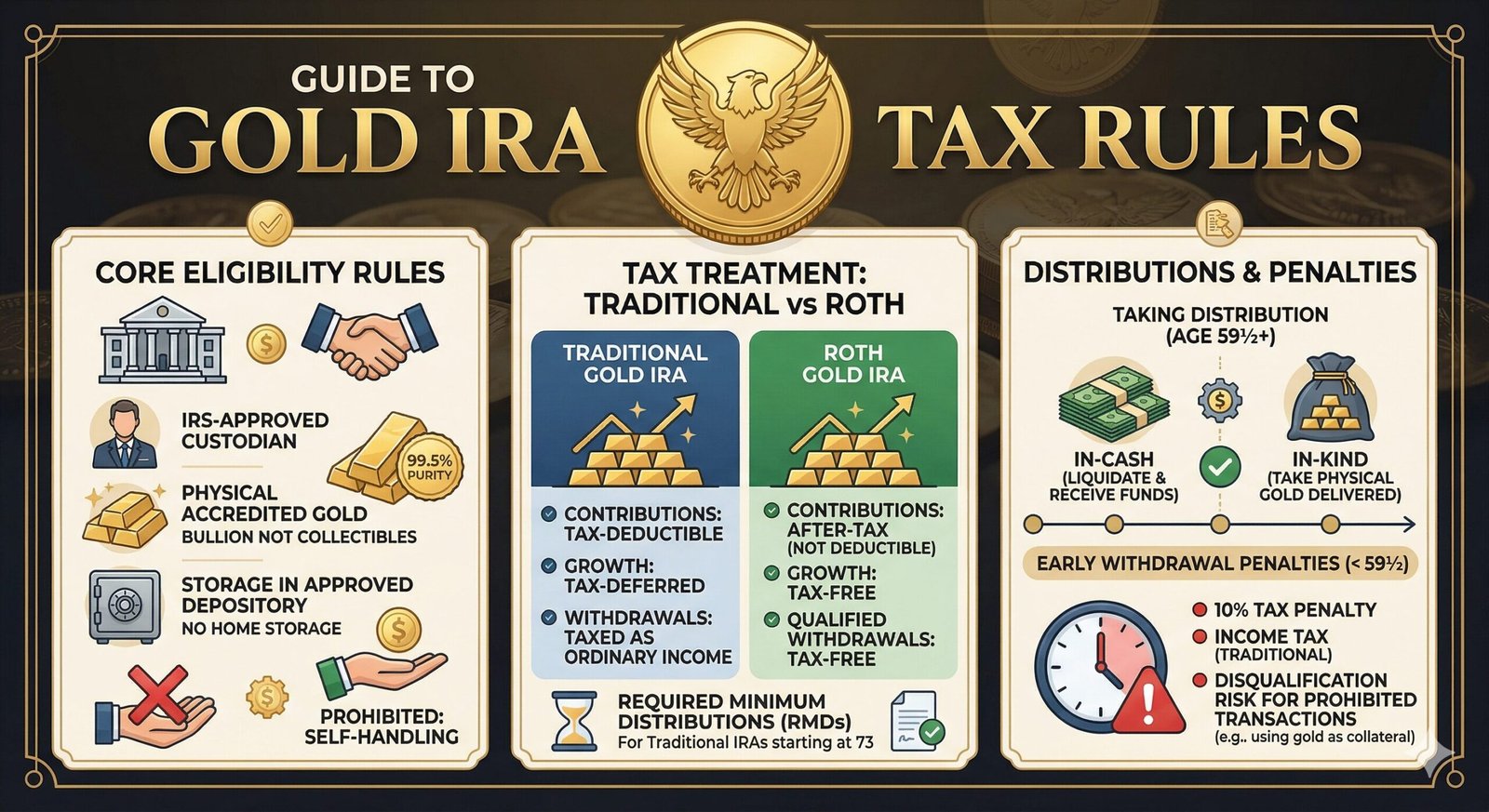
Not every gold product qualifies for inclusion in an IRA. The IRS sets strict purity thresholds: gold must be at least 99.5% pure (0.995 fineness), silver 99.9%, platinum 99.95%, and palladium 99.95%. Common products that meet the standard include American Gold Eagles, American Gold Buffalos, and certain gold bars produced by NYMEX- or COMEX-approved refiners. For a broader look at what qualifies, see our guide to IRA-eligible gold coins.
Custodian and Storage Requirements
The IRS requires that all physical metals held in a Gold IRA be stored at an approved third-party depository — not in your home, a personal safe, or a bank safety deposit box. This is a hard rule, not a recommendation. Metals must be held by an IRS-qualified custodian, and that custodian arranges approved storage on your behalf.
This three-party structure — you, your custodian, and a licensed depository — is what distinguishes a compliant Gold IRA from simply buying and keeping gold yourself. The IRS IRA investment FAQ addresses this directly and is worth bookmarking.
Contribution Limits
For 2025, the standard IRA contribution limit is $7,000 per year. If you’re 50 or older, you’re eligible for a catch-up contribution that brings your annual limit to $8,000. These limits apply across all of your IRAs combined — not per account. Up-to-date figures are published directly on the IRS contribution limits page.
Required Minimum Distributions
If you hold a traditional Gold IRA, you’ll be required to begin taking Required Minimum Distributions (RMDs) starting at age 73 under current law. Because your assets are physical metals rather than cash, this often means either selling a portion of your holdings or taking an in-kind distribution. Planning ahead for this is important — the IRS RMD FAQ explains the rules in full.
New Jersey-Specific Considerations for Gold IRA Investors
Here’s the important clarification: Gold IRAs are governed almost entirely by federal law. New Jersey does not impose a separate licensing regime on Gold IRA custodians, nor does the state have unique rules about what metals can be held in a retirement account. However, there are a handful of state-level factors that New Jersey residents should be aware of.
New Jersey State Income Tax Treatment of IRA Distributions
New Jersey has its own income tax structure, and it does not fully conform to federal tax treatment of retirement accounts. One important difference: New Jersey does not allow a deduction for traditional IRA contributions in the way that federal law does. That means contributions made to a traditional IRA may already have been taxed at the state level — which can affect how distributions are taxed in retirement.
When you eventually take distributions from a Gold IRA, New Jersey will tax those distributions as ordinary income, but the state does provide an exclusion for pension and retirement income for qualifying taxpayers. Whether a Gold IRA distribution qualifies depends on individual circumstances and the type of account you hold.
This is a nuanced area, and nothing in this article constitutes tax advice. Speak with a licensed tax professional who is familiar with New Jersey’s retirement income rules before making decisions. You can also review IRS Publication 590-A for the federal framework.
New Jersey’s Sales Tax Exemption on Precious Metals
One practical advantage for New Jersey investors is that the state exempts certain precious metals from sales tax when purchased for investment purposes. This is relevant if you’re ever buying metals outside of an IRA structure, and it reflects a broader recognition that gold and silver serve as financial assets in the state.
No State-Level Custodian Requirement
Your Gold IRA custodian does not need to be based in New Jersey. Most reputable custodians operate federally and serve clients in all 50 states. As a New Jersey resident, you have full access to the national market for Gold IRA custodians and depositories.
Comparing Gold IRA Account Types Available to New Jersey Investors
New Jersey residents can open any of the standard IRA types in a self-directed format. Here’s a quick comparison of the most common options:
If you’re considering rolling over funds from a 401(k) or existing IRA, our 401(k) to Gold IRA rollover guide walks through the process step by step, and the Gold IRA rollover rules page covers the specific IRS rules around timing and eligibility.
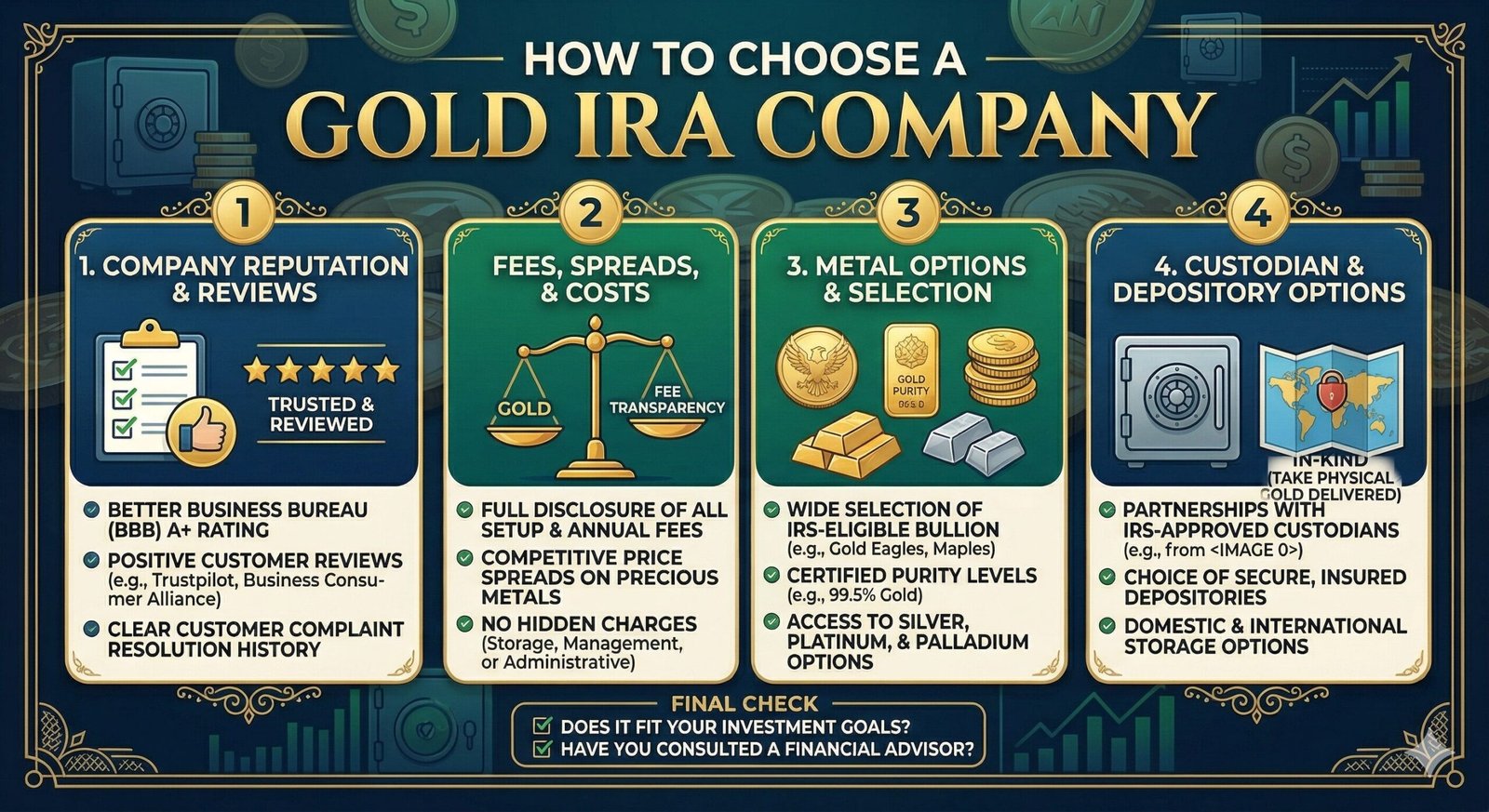
How to Find a Reputable Gold IRA Provider in New Jersey
Because your custodian doesn’t need to be located in New Jersey, your priority should be finding a nationally reputable company that serves New Jersey clients — not simply one with a local office.
What to Look for in a Custodian
Reputation matters enormously in this space. Look for companies with long operating histories, transparent fee structures, and strong ratings from independent sources like the Better Business Bureau at bbb.org. You can also verify the background of financial professionals through FINRA BrokerCheck.
A trustworthy custodian will be upfront about all costs — including setup fees, annual maintenance fees, and storage charges. Our Gold IRA fees guide explains what to expect and how to compare costs across providers.
Minimum Investment Requirements
Different custodians set different minimums to open an account. Some require as little as $5,000, while others set their floor at $25,000 or higher. Understanding the entry point before you apply saves time and avoids surprises. Our Gold IRA minimum investment guide covers what various providers typically require.
Avoiding Scams and High-Pressure Tactics
Unfortunately, the Gold IRA space has attracted some operators who use misleading claims or aggressive sales tactics. If a company is pressuring you to act immediately, making dramatic predictions, or promising guaranteed returns, treat that as a serious warning sign. Our Gold IRA scams guide covers the most common tactics and how to spot them.
The SEC investor resources page is also a valuable reference when vetting any retirement account provider.
Frequently Asked Questions: Gold IRA in New Jersey
Can I store my Gold IRA metals at home in New Jersey?
No. Regardless of which state you live in, IRS rules require that metals held inside an IRA be stored at an approved third-party depository. Storing IRA metals at home — even in a secure safe — would be treated as a distribution and trigger taxes and potential penalties.
Do I need to use a New Jersey-based custodian?
No. Gold IRA custodians operate federally and are not restricted by state boundaries. New Jersey residents can work with any IRS-qualified custodian in the United States, provided that custodian is properly licensed and reputable.
How does New Jersey’s income tax affect my Gold IRA distributions?
New Jersey taxes IRA distributions as ordinary income, but the state also offers retirement income exclusions for qualifying taxpayers. Because New Jersey does not conform to all federal IRA rules, consult a licensed tax professional familiar with state law before drawing income from your account.
Can I roll over my existing 401(k) into a Gold IRA if I live in New Jersey?
Yes. Living in New Jersey has no bearing on your ability to roll over a 401(k), 403(b), or other qualifying retirement account into a self-directed Gold IRA. Federal rollover rules govern this process entirely. See our Gold IRA rollover rules for the full breakdown.
Is a Gold IRA right for every retirement investor?
That depends on your individual circumstances, goals, and financial situation — and it’s a question best answered with the help of a qualified financial advisor. Our article on is a Gold IRA a good idea explores the considerations in detail without telling you what to do. Thinking through those factors carefully, ideally with professional guidance, is always the right starting point.
Ready to Explore Your Options?
New Jersey investors have full access to the national Gold IRA market and no shortage of reputable providers to consider. The federal rules apply uniformly, and finding the right custodian comes down to reputation, transparency, and fit with your specific situation.
For a curated, up-to-date overview of the most reputable providers in the country, visit our Best Gold IRA Companies of 2026 page, where we review the leading options based on fees, minimums, customer service, and compliance track record.
This article is for informational purposes only and does not constitute financial or tax advice. Investing in precious metals involves risk including possible loss of principal.
Related guides
- Gold IRA Consumer Affairs Reviews: What to Look For
- Gold IRA Trustpilot Reviews: What Real Customers Say
- Gold IRA BBB Complaints: What Consumer Reports Reveal
- Is a Gold IRA Worth the Fees? A Cost-Benefit Analysis
- Are Gold IRA Fees Too High? Breaking Down the Real Costs
- Gold IRA Mistakes to Avoid: 10 Common Errors Investors Make