Gold IRA in New Hampshire: Complete Investor Guide
New Hampshire has a well-earned reputation for financial independence. From its lack of a state income tax on wages to its broadly self-reliant culture, the Granite State attracts residents who take a hands-on approach to managing their own financial futures. For retirement investors in New Hampshire who want to include physical gold or other precious metals in their tax-advantaged accounts, a Gold IRA offers one avenue worth understanding in full.
This guide walks through how Gold IRAs work, what federal rules apply to New Hampshire residents, how to choose a qualified custodian, where your metals are stored, and what costs you should anticipate before opening an account.
What Is a Gold IRA and How Does It Work?
A Gold IRA is a self-directed individual retirement account that holds physical precious metals — such as gold, silver, platinum, or palladium — rather than conventional paper assets like stocks or mutual funds. The account operates under the same broad IRS framework as a traditional or Roth IRA, meaning contributions, withdrawals, and tax treatment follow familiar rules. What makes it different is the asset class held inside.
For a thorough grounding in the mechanics, visit our Gold IRA hub, which covers the foundational concepts in plain terms. You can also read Gold IRAs Explained in Detail for a deeper walk-through of how these accounts are structured.
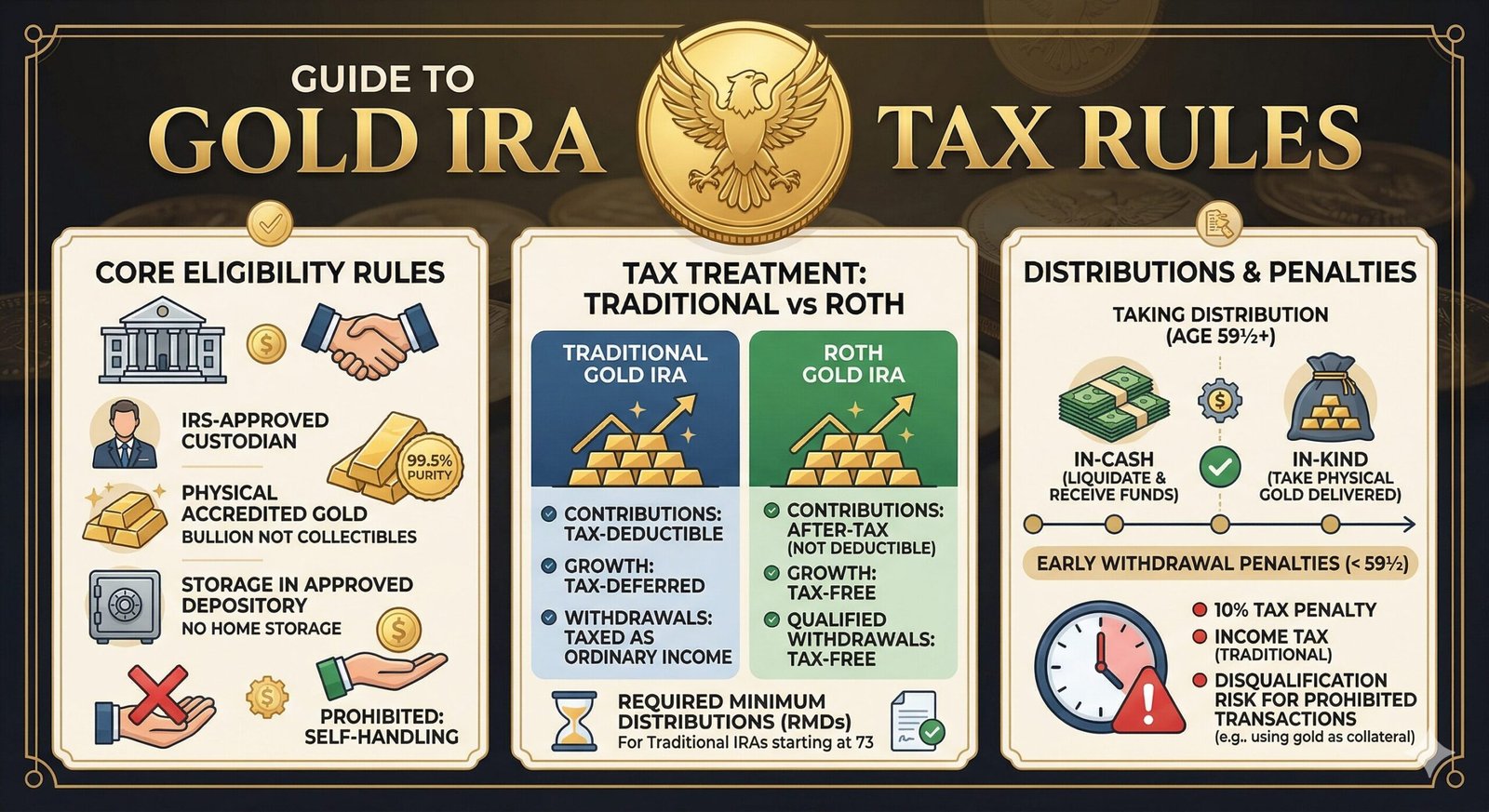
The IRS requires that physical metals in a self-directed IRA meet specific purity standards and be held by an approved custodian — not in a home safe or personal storage facility. This is a federal requirement, not a New Hampshire-specific one. According to the IRS IRA investment FAQ, collectibles are generally prohibited in IRAs, but certain bullion products that meet fineness thresholds are explicitly permitted.
Federal Rules That Apply to New Hampshire Residents
There is no state-level Gold IRA law in New Hampshire. All rules governing these accounts come from federal legislation, primarily the Internal Revenue Code, as interpreted and enforced by the IRS. New Hampshire residents are subject to the same contribution limits, distribution rules, and IRS purity requirements as investors in any other state.
IRS Purity Requirements for Eligible Metals
The IRS sets minimum fineness standards for metals held in a Gold IRA:
- Gold: 99.5% pure (0.995 fineness)
- Silver: 99.9% pure
- Platinum and Palladium: 99.95% pure
American Gold Eagle coins are a notable exception — they are IRA-eligible despite being slightly below the 99.5% fineness threshold, because Congress specifically authorized them. For a broader overview of which products qualify, our guide on IRA-eligible gold coins is a useful reference.
Contribution Limits
For 2024, the standard IRA contribution limit is $7,000 per year. Investors aged 50 and older can contribute an additional $1,000 as a catch-up contribution, bringing the total to $8,000. These figures apply to all IRA types, including Gold IRAs. The IRS contribution limits page is updated annually and is worth bookmarking.
Required Minimum Distributions
Once you reach age 73, the IRS requires you to begin taking required minimum distributions (RMDs) from a traditional Gold IRA. Because your assets are held as physical metals rather than cash, RMDs can be taken either in-kind (as physical metal) or by liquidating a portion of your holdings. The IRS RMD FAQ explains how these calculations work in practice.
New Hampshire’s Tax Environment and Gold IRAs
One of New Hampshire’s more appealing financial features is its absence of a broad-based state income tax on wages and salary. However, the state has historically taxed interest and dividend income under its Interest and Dividends Tax, which was phased out completely as of January 1, 2025. This means distributions from a traditional Gold IRA — which are treated as ordinary income — are not subject to New Hampshire state income tax.
This is a factual description of New Hampshire’s tax structure, not tax advice. Individual circumstances vary considerably. Always consult a qualified tax professional before making decisions based on your state tax situation.
Choosing a Gold IRA Custodian as a New Hampshire Investor
A self-directed IRA custodian is a financial institution authorized by the IRS to administer non-traditional retirement accounts. Unlike standard brokerage IRAs, a Gold IRA custodian must be equipped to handle physical asset documentation, coordinate with approved depositories, and maintain IRS-compliant records.
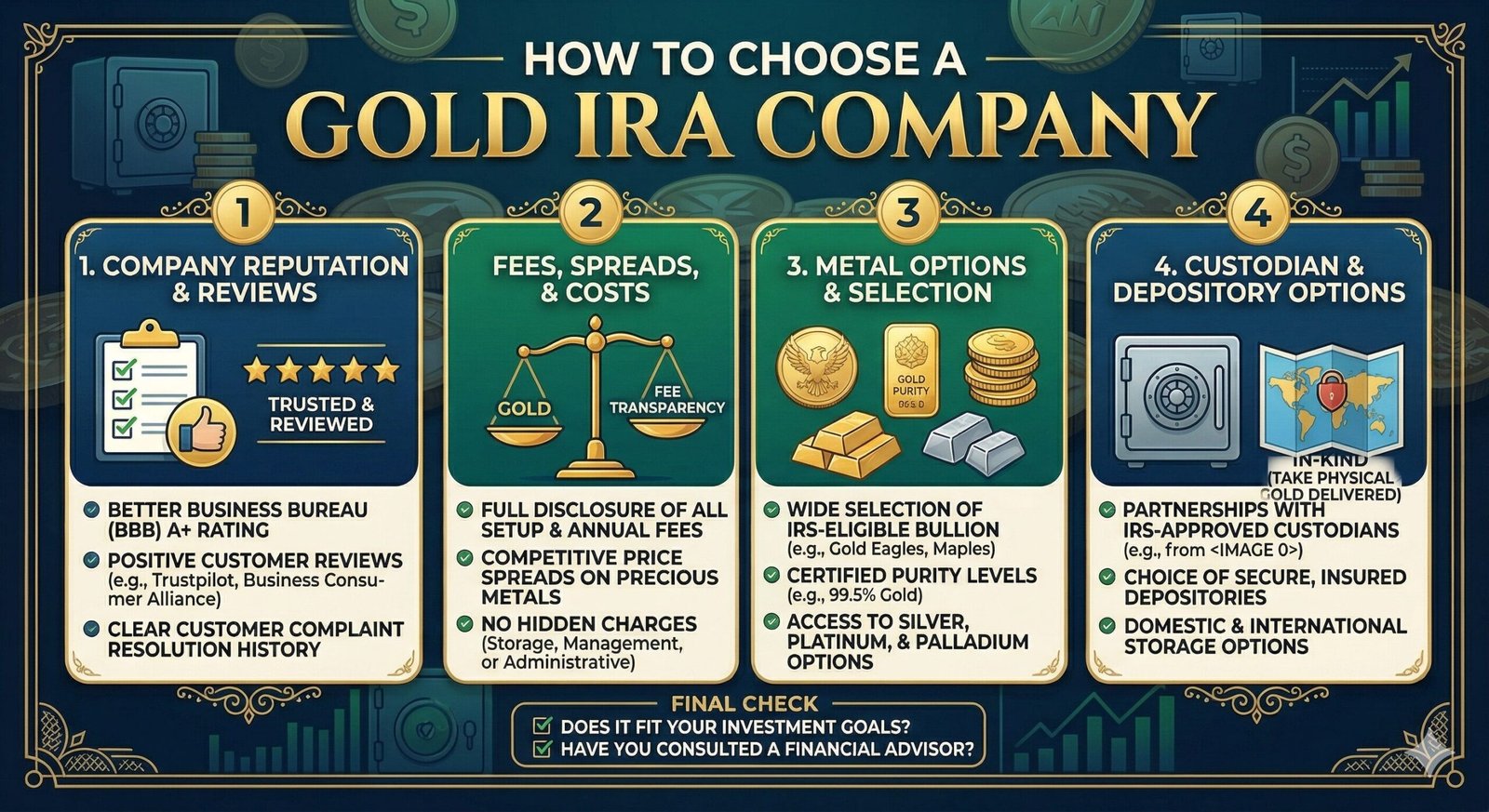
New Hampshire residents are not required to use a custodian based in-state. Most reputable custodians are licensed at the federal level and operate nationally. What matters is that the custodian is IRS-approved and has a verifiable track record. FINRA’s guidance on self-directed IRAs is a valuable resource when evaluating any self-directed account provider.
Before opening an account, research any custodian’s standing with the Better Business Bureau at bbb.org and review their regulatory history through FINRA BrokerCheck. Our Gold IRA scams guide also outlines common red flags to watch for when evaluating providers.
Where Is Your Gold Physically Stored?
IRS rules prohibit you from taking personal possession of metals held inside a Gold IRA. Your metals must be stored in an IRS-approved depository — a secure, insured facility that maintains segregated or commingled storage options.
New Hampshire does not have a major IRS-approved depository within state lines. This is common across most of the country. Approved depositories are located in select cities across the U.S., including Delaware, Texas, and Nevada, among others. Your custodian will typically have established relationships with one or more of these facilities and will manage logistics on your behalf.
When evaluating storage, ask whether the depository offers segregated storage (your metals kept separately from other clients’ holdings) versus commingled storage (pooled with others’ assets). Segregated storage typically costs more but may offer additional peace of mind regarding specific bar identification and accountability.
Key Fees to Understand Before You Commit
Gold IRA fees are more layered than those of a standard brokerage IRA. Understanding what you’ll pay — and to whom — is essential before opening an account. Our dedicated Gold IRA fees guide breaks this down in detail, but here is a structured overview:
These ranges are indicative and can vary widely between providers. Always request a complete fee schedule in writing before signing any agreement.
Rolling Over a 401(k) or Existing IRA to a Gold IRA
Many New Hampshire retirement investors considering a Gold IRA already have funds in a 401(k) from a former employer or a traditional IRA at a brokerage. Both types of accounts can potentially be rolled over or transferred into a self-directed Gold IRA.
There are two primary methods:
Direct rollover (or trustee-to-trustee transfer): Funds move directly from the old account to the new custodian without passing through your hands. This is generally the more straightforward approach and avoids triggering the 60-day rule.
Indirect rollover: You receive the funds personally and have 60 days to deposit them into the new account. If you miss the deadline, the IRS treats the distribution as taxable income — and if you’re under 59½, an early withdrawal penalty may also apply.
For a full walk-through of this process, our 401(k) to Gold IRA rollover guide covers each step clearly. You should also review the Gold IRA rollover rules to understand IRS limitations on frequency and timing. According to IRS Publication 590-A, you are generally limited to one IRA-to-IRA rollover per 12-month period.
Is a Gold IRA Right for You?
A Gold IRA is not a one-size-fits-all product. It carries real costs, meaningful complexity, and different risk characteristics than a conventional retirement account. Our article on is a Gold IRA a good idea examines the practical trade-offs in a balanced way.
If you are comparing a Gold IRA to your existing retirement structures, our Gold IRA vs Traditional IRA and Gold IRA vs 401(k) comparisons may help clarify how these accounts differ in terms of structure, flexibility, and tax treatment.
One additional consideration for New Hampshire investors: the Gold IRA minimum investment threshold varies by company and can range from $5,000 to $50,000 or more. If you are starting with a smaller amount, it is worth confirming minimums with any provider before beginning the paperwork process.
Frequently Asked Questions
Q: Do New Hampshire residents pay state tax on Gold IRA distributions?
New Hampshire does not levy a broad state income tax on ordinary income, including retirement distributions. As of January 1, 2025, the state’s Interest and Dividends Tax has been fully eliminated. This is a general factual statement; your specific circumstances may differ, and a tax professional can provide guidance tailored to your situation.
Q: Can I store my Gold IRA metals at home in New Hampshire?
No. IRS rules prohibit personal possession of metals held inside an IRA, regardless of which state you live in. Metals must be stored at an IRS-approved depository. Storing metals at home could result in the IRS treating the entire account as a taxable distribution.
Q: Does the custodian I choose need to be based in New Hampshire?
No. Gold IRA custodians are licensed at the federal level and can serve clients across all 50 states. Most investors work with national custodians regardless of their state of residence.
Q: How often can I roll over funds into a Gold IRA?
The IRS generally limits you to one IRA-to-IRA rollover per 12-month period. Trustee-to-trustee transfers — where funds move directly between institutions — do not count toward this limit. Our Gold IRA rollover rules page explains these distinctions in detail.
Q: What happens to my Gold IRA metals when I reach RMD age?
When you reach age 73, you must begin taking required minimum distributions from a traditional Gold IRA. You can take these as physical metal (in-kind distribution) or liquidate a portion of your holdings for cash. Your custodian will typically assist with the calculation and execution of RMDs.
Take the Next Step
If you are a New Hampshire investor exploring how a Gold IRA might fit into your retirement planning, the most important starting point is working with a credible, well-reviewed provider. Fees, custodian quality, and storage arrangements all vary significantly across companies. Our independently researched list of the Best Gold IRA Companies of 2026 is a good place to begin comparing your options in a structured, side-by-side format.
This article is for informational purposes only and does not constitute financial or tax advice. Investing in precious metals involves risk including possible loss of principal.
Related guides
- Gold IRA Consumer Affairs Reviews: What to Look For
- Gold IRA Trustpilot Reviews: What Real Customers Say
- Gold IRA BBB Complaints: What Consumer Reports Reveal
- Is a Gold IRA Worth the Fees? A Cost-Benefit Analysis
- Are Gold IRA Fees Too High? Breaking Down the Real Costs
- Gold IRA Mistakes to Avoid: 10 Common Errors Investors Make