Gold IRA in Montana: Investor Guide for 2026
Montana has always attracted a particular kind of independence — in its landscapes, its culture, and increasingly, in how its residents approach long-term financial planning. For retirement investors across Big Sky Country, questions about Gold IRAs are becoming more common, and for good reason. As retirement accounts grow and investors seek ways to hold physical assets within a tax-advantaged structure, understanding how a Gold IRA works — and what rules apply — is a worthwhile exercise.
This guide is written specifically for Montana residents exploring Gold IRAs in 2026. It covers the federal framework that governs these accounts, what to look for in a custodian, the costs involved, and how the rollover process typically works. If you are between 45 and 70 and starting to ask serious questions about physical gold in a retirement account, this is a practical starting point.
What Is a Gold IRA?
A Gold IRA is a self-directed Individual Retirement Account that holds physical precious metals — gold, silver, platinum, or palladium — rather than conventional paper assets like stocks or mutual funds. The account operates under the same federal tax framework as a traditional or Roth IRA, but requires a specialized custodian and an IRS-approved depository for storage.
For a detailed explanation of the account structure, visit our Gold IRA hub or read Gold IRAs Explained in Detail, which covers everything from the IRS requirements to the difference between a traditional and Roth Gold IRA.
It is worth noting upfront: a Gold IRA is not a simple, low-maintenance account. It involves more moving parts than a brokerage IRA, and investors should approach it with clear eyes about both the potential and the obligations involved.
Federal Rules Govern Gold IRAs — Montana Adds No State Layer
One of the first things Montana investors often wonder is whether their state has specific rules governing Gold IRAs. The answer is straightforward: Gold IRAs are regulated entirely at the federal level by the Internal Revenue Service. There is no additional Montana state licensing requirement, no separate state approval process, and no state-specific Gold IRA legislation that changes how these accounts function.
What Montana investors are subject to is exactly what every other American investor faces — the federal IRS framework for self-directed IRAs holding precious metals. That means the same contribution limits, the same rollover rules, and the same prohibited transaction restrictions apply whether you live in Billings, Missoula, Bozeman, or Great Falls.
This is actually useful information, because it means any reputable, IRS-compliant Gold IRA company operating nationally is fully capable of serving Montana residents. You are not required to use a Montana-based company, and in practice, most of the well-established custodians and dealers in this space operate out of states like Delaware, Nevada, or Texas.
IRS Requirements: What Makes a Gold IRA Compliant?
Understanding the IRS requirements is essential before opening any account. The rules are not optional, and non-compliance can result in the IRS treating your entire account as a taxable distribution — a costly outcome.
Purity and Eligibility Standards
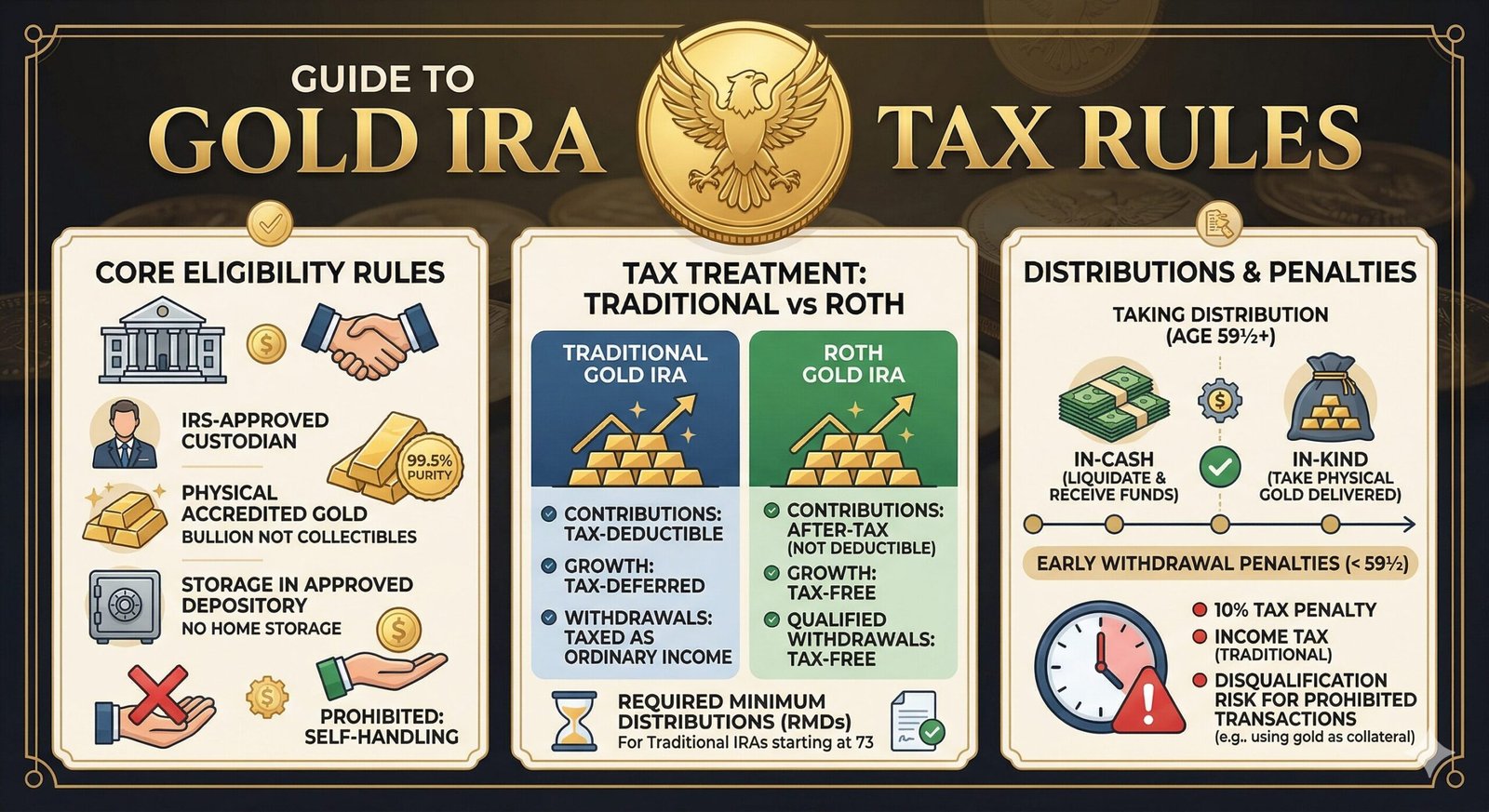
The IRS specifies that gold held inside an IRA must meet a minimum purity of 99.5%. Common eligible products include the American Gold Eagle (which is granted a special exception despite being 91.67% pure), the American Gold Buffalo, the Canadian Gold Maple Leaf, and certain gold bars and rounds from LBMA-approved refiners. You can review a full breakdown of IRA-eligible gold coins to understand which products qualify.
Not every gold coin or bar you can purchase at a local Montana coin shop will be IRA-eligible. Collectibles, rare coins, and products that don’t meet purity thresholds are excluded. The IRS IRA investment FAQ at IRS.gov provides authoritative guidance on what types of assets self-directed IRAs may hold.
Custodian and Storage Requirements
The IRS does not allow you to hold IRA-owned gold personally. You cannot store it in your home safe, a personal safe deposit box, or any facility you control. The metals must be held by an IRS-approved custodian and stored at an approved depository. This requirement applies uniformly — there are no exceptions for Montana residents living on rural property far from the nearest bank.
FINRA’s guidance on self-directed IRAs is worth reviewing, as it outlines the responsibilities custodians carry and the due diligence investors should apply when selecting one.
Contribution Limits and Rollover Rules
For 2026, the IRS contribution limit for IRAs is $7,000 per year for investors under 50, and $8,000 for those 50 and older (the catch-up contribution). These are the same limits that apply to any IRA — Gold IRAs do not receive a separate or elevated contribution allowance. The current limits are published directly at IRS.gov.
Most Montana investors who open a Gold IRA do so not through annual contributions but through a rollover from an existing retirement account — typically a 401(k), 403(b), or traditional IRA. The mechanics of a direct rollover versus an indirect rollover matter considerably, and understanding the 60-day rule and withholding implications is important. Our 401(k) to Gold IRA rollover guide covers this process step by step, and you can also review the detailed Gold IRA rollover rules that apply to any transfer.
Understanding Gold IRA Fees
This is an area where Montana investors — and all Gold IRA investors — need to pay close attention. Gold IRA fees are considerably higher than those associated with a conventional brokerage IRA, and they are structured differently.
Typical fees include a one-time account setup fee, an annual custodian maintenance fee, and annual storage fees charged by the depository. Some companies charge a flat annual storage fee regardless of account size; others charge a scaled percentage of the account’s value. The difference can be significant over time.
Here is a general overview of the fee categories you will encounter:
Our Gold IRA fees guide provides a more thorough breakdown of how these costs interact and what questions to ask before signing any agreement. Fee transparency is one of the most important factors when comparing custodians — any company unwilling to disclose its full fee schedule in writing should be treated with caution.
Selecting a Custodian as a Montana Investor
Because Montana has no state-level Gold IRA custodian licensing, Montana residents rely on the same nationally operating custodians available to all U.S. investors. When evaluating any company, there are several practical considerations worth prioritising.
Regulatory Standing and Reputation
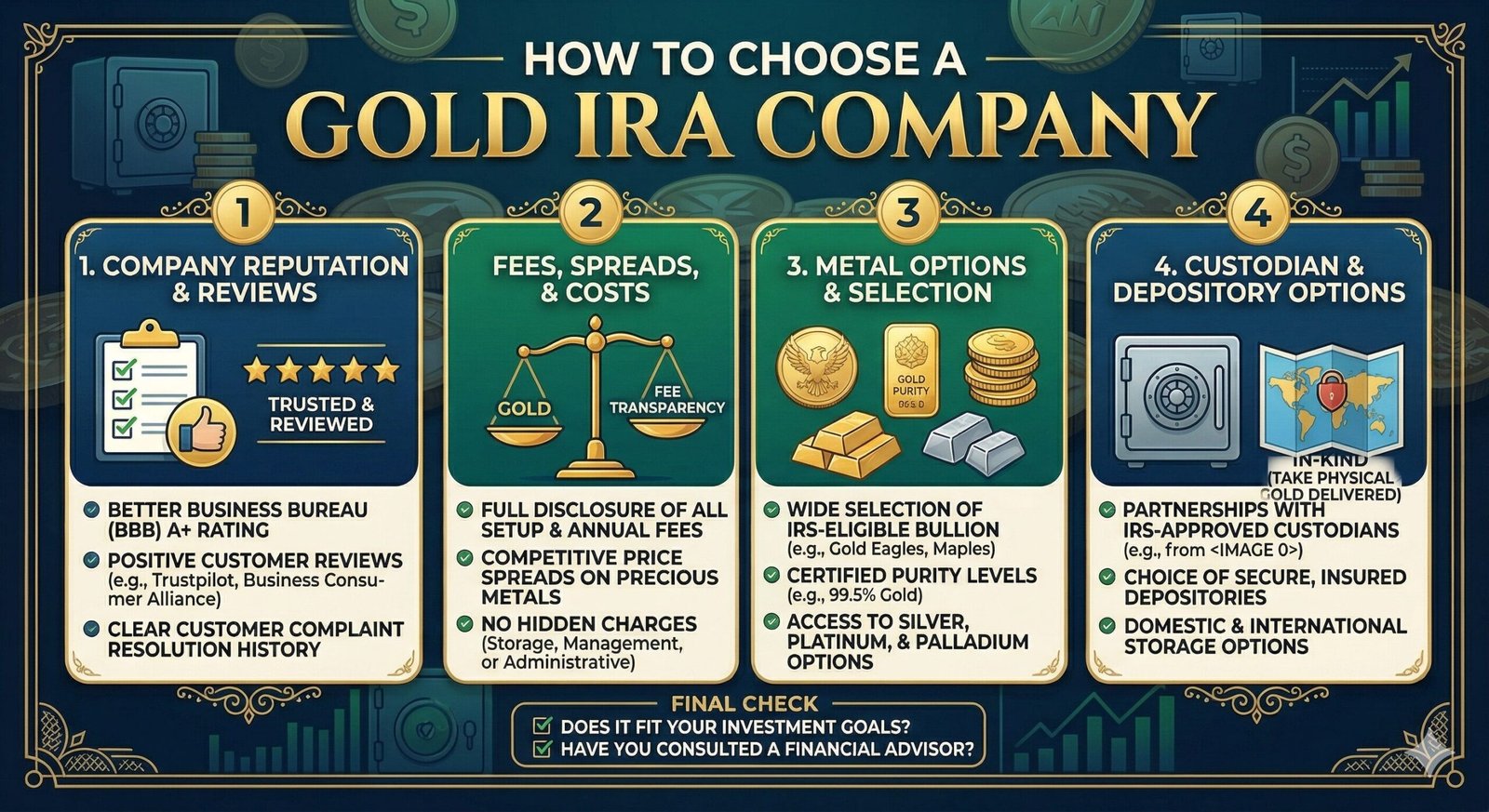
Custodians must be IRS-approved, which typically means they are chartered trust companies or banks. Beyond that baseline, look for companies with strong ratings on the Better Business Bureau at bbb.org and verify any financial professional’s credentials using FINRA BrokerCheck. A long operational history and clean regulatory record matter more than marketing claims.
Storage Options
Ask specifically whether the depository used offers segregated storage (your metals are stored separately from other clients’ metals) or commingled storage (metals are pooled). Both are IRS-compliant, but segregated storage offers a clearer chain of custody. Many Montana investors, given the state’s general preference for tangible assets and clear ownership, prefer segregated arrangements.
Customer Service and Educational Resources
The Gold IRA process involves real paperwork and real decisions — account types, storage elections, metal selections, and rollover coordination. Companies that invest in educating their clients typically make the process smoother. Look for responsive support teams and clear documentation. Our Gold IRA scams guide outlines the warning signs that should prompt you to walk away from any company.
Required Minimum Distributions and Gold IRAs
If your Gold IRA is structured as a traditional IRA (pre-tax contributions), you will be subject to Required Minimum Distributions beginning at age 73 under current federal rules. RMDs from a Gold IRA are the same as any other traditional IRA — the IRS requires a distribution based on your account value and life expectancy factor.
The complication with a Gold IRA is that your assets are physical — you cannot simply liquidate a fraction of a stock position. Your custodian will typically either sell a portion of your metals to satisfy the RMD in cash or, if permitted, distribute physical metal in-kind. Both approaches have implications worth understanding. The IRS RMD FAQ is a useful reference for the exact calculation rules and distribution deadlines.
Is a Gold IRA Right for Montana Investors?
This is a question that deserves a careful, individual answer. Our is a Gold IRA a good idea article walks through the considerations in plain terms, without pushing you toward any particular conclusion. Gold IRAs involve real costs, real regulatory complexity, and real tradeoffs that vary depending on your existing retirement assets, timeline, and financial situation.
What suits one Montana investor may not suit another. Someone with a substantial 401(k) from decades in the energy or agriculture industry, approaching retirement, may have different considerations than a self-employed ranch owner who has been contributing to a SEP IRA for years. Speaking with a qualified, independent financial advisor — one who is not compensated for steering you toward any particular product — is always a reasonable step before opening any self-directed account. The SEC investor resources page is a good reference point for understanding retirement account basics from a regulatory perspective.
You may also find it useful to compare Gold IRA vs Traditional IRA to understand how the structures differ before making any decisions.
Frequently Asked Questions
Q: Do Montana residents face any state-specific taxes on Gold IRA distributions?
Montana does impose a state income tax, and distributions from a traditional Gold IRA are treated as ordinary income — the same as any traditional IRA distribution — and would generally be subject to Montana state income tax in addition to federal income tax. However, this article does not constitute tax advice, and you should consult a qualified tax professional for guidance specific to your situation.
Q: Can I store Gold IRA metals at home in Montana?
No. Regardless of where you live, IRS rules require that all metals held inside an IRA be stored at an IRS-approved depository. Storing IRA-owned gold at home — including in a personal safe — is considered a prohibited transaction and can result in the IRS treating the entire account as a taxable distribution.
Q: Does Montana have any Gold IRA custodians operating within the state?
Montana has limited financial infrastructure for specialized trust companies compared to larger states. Most Gold IRA custodians serving Montana investors operate nationally from states such as Delaware, South Dakota, or Nevada. This is common and fully compliant — custodian location does not affect the IRS legitimacy of the account.
Q: What is the minimum investment typically required to open a Gold IRA?
This varies by company, but many reputable custodians set minimums between $10,000 and $50,000. Our Gold IRA minimum investment page provides a breakdown of what to expect across different companies in the market.
Q: How long does a 401(k) rollover into a Gold IRA typically take?
A direct rollover from a 401(k) to a Gold IRA generally takes between two and six weeks, depending on how quickly your plan administrator processes the transfer and how efficiently the receiving custodian handles the paperwork. An indirect rollover must be completed within 60 days to avoid tax consequences. See our Gold IRA rollover rules for a detailed timeline overview.
Ready to Take the Next Step?
If you are a Montana investor ready to explore your options in more depth, our independently researched comparison of the Best Gold IRA Companies of 2026 is the logical next step. We evaluate companies based on fee transparency, regulatory standing, customer service quality, and educational resources — giving you a clear starting point for your own due diligence.
This article is for informational purposes only and does not constitute financial or tax advice. Investing in precious metals involves risk including possible loss of principal.
Related guides
- Gold IRA Consumer Affairs Reviews: What to Look For
- Gold IRA Trustpilot Reviews: What Real Customers Say
- Gold IRA BBB Complaints: What Consumer Reports Reveal
- Is a Gold IRA Worth the Fees? A Cost-Benefit Analysis
- Are Gold IRA Fees Too High? Breaking Down the Real Costs
- Gold IRA Mistakes to Avoid: 10 Common Errors Investors Make