Gold IRA in Missouri: Complete Guide for 2026
If you live in Missouri and you’ve been researching ways to hold physical gold inside a retirement account, you’re not alone. Gold IRAs have attracted growing interest from retirement-minded investors across the country, and Missouri residents are no exception. Whether you’re a longtime saver in Kansas City, a retiree in St. Louis, or someone mid-career in Springfield, understanding how a gold IRA actually works — and what the rules look like from a Missouri perspective — is a practical first step before making any decisions.
This guide walks through everything Missouri residents need to know: what a gold IRA is, how the federal rules apply, what state-level considerations are relevant, how to choose a custodian, and what costs to expect. There’s no guesswork here — just the facts laid out clearly.
What Is a Gold IRA?
A gold IRA is a type of self-directed individual retirement account (IRA) that holds physical precious metals — including gold, silver, platinum, and palladium — rather than conventional paper assets like stocks or mutual funds. The account operates under the same federal framework as a traditional or Roth IRA, but with one critical difference: the assets inside are tangible metals stored in an IRS-approved depository.
For a thorough overview of the structure and mechanics, see our Gold IRAs Explained in Detail page. If you’re just getting started, our Gold IRA hub covers the foundational concepts in plain English.
The IRS sets strict rules about which metals qualify, how they must be stored, and who can hold the account. These rules apply uniformly to all U.S. residents, including those in Missouri. There is no Missouri-specific gold IRA framework — the rules are federal.
Federal IRS Rules That Apply to Missouri Residents
Because gold IRAs are governed at the federal level, Missouri residents are subject to the same IRS requirements as anyone else in the country. Understanding these rules helps you avoid costly mistakes.
Eligible Metals and Purity Standards
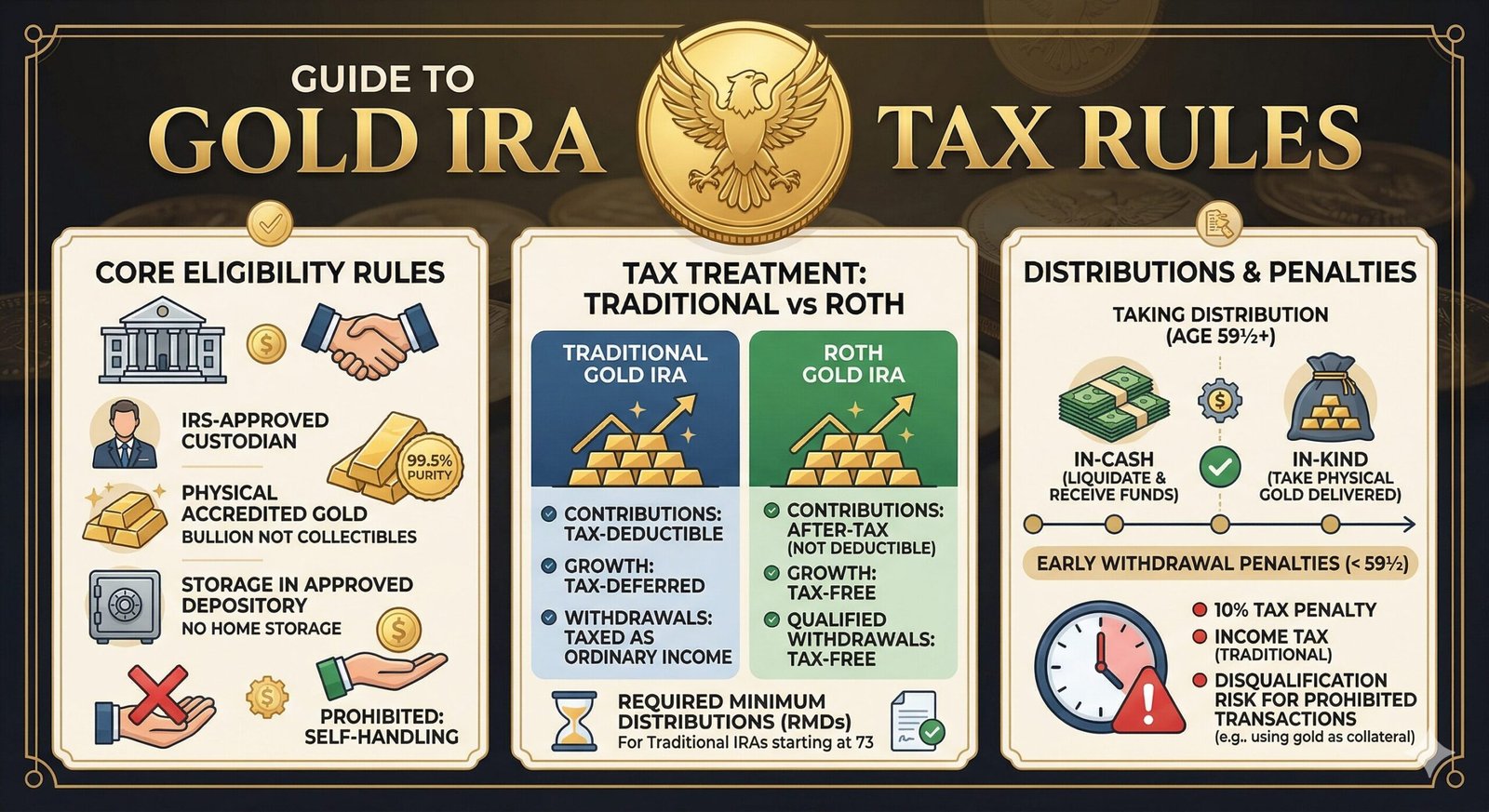
Not every piece of gold qualifies for IRA inclusion. The IRS requires that gold held in an IRA meet a minimum fineness of .995 (99.5% pure). Common qualifying products include American Gold Eagle coins, Canadian Gold Maple Leafs, and certain gold bars from approved refiners. If you want to explore which coins meet IRS standards, our guide to IRA-eligible gold coins goes into this in detail.
Custodian and Storage Requirements
A gold IRA must be administered by an IRS-approved custodian — typically a bank, trust company, or federally regulated financial institution. The physical metals must be stored in an IRS-approved depository, not at your home and not in a safe deposit box. Attempting to take personal possession of IRA-held gold before a qualifying distribution is a taxable event and may trigger penalties.
FINRA’s guidance on self-directed IRAs at FINRA’s guidance on self-directed IRAs is worth reading before you proceed, particularly around the risks associated with self-directed accounts.
Contribution Limits
For 2026, the IRS contribution limit for IRAs remains consistent with recent years. Taxpayers under 50 can contribute up to $7,000 annually, while those aged 50 and older can make a catch-up contribution bringing the total to $8,000. You can review current figures directly at the IRS contribution limits page.
Required Minimum Distributions (RMDs)
If you hold a traditional gold IRA, you are subject to required minimum distributions beginning at age 73 under current law. Because your assets are physical metals rather than cash, satisfying an RMD may require either selling a portion of your gold holdings or taking an in-kind distribution. The IRS RMD FAQ provides detailed guidance on how RMDs work across account types.
Missouri-Specific Considerations
While the IRS rules are national, there are a few Missouri-relevant points worth noting when thinking through a gold IRA.
Missouri State Income Tax on Retirement Distributions
Missouri imposes a state income tax, and distributions from a traditional gold IRA are treated as ordinary income at the state level. Missouri does offer a public pension exemption and certain deductions for retirement income for qualifying taxpayers, but private IRA distributions are generally taxable. You should consult a qualified tax professional about your specific situation — this article does not constitute tax advice.
No Missouri-Specific Precious Metals IRA Legislation
Unlike a handful of states that have passed legislation recognizing gold and silver as legal tender or exempting precious metals from certain state taxes, Missouri has not enacted equivalent laws that materially affect how a gold IRA operates for state residents. The account structure, custodian requirements, and metal eligibility rules remain entirely federal.
Choosing a Custodian: Missouri Residents Are Not Limited to In-State Companies
One important clarification: Missouri residents are not required to use a Missouri-based custodian. Gold IRA custodians are federally chartered or state-chartered trust companies, and many operate nationally. You can work with a reputable custodian based in any state, provided they are IRS-approved. The metals themselves will be stored in a national IRS-approved depository, which may be located in states like Delaware, Texas, or Utah.
How to Set Up a Gold IRA in Missouri: Step by Step
The process of opening a gold IRA is similar regardless of which state you live in. Here’s how it typically works:
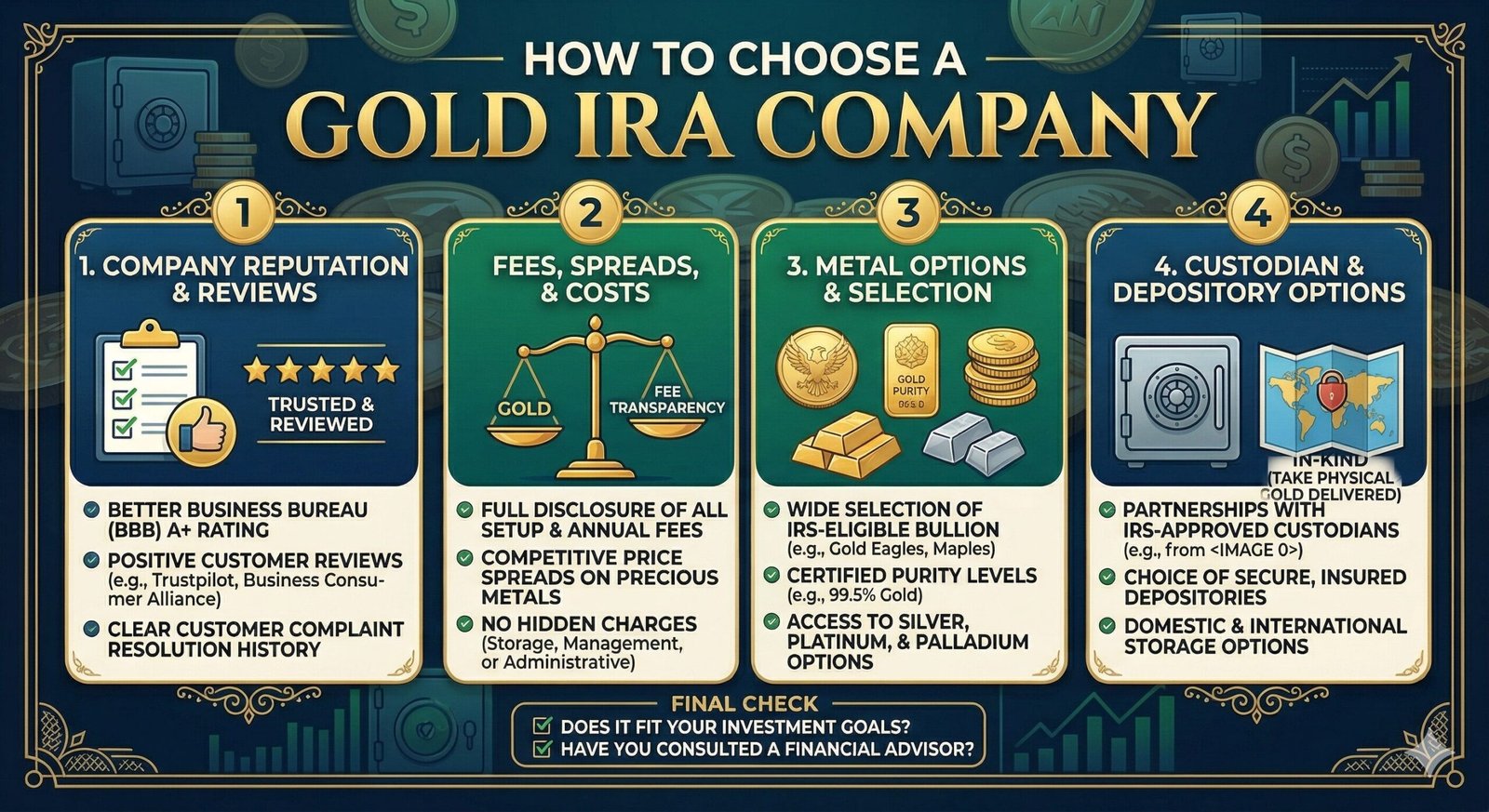
Step 1: Choose a custodian. Research IRS-approved custodians who specialize in self-directed precious metals IRAs. Check their reputation at bbb.org and review the SEC investor resources for general guidance on evaluating retirement account providers.
Step 2: Open your account. Complete the custodian’s application, which typically involves identity verification, beneficiary designations, and selecting your account type (traditional, Roth, SEP, or SIMPLE IRA).
Step 3: Fund the account. You can fund a gold IRA through a new cash contribution (subject to annual limits), a transfer from an existing IRA, or a rollover from an employer-sponsored plan such as a 401(k). For rollover-specific guidance, read our 401(k) to Gold IRA rollover guide and review the Gold IRA rollover rules before initiating anything.
Step 4: Select your metals. Work with your custodian and a dealer to select IRS-eligible gold products. The metals must meet purity requirements and be purchased through the custodian or an approved dealer.
Step 5: Arrange storage. Your custodian will coordinate delivery of the metals to an IRS-approved depository on your behalf. You will receive documentation confirming ownership.
Gold IRA Fees: What Missouri Residents Should Expect
Costs are an important and often underappreciated part of owning a gold IRA. Unlike a standard brokerage IRA where you might pay a simple management fee, gold IRAs typically involve several layers of fees. Our detailed Gold IRA fees guide breaks these down fully, but the table below offers a summary of the most common fee categories.
These fees vary between providers and can add up meaningfully over time. Always request a complete fee schedule in writing before opening an account. If you’re weighing account types, our Gold IRA vs Traditional IRA comparison and Gold IRA vs 401(k) guide may be helpful reference points.
Avoiding Scams and Choosing Reputable Providers
Self-directed IRAs, including gold IRAs, attract more than their fair share of bad actors. High-pressure sales tactics, exaggerated claims about metals values, and unlicensed dealers are genuine risks in this space. Before you move forward with any provider, read our Gold IRA scams guide and verify that your custodian is properly licensed and regulated.
You can also use FINRA BrokerCheck to research the background of financial professionals involved in your account setup. The IRS maintains a full explanation of IRA investment rules at IRS Publication 590-A, which is worth reviewing directly.
One useful reference point: look at a company’s minimum investment thresholds before you apply. Our Gold IRA minimum investment guide explains how minimums vary by provider and what to expect at different account sizes.
Frequently Asked Questions: Gold IRA in Missouri
Q: Do Missouri residents pay state tax on gold IRA distributions?
A: Generally, yes. Missouri taxes ordinary income at the state level, and traditional gold IRA distributions are classified as ordinary income. Missouri does provide some retirement income deductions for qualifying taxpayers, but these are subject to conditions. Speak with a licensed tax professional for guidance specific to your circumstances.
Q: Can I store my gold IRA metals at home in Missouri?
A: No. IRS rules require that metals held in a gold IRA be stored at an IRS-approved depository. Storing IRA gold at home or in a personal safe deposit box constitutes a distribution, triggering taxes and potential penalties. This rule applies to all U.S. residents regardless of state.
Q: Does Missouri have any gold-friendly tax laws that affect IRAs?
A: Missouri has not enacted the kind of precious metals legal tender or sales tax exemption legislation found in some other states. Gold IRA accounts operate under standard federal rules for Missouri residents.
Q: How do I know if a gold IRA is right for me?
A: That depends entirely on your individual financial situation, goals, and timeline. We’d encourage you to research thoroughly and consult a qualified financial advisor. Our article on is a Gold IRA a good idea walks through the key considerations in a balanced way.
Q: Can I roll over my 401(k) from a Missouri employer into a gold IRA?
A: In many cases, yes — but the rules depend on whether you are still employed and the terms of your plan. Generally, 401(k) rollovers into a gold IRA are possible when you’ve left an employer or reached a qualifying event. Review our Gold IRA rollover rules for a detailed explanation before initiating a transfer.
Ready to Take the Next Step?
If you’re a Missouri resident seriously considering a gold IRA, your first practical move is finding a reputable, IRS-approved custodian you can trust. To help with that, we’ve compiled and reviewed the leading providers in the industry. Explore our full review list at Best Gold IRA Companies of 2026 to compare custodians by reputation, fees, minimums, and customer service record.
This article is for informational purposes only and does not constitute financial or tax advice. Investing in precious metals involves risk including possible loss of principal.
Related guides
- Gold IRA Consumer Affairs Reviews: What to Look For
- Gold IRA Trustpilot Reviews: What Real Customers Say
- Gold IRA BBB Complaints: What Consumer Reports Reveal
- Is a Gold IRA Worth the Fees? A Cost-Benefit Analysis
- Are Gold IRA Fees Too High? Breaking Down the Real Costs
- Gold IRA Mistakes to Avoid: 10 Common Errors Investors Make