Gold IRA in Nebraska: Rules and Top Providers
If you live in Nebraska and you’re exploring ways to add physical gold to your retirement savings, you’re in good company. Retirement investors across the Cornhusker State are increasingly curious about Gold IRAs — and understandably so. The structure is federally governed, reasonably straightforward once you understand the basics, and accessible to most Americans with an existing retirement account.
This guide walks you through exactly what a Gold IRA is, how the federal rules apply to Nebraska residents, what to look for in a provider, and the practical steps involved in getting started. No jargon, no pressure — just the information you need to make an informed decision.
What Is a Gold IRA?
A Gold IRA is a type of self-directed Individual Retirement Account that holds physical precious metals — gold, silver, platinum, or palladium — rather than paper assets like stocks or mutual funds. The account operates under the same broad IRS framework as a traditional or Roth IRA, but because it holds a non-traditional asset, it requires a few additional moving parts: a self-directed IRA custodian, an approved precious metals dealer, and an IRS-compliant storage facility.
For a thorough breakdown of the account structure, visit our Gold IRA hub, which covers everything from contribution limits to eligible metals. If you want to go deeper on the mechanics, Gold IRAs Explained in Detail is also worth reading before you take any next steps.
The key point for Nebraska residents is this: Gold IRAs are governed by federal law, not state law. Where you live does not determine which custodians you can use, which dealers you can buy from, or where your metals must be stored. Nebraska-specific considerations tend to be more practical than regulatory — things like provider reputation, customer service, and the reliability of the companies you choose to work with.
Federal Rules That Apply to Nebraska Gold IRA Holders
Regardless of which state you live in, every Gold IRA must comply with the same IRS regulations. Here’s a summary of the most important rules.
Contribution Limits
For 2025, the IRS allows a maximum IRA contribution of $7,000 per year if you’re under age 50, and $8,000 if you’re 50 or older. These limits apply across all your IRAs combined — not per account. If you already contribute to a traditional or Roth IRA, those contributions count toward the same annual cap. You can verify the current figures directly with the IRS contribution limits page.
Metal Eligibility Standards
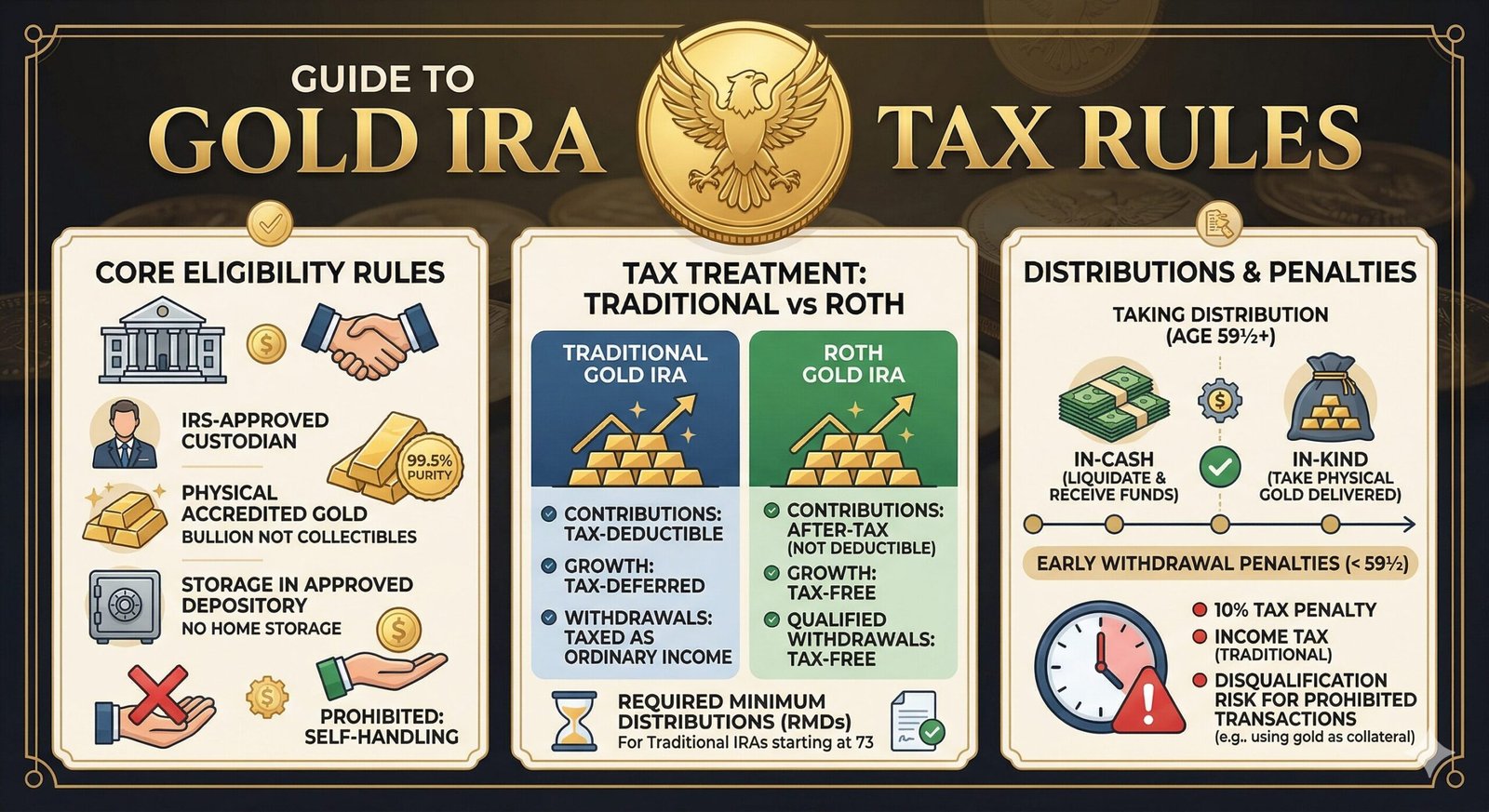
Not every gold coin or bar qualifies for IRA inclusion. The IRS requires that gold meet a minimum purity of 99.5% (0.995 fineness). Silver must be 99.9% pure, while platinum and palladium must reach 99.95%. Common IRA-eligible options include American Gold Eagle coins (which are given a statutory exemption despite being 91.67% pure), American Gold Buffalo coins, and certain international bullion coins and bars from accredited refiners. For a closer look at what’s permitted, see our guide to IRA-eligible gold coins.
Storage Requirements
This is where many first-time Gold IRA investors are surprised. The IRS prohibits “home storage” of IRA-held metals. Your gold must be held by an approved IRS custodian and stored at an IRS-compliant depository. Nebraska does not have major IRS-approved depositories within its borders — but that’s not unusual. Most Gold IRA investors across the country store their metals at facilities in states like Delaware, Texas, or Utah. Your custodian will typically offer a choice of storage locations. The metals remain legally yours; they’re simply held in a secure, insured vault on your behalf.
Required Minimum Distributions
Once you reach age 73, the IRS requires you to begin taking Required Minimum Distributions (RMDs) from your traditional Gold IRA. With physical metals, this means you’ll either need to sell a portion of your holdings to meet the RMD in cash, or take an “in-kind” distribution (receiving physical metal). Both approaches have implications worth understanding in advance. The IRS RMD FAQ is a useful starting point for the rules in plain terms.
Rolling Over an Existing Retirement Account
Many Nebraska residents who open a Gold IRA do so by rolling over funds from a 401(k), 403(b), or existing traditional IRA — rather than making fresh annual contributions. A rollover allows you to move retirement savings you’ve already accumulated into a self-directed structure that can hold physical metals.
The process generally involves three steps: choosing a self-directed IRA custodian, opening the new account, and requesting a transfer or rollover from your existing plan administrator. If you’re moving funds from a former employer’s 401(k), our 401(k) to Gold IRA rollover guide covers the process in detail.
One thing to watch carefully is the distinction between a direct rollover and an indirect rollover. In an indirect rollover, the funds are paid to you first, and you have 60 days to deposit them into the new account. Miss that window, and the IRS may treat the distribution as taxable income — potentially with penalties attached. A direct rollover, where the funds move institution-to-institution without passing through your hands, avoids this risk entirely. For a full breakdown of the applicable rules, our Gold IRA rollover rules guide is worth bookmarking.
Comparing Key Gold IRA Account Types
Nebraska investors typically choose between a traditional Gold IRA and a Roth Gold IRA. The table below outlines the key differences.
For a more detailed comparison of how these accounts stack up against conventional options, our Gold IRA vs Traditional IRA guide goes into greater depth, and you may also find our Gold IRA vs 401(k) comparison useful if you’re deciding whether to roll over an employer plan.
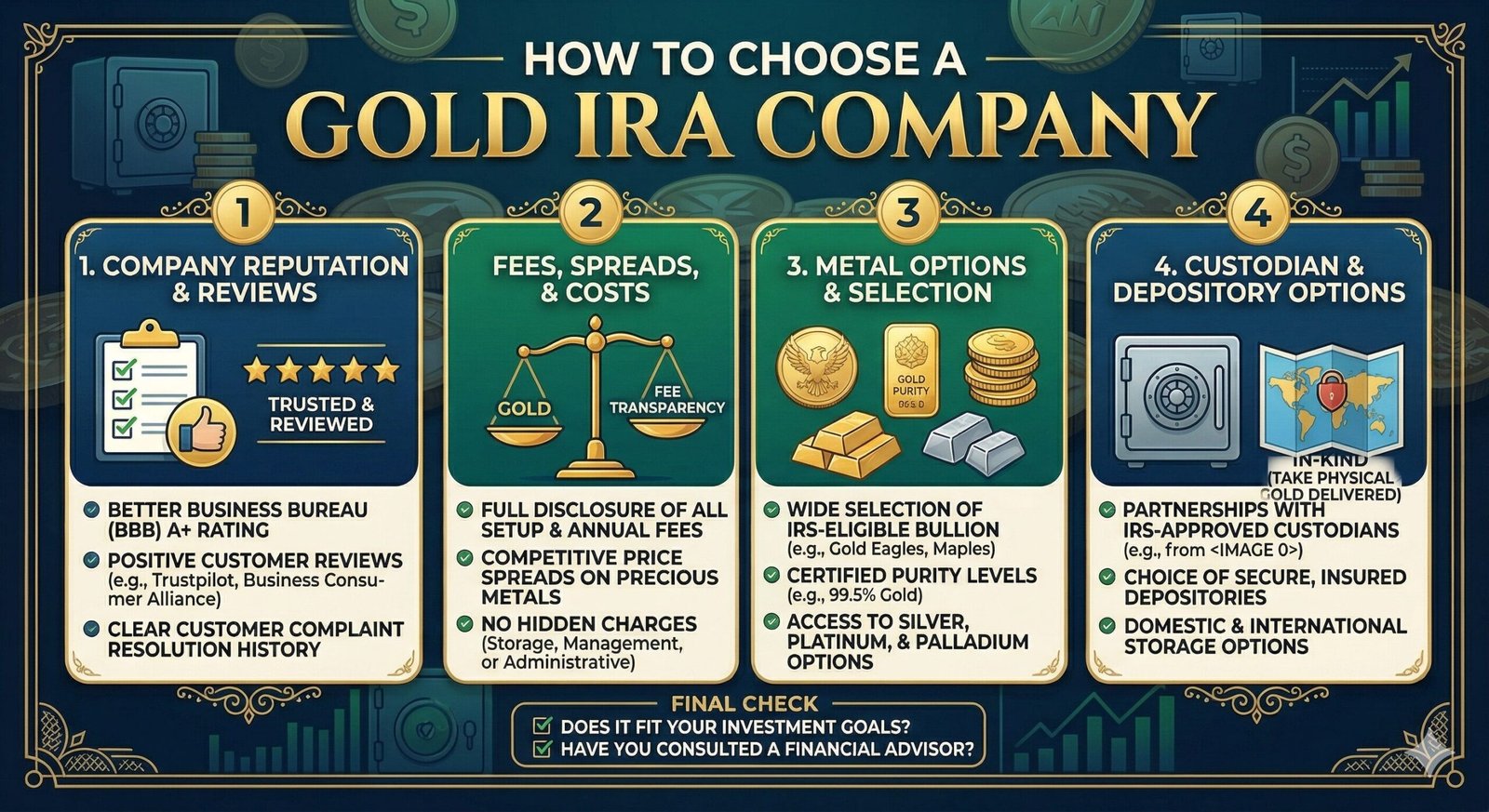
What to Look for in a Gold IRA Provider
Nebraska residents have access to the full national market of Gold IRA companies. Because these companies operate federally and deal with investors across all 50 states, your geographic location doesn’t restrict your options. That said, choosing the right provider is one of the most consequential decisions in the Gold IRA process.
Custodian vs. Dealer
It’s important to understand that a Gold IRA involves at least two separate companies: a custodian (who administers the account and holds legal title to the assets on your behalf) and a precious metals dealer (who sources and sells the physical gold). Some Gold IRA companies serve as dealers and coordinate the custodian relationship on your behalf, acting as a single point of contact. Others are custodians only. Understanding which role each company plays will help you ask the right questions.
Fees and Transparency
Gold IRA fees can vary considerably between providers and are worth scrutinizing carefully. Common costs include account setup fees, annual custodian fees, storage fees (which may be flat or percentage-based), and transaction fees when you buy or sell metals. Our Gold IRA fees guide explains how these costs work and what questions to ask before signing up. Always request a complete written fee schedule — not just a verbal summary — before committing.
Reputation and Credentials
Check whether a company is accredited by the Better Business Bureau at bbb.org and look at its complaint history, not just its star rating. FINRA’s guidance on self-directed IRAs at FINRA’s guidance on self-directed IRAs also offers a clear picture of what to look out for in this space. Look for companies with transparent ownership, verifiable track records, and responsive customer service — particularly companies that don’t pressure you to make quick decisions.
Red Flags to Avoid
Unfortunately, the Gold IRA space does attract some operators whose practices fall short of acceptable standards. High-pressure sales tactics, vague fee disclosures, and promises about investment performance are warning signs. Our Gold IRA scams guide covers the most common tactics used against retirement investors and how to spot them before they cost you. Reading it before engaging with any company is time well spent.
If you want to compare vetted, reviewed companies before starting your research, our Best Gold IRA Companies of 2026 page is a good reference point.
Is a Gold IRA Right for You?
That’s a question only you can answer — ideally in consultation with a licensed financial advisor who understands your full retirement picture. A Gold IRA isn’t the right structure for every investor, and it comes with real costs, real complexity, and real limitations that should be weighed carefully. Our article on is a Gold IRA a good idea takes an honest look at the pros, cons, and practical realities of the account structure.
If you’re curious about what minimum investment levels look like across the industry, our Gold IRA minimum investment guide can help you understand what different companies typically require to open an account.
The IRS IRA investment FAQ and IRS Publication 590-A are also authoritative federal resources that explain IRA rules directly from the source — always worth consulting alongside third-party guides like this one. Additional general background on retirement accounts is available through SEC investor resources.
Frequently Asked Questions: Gold IRA in Nebraska
Q: Does Nebraska have any state-specific rules that affect Gold IRAs?
A: No. Gold IRAs are governed entirely by federal IRS regulations. Nebraska does not impose additional state-level requirements on IRA structures, including self-directed IRAs. State income tax treatment of IRA distributions is a separate matter — consult a tax professional for guidance specific to your situation.
Q: Can I store my Gold IRA metals in Nebraska?
A: You cannot store IRA-held metals at home or in a personal safe-deposit box in Nebraska or anywhere else. IRS rules require that metals be held by an approved custodian at an IRS-compliant depository. Nebraska does not currently have major IRS-approved depositories, so your metals would likely be stored out of state — a common arrangement for Gold IRA investors nationwide.
Q: Can I roll over my existing 401(k) from a Nebraska employer into a Gold IRA?
A: In many cases, yes — particularly if you’ve left that employer and the funds are sitting in a former employer’s plan. If you’re still employed, in-service withdrawals from a 401(k) are subject to plan-specific rules and may not always be permitted. A direct rollover is generally the cleanest approach. Our 401(k) to Gold IRA rollover guide explains the process step by step.
Q: How long does it take to open a Gold IRA?
A: Account setup typically takes between one and three weeks from start to finish, though timelines vary by custodian and the speed of any transfer from an existing plan. The process involves completing paperwork, funding the account (either through a rollover or fresh contribution), and then purchasing eligible metals once the funds are in place.
Q: What happens to my Gold IRA metals if the company I used goes out of business?
A: Your IRA assets are legally yours and are held separately from the operating assets of the custodian or dealer. A reputable custodian will maintain your assets in a segregated or allocated account at the depository. In the event a custodian ceases operations, assets should be transferable to a new custodian. This is one reason why choosing an established, well-capitalized custodian matters — and why reading FINRA’s guidance and checking BBB records is a sensible step before opening any account.
Whether you’re just beginning to explore the idea or ready to compare providers in earnest, start with a solid foundation of knowledge. Visit our Best Gold IRA Companies of 2026 page to see a curated list of providers reviewed for transparency, fees, reputation, and customer service standards.
This article is for informational purposes only and does not constitute financial or tax advice. Investing in precious metals involves risk including possible loss of principal.
Related guides
- Gold IRA Consumer Affairs Reviews: What to Look For
- Gold IRA Trustpilot Reviews: What Real Customers Say
- Gold IRA BBB Complaints: What Consumer Reports Reveal
- Is a Gold IRA Worth the Fees? A Cost-Benefit Analysis
- Are Gold IRA Fees Too High? Breaking Down the Real Costs
- Gold IRA Mistakes to Avoid: 10 Common Errors Investors Make