What Happens to Your Gold IRA When You Die?
Planning for retirement is something most investors spend years thinking about. But what happens to the assets you’ve accumulated — including a Gold IRA — once you’re no longer around to manage them? This is a question that doesn’t get nearly enough attention, and the consequences of leaving it unanswered can be costly for the people you leave behind.
Whether you’ve already opened a Gold IRA or you’re still in the research phase, understanding what happens to it at death is a critical part of retirement planning. The rules governing inherited IRAs are set by the IRS, and they’ve changed significantly in recent years. Getting familiar with them now can help you make better decisions about how you structure your account and whom you name as a beneficiary.
This guide walks through what your heirs can expect, what the IRS requires, and how the type of beneficiary you choose will affect the outcome.
Why This Question Matters More Than You Think
A Gold IRA is a self-directed individual retirement account that holds physical precious metals — gold, silver, platinum, or palladium — rather than paper assets like stocks or mutual funds. Like any IRA, it comes with specific IRS rules around contributions, withdrawals, and, importantly, what happens when the account owner passes away.
The physical nature of the assets inside a Gold IRA adds a layer of complexity that doesn’t exist with a standard IRA. Beneficiaries can’t simply transfer gold bars to a bank account. The metals must be handled through an IRS-approved custodian, and distributions must follow the same rules that govern any inherited IRA. For a thorough grounding in how these accounts work day-to-day, our Gold IRA hub is a helpful starting point.
You can also review Gold IRAs Explained in Detail for a deeper look at the account mechanics before diving into the inheritance rules below.
The Role of Beneficiary Designations
The single most important step you can take right now is designating a beneficiary — and keeping that designation up to date. Your Gold IRA does not pass through your will. It passes directly to whoever is named on the beneficiary designation form held by your custodian. That means if your will says one thing and your IRA beneficiary form says another, the IRA form wins.
Many account holders make the mistake of setting a beneficiary once and never revisiting it after major life events like marriage, divorce, or the death of a loved one. This can lead to assets passing to an unintended recipient, or — if no beneficiary is named — into your estate, which triggers a far less favorable distribution timeline and can create unnecessary legal complications.
Most custodians allow you to name both a primary beneficiary and one or more contingent beneficiaries. A contingent beneficiary inherits only if the primary beneficiary predeceases you or disclaims the inheritance. It’s worth reviewing these designations periodically and updating them whenever your circumstances change.
How the SECURE Act Changed Inherited IRA Rules
Before 2020, beneficiaries who inherited an IRA had considerable flexibility. A non-spouse beneficiary could stretch distributions over their own lifetime, which allowed the account to remain tax-deferred for decades. That option, commonly known as the “stretch IRA,” was largely eliminated by the Setting Every Community Up for Retirement Enhancement (SECURE) Act of 2019.
Under the current rules, most non-spouse beneficiaries are now subject to what’s called the 10-Year Rule. This requires the inherited IRA to be fully distributed within 10 years of the original account owner’s death. There is no requirement to take distributions in any particular year during that window — only that the account be emptied by the end of the tenth year.
SECURE Act 2.0, passed in late 2022, made further adjustments to required minimum distribution (RMD) rules and beneficiary categories. Given how frequently these rules evolve, it’s worth checking the IRS IRA investment FAQ for the most current guidance.
Eligible Designated Beneficiaries: A Different Set of Rules
Not every beneficiary falls under the 10-Year Rule. The IRS recognizes a category called Eligible Designated Beneficiaries (EDBs), who retain more favorable distribution options. This group includes:
- Surviving spouses — who have the most flexibility of any beneficiary
- Minor children of the account owner — until they reach the age of majority
- Disabled individuals — as defined by IRS criteria
- Chronically ill individuals — also under IRS definition
- Beneficiaries who are not more than 10 years younger than the deceased account owner
If you fall into one of these categories, you may be able to stretch distributions over your life expectancy rather than being bound by the 10-year window. However, once a minor child reaches the age of majority, the 10-Year Rule kicks in for the remaining balance.
Spousal Inheritance: The Most Flexible Option
A surviving spouse has the broadest set of choices when inheriting a Gold IRA. They can:
Roll the account into their own IRA. The surviving spouse can treat the inherited Gold IRA as their own, effectively becoming the account owner. This is generally the most advantageous option because it allows them to delay RMDs based on their own age and apply their own beneficiary designations going forward.
Open an inherited IRA in their own name. This keeps the assets separate from their existing retirement accounts and may be beneficial if the surviving spouse is under 59½ and needs access to funds without incurring the 10% early withdrawal penalty.
Take a lump-sum distribution. This is generally the least tax-efficient option, as the full amount becomes taxable income in the year it’s received.
Each of these choices carries different tax implications. For more on the structural differences between account types, the Gold IRA vs Traditional IRA comparison is a useful reference.
Non-Spouse Beneficiaries: What They Need to Know
For most non-spouse beneficiaries — adult children, siblings, friends, or non-qualifying trusts — the 10-Year Rule applies. The inherited account must be fully liquidated within a decade. During that period, the beneficiary must work with the original custodian (or transfer to a new custodian) to manage the account in accordance with IRS rules.
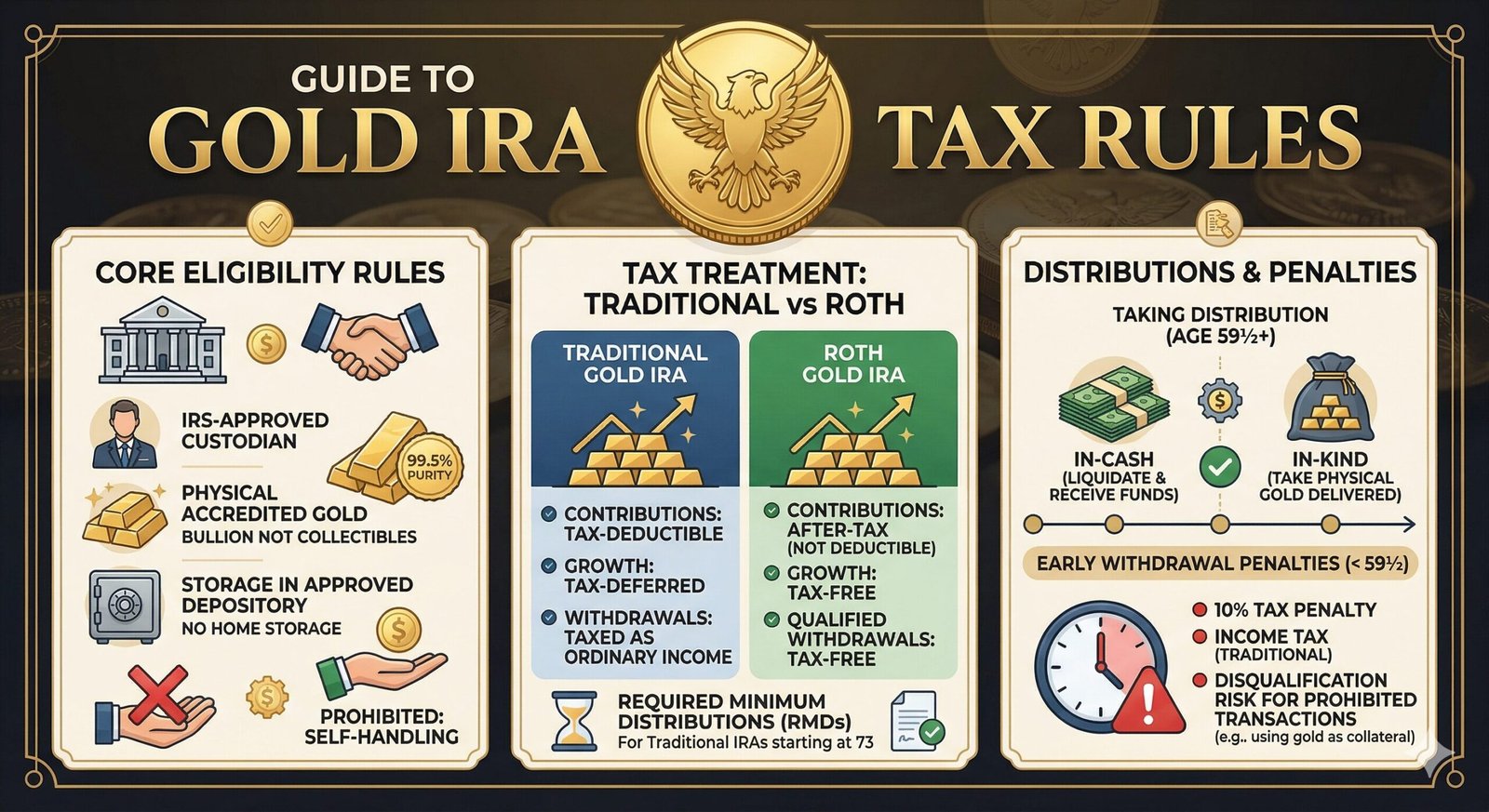
Because a Gold IRA holds physical metals, distributions can take two forms: the beneficiary can request an in-kind distribution (receiving the physical metal itself) or a cash distribution (the custodian sells the metal and transfers the proceeds). Either way, ordinary income tax applies to the distribution amount for a Traditional Gold IRA. A Roth Gold IRA, if the account owner had held it for at least five years, may allow tax-free distributions to beneficiaries.
FINRA provides additional context for consumers navigating inherited self-directed accounts in their guidance on self-directed IRAs, which is worth reading if you or your heirs are unfamiliar with how these accounts differ from conventional brokerage IRAs.
Required Minimum Distributions and Inherited Gold IRAs
RMD rules for inherited IRAs are a common source of confusion. Under current IRS rules, if the original account owner had already reached the age at which RMDs were required, the beneficiary’s obligations depend on whether the owner had begun taking those distributions before death.
If the original owner had not yet started RMDs, non-spouse beneficiaries subject to the 10-Year Rule simply need to empty the account by year ten — with no annual distribution requirement in between. If the owner had already started taking RMDs, the beneficiary must continue taking annual distributions at minimum, with the full account balance distributed by the end of year ten.
These rules are technical, and the IRS has been issuing transitional guidance since the SECURE Act passed. The IRS RMD FAQ is the definitive source for current requirements.
What Happens to the Physical Gold?
This is where a Gold IRA differs meaningfully from a standard inherited IRA. The physical metals are held in an IRS-approved depository — not at home, not in a bank safe deposit box, and not with the dealer who originally sold them. When the account owner dies, the metals remain at the depository until the custodian receives proper documentation and instructions from the beneficiary.
Beneficiaries should expect to provide a death certificate, beneficiary identification, and potentially probate documentation depending on the state. The custodian will then either continue managing the account under the beneficiary’s name, facilitate a transfer, or arrange a distribution of the physical assets or their cash equivalent.
Ongoing storage and custodian fees continue to accrue during this period. It’s worth reviewing what those fees look like — our Gold IRA fees guide covers the typical cost structure in detail.
Choosing the Right Custodian With Inheritance in Mind
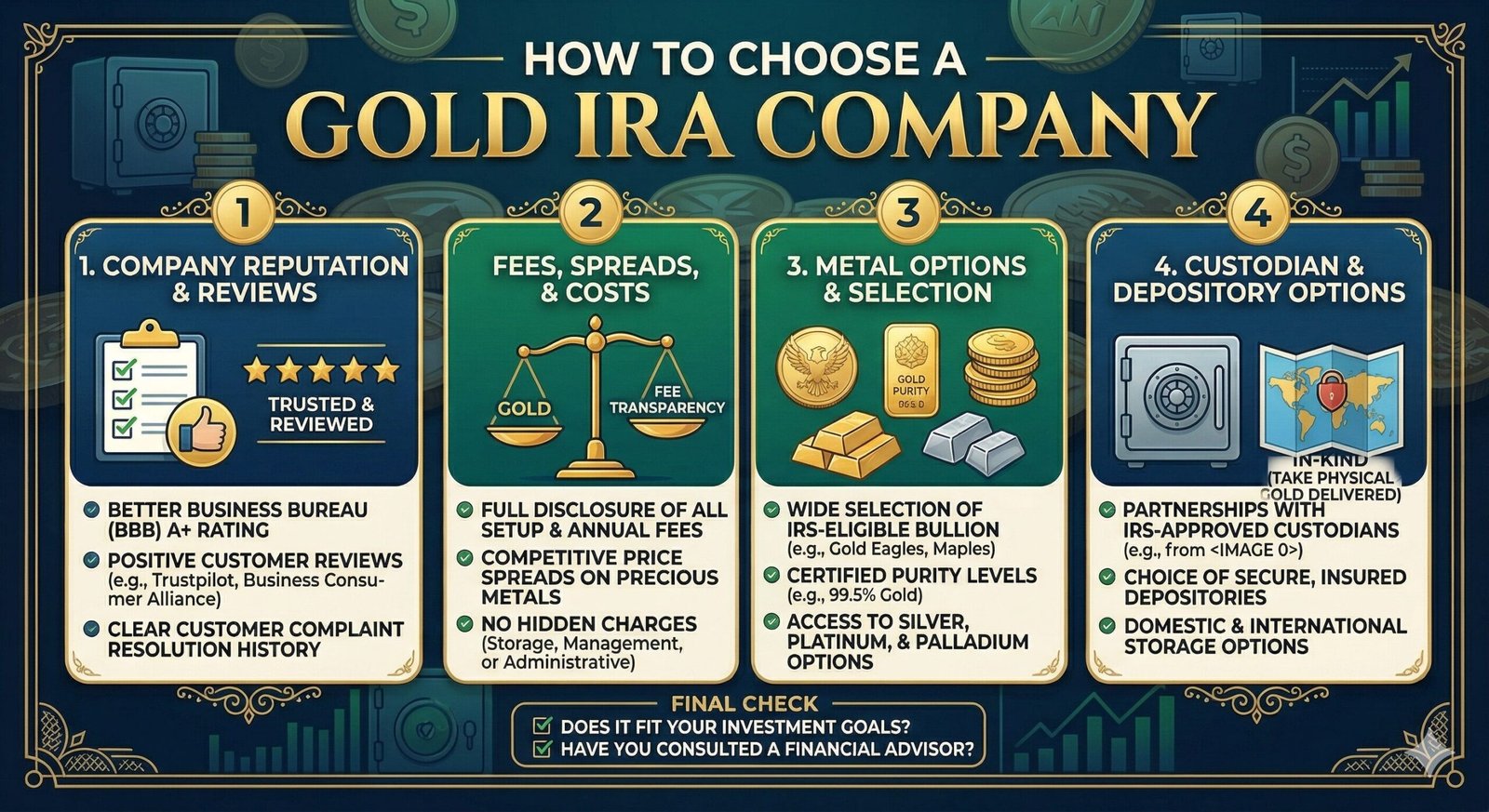
Not all Gold IRA custodians handle inherited accounts with the same level of competence or transparency. When setting up your account, it’s reasonable to ask prospective custodians directly about their inherited account procedures: How long does the transfer process take? What documentation is required? Do they charge additional fees for estate processing?
For guidance on evaluating custodians and avoiding potential pitfalls, the Gold IRA scams guide is a practical resource. You can also verify the standing of any company through bbb.org and cross-reference broker-dealer registrations via FINRA BrokerCheck.
Inherited Gold IRA: Key Rules at a Glance
Note: Rules are subject to IRS updates. Always consult the IRS Publication 590-A and a qualified professional for current guidance.
Frequently Asked Questions
Can my beneficiary keep the Gold IRA as a Gold IRA?
In most cases, a non-spouse beneficiary cannot contribute to an inherited IRA or roll it into their own IRA. They must open a separate inherited IRA and take distributions according to the applicable rules. A surviving spouse has the unique ability to roll the account into their own IRA, effectively continuing it under their own name and terms.
What if I don’t name a beneficiary?
If no beneficiary is named, the account will typically pass to your estate. This generally means a shorter distribution window — often five years — and the assets may be subject to probate, which can delay access and add costs. Naming a beneficiary is strongly recommended.
Does my heir pay taxes on an inherited Gold IRA?
Distributions from an inherited Traditional Gold IRA are generally taxable as ordinary income in the year they’re received. Inherited Roth Gold IRA distributions may be tax-free if the original account met the five-year holding requirement. Neither scenario constitutes tax advice — heirs should consult a qualified tax professional for their specific situation.
Can my beneficiary take the physical gold instead of cash?
Yes. Beneficiaries generally have the option of taking an in-kind distribution, meaning the physical metal is transferred to them rather than being sold. However, the fair market value of the metal at the time of distribution is still treated as taxable income for a Traditional Gold IRA. Storage and logistics of holding physical gold outside an IRA become the beneficiary’s responsibility.
What if I inherited a Gold IRA and I’m not sure what to do?
The first step is to contact the custodian and notify them of the account owner’s death. They will guide you through the documentation process. From there, review your options carefully before making any distributions, as some decisions — particularly around rollovers — cannot be undone. Reviewing the IRS contribution limits page and speaking with a financial or tax professional can also help you understand the landscape before acting.
Plan Ahead While You Still Can
Understanding what happens to your Gold IRA when you die isn’t morbid — it’s responsible. The decisions you make today, from whom you name as a beneficiary to which custodian you choose, will directly affect what your loved ones inherit and how easily they can access it.
If you’re still evaluating your options, or if you’re wondering is a Gold IRA a good idea for your situation, take the time to review the full landscape of providers and account structures. To explore the top-rated custodians in the market today, visit our guide to the Best Gold IRA Companies of 2026.
This article is for informational purposes only and does not constitute financial or tax advice. Investing in precious metals involves risk including possible loss of principal.
Related guides
- Gold IRA Consumer Affairs Reviews: What to Look For
- Gold IRA Trustpilot Reviews: What Real Customers Say
- Gold IRA BBB Complaints: What Consumer Reports Reveal
- Is a Gold IRA Worth the Fees? A Cost-Benefit Analysis
- Are Gold IRA Fees Too High? Breaking Down the Real Costs
- Gold IRA Mistakes to Avoid: 10 Common Errors Investors Make