
How to Transfer Your Gold IRA to Another Company
If you have a Gold IRA and you’re not satisfied with your current provider — whether it’s the fees, the service, or something else entirely — you have the right to move your account to a different company. This process is called a trustee-to-trustee transfer, and when done correctly, it is a straightforward, tax-free event under IRS rules.
That said, there are important steps, timelines, and rules to follow. Getting any of them wrong can turn a routine transfer into an unexpected tax bill. This guide walks you through the entire process clearly, so you can make informed decisions before taking any action.
Why People Transfer Their Gold IRA to Another Company
Investors switch Gold IRA custodians for a wide range of reasons, and there’s nothing unusual about wanting to make a change. Some of the most common motivations include concerns about annual fees, dissatisfaction with customer service, a desire for a broader selection of IRS-approved metals, or simply wanting a custodian with a stronger track record of communication and transparency.
It’s also worth noting that the Gold IRA industry is not without its bad actors. If you’ve noticed red flags — pressure tactics, unclear fee structures, or a custodian that seems difficult to reach — that’s a serious enough reason to consider moving your account. Our Gold IRA scams guide covers the warning signs in detail, and it’s worth reading before you decide where to land next.
Whatever your reason, the right to transfer a self-directed IRA is well established under federal tax law. The IRS does not limit how often you can execute a direct trustee-to-trustee transfer, which is an important distinction we’ll cover shortly.
Understanding the Two Types of Gold IRA Transfers
Before you contact anyone, you need to understand the difference between two methods of moving retirement assets: a direct transfer and an indirect rollover. The distinction matters enormously for tax purposes.
Direct Trustee-to-Trustee Transfer
A direct transfer is when your current custodian sends your Gold IRA assets directly to your new custodian — without the funds or metals ever passing through your hands. This is the cleanest method. There is no withholding requirement, no 60-day deadline to worry about, and no tax event triggered. You can execute as many direct transfers as you wish in a given year.
This is the method most Gold IRA holders use when switching companies, and it’s the one most reputable custodians will recommend. For a broader look at how these accounts work under the hood, see Gold IRAs Explained in Detail.
Indirect Rollover
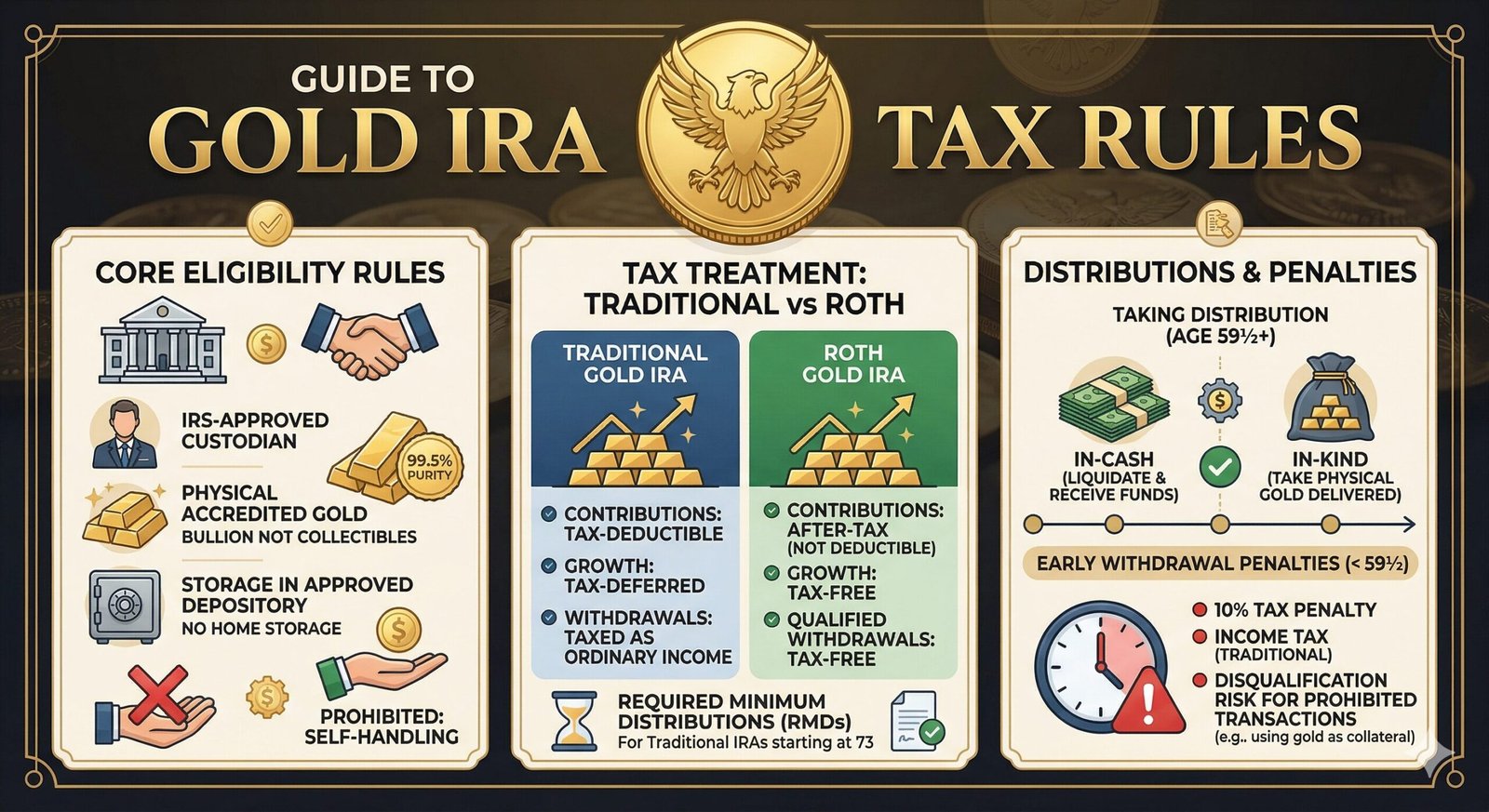
An indirect rollover works differently. In this case, your current custodian distributes the assets to you — either as cash or as physical metals — and you then have 60 days to deposit those assets into a new IRA. If you miss the 60-day window, the IRS treats the distribution as taxable income. If you’re under 59½, a 10% early withdrawal penalty also applies.
Additionally, for traditional IRAs, the distributing custodian may withhold 20% for taxes upfront if the distribution is sent to you directly. You’d then need to come up with that 20% out of pocket to deposit the full amount into the new account — or the shortfall is treated as a taxable distribution.
For most people transferring a Gold IRA, a direct transfer is the safer and more practical route. Indirect rollovers can make sense in specific situations, but they carry real risk if anything delays the re-deposit. You can review a full breakdown of both approaches in our Gold IRA rollover rules page.
The Transfer Process: Step by Step
Transferring a Gold IRA to a new company is not complicated, but it does require coordination between two institutions — and your active participation to get things started.
Step 1: Choose Your New Custodian
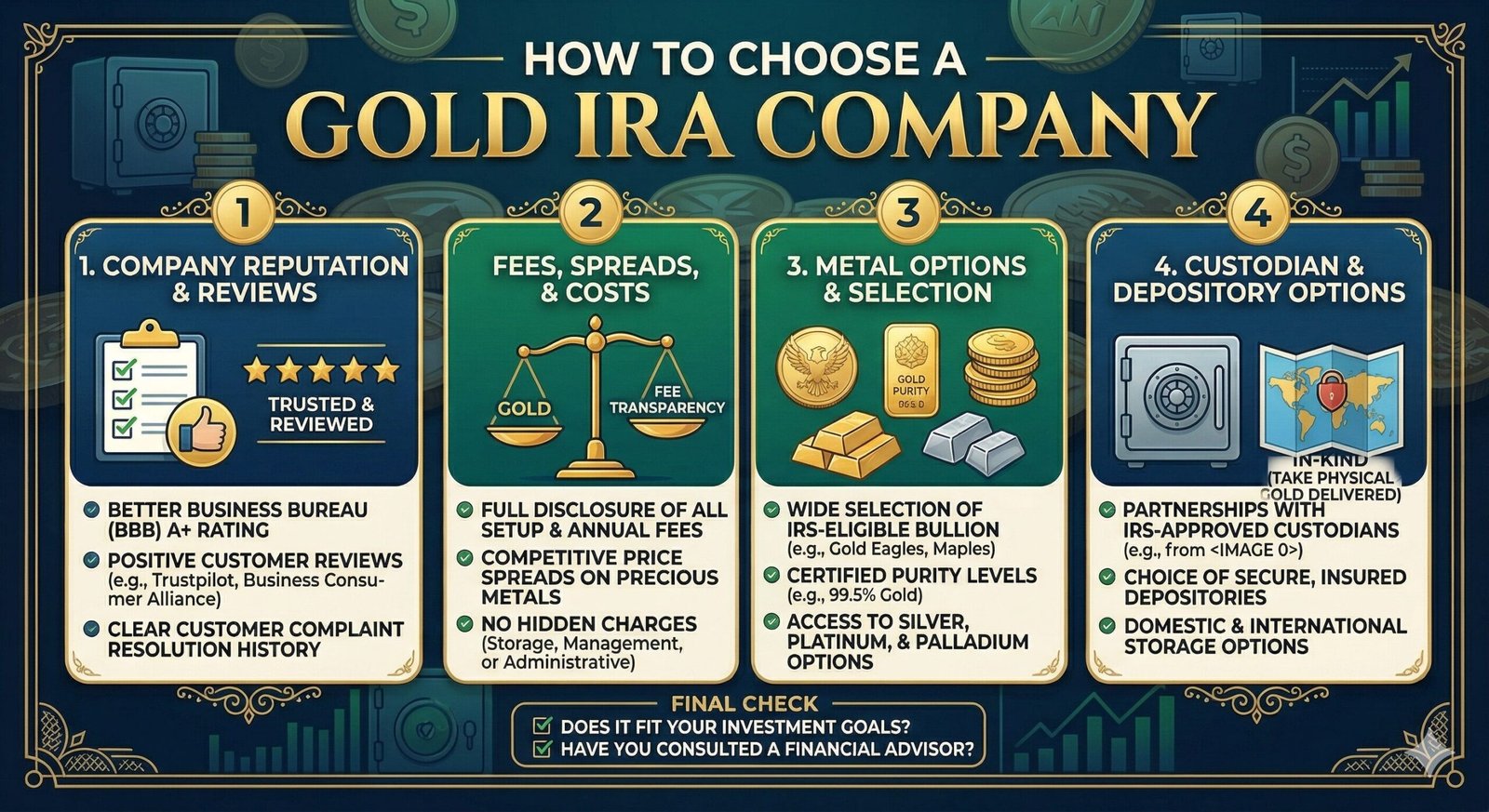
This is the most important decision you’ll make in the process. Your new Gold IRA custodian must be an IRS-approved trustee for self-directed IRAs. Not every financial institution qualifies. Look for a company with clear, transparent fee schedules, a strong reputation with independent review platforms, and responsive customer service.
Before committing, request a complete fee schedule in writing. Storage fees, setup fees, annual maintenance fees, and transaction fees can vary significantly between providers. Our Gold IRA fees guide breaks down what to look for and what questions to ask. You should also verify the company’s standing with your state’s financial regulator, check bbb.org for complaint history, and look up any broker-dealer affiliates on FINRA BrokerCheck.
FINRA’s guidance on self-directed IRAs is also worth reading — it explains the due diligence responsibilities that fall on account holders when working with self-directed retirement accounts.
Step 2: Open Your New Gold IRA Account
Once you’ve selected a new custodian, you’ll need to open a new Gold IRA account with them before the transfer can begin. This typically involves completing an account application, providing identification documentation, and signing a custodian agreement. Many companies can complete this step within a few business days.
Be clear with the new custodian from the start that you’re initiating a transfer from an existing Gold IRA. They will generally have a dedicated transfer team and paperwork specific to this process.
Step 3: Initiate the Transfer Request
Here’s where most of the administrative work happens. Your new custodian will typically provide you with a Transfer Request Form (sometimes called a Letter of Acceptance or LOA). You complete this form and submit it to your current custodian, authorizing them to transfer your assets.
Your current custodian may also have their own paperwork to complete. Expect some back-and-forth between the two institutions. This is normal. Stay in contact with both parties and keep copies of every document you sign.
Step 4: Physical Metal Liquidation or In-Kind Transfer
This is a step that surprises some investors. When your Gold IRA holds physical gold or silver, your assets cannot simply be wired like cash. The transfer can happen in one of two ways:
In-kind transfer: Your physical metals are re-registered at the depository and transferred in their physical form to an account under your new custodian — without being sold. This is possible when both custodians use the same approved depository, or when the depository can accommodate a direct re-registration.
Liquidation and re-purchase: If the custodians use different depositories, or if an in-kind transfer is not logistically available, your metals may need to be sold at current market value, the cash transferred to the new custodian, and equivalent metals repurchased in your new account. This does not create a taxable event within the IRA — but it does mean your metals exposure has a brief gap, and transaction costs apply.
Ask both custodians upfront which method applies to your situation. The IRS has specific rules about what constitutes eligible IRA property — IRS Publication 590-A covers these rules in full, and the IRS IRA investment FAQ is another helpful reference point.
Step 5: Confirm Receipt and Account Funding
Once the transfer is complete, verify with your new custodian that all assets have been received and properly credited to your account. Review your account statement carefully. If metals were liquidated and repurchased, confirm the quantities and types of metal now held. Cross-check that any IRA-eligible gold coins or bars in your new account meet IRS fineness standards.
Key Rules and Timelines to Know
The one-per-year rule on indirect rollovers applies across all of your IRAs combined — not per account. Direct transfers are not subject to this limit. See the IRS contribution limits page for related rules, and the IRS RMD FAQ if you’re of required minimum distribution age and concerned about how a transfer affects your obligations.
How Long Does a Gold IRA Transfer Take?
Most direct transfers take between two and six weeks to complete from the time the paperwork is submitted. In some cases, it can take longer — particularly if there are delays in paperwork processing on either end, or if the metals must be transported between depositories.
Stay proactive. Don’t assume the process is moving forward without checking in. A good custodian will keep you updated at each stage, but it’s reasonable — and advisable — to follow up with both institutions if you haven’t received confirmation within ten business days of submitting transfer documents.
What to Watch Out For During a Transfer
Not every Gold IRA provider makes the transfer process easy. Some custodians impose transfer-out fees, often ranging from $50 to several hundred dollars. These should be disclosed in your existing custodian agreement — review it before you begin, and factor those costs into your decision-making.
Also be cautious of your new provider rushing you into purchasing metals before the transfer has cleared. Reputable companies will wait until your transferred funds are confirmed before processing any metal purchases. If a company is pressuring you to act immediately or is vague about timelines, treat that as a red flag.
Our Gold IRA minimum investment page also covers what to expect in terms of opening balance requirements at new custodians — which can vary considerably across the industry.
Frequently Asked Questions
Is transferring a Gold IRA to another company a taxable event?
A direct trustee-to-trustee transfer is not a taxable event. The IRS does not treat this as a distribution as long as the assets move directly between custodians without passing through your hands. An indirect rollover can become taxable if the 60-day re-deposit deadline is missed.
How many times can I transfer my Gold IRA per year?
There is no annual limit on direct transfers. You can move a Gold IRA from one custodian to another as many times as you wish in a given year using a direct transfer. The one-per-year rule only applies to indirect (60-day) rollovers.
Can I transfer a 401(k) directly to a new Gold IRA company?
A 401(k) cannot be transferred directly to a Gold IRA as a custodian-to-custodian transfer in the traditional sense — it typically involves a rollover process. Our 401(k) to Gold IRA rollover guide explains how that process works and what the rules are.
What happens to my physical gold during the transfer?
Your gold remains stored at an IRS-approved depository throughout the process. Depending on the custodians involved, it may be re-registered in place or physically moved to a new depository. Your new custodian should be able to tell you which method will apply.
Do I need to do anything special if I’m already taking required minimum distributions?
If you are subject to required minimum distributions, a transfer does not suspend or defer that obligation. Your RMD for the year must still be taken — typically before any transfer is completed or from remaining assets. The IRS RMD FAQ provides authoritative guidance on this topic.
Ready to Explore Your Options?
Transferring a Gold IRA to another company is a legitimate and often sensible step for investors who want better service, lower fees, or a custodian that’s more aligned with their long-term retirement planning approach. The key is to understand the rules before you act, choose your new custodian carefully, and use a direct transfer to avoid unnecessary risk.
If you’re still deciding which company to move to, start by reviewing our independent analysis of the Best Gold IRA Companies of 2026 — a regularly updated resource comparing top custodians across fees, customer service, storage options, and more. You can also visit our Gold IRA hub for a complete overview of how these accounts work from the ground up.
This article is for informational purposes only and does not constitute financial or tax advice. Investing in precious metals involves risk including possible loss of principal.
Related guides
- Gold IRA Consumer Affairs Reviews: What to Look For
- Gold IRA Trustpilot Reviews: What Real Customers Say
- Gold IRA BBB Complaints: What Consumer Reports Reveal
- Is a Gold IRA Worth the Fees? A Cost-Benefit Analysis
- Are Gold IRA Fees Too High? Breaking Down the Real Costs
- Gold IRA Mistakes to Avoid: 10 Common Errors Investors Make