
How to Close a Gold IRA Account: Steps and Costs
Closing a Gold IRA account is not a decision most investors make lightly — and it shouldn’t be. Whether you’re consolidating retirement accounts, responding to a change in your financial situation, or simply reassessing your retirement strategy, the process involves more than just making a phone call to your custodian. There are specific steps to follow, costs to account for, and potential tax consequences that can significantly affect what you actually walk away with.
This guide walks you through the full process in plain English, so you know exactly what to expect before you take any action.
What It Actually Means to “Close” a Gold IRA
Before diving into the how-to, it’s worth clarifying what closing a Gold IRA actually involves — because the mechanics are different from closing a standard brokerage or bank account.
A Gold IRA is a self-directed individual retirement account that holds physical precious metals rather than paper assets. Those metals are stored in an IRS-approved depository on your behalf, and a custodian oversees the account’s compliance with IRS regulations. When you decide to close the account, you’re not just terminating a software account or cancelling a subscription — you’re making a decision about what happens to a physical asset that’s sitting in a vault somewhere.
You have two primary options when closing:
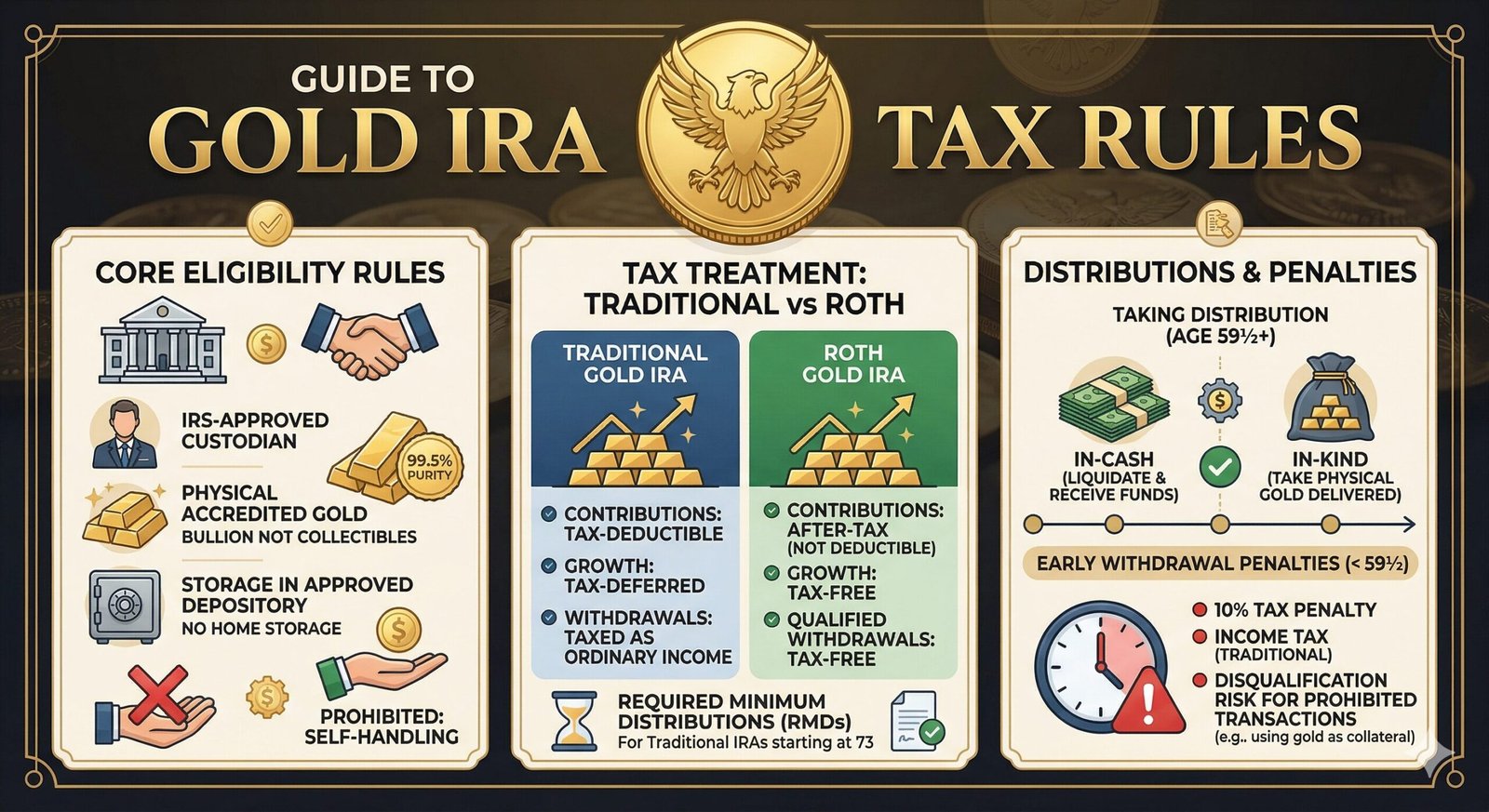
Distribution in cash: Your custodian arranges for your metals to be sold, and the proceeds are distributed to you (or rolled into another account). This is the most common route.
Distribution in kind (taking physical possession): Rather than selling, you request that the actual metals be shipped to you. This is possible, but it comes with its own set of complications, including shipping costs, insurance, and the fact that the IRS treats this as a taxable distribution at the fair market value of the metals at the time of transfer.
Understanding which option suits your situation is the first decision you’ll need to make. For a broader grounding in how these accounts work, our Gold IRA hub covers the fundamentals from start to finish.
Reasons People Close a Gold IRA Account
There’s no single reason someone decides to close one of these accounts, and none of them are inherently right or wrong. Common situations include:
- Reaching retirement age and needing to begin drawing down assets
- Consolidating multiple retirement accounts into one
- Dissatisfaction with custodian service or fees
- A significant life event such as a medical need or major expense
- A decision to transfer assets to a different type of account
It’s worth noting that if you’re unhappy with your current custodian but still want to hold precious metals in an IRA, you may not need to close the account at all — you may simply need to do a rollover to a new custodian. Our Gold IRA rollover rules page explains how that process works and what the IRS requires.
Step-by-Step: How to Close a Gold IRA Account
Step 1: Review Your Custodian Agreement
Your first action should be to locate and read your custodian agreement — the document you signed when you opened the account. This will outline the specific procedures for account closure, any required notice periods, and the fees you’ll be charged. Most custodians require written notice of closure, and some have processing windows that can take days or weeks.
Step 2: Decide What Happens to Your Metals
As outlined above, you’ll need to choose between a cash distribution (liquidation) or an in-kind distribution. If you’re planning to transfer to another IRA — whether a traditional IRA, Roth IRA, or another Gold IRA — this may be structured as a rollover or transfer rather than a full closure. The distinction matters because a direct trustee-to-trustee transfer is generally not a taxable event, while a distribution to you personally may be.
For more on the tax structure of these accounts, the IRS IRA investment FAQ is a reliable starting point.
Step 3: Submit a Written Closure Request
Contact your custodian and request the appropriate closure or distribution forms. Most reputable custodians have a formal process for this. You’ll typically need to provide:
- Your account number and personal identification
- Your chosen distribution method (cash or in-kind)
- Banking details if you’re requesting a wire transfer of proceeds
- A signed and dated closure request form
Some custodians may require a signature guarantee (similar to a notarized signature) particularly for larger accounts. Ask in advance so you’re not caught off guard.
Step 4: Allow for Processing Time
Once your request is submitted, there’s typically a processing period. Liquidating physical metals isn’t instantaneous — your custodian needs to coordinate with the depository to arrange the sale or shipment of the metals. Expect anywhere from one to three weeks for the full process to be completed, though timelines vary between custodians.
Step 5: Receive Your Distribution and Handle Tax Reporting
Once the metals have been sold (or shipped), your distribution will be processed. Your custodian will issue a Form 1099-R at tax time, reporting the distribution to the IRS. You’ll need to report this on your tax return.
Costs Involved in Closing a Gold IRA
This is where many account holders are caught off guard. Closing a Gold IRA is rarely free, and the total cost can be meaningful depending on your custodian and the size of your account.
Here’s a summary of the typical fees you may encounter:
These figures are illustrative ranges based on common industry practice. Your actual costs will depend on your specific custodian agreement. Before initiating closure, request a written breakdown of all fees from your custodian. Our Gold IRA fees guide goes deeper on what to expect across the industry.
Tax Consequences of Closing a Gold IRA
This is one of the most important aspects of the entire process, and it’s where getting the details right really matters.
Traditional Gold IRA Distributions
If your Gold IRA is structured as a traditional IRA (meaning contributions were made with pre-tax dollars), any distribution — whether in cash or in kind — is taxable as ordinary income in the year you receive it. This includes the full fair market value of any metals distributed in kind.
If you’re under age 59½, you’ll also generally owe a 10% early withdrawal penalty on top of income tax, unless an exception applies. The IRS provides a list of exceptions in IRS Publication 590-A.
Roth Gold IRA Distributions
If your account is a Roth Gold IRA, qualified distributions are generally tax-free. However, certain conditions must be met — the account must have been open for at least five years, and you must be at least 59½ years old, among other requirements. Non-qualified distributions may still be subject to tax and penalties on the earnings portion.
Required Minimum Distributions (RMDs)
If you’re over age 73, be aware that Gold IRAs are subject to required minimum distributions, just like traditional IRAs. Closing an account doesn’t relieve you of any RMD obligations for the current tax year. The IRS RMD FAQ has authoritative guidance on this.
It’s worth emphasising that this article does not constitute tax advice. The tax treatment of IRA distributions is specific to your individual circumstances. Consulting a qualified tax professional before closing your account is strongly recommended.
Should You Transfer Instead of Close?
If you’re closing your Gold IRA primarily because you’re unhappy with your custodian, it’s worth knowing that a direct transfer to a new custodian is often simpler, faster, and more tax-efficient than a full closure followed by opening a new account.
A trustee-to-trustee transfer — where your metals or their cash equivalent move directly from one custodian to another — is generally not treated as a taxable distribution. You also avoid the 60-day rollover window that applies if you take possession of the funds yourself. Our 401(k) to Gold IRA rollover guide covers the rollover mechanics in detail, much of which also applies to IRA-to-IRA transfers.
If you’re still weighing whether staying in a Gold IRA makes sense for you at all, you might find our article on is a Gold IRA a good idea a useful read before making any final decisions.
Protecting Yourself Through the Process
Whenever you’re dealing with significant retirement assets, it pays to be cautious. Make sure your custodian is properly registered and in good standing. You can verify custodians and check for complaints through bbb.org and confirm registration status via FINRA BrokerCheck. FINRA’s guidance on self-directed IRAs is also worth reviewing if you’re unfamiliar with the unique risks and responsibilities that come with these accounts.
Our Gold IRA scams guide covers some of the red flags to watch for, including custodians who make the closure process unusually difficult or who add undisclosed fees.
Frequently Asked Questions
How long does it take to close a Gold IRA account?
The timeline varies between custodians, but most account holders should expect the process to take one to three weeks from the time a formal closure request is submitted. Delays can occur if additional documentation is required or if the depository needs extra time to arrange liquidation or shipment of metals.
Can I close my Gold IRA without paying taxes?
Not in most cases. If your account is a traditional Gold IRA, distributions are taxable as ordinary income. A Roth Gold IRA may allow tax-free distributions if specific IRS conditions are met. Rolling assets directly to another qualifying IRA account is one way to potentially avoid an immediate tax event, but this is a transfer, not a closure. Always consult a tax professional for advice specific to your situation.
What happens to my metals when I close the account?
You’ll choose between having your metals liquidated (sold) and receiving the cash proceeds, or taking an in-kind distribution where the physical metals are shipped directly to you. Both options are treated as IRA distributions for tax purposes, with fair market value at the time of distribution used as the basis.
Are there penalties for closing a Gold IRA early?
If you close your account and take a distribution before age 59½, you’ll generally owe a 10% early withdrawal penalty in addition to any applicable income tax, unless you qualify for one of the IRS exceptions. This applies to traditional Gold IRAs; different rules apply to Roth accounts.
Do I have to pay a fee to close my Gold IRA?
Most custodians charge a termination or account closure fee, which can range from nothing to several hundred dollars. You may also face liquidation fees, wire transfer fees, and potentially prorated storage charges. Always request a complete written fee disclosure before initiating closure.
Ready to Explore Your Options?
Closing a Gold IRA is a significant financial decision, and the right path forward depends on your individual circumstances, tax situation, and retirement goals. Whether you decide to close, transfer, or simply leave your account in place, going in with a clear understanding of the process puts you in a much stronger position.
If you’re also thinking about your broader options in the Gold IRA space, take a look at our Best Gold IRA Companies of 2026 guide, where we’ve compiled detailed information on some of the most widely reviewed custodians currently operating in the market.
This article is for informational purposes only and does not constitute financial or tax advice. Investing in precious metals involves risk including possible loss of principal.
Related guides
- Gold IRA Consumer Affairs Reviews: What to Look For
- Gold IRA Trustpilot Reviews: What Real Customers Say
- Gold IRA BBB Complaints: What Consumer Reports Reveal
- Is a Gold IRA Worth the Fees? A Cost-Benefit Analysis
- Are Gold IRA Fees Too High? Breaking Down the Real Costs
- Gold IRA Mistakes to Avoid: 10 Common Errors Investors Make