
Gold IRA vs Money Market: What Retirement Investors Should Know
When you’re in your 50s or 60s and thinking seriously about how to structure your retirement savings, you’ll inevitably encounter a wide range of account types and options. Two that often come up in the same conversation — though they work in very different ways — are Gold IRAs and money market accounts. Both have a legitimate place in the retirement planning conversation, but they serve fundamentally different purposes and come with their own sets of rules, costs, and trade-offs.
This article isn’t here to tell you which one to choose. That’s a decision for you and a qualified financial advisor. What it will do is lay out the mechanics of each clearly, so you can walk into that conversation better informed.
What Is a Gold IRA?
A Gold IRA is a type of self-directed Individual Retirement Account that holds physical precious metals — typically gold, and sometimes silver, platinum, or palladium — rather than paper-based assets like stocks or mutual funds. If you want to understand what a Gold IRA is in full detail, our dedicated hub is a good starting point.
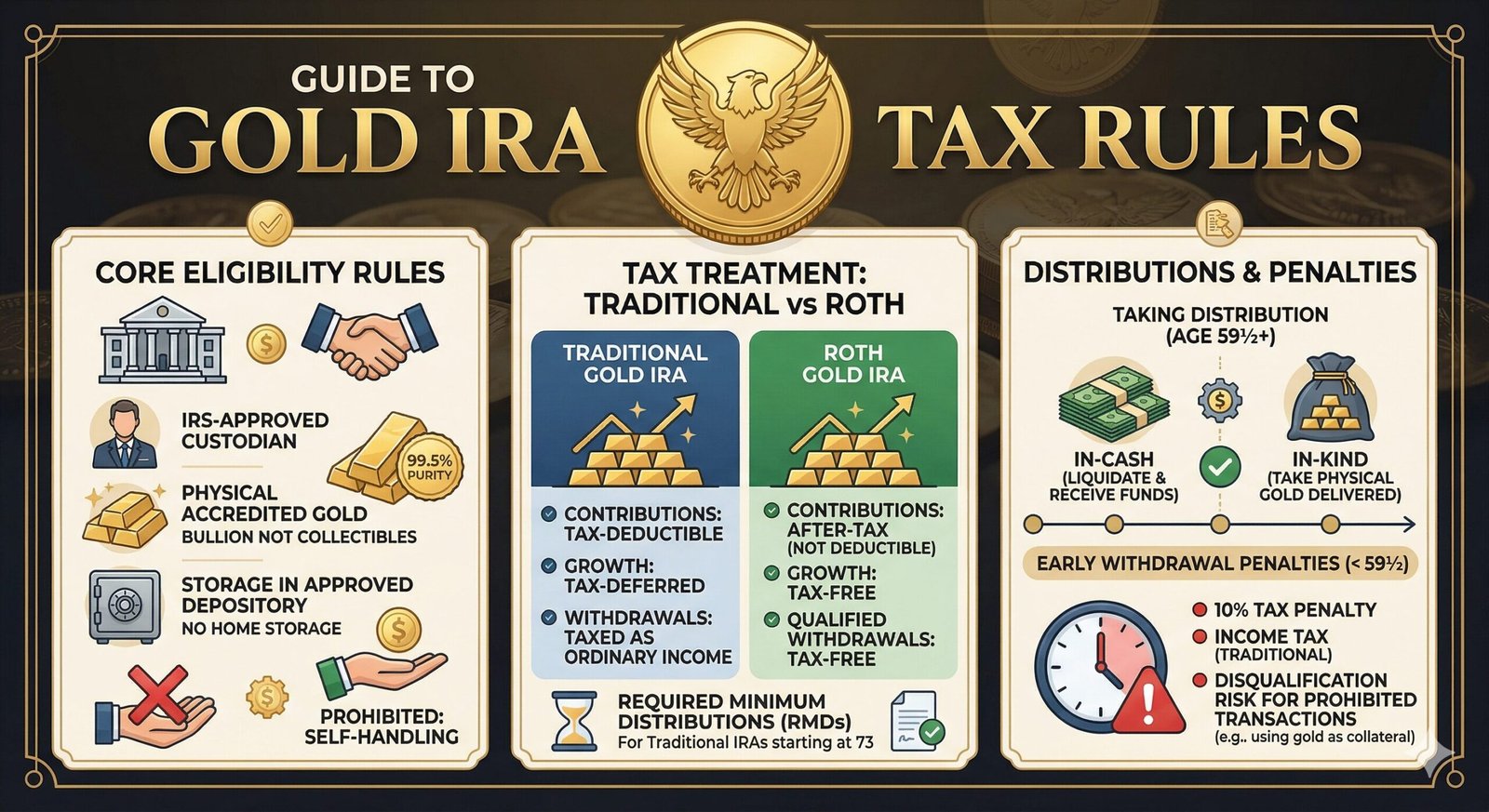
The IRS permits physical gold to be held inside an IRA under specific conditions, outlined in IRS Publication 590-A. The metals must meet minimum purity standards (gold must be at least 99.5% pure), and they must be stored in an IRS-approved depository — not at home, and not in a private safe. For a broader breakdown of how these accounts are structured, Gold IRAs Explained in Detail walks through the rules step by step.
Gold IRAs follow the same basic tax structure as traditional or Roth IRAs. A traditional Gold IRA allows pre-tax contributions, with taxes paid upon withdrawal. A Roth Gold IRA uses after-tax dollars, with qualifying withdrawals made tax-free. The IRS sets annual contribution limits — currently $7,000 per year for those under 50, and $8,000 for those 50 and older, as confirmed by the IRS contribution limits page.
One important practical point: Gold IRAs are subject to Required Minimum Distributions (RMDs) once you reach age 73, if they’re structured as traditional IRAs. Because the assets are physical metals, this can add complexity at distribution time — you’ll either need to liquidate a portion of the metals or take an in-kind distribution. The IRS RMD FAQ covers this in detail.
Costs Involved with a Gold IRA
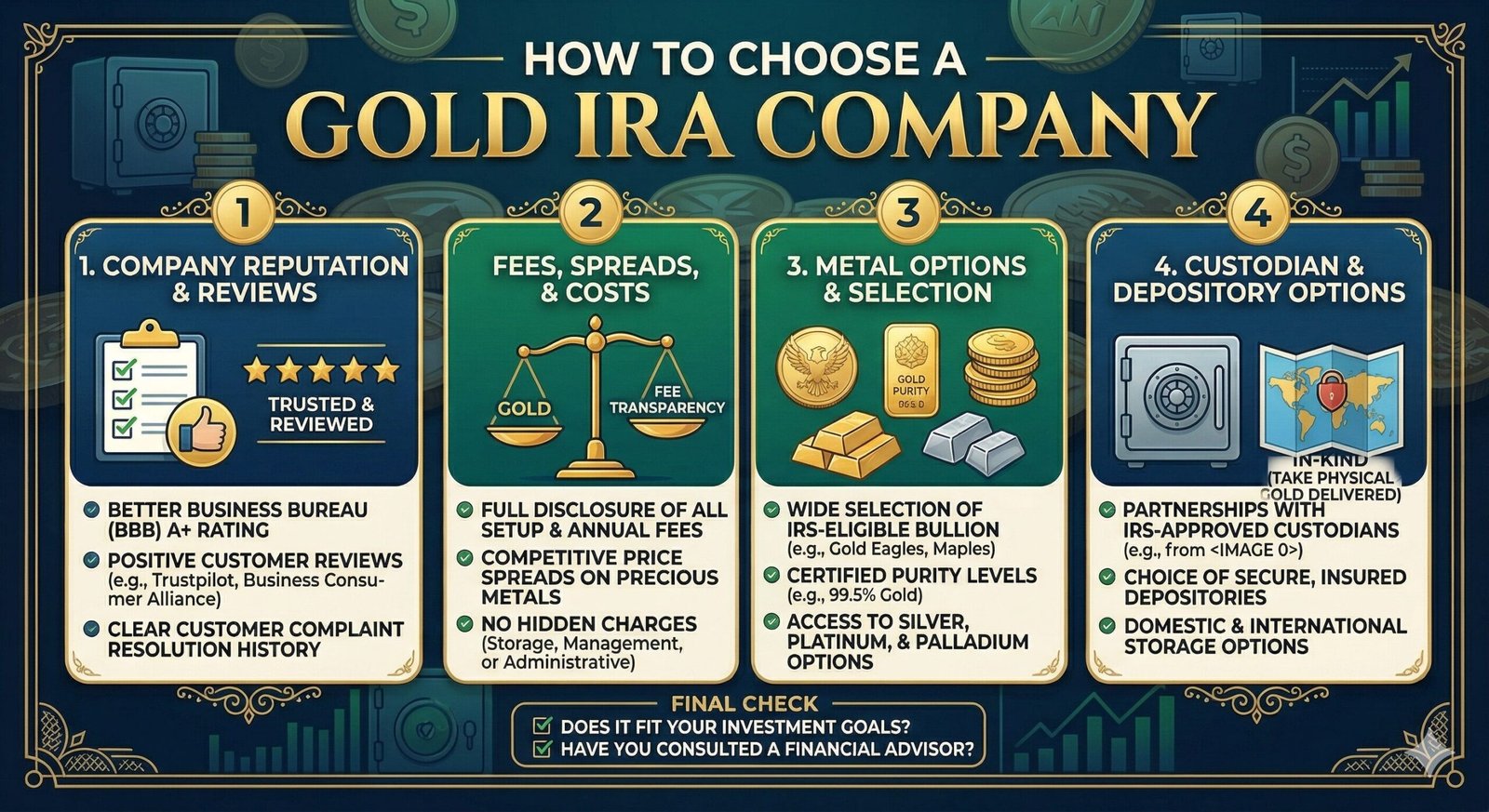
Gold IRAs tend to carry more fees than conventional IRAs. You’ll typically encounter account setup fees, annual custodian fees, and storage fees charged by the depository. These can add up meaningfully over time, so it’s worth reviewing our Gold IRA fees guide before making any decisions. Transparency in fee disclosure is one of the markers of a reputable provider — and a signal to look for when evaluating companies.
What Is a Money Market Account?
A money market account (MMA) is a type of interest-bearing deposit account offered by banks and credit unions. It typically offers higher interest rates than a standard savings account, while still providing easy access to your funds. Most money market accounts are FDIC-insured up to $250,000 per depositor, per institution.
Money market accounts are not the same thing as money market funds, though the names are often confused. A money market fund is a type of mutual fund that invests in short-term, low-risk debt instruments, and it is not FDIC-insured. The distinction matters, particularly for retirement investors evaluating risk.
Within the context of retirement savings, money market accounts can be held inside certain IRAs — typically as a low-risk cash position rather than a long-term growth vehicle. Some brokerage-based IRA platforms allow you to park cash in a money market fund between investment decisions. However, a money market account held outside of a retirement account has no tax-advantaged status.
How Money Market Accounts Work in Practice
Interest rates on money market accounts fluctuate with broader interest rate conditions. When rates are high, MMAs can be reasonably attractive for short-term cash management. When rates are low, the returns may barely keep pace with inflation — or may not keep pace at all. It’s worth noting that money market accounts are generally not designed as long-term wealth-building vehicles.
Access to funds is relatively straightforward. Most accounts allow withdrawals with limited restrictions, making them a liquid option that Gold IRAs cannot match. Physical gold held inside an IRA cannot simply be withdrawn at will — the process involves liquidation through your custodian and is subject to the same early withdrawal rules that govern other IRAs. A 10% penalty applies to withdrawals taken before age 59½ in most cases, in addition to applicable taxes.
Side-by-Side Comparison: Gold IRA vs Money Market
The table below summarizes the key structural differences between a Gold IRA and a money market account to make comparison easier.
Key Considerations for Retirement Investors
Liquidity and Accessibility
One of the clearest practical differences between a Gold IRA and a money market account is liquidity. Money market accounts are designed to be accessible — you can reach your money quickly and easily. Gold IRAs are not. Selling physical gold inside an IRA takes time, involves your custodian, and may come with transaction costs. If you’re weighing these options and liquidity is a priority, that’s a meaningful factor to discuss with your advisor.
Fees and Long-Term Costs
A money market account held at a bank typically has minimal fees — sometimes none at all. A Gold IRA, by contrast, involves ongoing annual costs for custody and storage. Over a 10- or 20-year period, these costs accumulate. Depending on the value of the account and the rate of return on the underlying metals, the fee burden can be significant. Review our Gold IRA fees guide for a thorough breakdown of what to expect.
Tax Structure
This is where the Gold IRA has a structural advantage over a standard money market account — though not necessarily over a money market account held inside a traditional IRA. Interest earned in a regular money market account is taxable as ordinary income in the year it’s earned. A traditional Gold IRA defers taxes until withdrawal. A Roth Gold IRA may allow tax-free qualified withdrawals. If you’re already familiar with how traditional IRAs work, the Gold IRA vs Traditional IRA comparison may help clarify the nuances.
Regulatory Protections
Money market accounts held at FDIC-insured institutions carry government-backed deposit insurance. Gold IRAs do not. However, reputable Gold IRA custodians are regulated at the federal level — FINRA’s guidance on self-directed IRAs is worth reading before opening any self-directed account. You can also verify custodian credentials through FINRA BrokerCheck.
Rolling Over Existing Retirement Funds
If you have funds in a 401(k) or existing IRA that you’re considering moving into a Gold IRA, there are specific rules governing how that process works. Our Gold IRA rollover rules page covers the mechanics in detail, and our 401(k) to Gold IRA rollover guide is a practical resource if you’re starting from a workplace plan.
A Note on Doing Your Due Diligence
Whether you’re exploring a Gold IRA or evaluating money market options inside a retirement account, the quality of the institution or provider you work with matters enormously. For Gold IRAs in particular, the self-directed structure means you carry more responsibility as an account holder. Before working with any Gold IRA company, check their standing with bbb.org, read verified customer reviews, and use FINRA BrokerCheck to confirm that any associated broker is properly registered. Our Gold IRA scams guide walks through the warning signs to watch for.
Also worth reviewing: the SEC investor resources page on retirement accounts provides a solid federal-level overview of how IRAs are regulated and what protections exist.
Frequently Asked Questions
Q: Can I hold a money market account inside a Gold IRA?
A: No. A Gold IRA is specifically structured to hold IRS-approved physical precious metals. Cash positions, including money market accounts, are not permitted within a Gold IRA. If you want a money market option inside a retirement account, that would need to be a separate IRA through a bank or brokerage.
Q: Is a Gold IRA riskier than a money market account?
A: Both carry their own forms of risk. Money market accounts at FDIC-insured banks carry very low risk of losing your principal within insured limits, but their returns may be modest and subject to interest rate fluctuation. Gold IRAs involve exposure to the price of physical gold, which can be volatile. Investing in precious metals involves risk, including possible loss of principal. This is a question best worked through with a qualified financial advisor.
Q: What are the eligibility requirements to open a Gold IRA?
A: To contribute to a Gold IRA, you generally need earned income and must fall within IRS income and contribution guidelines. The IRS IRA investment FAQ provides current eligibility information. You can also review is a Gold IRA a good idea for a broader look at who these accounts tend to suit.
Q: What types of gold can be held in a Gold IRA?
A: The IRS requires gold held in an IRA to meet a minimum purity standard of 99.5%. Coins and bars that meet this threshold and come from approved mints or refiners qualify. Our page on IRA-eligible gold coins covers the most commonly used options and what to look for.
Q: How much do I need to open a Gold IRA?
A: Minimum investment requirements vary by provider and can range from around $5,000 to $25,000 or more. Our Gold IRA minimum investment page provides a detailed breakdown by company type and account structure.
Ready to Learn More?
If you’re exploring your options and want to see how leading Gold IRA providers compare on fees, minimums, storage options, and customer service reputation, a good next step is reviewing our independently researched Best Gold IRA Companies of 2026. It’s designed to give retirement investors a clear, factual starting point — without the sales pressure.
This article is for informational purposes only and does not constitute financial or tax advice. Investing in precious metals involves risk including possible loss of principal.
Related guides
- Gold IRA Consumer Affairs Reviews: What to Look For
- Gold IRA Trustpilot Reviews: What Real Customers Say
- Gold IRA BBB Complaints: What Consumer Reports Reveal
- Is a Gold IRA Worth the Fees? A Cost-Benefit Analysis
- Are Gold IRA Fees Too High? Breaking Down the Real Costs
- Gold IRA Mistakes to Avoid: 10 Common Errors Investors Make