Gold IRA Required Minimum Distributions: Complete Guide
Required minimum distributions represent one of the most important aspects of retirement planning that Gold IRA holders must understand. These mandatory withdrawals from retirement accounts begin at age 73 and continue throughout your lifetime, affecting how you manage your precious metals investments in retirement.
Understanding how RMDs work with Gold IRAs involves navigating complex IRS regulations while managing the unique characteristics of physical precious metals. Unlike traditional paper assets, gold and silver require specific handling procedures that can impact your distribution strategy and overall retirement income planning.
Understanding Required Minimum Distributions
Required minimum distributions are annual withdrawals that the IRS mandates from most retirement accounts once you reach age 73. The IRS RMD FAQ provides comprehensive details about these requirements, which apply to Traditional IRAs, SEP IRAs, SIMPLE IRAs, and employer-sponsored retirement plans.
The underlying principle behind RMDs stems from the tax-deferred nature of these accounts. The government allowed you to defer taxes on contributions and growth over the years, but eventually wants to collect those taxes. RMDs ensure that retirement funds don’t remain sheltered from taxation indefinitely.
For Gold IRA holders, this means you cannot simply hold your precious metals forever. At some point, you must begin taking distributions, which typically involves either taking physical delivery of metals or having your custodian sell portions of your holdings to provide cash distributions.
RMD Age Requirements and Timeline
The SECURE Act 2.0 changed the RMD starting age from 72 to 73 for individuals who turn 72 after December 31, 2022. If you were born in 1951 or later, your first RMD must be taken by April 1 of the year after you turn 73. For those born in 1950 or earlier, the original age 70½ rule applied.
Your first RMD has a special deadline – April 1 of the year following the year you turn 73. However, this creates a potential “double taxation” year because you’ll need to take both your first RMD and your second RMD in the same calendar year. Many financial advisors recommend taking your first RMD in the year you turn 73 to spread the tax impact across two years.
After your first RMD, all subsequent distributions must be completed by December 31 of each year. Missing an RMD deadline triggers severe penalties – the IRS imposes a 25% excise tax on the amount you should have withdrawn but didn’t.
How RMDs Are Calculated
The IRS uses a specific formula to determine your required minimum distribution amount each year. This calculation involves your account balance as of December 31 of the previous year divided by a life expectancy factor from IRS tables.
The most commonly used table is the Uniform Lifetime Table, found in IRS Publication 590-A. This table provides life expectancy factors based on your age, assuming you have a beneficiary who is no more than 10 years younger than you.
For example, if you’re 75 years old, the life expectancy factor is 24.6. If your Gold IRA had a balance of $100,000 on December 31 of the previous year, your RMD would be $100,000 divided by 24.6, equaling approximately $4,065.
Special Calculation Rules
Certain situations require different calculation methods. If your spouse is your sole beneficiary and is more than 10 years younger than you, you may use the Joint and Last Survivor Table, which typically results in smaller required distributions.
The calculation becomes more complex when you have multiple retirement accounts. While you must calculate the RMD for each account separately, you can aggregate the total RMD amount and take it from any combination of your IRA accounts. This flexibility can be particularly valuable for Gold IRA holders who may want to take distributions from accounts with more liquid assets.
Understanding our Gold IRA guide helps clarify how these accounts function within the broader retirement landscape and how RMDs fit into your overall strategy.
Gold IRA RMD Distribution Options
Gold IRA holders have several options for satisfying their RMD requirements, each with distinct advantages and considerations. The choice often depends on your personal circumstances, market conditions, and long-term financial goals.
Physical Distribution of Precious Metals
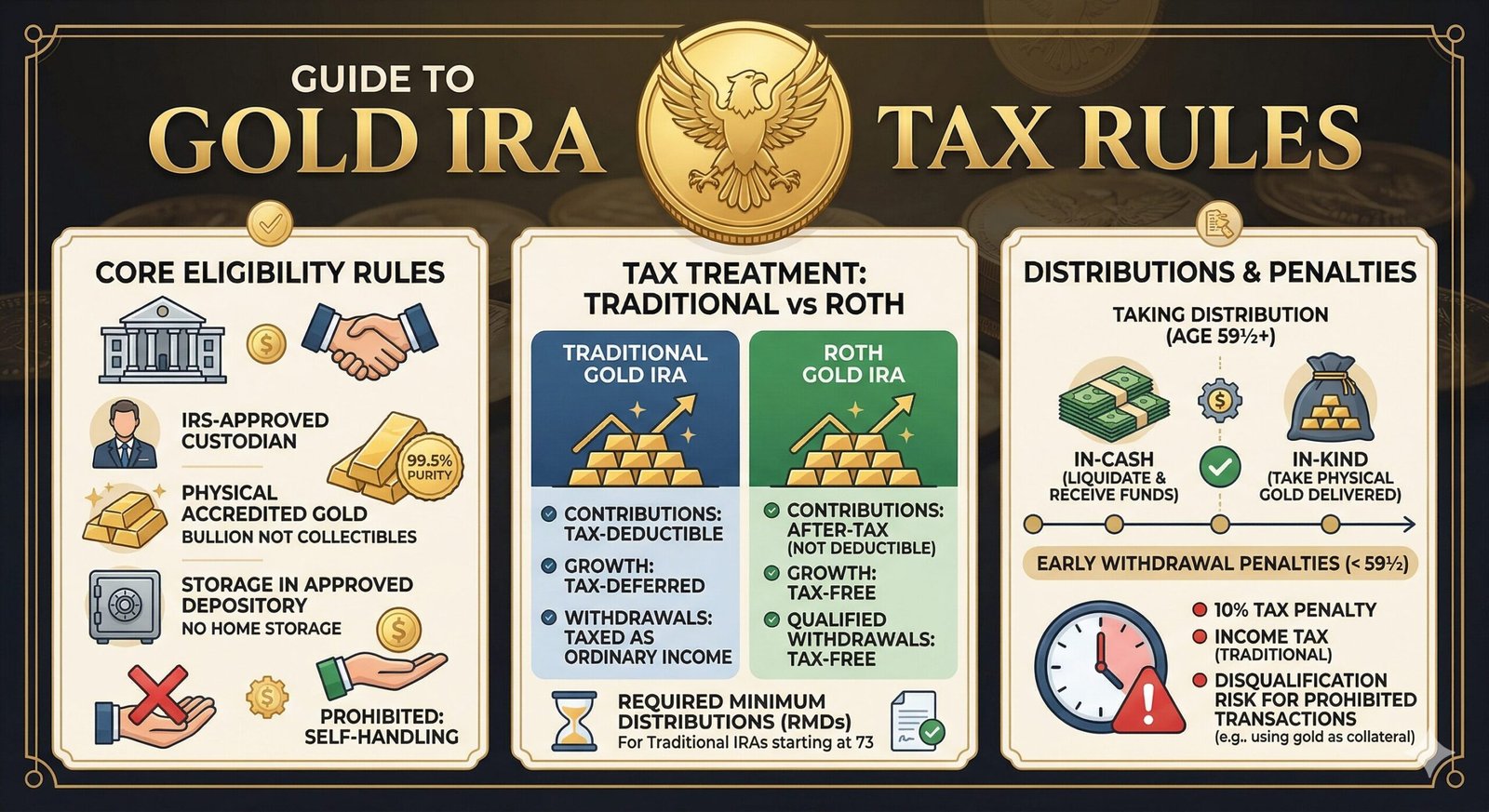
Taking physical possession of gold or silver represents one unique option available to Gold IRA holders. Your custodian can distribute actual precious metals to you, with the fair market value of those metals counting toward your RMD requirement.
Physical distributions require careful planning because you cannot simply take a fraction of a gold coin. The IRS values the metals at fair market value on the distribution date, which means you need to coordinate with your custodian to ensure the metals distributed meet your exact RMD amount as closely as possible.
When you receive physical metals, you’ll owe ordinary income tax on their fair market value, just as you would with any traditional IRA distribution. The metals become your personal property, no longer subject to IRA storage and handling requirements.
Cash Distributions Through Metal Sales
Many Gold IRA holders prefer cash distributions, which require your custodian to sell a portion of your precious metals holdings. The custodian sells enough metals to generate the cash needed to meet your RMD requirement, then distributes that cash to you.
This approach offers several advantages. Cash distributions provide exact amounts, eliminating the challenge of matching physical metals to precise RMD calculations. You maintain flexibility in how you use the distribution, whether for living expenses, reinvestment in other accounts, or other financial goals.
The timing of metal sales can impact your distribution amount due to precious metals price fluctuations. Working closely with your custodian to understand their sale procedures and timing helps you plan more effectively.
In-Kind Transfers to Taxable Accounts
Some investors choose to transfer precious metals from their Gold IRA to a regular, taxable precious metals account. This satisfies the RMD requirement while allowing you to maintain your metals holdings outside the IRA structure.
In-kind transfers count as distributions for tax purposes, meaning you’ll owe taxes on the fair market value of the transferred metals. However, this approach lets you continue holding physical precious metals without the ongoing fees and restrictions associated with IRA accounts.
Tax Implications of Gold IRA RMDs
Required minimum distributions from Gold IRAs carry the same tax implications as distributions from traditional IRAs. The distributed amount gets added to your taxable income for the year, potentially pushing you into a higher tax bracket.
Unlike some other retirement account distributions, Gold IRA RMDs don’t qualify for special tax treatment like capital gains rates or income averaging. The entire distribution amount gets taxed as ordinary income at your marginal tax rate.
Planning for Tax Impact
The tax impact of RMDs can be significant, especially for retirees with substantial precious metals holdings. Strategic planning throughout the year can help minimize the tax burden and coordinate RMDs with other income sources.
Consider the timing of your RMD within the calendar year. Taking distributions early in the year provides more time to plan for the tax impact, while December distributions might offer more certainty about your annual income picture.
Some retirees benefit from making estimated tax payments on their RMDs to avoid underpayment penalties. The IRS generally requires quarterly payments if you expect to owe more than $1,000 in taxes after withholding and credits.
Our Gold IRA rollover rules guide provides additional context about how tax planning intersects with precious metals retirement accounts.
Working with Custodians and Dealers
Gold IRA required minimum distributions involve coordination between multiple parties, including your IRA custodian, precious metals dealer, and potentially your tax advisor. Understanding each party’s role helps ensure smooth distribution processing.
Your IRA custodian maintains responsibility for calculating your RMD amount, executing distributions, and providing necessary tax documentation. They must ensure compliance with IRS regulations while accommodating the unique aspects of precious metals holdings.
When physical distributions or metal sales are required, your custodian coordinates with their approved precious metals dealers. These dealers handle the actual sale or transfer of metals, providing fair market valuations and ensuring proper documentation.
Communication and Documentation
Clear communication with your custodian about your distribution preferences prevents confusion and delays. Some custodians offer automatic RMD programs that calculate and distribute your required amount annually, while others require manual requests for each distribution.
Proper documentation becomes crucial for tax reporting and record-keeping. Your custodian provides Form 1099-R documenting your distribution amount, which you’ll need for tax preparation. If you take physical metals, ensure you receive documentation showing the fair market value calculation used for tax reporting.
Comparison of Gold IRA RMD Options
Common RMD Mistakes to Avoid
Several common mistakes can create problems for Gold IRA holders managing required minimum distributions. Understanding these pitfalls helps you avoid costly errors and penalties.
Missing the RMD deadline represents the most expensive mistake. The 25% penalty on the missed distribution amount can be reduced to 10% if you correct the mistake promptly and file the appropriate forms with the IRS. However, avoiding the penalty entirely by meeting deadlines is always preferable.
Calculating RMDs incorrectly often stems from using wrong account balances or life expectancy factors. Always use the December 31 balance from the previous year, and ensure you’re referencing the correct IRS life expectancy table for your situation.
Some investors mistakenly believe they can take RMDs from any retirement account to satisfy requirements for all accounts. While you can aggregate IRA RMDs, employer plan RMDs must generally be taken from each specific plan.
Record Keeping Challenges
Maintaining accurate records becomes particularly important with Gold IRA RMDs due to the complexity of precious metals valuations and transactions. Keep detailed records of all distributions, fair market value calculations, and tax reporting documents.
Understanding Gold IRA fees helps you anticipate the costs associated with RMD processing and factor these into your distribution planning.
Estate Planning Considerations
Required minimum distributions don’t end with your death – they continue for your beneficiaries under specific rules that vary based on the beneficiary’s relationship to you and age.
Surviving spouses have the most flexibility, including the option to treat an inherited Gold IRA as their own account and restart the RMD timeline based on their age. Non-spouse beneficiaries generally must distribute the entire account within 10 years of your death, though specific rules vary based on the beneficiary’s age and relationship to you.
The SECURE Act significantly changed beneficiary distribution rules, eliminating the “stretch IRA” for most non-spouse beneficiaries. This means inherited Gold IRAs must typically be distributed much faster than under previous rules, potentially creating larger tax burdens for your heirs.
Planning for these distribution requirements influences how you structure your overall estate plan and may affect decisions about is a Gold IRA a good idea for your specific situation.
Integration with Overall Retirement Strategy
Gold IRA required minimum distributions should align with your broader retirement income strategy. These distributions represent just one income stream that needs coordination with Social Security, pension payments, and withdrawals from other retirement accounts.
The lumpy nature of precious metals distributions can create timing challenges. Unlike mutual funds that can be sold in precise amounts daily, precious metals may require larger transactions that create uneven distribution amounts across years.
Consider how Gold IRA RMDs fit into your overall tax planning strategy. Years with large RMDs might benefit from increased charitable giving, tax-loss harvesting in taxable accounts, or other strategies to manage your overall tax burden.
Some retirees use RMDs to rebalance their overall asset allocation, particularly if their Gold IRA represents a significant portion of their retirement savings. However, remember that investment advice and specific allocation recommendations fall outside the scope of educational content.
Our Gold IRA vs Traditional IRA comparison helps illustrate how different account types integrate into comprehensive retirement planning.
Frequently Asked Questions
When do Gold IRA required minimum distributions begin?
Gold IRA RMDs begin at age 73 for individuals born in 1951 or later. Your first RMD must be taken by April 1 of the year following the year you turn 73, with all subsequent RMDs due by December 31 each year. The same rules apply as for traditional IRAs, since Gold IRAs are simply traditional IRAs that hold precious metals.
Can I take my Gold IRA RMD as physical precious metals?
Yes, you can satisfy your RMD requirement by taking physical delivery of gold or silver from your account. The fair market value of the metals on the distribution date counts toward your RMD requirement. However, coordinating the exact amount can be challenging since you cannot take fractions of coins or bars.
How are Gold IRA RMDs calculated differently from other IRAs?
Gold IRA RMDs use the same calculation method as traditional IRAs – your December 31 account balance divided by the appropriate IRS life expectancy factor. The only difference lies in the distribution method, where you might receive physical metals or cash from metal sales rather than stock or bond proceeds.
What happens if I miss my Gold IRA RMD deadline?
Missing an RMD deadline triggers a 25% penalty on the amount you should have withdrawn. This penalty can potentially be reduced to 10% if you take the missed distribution promptly and file Form 5329 with the IRS. Some circumstances may qualify for penalty waivers, but it’s always better to meet the deadline.
Can I donate my Gold IRA RMD directly to charity?
Qualified charitable distributions (QCDs) allow direct transfers from your IRA to qualified charities, counting toward your RMD requirement while potentially reducing your taxable income. However, QCDs must be made directly from the IRA to the charity – you cannot take a distribution and then donate the proceeds to achieve the same tax benefit.
Understanding Gold IRA required minimum distributions requires careful attention to IRS regulations, coordination with financial professionals, and integration with your overall retirement strategy. These distributions represent a significant aspect of precious metals retirement investing that affects both your current income and long-term financial planning.
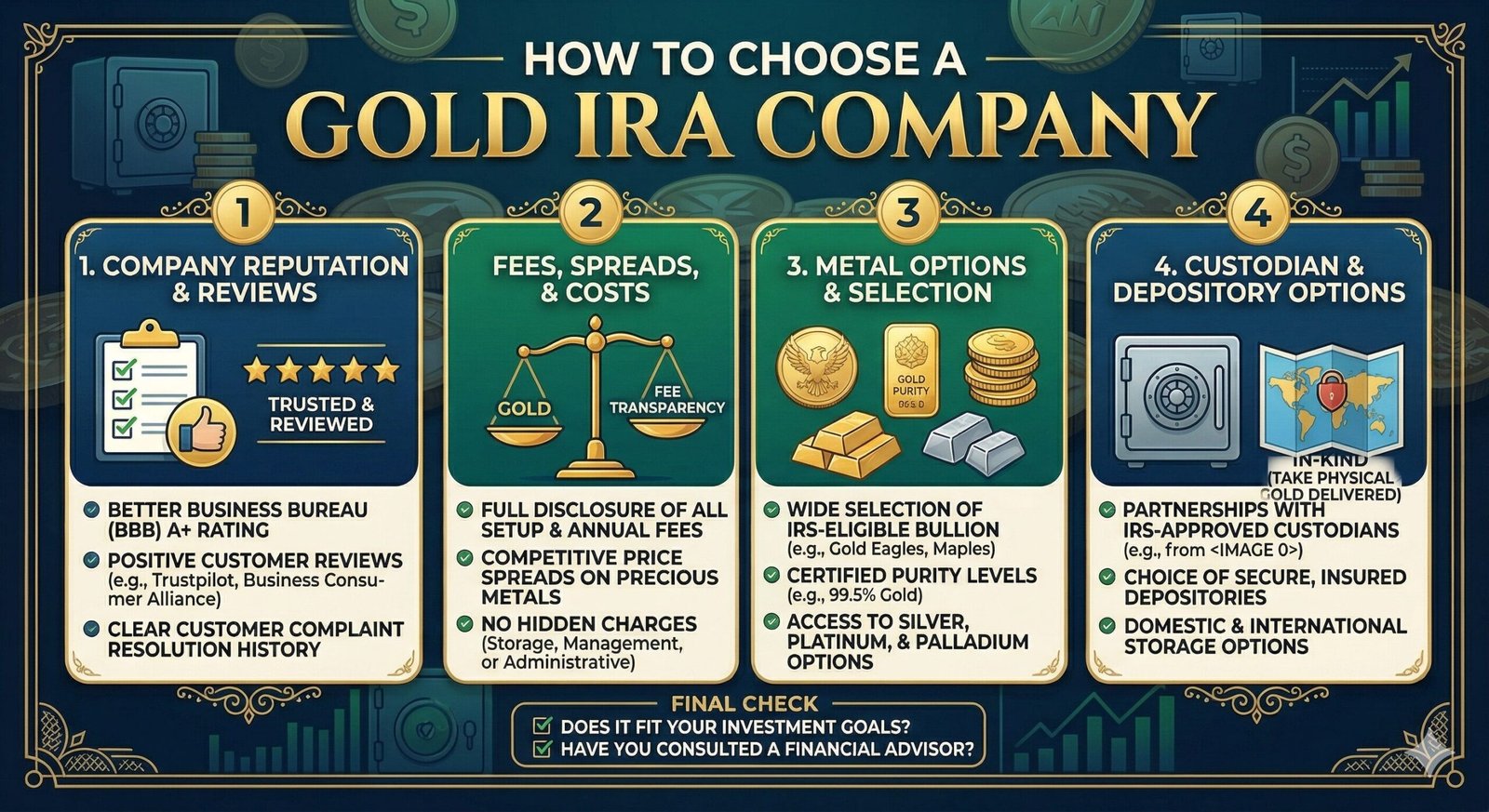
For comprehensive information about selecting the right custodian to handle your Gold IRA RMDs effectively, review our detailed analysis of the Best Gold IRA Companies of 2026 to find providers with strong distribution processing capabilities and customer service.
This article is for informational purposes only and does not constitute financial or tax advice. Investing in precious metals involves risk including possible loss of principal.
Related guides
- Gold IRA Consumer Affairs Reviews: What to Look For
- Gold IRA Trustpilot Reviews: What Real Customers Say
- Gold IRA BBB Complaints: What Consumer Reports Reveal
- Is a Gold IRA Worth the Fees? A Cost-Benefit Analysis
- Are Gold IRA Fees Too High? Breaking Down the Real Costs
- Gold IRA Mistakes to Avoid: 10 Common Errors Investors Make