Gold IRA in Texas: Rules, Providers and Storage Options
Texas residents interested in adding precious metals to their retirement planning have access to the same federal Gold IRA opportunities as investors nationwide. However, understanding state-specific considerations, local storage facilities, and regional providers can help Texans make more informed decisions about their retirement assets.
A Gold IRA operates under the same Internal Revenue Service regulations regardless of your state of residence. The fundamental structure, contribution limits, and withdrawal rules remain consistent whether you live in Houston, Dallas, Austin, or any other Texas city. What can vary are the companies serving your area, storage facility locations, and local tax implications.
Understanding Gold IRAs for Texas Residents
Gold Individual Retirement Accounts function as self-directed retirement vehicles that allow investors to hold IRS-approved precious metals instead of traditional paper assets. According to IRS Publication 590-A, these accounts must be administered by qualified custodians and follow strict purity and storage requirements.
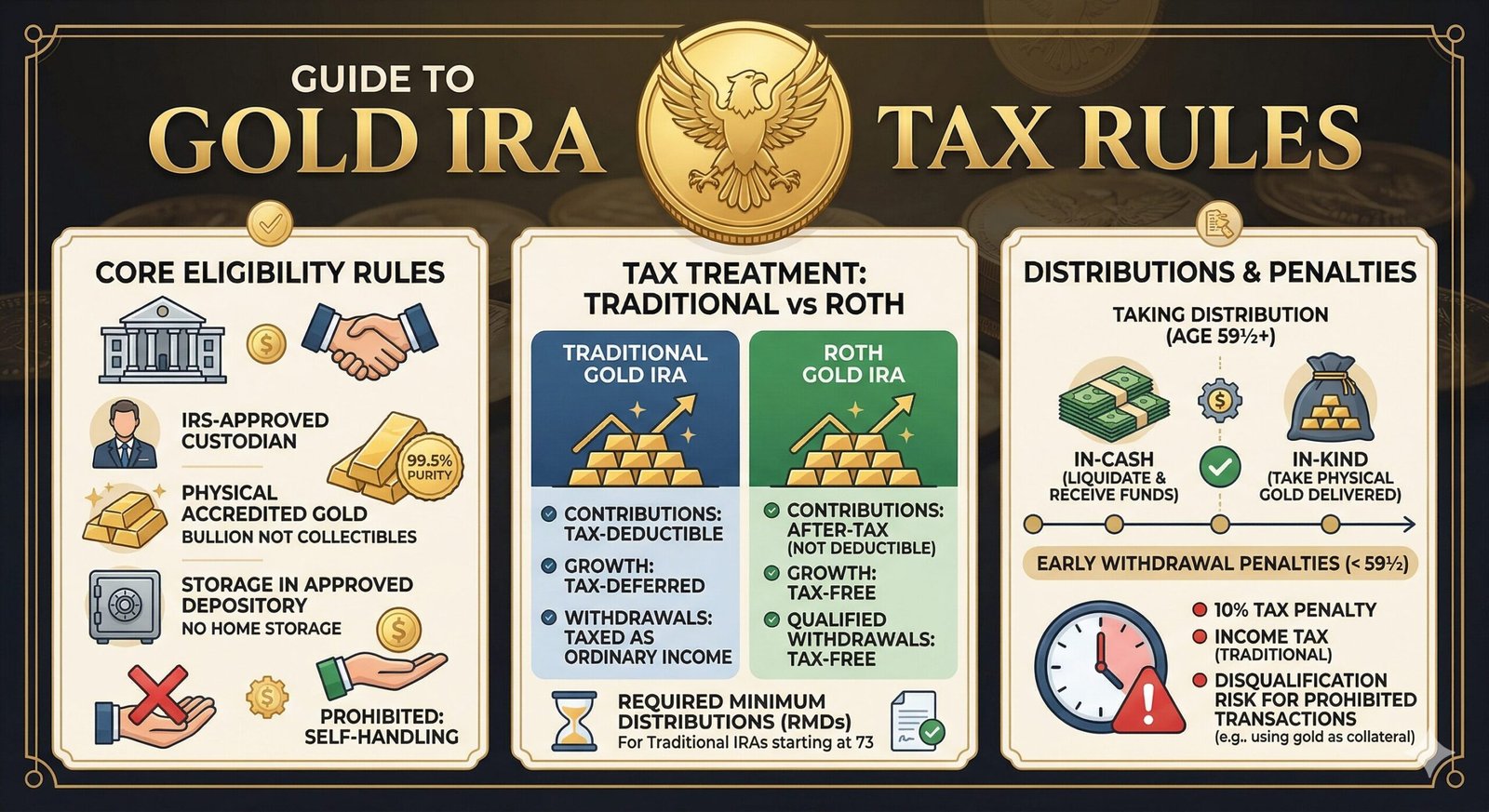
Texas investors can establish either traditional or Roth Gold IRAs. Traditional Gold IRAs offer potential tax deductions on contributions, with taxes paid upon withdrawal during retirement. Roth Gold IRAs use after-tax dollars for contributions but allow tax-free withdrawals in retirement, assuming certain conditions are met.
The appeal of Gold IRAs among Texas residents often stems from concerns about economic uncertainty, currency devaluation, and the desire for tangible assets in retirement portfolios. Texas has historically maintained a strong culture of self-reliance and individual responsibility, which aligns with the concept of holding physical precious metals.
For comprehensive information about how these accounts work, refer to our detailed guide on what a Gold IRA is and Gold IRAs Explained in Detail.
Gold IRA Rules and Regulations in Texas
The federal government sets all Gold IRA regulations through the Internal Revenue Service. Texas state law does not impose additional restrictions on Gold IRAs beyond federal requirements. This means Texas residents follow the same rules as investors in other states.
Key federal regulations include annual contribution limits, which for 2024 are $7,000 for individuals under 50 and $8,500 for those 50 and older. These limits apply to all IRA contributions combined, whether traditional, Roth, or precious metals accounts. The IRS contribution limits page provides current year information.
Required minimum distributions begin at age 73 for traditional Gold IRAs, following the same schedule as conventional retirement accounts. The IRS RMD FAQ outlines these requirements in detail.
Texas residents must also ensure their precious metals meet IRS purity standards: gold must be 99.5% pure, silver 99.9% pure, platinum and palladium 99.95% pure. Only certain coins and bars qualify for IRA inclusion, as detailed in our guide to IRA-eligible gold coins.
Income limits affect Roth IRA eligibility but not traditional IRA contributions. High-income Texas residents may need to consider backdoor Roth conversions or focus on traditional Gold IRAs if their income exceeds Roth contribution thresholds.
Gold IRA Providers Serving Texas
Numerous precious metals dealers and Gold IRA companies serve Texas residents, ranging from national firms to regional specialists. When evaluating providers, Texas investors should consider factors such as company reputation, fee structures, customer service quality, and storage options.
National companies often provide consistent service standards and may offer competitive pricing due to their scale. Regional firms might offer more personalized service and better understanding of local market conditions. Some providers specialize in serving specific geographic areas or client types.
Due diligence is essential when selecting a Gold IRA provider. Check company ratings with the Better Business Bureau and verify any financial advisors through FINRA BrokerCheck. Read customer reviews and understand all fee structures before making commitments.
Many Texas investors prefer companies that offer transparent pricing, educational resources, and ongoing customer support. Some providers offer buyback guarantees, though terms and conditions vary significantly between companies.
For guidance on selecting appropriate providers, consult our comprehensive review of the Best Gold IRA Companies of 2026. Additionally, our Gold IRA scams guide helps identify warning signs of questionable companies.
Storage Options for Texas Gold IRA Investors
IRS regulations require Gold IRA assets to be stored in approved depositories, not in personal possession. Several IRS-approved storage facilities serve Texas residents, offering segregated and non-segregated storage options.
Delaware Depository Service operates facilities in multiple states and provides storage services for many Gold IRA custodians. International Depository Services offers storage in Delaware and Texas, providing regional convenience for some investors. Brink’s Global Services maintains secure facilities nationwide and serves numerous precious metals dealers.
Texas residents can choose between segregated storage, where their metals are stored separately and individually identified, or non-segregated storage, where metals are pooled with other investors’ holdings of the same type and purity. Segregated storage typically costs more but offers additional peace of mind and easier auditing.
Some Texas investors prefer storage facilities within the state for perceived convenience, though the practical differences are minimal since investors cannot physically access their metals regardless of location. All IRS-approved depositories maintain high security standards, insurance coverage, and regular auditing procedures.
Storage fees vary by facility and storage type, typically ranging from 0.5% to 1.5% of account value annually. Understanding these ongoing costs is crucial for evaluating the total expense of Gold IRA ownership, as covered in our Gold IRA fees guide.
Texas State Tax Considerations
Texas does not impose state income tax, which simplifies Gold IRA tax planning for residents. This means Texas investors only deal with federal tax implications for their precious metals retirement accounts.
Traditional Gold IRA contributions may be deductible on federal tax returns, subject to income and employer plan participation limits. Withdrawals during retirement are taxed as ordinary income at federal rates. Roth Gold IRA contributions use after-tax dollars, but qualified withdrawals are federally tax-free.
Early withdrawal penalties apply to Gold IRAs just as with conventional retirement accounts. Withdrawals before age 59½ typically incur a 10% federal penalty plus ordinary income taxes on the withdrawal amount. Some exceptions exist for first-time home purchases, higher education expenses, and other qualifying circumstances.
The absence of state income tax in Texas means residents avoid the complexity of state-specific retirement account rules that exist in many other states. This can simplify record-keeping and tax planning for Gold IRA investors.
Rollover and Transfer Considerations
Texas residents can fund Gold IRAs through direct transfers from existing retirement accounts, including 401(k) plans from current or former employers. The rollover process follows federal guidelines regardless of state residence.
Our 401(k) to Gold IRA rollover guide explains the step-by-step process for moving funds from employer plans to precious metals accounts. The Gold IRA rollover rules provide detailed information about timing requirements and potential tax implications.
Direct rollovers, where funds move directly from one custodian to another, avoid the 60-day rollover limitation and reduce the risk of unintended tax consequences. Indirect rollovers require completing the transaction within 60 days to avoid taxes and penalties.
Texas residents with multiple retirement accounts may benefit from consolidating funds into a single Gold IRA, potentially reducing administrative complexity and fees. However, this strategy should be evaluated carefully based on individual circumstances and existing account features.
Some employers restrict in-service withdrawals from active 401(k) plans, meaning employees may need to wait until job separation or retirement to access these funds for Gold IRA rollovers.
Minimum Investment Requirements
Gold IRA minimum investment requirements vary significantly among providers, typically ranging from $5,000 to $50,000 for initial accounts. Some companies offer lower minimums for rollover accounts compared to new cash contributions.
These minimums exist partly due to the fixed costs associated with account setup, custodial services, and storage arrangements. Smaller accounts may face proportionally higher fee burdens, making Gold IRAs less economically efficient for investors with limited retirement savings.
Texas residents should evaluate whether their available investment amount justifies Gold IRA ownership given the fee structure. Our Gold IRA minimum investment guide provides detailed information about entry requirements and cost considerations.
Some providers offer reduced minimums for existing customers or during promotional periods. Others require higher minimums but include services like free storage for the first year or waived setup fees.
Investment minimums may also apply to specific precious metals products. Premium coins and bars often have higher individual costs, potentially requiring larger account values to achieve meaningful allocation levels.
Making an Informed Decision
Before establishing a Gold IRA, Texas residents should carefully consider their overall retirement strategy and how precious metals fit within their financial goals. Gold IRAs represent one option among many retirement planning tools, each with distinct characteristics and trade-offs.
Understanding your risk tolerance, time horizon, and retirement income needs helps determine whether a Gold IRA aligns with your circumstances. Some investors find precious metals complement their existing retirement accounts, while others prefer focusing on traditional assets.
Fee analysis is particularly important given the multiple costs associated with Gold IRAs, including custodial fees, storage charges, dealer markups, and potential liquidation costs. These ongoing expenses can significantly impact long-term returns and should be weighed against potential benefits.
Educational resources can help Texas residents make more informed decisions. FINRA’s guidance on self-directed IRAs provides valuable information about the broader category of alternative retirement investments.
Consider consulting with qualified financial advisors who understand both precious metals investing and retirement planning. The SEC investor resources page offers guidance on working with investment professionals.
For those weighing different retirement account options, our Gold IRA vs Traditional IRA and Gold IRA vs 401(k) comparisons provide detailed analysis of the key differences and considerations.
Frequently Asked Questions
Can Texas residents store Gold IRA assets at home?
No, IRS regulations require Gold IRA assets to be stored in approved depositories. Home storage disqualifies the account from IRA status and creates immediate tax consequences and penalties.
Are there additional state regulations for Gold IRAs in Texas?
Texas does not impose additional regulations beyond federal IRS requirements. Gold IRAs in Texas follow the same rules as in all other states.
Do I need a Texas-based custodian for my Gold IRA?
No, you can use any IRS-approved custodian regardless of their location. Many Gold IRA custodians serve clients nationwide from their primary business locations.
How do Texas state taxes affect Gold IRA withdrawals?
Texas does not have state income tax, so withdrawals from Gold IRAs are subject only to federal taxation. This simplifies tax planning compared to states with income taxes.
What happens to my Gold IRA if I move from Texas to another state?
Your Gold IRA remains unchanged if you relocate. Federal regulations govern these accounts, so state residency changes do not affect account structure or holdings.
Texas residents interested in exploring whether a Gold IRA aligns with their retirement planning goals should research thoroughly and consider their individual circumstances carefully. For comprehensive reviews of companies serving Texas investors, visit our guide to the Best Gold IRA Companies of 2026.
This article is for informational purposes only and does not constitute financial or tax advice. Investing in precious metals involves risk including possible loss of principal.
Related guides
- Gold IRA Consumer Affairs Reviews: What to Look For
- Gold IRA Trustpilot Reviews: What Real Customers Say
- Gold IRA BBB Complaints: What Consumer Reports Reveal
- Is a Gold IRA Worth the Fees? A Cost-Benefit Analysis
- Are Gold IRA Fees Too High? Breaking Down the Real Costs
- Gold IRA Mistakes to Avoid: 10 Common Errors Investors Make