Gold IRA in Massachusetts: Rules and Top Providers
For retirement savers across the Bay State — from Boston’s financial district to the quieter communities of the Pioneer Valley — interest in gold individual retirement accounts has grown steadily in recent years. Whether you’re a long-time investor who has watched market cycles come and go, or someone approaching retirement who’s simply looking to understand all available options, a Gold IRA is a topic worth understanding clearly and completely.
This guide covers how Gold IRAs work, what rules apply specifically in the context of Massachusetts, how to evaluate providers, and what questions to ask before moving forward. As always, nothing here constitutes investment advice — this is educational information only.
What Is a Gold IRA?
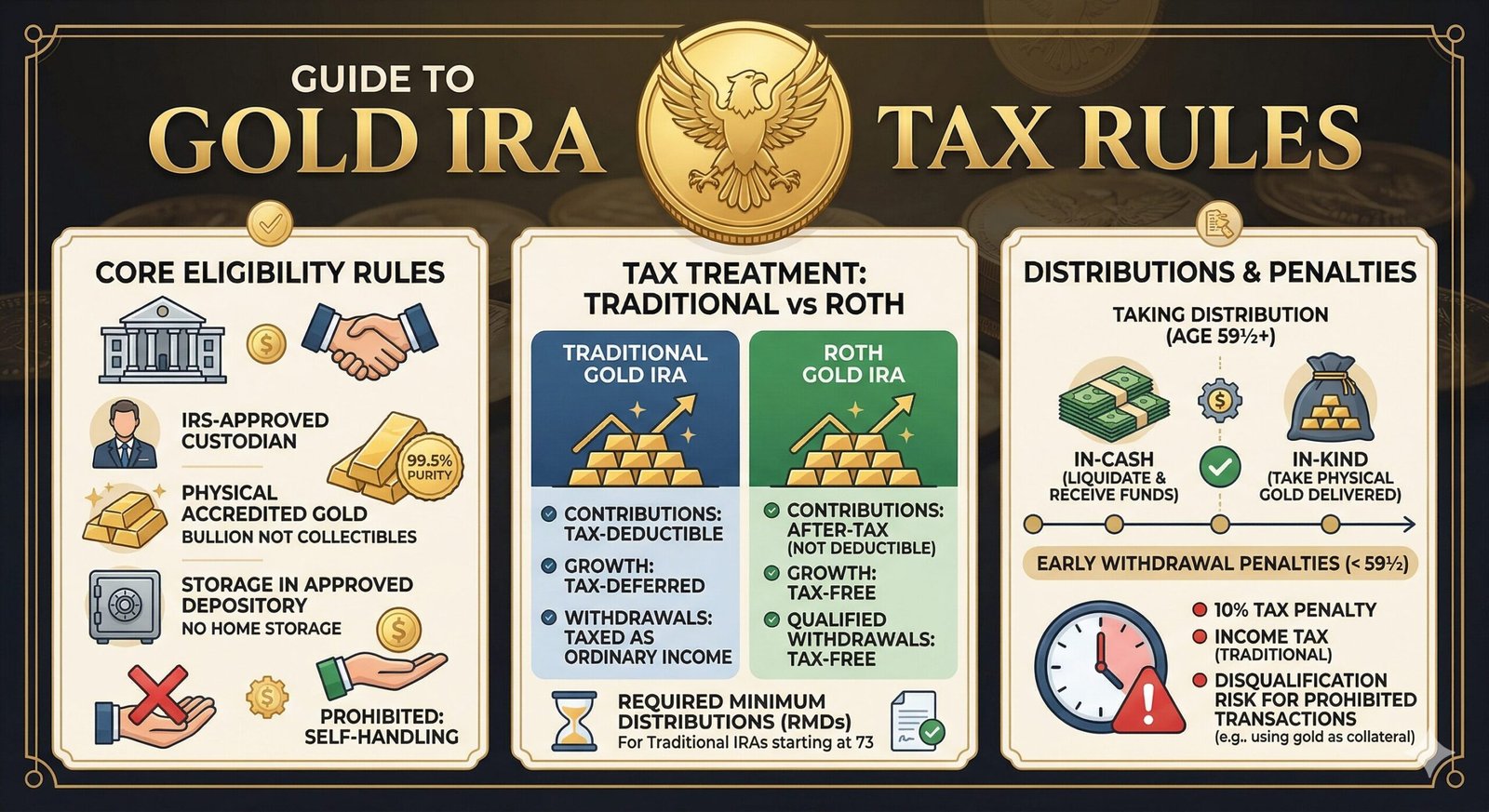
A Gold IRA is a self-directed individual retirement account that holds physical precious metals — typically gold bullion bars or coins — rather than conventional paper assets like stocks or mutual funds. It operates under the same basic IRS framework as a Traditional or Roth IRA, but with one critical difference: the account must be managed through a qualified custodian, and the physical metals must be stored in an IRS-approved depository.
For a deeper grounding in how these accounts work, visit our Gold IRA hub or read our full Gold IRAs Explained in Detail guide.
The IRS sets strict rules around which metals qualify for inclusion. Gold must generally be at least 99.5% pure to be eligible. Certain coins — including the American Gold Eagle, Canadian Gold Maple Leaf, and Australian Gold Kangaroo — meet IRS standards. Our guide to IRA-eligible gold coins outlines the approved options in detail.
Does Massachusetts Have Separate Gold IRA Rules?
This is one of the most common questions from Bay State investors, and the answer is largely reassuring: Gold IRAs are governed by federal law, primarily the Internal Revenue Code. Massachusetts does not impose an additional layer of state-specific Gold IRA regulations that overrides or contradicts federal rules.
That said, Massachusetts residents do need to be aware of a few state-level considerations:
Massachusetts State Income Tax and IRAs
Massachusetts generally conforms to federal IRA treatment for income tax purposes, but with some nuances. Traditional IRA contributions may or may not be deductible on your Massachusetts state return depending on your specific circumstances, and distributions are taxed at the state level. The Massachusetts Department of Revenue administers these rules, and they can differ in subtle ways from federal treatment — particularly around Roth IRA contributions that were taxed at the federal level before the state conformed to certain provisions.
This is not tax advice, and the specifics vary by individual situation. We strongly recommend consulting a Massachusetts-licensed tax professional or CPA for guidance on how IRA distributions will be treated on your state return.
Consumer Protection Considerations in Massachusetts
Massachusetts has a strong consumer protection framework under Chapter 93A, its consumer protection statute. While this doesn’t specifically regulate Gold IRAs, it does mean that Massachusetts residents have legal recourse if a provider engages in deceptive or unfair business practices. This is worth keeping in mind as you evaluate Gold IRA companies — understanding your rights as a Bay State consumer adds an additional layer of confidence when choosing a provider.
For broader guidance on avoiding dishonest operators in this space, our Gold IRA scams guide is essential reading before you engage with any company.
Federal Rules Every Massachusetts Gold IRA Investor Must Know
Regardless of which state you live in, federal law sets the framework for how Gold IRAs operate. Here are the key rules every investor should understand.
Contribution Limits
For 2025, the IRS contribution limit for IRAs is $7,000 per year, or $8,000 if you are aged 50 or older. This applies to your total IRA contributions across all accounts — not per account. You can confirm current figures directly with the IRS contribution limits page.
Custodian Requirements
You cannot hold physical gold in a standard brokerage IRA. A Gold IRA must be held with a qualified custodian — typically a trust company or bank — that is approved to administer self-directed IRAs. FINRA’s guidance on self-directed IRAs, available at the FINRA self-directed IRA resource, provides important context on how these accounts differ from conventional IRAs.
Storage Requirements
IRS rules prohibit you from taking personal possession of the gold held inside your IRA. All metals must be stored in an IRS-approved third-party depository. These facilities maintain segregated or non-segregated storage depending on the provider and pricing tier you select.
Required Minimum Distributions
Once you reach age 73, you are generally required to begin taking Required Minimum Distributions (RMDs) from a Traditional Gold IRA. Because your assets are held as physical metal rather than cash, this can create a logistical consideration: the custodian may need to liquidate a portion of your holdings to fund the distribution. For full details, see the IRS RMD FAQ.
Rolling Over an Existing Retirement Account
Many Massachusetts investors fund a Gold IRA by rolling over an existing 401(k) or Traditional IRA rather than making fresh annual contributions. This can be a practical way to move a larger sum of money into a self-directed structure without triggering immediate tax consequences — provided the rollover is executed correctly.
Our 401(k) to Gold IRA rollover guide walks through the mechanics in plain language. For a detailed look at the compliance requirements, see our Gold IRA rollover rules page.
There are two rollover types to understand:
- Direct rollover: Funds move directly from your existing custodian to the new Gold IRA custodian, without passing through your hands. This is the simpler and generally preferred approach.
- Indirect rollover: Funds are distributed to you first, and you have 60 days to deposit them into the new account. Failing to meet the 60-day deadline can result in the distribution being treated as taxable income, with potential penalties if you are under age 59½.
The IRS provides detailed rollover guidance through IRS Publication 590-A.
Key Fees to Understand Before You Open an Account
Gold IRAs carry a fee structure that is meaningfully different from a standard IRA held at a brokerage. Before committing to any provider, Massachusetts investors should understand what they are paying for. Our dedicated Gold IRA fees guide covers this topic comprehensively, but the table below outlines the main cost categories.
Fees vary significantly between providers and can erode returns over time, so comparing costs carefully is important. The Gold IRA minimum investment page also explains the entry thresholds different companies impose, which range from a few thousand dollars to $50,000 or more.
How to Evaluate Gold IRA Providers as a Massachusetts Resident
Choosing a Gold IRA company requires the same careful due diligence you’d apply to any financial services provider. Here’s what to look for:
Custodian and Depository Relationships
Confirm that the company works with an IRS-approved custodian and a reputable third-party depository. The company itself is typically a precious metals dealer — the custodian is the entity actually administering the IRA.
Reputation and Complaints History
Check the company’s rating and complaint history at bbb.org. Look for patterns in complaints rather than isolated incidents — any company with significant volume will have some. Also consider using FINRA BrokerCheck to verify the background of any financial professionals involved.
Transparency on Fees and Pricing
Reputable companies disclose their fees clearly, without requiring you to sit through a high-pressure sales call to get basic information. If a company is evasive about costs upfront, that’s a meaningful warning sign.
Customer Education
The best Gold IRA companies invest in educating their customers rather than simply closing sales. Look for providers that offer accessible resources, honest explanations of risk, and direct access to knowledgeable staff.
For a side-by-side look at the leading options, see our Best Gold IRA Companies of 2026 page.
Gold IRA vs. Traditional IRA: Key Differences
If you currently hold a Traditional IRA and are curious how a Gold IRA compares structurally, our Gold IRA vs Traditional IRA guide covers the mechanics in depth. The core difference is what the account holds — physical metals in one case, paper assets in the other — along with the additional custodian and storage requirements that apply to self-directed accounts.
For a comparison with 401(k) plans, the Gold IRA vs 401(k) guide is a useful companion read.
If you’re still weighing whether a Gold IRA suits your personal situation, our article on is a Gold IRA a good idea offers a balanced look at the considerations involved — without pushing you in any direction. You might also find the SEC investor resources page helpful for a government-level overview of retirement account options.
Frequently Asked Questions
Can Massachusetts residents open a Gold IRA with any provider, or are there state restrictions?
Massachusetts residents can open a Gold IRA with any federally compliant provider that serves customers in their state. There are no Massachusetts-specific licensing requirements for Gold IRA dealers that would meaningfully restrict your choices, though you should always verify that any company you use is properly structured and works with an IRS-approved custodian.
Is gold held in a Gold IRA taxed differently in Massachusetts than elsewhere?
Gold IRA distributions are subject to both federal and Massachusetts state income tax in the case of Traditional IRAs. The state rate and treatment may differ slightly from federal rules. For Roth Gold IRAs, qualified distributions are generally federal-tax-free, though Massachusetts conformity to Roth rules has some historical nuances. A Massachusetts CPA can clarify your specific situation.
Are there Gold IRA storage facilities in Massachusetts?
IRS-approved depositories are primarily located in states like Delaware, Texas, and Utah — not typically in Massachusetts. That is standard across the industry and is not specific to being a Bay State resident. Your metals are insured and audited at these facilities regardless of where you live.
What happens to my Gold IRA if I move out of Massachusetts?
Your Gold IRA is a federally structured account. Moving to another state does not affect the account itself — only your state tax treatment of any distributions would change based on your new state of residence at the time of withdrawal.
What is the minimum amount needed to open a Gold IRA?
This varies considerably by provider. Some companies have minimum investment requirements as low as $2,000–$5,000, while others require $25,000–$50,000 or more. See our Gold IRA minimum investment guide for a full breakdown by company.
Ready to Learn More?
Opening a Gold IRA is a significant decision that deserves careful research. If you’re a Massachusetts investor who has done your reading and is ready to compare the leading providers side by side, our Best Gold IRA Companies of 2026 page is the best next step — with detailed profiles, fee comparisons, and what to look for in each provider.
This article is for informational purposes only and does not constitute financial or tax advice. Investing in precious metals involves risk including possible loss of principal.
Related guides
- Gold IRA Consumer Affairs Reviews: What to Look For
- Gold IRA Trustpilot Reviews: What Real Customers Say
- Gold IRA BBB Complaints: What Consumer Reports Reveal
- Is a Gold IRA Worth the Fees? A Cost-Benefit Analysis
- Are Gold IRA Fees Too High? Breaking Down the Real Costs
- Gold IRA Mistakes to Avoid: 10 Common Errors Investors Make