Gold IRA in Iowa: Guide for Retirement Investors
If you live in Iowa and you’re thinking seriously about your retirement finances, you’ve likely come across the term “Gold IRA.” Maybe you’ve seen it advertised, heard it mentioned by a financial commentator, or discussed it with friends who are also approaching retirement age. Whatever brought you here, the questions Iowa investors tend to ask are the same: What exactly is a Gold IRA? How does it work in practice? And what do I need to know before I take any steps?
This guide is designed to answer those questions clearly and honestly. It won’t tell you what to do with your money — that’s a conversation for a licensed financial advisor who knows your specific situation. What it will do is give you a solid foundation in how Gold IRAs work, what the IRS requires, what costs to expect, and how to approach the process intelligently as an Iowa-based investor.
What Is a Gold IRA?
A Gold IRA is a type of self-directed Individual Retirement Account that allows you to hold physical precious metals — primarily gold — as part of your retirement savings. Unlike a conventional IRA, which typically holds paper assets like stocks and mutual funds, a Gold IRA holds tangible assets that are stored in an IRS-approved depository.
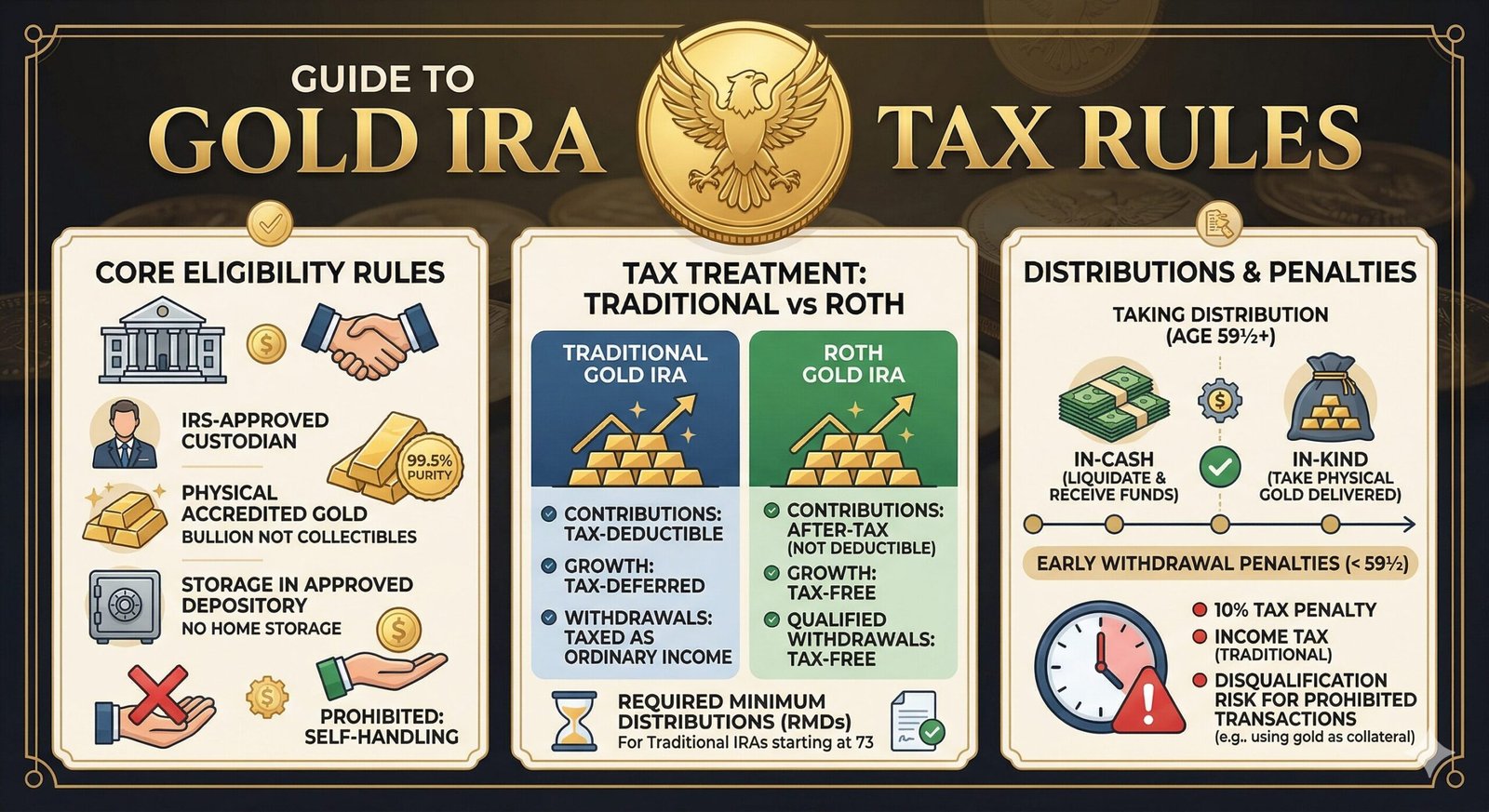
The tax treatment of a Gold IRA follows the same structure as a conventional IRA. A traditional Gold IRA uses pre-tax contributions, with taxes deferred until you take distributions. A Roth Gold IRA uses after-tax contributions, with qualified distributions in retirement potentially tax-free. For a deeper look at how these structures work, see our Gold IRA vs Traditional IRA comparison.
You can also explore Gold IRAs Explained in Detail if you want a comprehensive walkthrough of the account mechanics before going further.
The IRS does not treat Gold IRAs as a special category — they are simply self-directed IRAs that happen to hold alternative assets. That means all the usual IRA rules around contribution limits, required minimum distributions, and prohibited transactions apply in full. The IRS IRA investment FAQ is worth bookmarking if you want to read the rules directly from the source.
How Gold IRAs Work for Iowa Residents
Living in Iowa doesn’t change the federal rules that govern Gold IRAs — the IRS sets those rules uniformly across all states. What it does mean is that you’ll be working within Iowa’s broader financial and regulatory environment when choosing service providers, understanding your tax obligations, and making decisions about account structure.
The Three-Party Structure
Every Gold IRA involves three distinct parties, and understanding this structure is essential.
The Custodian is the IRS-approved financial institution that administers your account, handles the paperwork, files required reports with the IRS, and ensures the account remains compliant. Iowa residents can use custodians based anywhere in the country — you are not limited to Iowa-headquartered firms. However, you should verify that any custodian you consider is licensed and in good standing. FINRA’s guidance on self-directed IRAs at FINRA’s guidance on self-directed IRAs outlines key due diligence steps worth reviewing.
The Dealer is the precious metals company that sources and sells the gold (or other eligible metals) that goes into your account. The dealer and the custodian are separate entities — though some companies market themselves as offering an end-to-end service that coordinates both.
The Depository is the IRS-approved, secure storage facility where your physical metals are held. This is a critical point: the IRS does not permit you to take personal possession of gold held inside an IRA. It must be stored at an approved third-party depository. Iowa does not currently have any IRS-approved depositories, so your metals will almost certainly be stored out of state — typically at facilities in Delaware, Texas, Utah, or South Dakota.
Eligible Metals and Purity Standards
Not all gold qualifies for IRA inclusion. The IRS sets minimum purity requirements: gold must be at least 99.5% pure. Common eligible products include American Gold Eagle coins (which are an exception to the purity rule under the tax code), American Gold Buffalo coins, and various gold bars from approved refiners. For a detailed breakdown of what qualifies, see our guide on IRA-eligible gold coins.
Rolling Over an Existing Retirement Account
Many Iowa investors who open a Gold IRA do so by rolling over funds from an existing 401(k) or traditional IRA, rather than making new cash contributions. This is a common and IRS-recognized approach, provided the rollover is executed correctly.
The IRS permits two types of rollovers. A direct rollover moves funds from your existing account directly to the new Gold IRA custodian without passing through your hands. A 60-day rollover sends the funds to you first, and you have 60 days to deposit them into the new account — miss that window and the distribution may be treated as taxable income, potentially with additional penalties.
For most people, the direct rollover is the cleaner option because it eliminates the risk of the 60-day deadline and avoids mandatory withholding. Our 401(k) to Gold IRA rollover guide walks through the process step by step, and the Gold IRA rollover rules page covers the IRS rules in detail.
It’s also worth knowing that the IRS limits you to one indirect (60-day) rollover per 12-month period across all your IRAs. Direct custodian-to-custodian transfers are not subject to this limit. You can read the IRS contribution and rollover rules at IRS Publication 590-A.
Contribution Limits and Required Minimum Distributions
If you’re contributing new money to a Gold IRA rather than rolling over an existing account, the standard IRA contribution limits apply. For 2025, the limit is $7,000 per year ($8,000 if you’re 50 or older, thanks to the catch-up contribution provision). These limits apply across all your IRAs combined — not separately per account. The IRS publishes current figures at their IRS contribution limits page.
Required Minimum Distributions (RMDs) apply to traditional Gold IRAs starting at age 73 under current law. Because your account holds physical gold rather than cash, satisfying an RMD requires either selling a portion of your holdings to generate cash, or taking an in-kind distribution of a proportional amount of metal — which then becomes a taxable event. For more on how RMDs work with Gold IRAs, the IRS RMD FAQ is the authoritative source. Roth Gold IRAs are not subject to RMDs during the account holder’s lifetime.
Understanding Gold IRA Fees
Gold IRA fees are a meaningful consideration that’s easy to overlook when you’re focused on the metals themselves. Unlike a standard brokerage IRA where fees may be minimal, a Gold IRA involves several layers of ongoing cost.
Our Gold IRA fees guide breaks all of this down in depth, but here is a summary of the fee types you’ll encounter:
These fees vary significantly between providers. Iowa investors should request a full, written fee schedule from any custodian or dealer before committing to anything. Fees that are vague or bundled together in a way that makes total cost difficult to calculate deserve closer scrutiny.
Iowa-Specific Considerations
While federal rules govern Gold IRAs, Iowa does have its own income tax structure that affects retirement distributions. Iowa generally taxes retirement income, though the state has been phasing in changes that reduce or eliminate taxes on retirement income for residents 55 and older. These changes are being implemented over several years, and the specifics depend on your age and income level.
This is an area where speaking with an Iowa-based CPA or tax professional is genuinely valuable — not to get advice on whether to open a Gold IRA, but to understand how distributions from any retirement account, including a Gold IRA, will be treated under Iowa state tax law in your specific circumstance. This article does not constitute tax advice, and state tax rules change over time.
Avoiding Scams and Choosing Reputable Providers
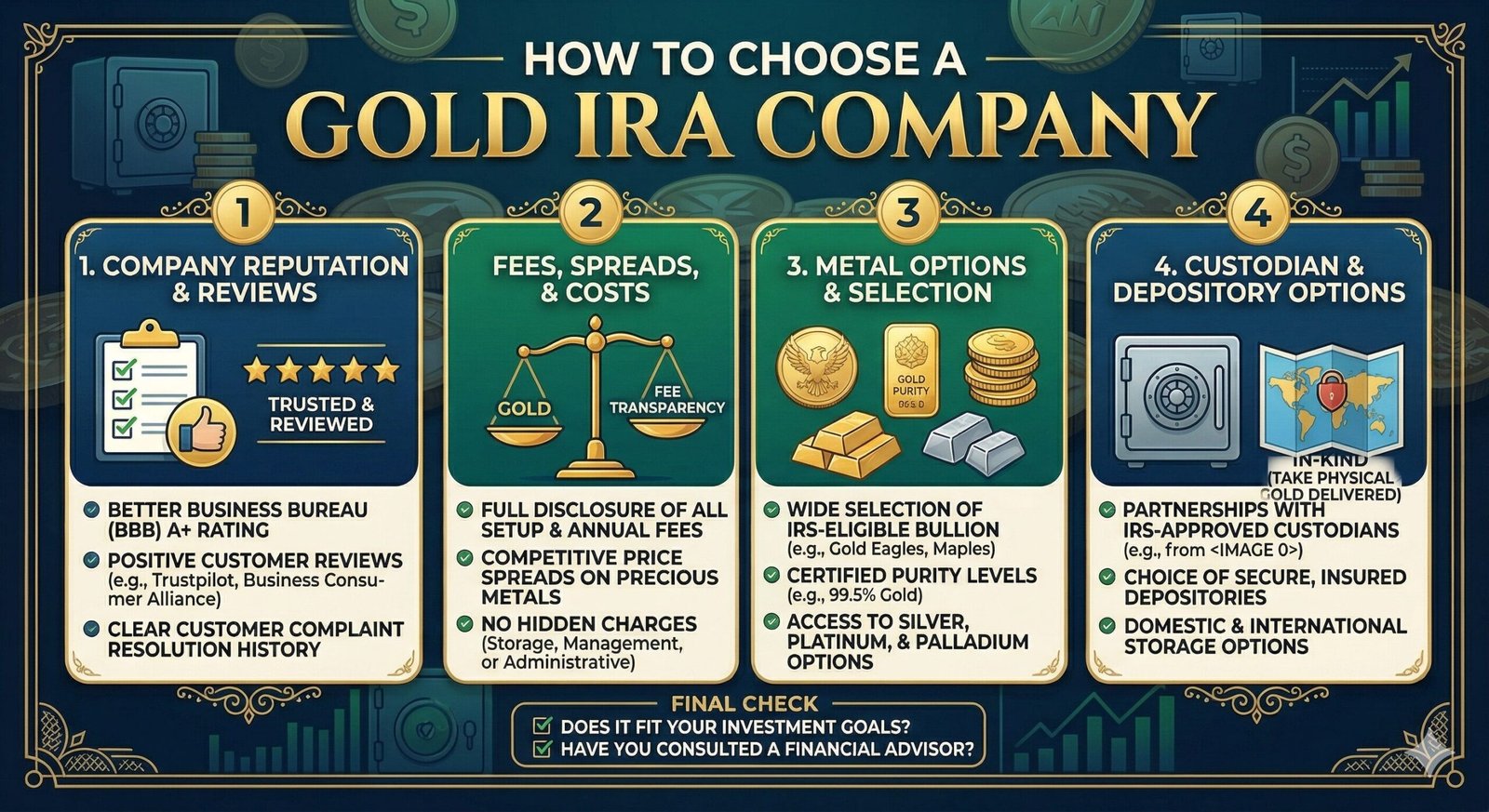
Unfortunately, the Gold IRA space attracts a share of misleading marketing and outright fraudulent operators. Iowa residents — like investors anywhere — should approach this area with careful due diligence. Our Gold IRA scams guide covers the warning signs in detail, but a few principles are worth stating here.
Verify that any custodian you’re considering is properly licensed. Check their standing with the Better Business Bureau at bbb.org and confirm any broker or dealer through FINRA BrokerCheck. Be cautious of high-pressure sales tactics, unrealistic claims about gold’s past or future performance, and offers that sound too straightforward. Legitimate companies welcome questions and give you time to make informed decisions.
The SEC also provides useful context for retirement investors at their SEC investor resources page.
Is a Gold IRA the Right Fit for You?
That’s not a question this article can answer — and it shouldn’t try to. The considerations are personal: your age, your existing retirement assets, your income needs in retirement, your tax situation, and your comfort with the unique characteristics of holding physical assets in a retirement account. For a balanced look at the question, see our page on is a Gold IRA a good idea, which explores both the potential appeal and the genuine limitations of this account type.
What this article can say is that Gold IRAs are legitimate IRS-recognized accounts with a well-defined regulatory structure. They come with real costs, meaningful logistical considerations, and rules that must be followed carefully. Iowa investors who take the time to understand those rules — and who work with reputable, transparent service providers — are far better positioned to make a sound decision than those who act quickly based on a single advertisement or a rushed sales call.
You can start your research on service providers at our Best Gold IRA Companies of 2026 page, which reviews and compares leading custodians and dealers to help you identify providers worth speaking with.
Frequently Asked Questions
Can Iowa residents open a Gold IRA with any custodian in the country?
Yes. The IRS does not restrict which state your Gold IRA custodian is based in. Iowa residents can work with any IRS-approved custodian operating in the United States. You should verify the custodian’s credentials and licensing regardless of their location.
Will my gold physically be stored in Iowa?
Almost certainly not. Iowa does not have IRS-approved precious metals depositories. Your gold will be stored at a facility in another state — common locations include Delaware, Texas, Utah, and South Dakota. You should confirm the specific depository your custodian uses and understand the storage fees involved.
What happens to my Gold IRA when I turn 73 and need to take RMDs?
Traditional Gold IRAs are subject to Required Minimum Distributions starting at age 73. Because the account holds physical metal rather than cash, satisfying an RMD typically involves either selling a portion of your metals or taking an in-kind distribution. Both approaches have tax consequences. The IRS RMD FAQ provides the official framework, and your custodian and a tax advisor can help you plan accordingly.
Can I roll over my existing Iowa employer 401(k) into a Gold IRA?
In many cases, yes — though whether your current 401(k) plan allows an in-service rollover depends on your plan’s specific rules. If you’ve left your employer, rolling over a former 401(k) into a Gold IRA is generally permissible under IRS rules. Our Gold IRA rollover rules page covers the requirements in detail.
What is the minimum investment needed to open a Gold IRA?
Minimums vary by custodian and dealer. Some require as little as $5,000 to open an account, while others set minimums of $25,000 or higher. Our Gold IRA minimum investment page provides a breakdown of what different providers typically require, which can help you narrow your options early in the process.
Ready to compare providers? Visit our Best Gold IRA Companies of 2026 page for a reviewed list of reputable custodians and dealers serving Iowa and all U.S. retirement investors.
This article is for informational purposes only and does not constitute financial or tax advice. Investing in precious metals involves risk including possible loss of principal.
Related guides
- Gold IRA Consumer Affairs Reviews: What to Look For
- Gold IRA Trustpilot Reviews: What Real Customers Say
- Gold IRA BBB Complaints: What Consumer Reports Reveal
- Is a Gold IRA Worth the Fees? A Cost-Benefit Analysis
- Are Gold IRA Fees Too High? Breaking Down the Real Costs
- Gold IRA Mistakes to Avoid: 10 Common Errors Investors Make