Gold IRA in Indiana: Rules, Providers, and Storage
If you live in Indiana and have been exploring ways to add physical gold to your retirement savings, you’ve likely come across the term “Gold IRA.” For many Hoosier retirees and near-retirees, the concept raises a natural set of questions: How does it actually work? Are there Indiana-specific rules I need to know about? Where would my gold be stored? And how do I find a trustworthy company to work with?
This guide answers all of those questions in plain English, walking you through the federal framework that governs these accounts, what Indiana residents specifically need to understand, and the practical steps involved in opening and maintaining a Gold IRA.
What Is a Gold IRA?
A Gold IRA is a type of self-directed Individual Retirement Account that holds physical precious metals — typically gold bullion or IRS-approved gold coins — rather than conventional assets like stocks or mutual funds. The account operates under the same broad IRS framework as a traditional or Roth IRA, which means it comes with the same annual contribution limits, rollover rules, and distribution requirements.
If you’d like a thorough introduction to how these accounts are structured, our Gold IRA hub covers the full picture. You can also read Gold IRAs Explained in Detail for a deeper technical breakdown of the account mechanics.
The critical distinction between a Gold IRA and a standard IRA is that the physical metal must be stored by an IRS-approved custodian and kept in an approved depository. You cannot simply purchase gold bars and store them in your home safe and call it a retirement account — the IRS explicitly prohibits this arrangement for IRA-held metals.
Does Indiana Have Special Gold IRA Rules?
This is one of the most common questions Indiana residents ask, and the short answer is: no, Indiana does not impose additional state-level rules on Gold IRAs beyond the federal framework. These accounts are governed primarily by federal law — specifically, rules set by the Internal Revenue Service under the Employee Retirement Income Security Act (ERISA) and the Internal Revenue Code.
That said, Indiana residents should be aware of a few state-level considerations:
State income tax on distributions. Indiana has a flat state income tax rate. When you take distributions from a traditional Gold IRA in retirement, those withdrawals are generally taxed as ordinary income at both the federal and Indiana state level. This is consistent with how traditional IRA distributions are treated broadly. For specific guidance on how Indiana taxes retirement income, you should consult a qualified tax professional, as this article does not constitute tax advice.
Indiana investor protections. Indiana residents working with any financial company — including precious metals dealers and IRA custodians — have access to protections through the Indiana Securities Division. If you’re evaluating a provider, you can cross-reference them against resources like FINRA BrokerCheck and check their Better Business Bureau standing at bbb.org to verify legitimacy.
For a broader overview of how federal rules interact with your account, the IRS IRA investment FAQ is a reliable starting point.
IRS Rules Every Indiana Investor Must Understand
Regardless of what state you live in, a Gold IRA must comply with IRS regulations on several fronts.
Eligible Metals
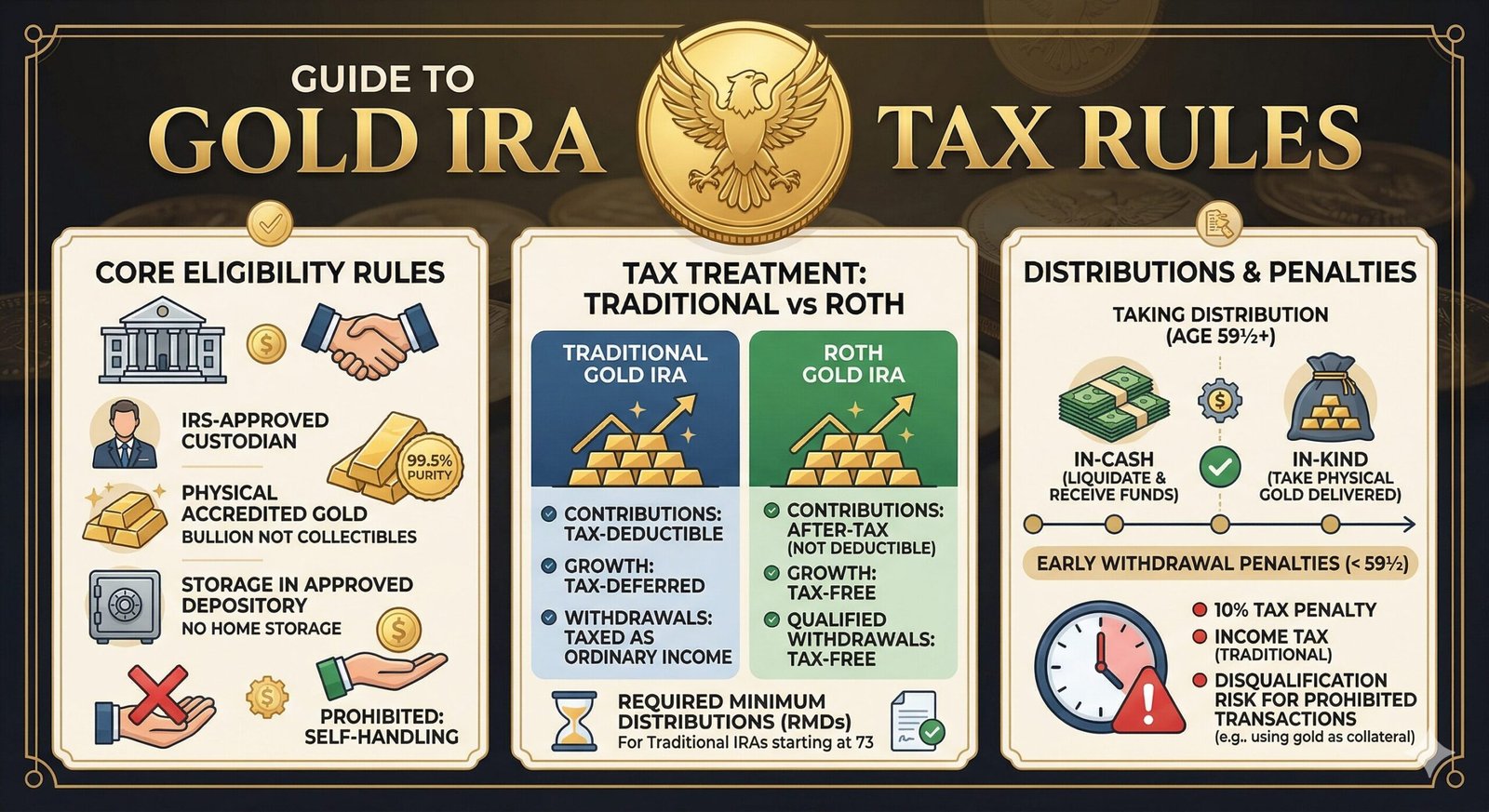
Not all gold qualifies for IRA inclusion. The IRS requires that gold held inside an IRA meet a minimum fineness of 99.5% purity. American Gold Eagle coins are a notable exception — they meet IRS eligibility despite being slightly below that purity threshold. For a full breakdown of which coins and bars qualify, see our guide to IRA-eligible gold coins.
Contribution Limits
For 2025, the IRS annual contribution limit for IRAs is $7,000 for individuals under 50, and $8,000 for those aged 50 and older. These limits apply to your total IRA contributions across all accounts — not just your Gold IRA. You can verify current figures directly through the IRS contribution limits page.
Required Minimum Distributions
Once you turn 73, the IRS requires you to begin taking Required Minimum Distributions (RMDs) from a traditional Gold IRA — the same as with any traditional IRA. Because your assets are held in physical metal rather than cash, you’ll need to plan ahead: either liquidate a portion of your holdings to cover the RMD or arrange an in-kind distribution with your custodian. The IRS RMD FAQ offers detailed guidance on these requirements.
Prohibited Transactions
The IRS enforces strict rules around self-dealing in self-directed IRAs. You cannot, for instance, purchase gold from yourself, store IRA-held gold at your own residence, or use the gold personally in any way while it remains inside the IRA. FINRA has published useful guidance on self-directed IRAs that Indiana investors should review before opening an account.
Rollover Options for Indiana Residents
Many Indiana investors who open Gold IRAs do so by rolling over an existing 401(k), 403(b), or traditional IRA rather than starting from scratch with new contributions. This is a practical route for those who have accumulated retirement savings in employer-sponsored plans and want to move a portion into a self-directed precious metals account.
The two main rollover methods are a direct rollover, where funds move directly between custodians without passing through your hands, and an indirect rollover, where you receive the funds and must redeposit them within 60 days to avoid taxes and penalties. The direct method is generally simpler and carries less risk of error.
For a detailed walkthrough of the process, our 401(k) to Gold IRA rollover guide covers every step, and our Gold IRA rollover rules page explains the IRS regulations that govern these transfers.
Gold IRA Storage: Where Is Your Metal Actually Kept?
For Indiana investors, one of the most practical questions is: where does the gold go?
IRS rules require that precious metals held in a Gold IRA be stored at an IRS-approved depository — a secure, insured facility that specializes in holding physical assets on behalf of IRA custodians. These depositories are generally located across the United States in cities like Dallas, Salt Lake City, Wilmington (Delaware), and Las Vegas, among others.
Indiana does not currently host a major IRS-approved precious metals depository, which means your gold will likely be stored out of state. This is entirely standard practice and is no cause for concern. Reputable depositories carry significant insurance coverage and operate under regular audits to verify holdings.
You will typically be able to choose between segregated storage, where your metals are stored separately from other clients’ holdings, and commingled storage, where metals of the same type are pooled together. Segregated storage usually carries a higher annual fee but offers additional peace of mind for some investors.
Storage fees, along with custodian fees and dealer markup, form the core cost structure of a Gold IRA. Our Gold IRA fees guide provides a clear breakdown of what Indiana investors can typically expect to pay.
Key Costs at a Glance
Fees vary meaningfully between providers, so comparing custodians carefully before committing is important. See Gold IRA minimum investment to understand entry thresholds as well.
Choosing a Gold IRA Provider as an Indiana Resident
Indiana residents have access to the full national market of Gold IRA custodians and precious metals dealers. Because this is a federal product, there is no requirement to work with an Indiana-based company.
When evaluating providers, consider the following:
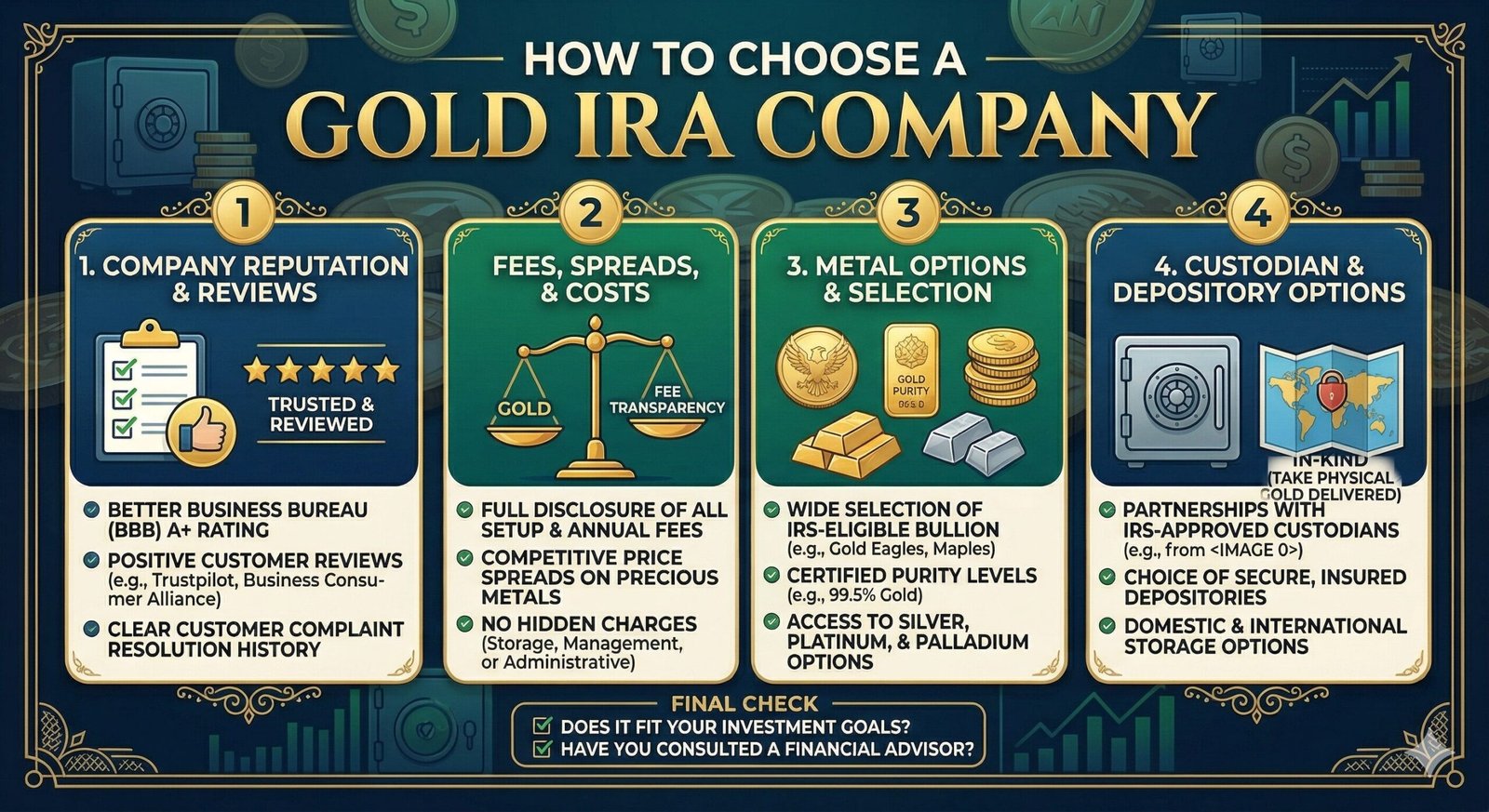
Custodian credentials. Your custodian must be an IRS-approved trustee — typically a bank, credit union, or non-bank trust company approved to hold self-directed IRA assets. Confirm their regulatory standing through publicly available resources.
Dealer transparency. The precious metals dealer who sells you the gold should be willing to clearly disclose their pricing, markup, and buy-back policies in writing before any transaction.
Customer service quality. Because Gold IRAs involve ongoing account management over many years, consistent, accessible customer service matters more than it might with a standard brokerage account.
Reputation and complaints. Review each company’s BBB profile and check for regulatory actions or unresolved complaints. Our Gold IRA scams guide highlights common red flags to watch for.
You can also compare vetted providers through our roundup of the Best Gold IRA Companies of 2026.
Frequently Asked Questions
Q: Can I store my Gold IRA metals at home if I live in Indiana?
No. IRS rules prohibit IRA account holders from taking personal possession of metals held within the IRA. All IRA-held metals must be stored at an IRS-approved depository. Taking personal possession before a qualifying distribution triggers taxes and potential penalties.
Q: Is a Gold IRA treated differently under Indiana state tax law compared to a regular IRA?
For state income tax purposes, Indiana generally treats Gold IRA distributions the same way as traditional IRA distributions — as ordinary income. The state does not impose specific rules that single out Gold IRAs. Consult a licensed tax professional for advice specific to your situation.
Q: How long does it take to open a Gold IRA in Indiana?
The process typically takes between two and four weeks from start to finish, depending on how quickly the rollover or transfer from your existing account is processed. Account setup itself can often be completed online within a few business days.
Q: What happens to my Gold IRA if I move out of Indiana?
Nothing changes about the structure or rules of your account. Gold IRAs are federal accounts governed by IRS rules, so relocating to another state has no impact on how your account operates.
Q: Is a Gold IRA right for me?
That decision depends on your individual financial circumstances, goals, and risk tolerance. We recommend reading is a Gold IRA a good idea and consulting with a qualified financial advisor before making any decisions. Past performance of any asset is not a guarantee of future results.
Ready to Learn More?
If you’re an Indiana resident weighing your retirement account options, the next step is comparing the companies that specialize in this space. Our independently researched guide to the Best Gold IRA Companies of 2026 is a useful starting point for understanding what leading providers offer, how their fees stack up, and what the account-opening process looks like in practice.
This article is for informational purposes only and does not constitute financial or tax advice. Investing in precious metals involves risk including possible loss of principal.
Related guides
- Gold IRA Consumer Affairs Reviews: What to Look For
- Gold IRA Trustpilot Reviews: What Real Customers Say
- Gold IRA BBB Complaints: What Consumer Reports Reveal
- Is a Gold IRA Worth the Fees? A Cost-Benefit Analysis
- Are Gold IRA Fees Too High? Breaking Down the Real Costs
- Gold IRA Mistakes to Avoid: 10 Common Errors Investors Make