Gold IRA in Idaho: What You Need to Know in 2026
If you live in Idaho and you’ve been exploring your retirement account options, you may have come across the term “Gold IRA.” It’s a topic that generates plenty of questions — and understandably so. The rules governing these accounts are more involved than those for a standard IRA, and the landscape of companies offering them is crowded enough that knowing where to start can feel overwhelming.
This guide is written specifically for Idaho residents who want a clear, honest explanation of how Gold IRAs work, what the federal and structural requirements look like, and what you should watch out for as you do your research. We won’t be telling you what to do with your money — that’s a conversation for a qualified financial advisor. What we will do is give you the factual foundation you need to have that conversation confidently.
What Is a Gold IRA?
A Gold IRA is a type of self-directed Individual Retirement Account that holds physical precious metals — typically gold, but also silver, platinum, and palladium — rather than conventional assets like stocks, mutual funds, or bonds. To understand what a Gold IRA is at a structural level, you need to know a few key things: these are still IRAs governed by IRS rules, they require a specialized custodian, and the physical metals must be stored at an approved depository.
The IRS does not allow you to take personal possession of the metals while they’re inside the IRA. That rule is non-negotiable, and it applies regardless of what state you live in. Whether you’re in Boise, Coeur d’Alene, Twin Falls, or anywhere else in Idaho, the federal framework is identical.
For a deeper look at how these accounts are structured, see our Gold IRAs Explained in Detail resource.
How Idaho Residents Access a Gold IRA
Idaho doesn’t have its own state-level IRA rules that override federal law. Your Gold IRA will be governed almost entirely by federal IRS regulations, which means your experience will be structurally similar to that of someone opening a Gold IRA in any other state.
That said, where you live does matter in a few practical ways:
Choosing a custodian: You are not required to use an Idaho-based custodian. Most Gold IRA custodians operate nationally and are typically chartered in states like South Dakota, Delaware, or Nevada. What matters is that the custodian is IRS-approved to hold alternative assets in a self-directed IRA.
Storage location: Your metals will be stored in an IRS-approved depository — not in your home, not in a local safe deposit box, and not anywhere in Idaho unless there happens to be an approved facility near you. Most major depositories are located in states like Delaware, Texas, and Utah.
Working with dealers: You can work with any licensed precious metals dealer, regardless of their location. Many Idaho residents work with nationally operating dealers entirely online or by phone.
IRS Rules That Apply to Every Gold IRA
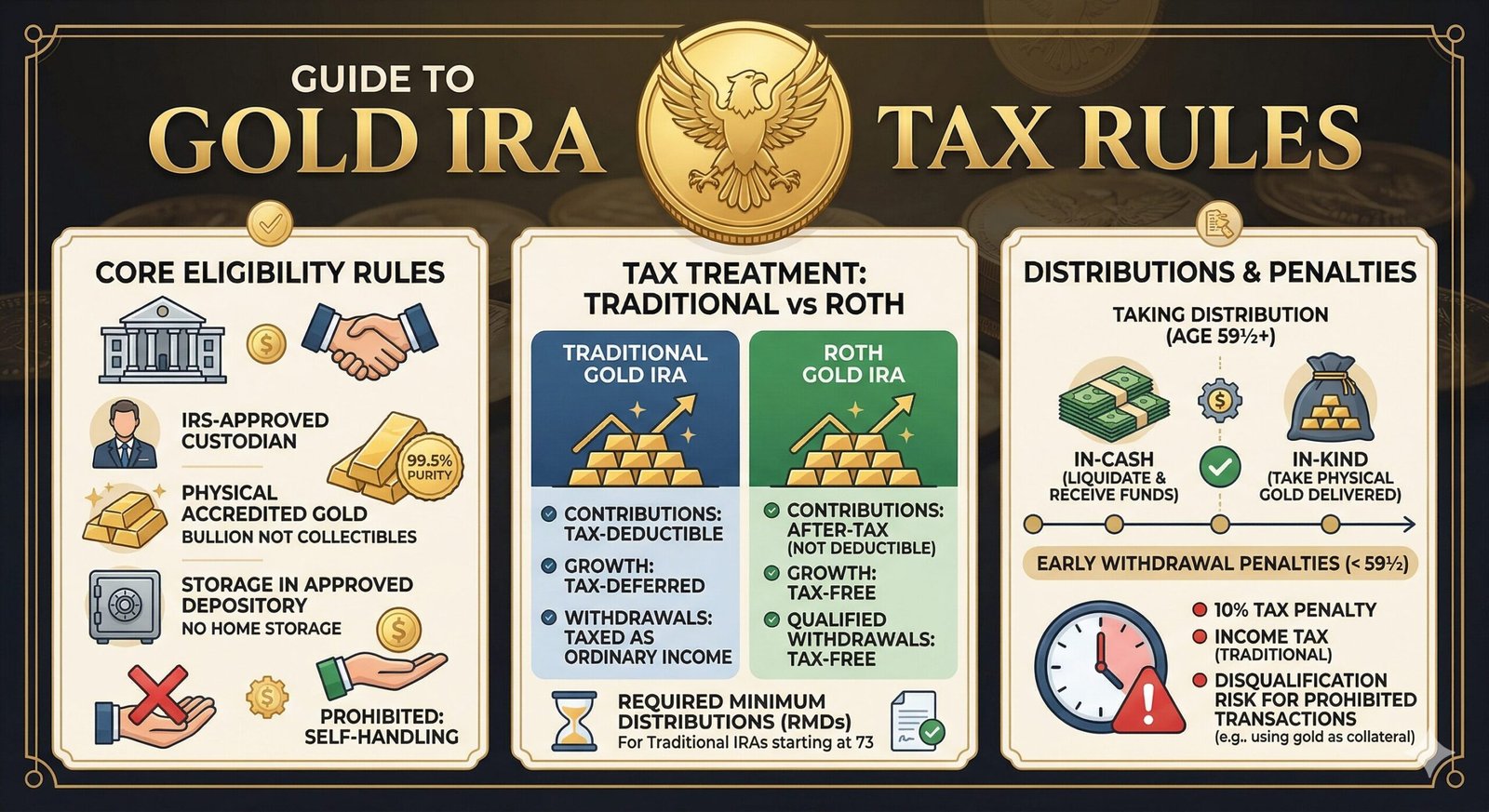
Before getting into the details of setting one up, it’s worth reviewing the core IRS requirements that govern these accounts. IRS Publication 590-A covers IRA contributions in detail, and the IRS IRA investment FAQ clarifies what kinds of assets are permitted inside an IRA.
Eligible Metals
Not every piece of gold qualifies for inclusion in a Gold IRA. The IRS has specific purity standards:
- Gold must be at least 99.5% pure
- Silver must be at least 99.9% pure
- Platinum and palladium must each be at least 99.95% pure
There are some exceptions — for example, the American Gold Eagle coin is permitted despite being slightly below the 99.5% threshold, because it’s explicitly authorized under IRS rules. For a full breakdown of qualifying coins and bars, see our guide to IRA-eligible gold coins.
Contribution Limits
Gold IRAs follow the same annual contribution limits as traditional and Roth IRAs. For 2026, the IRS limit is $7,000 per year for individuals under age 50, and $8,000 for those 50 and older (the catch-up contribution). You can confirm current limits at the IRS contribution limits page.
Required Minimum Distributions
If you hold a traditional Gold IRA, you’ll be subject to required minimum distributions (RMDs) starting at age 73. Because your account holds physical metals rather than cash, taking an RMD means either liquidating some of your holdings or taking an in-kind distribution — both of which have tax implications you’ll want to discuss with a tax professional. See the IRS RMD FAQ for more detail.
Rollovers: Moving an Existing Retirement Account Into a Gold IRA
Many Idaho residents who explore Gold IRAs aren’t starting from scratch — they have existing 401(k) accounts from former employers, traditional IRAs, or other retirement vehicles they want to restructure. Rolling over those funds into a Gold IRA is a common path.
The process involves more steps than a standard IRA rollover, and getting it wrong can trigger taxes and penalties. Our 401(k) to Gold IRA rollover guide walks through the process in detail, and you’ll also want to review the Gold IRA rollover rules that apply to these transfers.
The short version: a direct rollover — where funds move from one custodian directly to another without passing through your hands — is generally the cleanest approach. An indirect rollover, where you receive the funds personally before depositing them elsewhere, creates a 60-day window and withholding complications that can create significant tax exposure if not handled carefully.
Fees to Expect With a Gold IRA in Idaho
Gold IRAs carry more fees than conventional IRAs, and understanding the fee structure before you open an account is important. Because these accounts require specialized custodianship, physical storage, and insurance, you should anticipate several layers of cost.
Our Gold IRA fees guide explains each of these in more detail and offers guidance on what questions to ask before signing any paperwork.
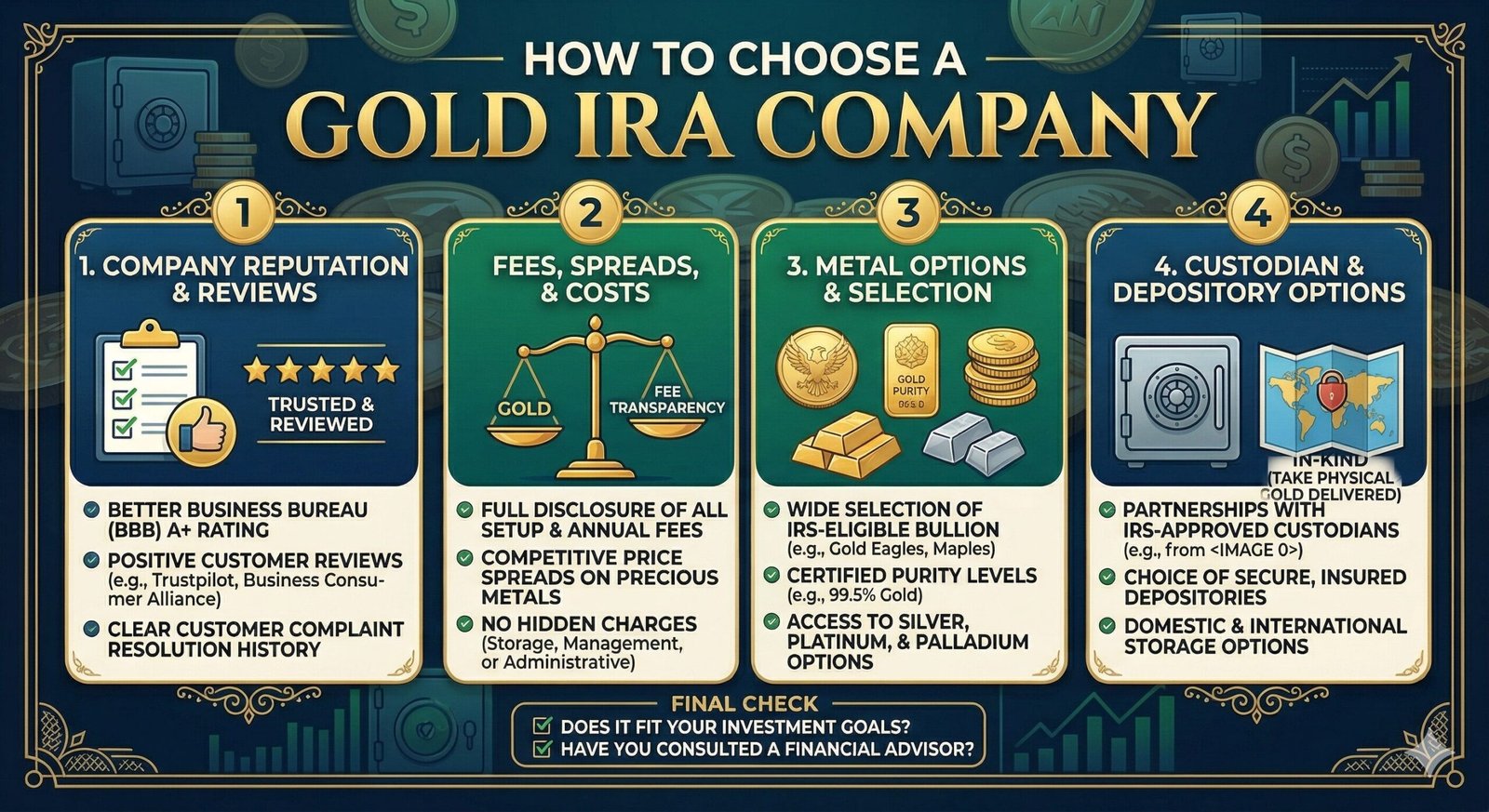
What to Look for in a Gold IRA Company
Idaho residents have access to the same national pool of Gold IRA companies as everyone else in the country. The challenge is evaluating them. FINRA’s guidance on self-directed IRAs is a useful starting point for understanding the risks involved with this account type, and FINRA BrokerCheck can help you verify the background of any firm or individual you’re working with.
When evaluating companies, pay attention to:
Transparency about fees. A reputable company will disclose all costs upfront and in writing. Vague fee structures or reluctance to answer direct questions should be a red flag.
Custodian relationships. The company you work with to purchase metals is typically a dealer, not the custodian. Make sure you understand who is actually holding your IRA and what their track record looks like.
Ratings and reviews. Sites like bbb.org can help you assess a company’s complaint history. Look at both the rating and the nature of any complaints.
Pressure tactics. Legitimate firms in this space don’t pressure clients to make quick decisions. If you’re hearing urgency-based language or being discouraged from doing your own research, consider that a warning sign. Our Gold IRA scams guide covers the most common tactics used by bad actors in this industry.
You can also compare leading companies in this space through our Best Gold IRA Companies of 2026 page.
Is a Gold IRA Right for You?
That’s genuinely not a question we can answer for you — and we wouldn’t try to. What we can say is that a Gold IRA is a more complex and more expensive vehicle than a standard IRA, and it’s worth approaching it with the same level of scrutiny you’d apply to any significant financial decision.
If you’re comparing your options, our article on Gold IRA vs Traditional IRA breaks down the structural differences between these account types, and our piece on is a Gold IRA a good idea explores the key considerations most retirement investors should think through. You may also find our Gold IRA minimum investment guide useful — most companies require a minimum opening balance of $10,000 to $25,000, which is worth knowing before you start comparing providers.
Additionally, the SEC investor resources page offers helpful context on retirement account structures for anyone wanting an independent perspective from a federal regulatory body.
Frequently Asked Questions
Can I store gold from my Gold IRA at home in Idaho?
No. IRS rules require that physical metals held inside an IRA be stored with an approved depository. Taking personal possession of IRA-held metals — including storing them at home — is treated as a distribution, which may trigger taxes and early withdrawal penalties.
Do Idaho state taxes apply to Gold IRA distributions?
Idaho does tax retirement income, including IRA distributions, at the state level. How that applies to your specific situation depends on your income, filing status, and the type of IRA you hold. Consult a tax professional familiar with Idaho state tax law for guidance on your situation.
Can I roll my existing Idaho-based 401(k) into a Gold IRA?
In many cases, yes — particularly if the 401(k) is from a former employer. Some active employer 401(k) plans also allow in-service rollovers, but this depends on the plan’s rules. Review our Gold IRA vs 401(k) article for more context, and speak with your plan administrator before initiating any rollover.
How do I know if a Gold IRA company is legitimate?
Start by checking their BBB profile at bbb.org, look up their custodian partner independently, and verify any individuals you’re dealing with through FINRA BrokerCheck. Ask direct questions about fees, storage arrangements, and buyback policies — and take your time before committing.
Are there Idaho-specific regulations I need to know about?
Gold IRAs are governed primarily by federal law, and there are no Idaho-specific rules that change the fundamental structure of these accounts. Idaho does have its own securities laws, which may apply to how Gold IRA products are marketed in the state, but the account mechanics are set by the IRS.
Ready to Learn More?
If you’re an Idaho resident considering a Gold IRA, the most important next step is doing your research carefully — not rushing into any agreement. To compare the leading providers in this space and understand what distinguishes them, visit our Best Gold IRA Companies of 2026 page, where we’ve put together a thorough overview to help you ask the right questions.
This article is for informational purposes only and does not constitute financial or tax advice. Investing in precious metals involves risk including possible loss of principal.
Related guides
- Gold IRA Consumer Affairs Reviews: What to Look For
- Gold IRA Trustpilot Reviews: What Real Customers Say
- Gold IRA BBB Complaints: What Consumer Reports Reveal
- Is a Gold IRA Worth the Fees? A Cost-Benefit Analysis
- Are Gold IRA Fees Too High? Breaking Down the Real Costs
- Gold IRA Mistakes to Avoid: 10 Common Errors Investors Make