Gold IRA in Delaware: Rules and Top Providers
If you live in Delaware and you’re exploring ways to hold physical gold or other precious metals within a tax-advantaged retirement account, you’re not alone. Across the First State and beyond, retirement investors are increasingly curious about Gold IRAs — what they are, how they work, and what it actually takes to open one. This guide walks you through everything you need to know, from the federal rules that govern these accounts to the practical steps involved in getting started as a Delaware resident.
What Is a Gold IRA?
A Gold IRA is a type of self-directed Individual Retirement Account that allows you to hold IRS-approved physical precious metals — including gold, silver, platinum, and palladium — rather than the paper-based assets typically found in conventional retirement accounts. For a thorough foundation on how these accounts function, visit our Gold IRA guide.
Unlike a standard IRA managed through a brokerage or mutual fund company, a Gold IRA requires a specialized custodian and a separate approved depository where your metals are stored. These accounts follow the same contribution limits, rollover rules, and tax treatment as traditional or Roth IRAs — they simply hold a different type of asset.
To understand the full scope of the rules that apply, Gold IRAs Explained in Detail provides a thorough breakdown of account types, custodian requirements, and IRS regulations.
Does Delaware Have Its Own Gold IRA Rules?
This is one of the most common questions Delaware residents ask, and the answer is straightforward: Gold IRAs are governed by federal law, not state law. Delaware does not impose its own layer of precious metals IRA regulations on top of IRS rules. Whether you live in Wilmington, Dover, Newark, or anywhere else in the state, the rules that apply to your Gold IRA are set by the Internal Revenue Service.
That said, Delaware’s status as a business-friendly state — home to an outsized number of registered financial companies and custodians — can be advantageous when it comes to provider selection and account administration. Many Gold IRA custodians and affiliated depositories are incorporated in Delaware, even if their physical operations are located elsewhere.
For the authoritative federal framework, the IRS IRA investment FAQ is an excellent primary reference point.
The Federal Rules That Govern Your Gold IRA
Regardless of where you live, the following federal requirements apply to any Gold IRA account.
IRS-Approved Metals Only
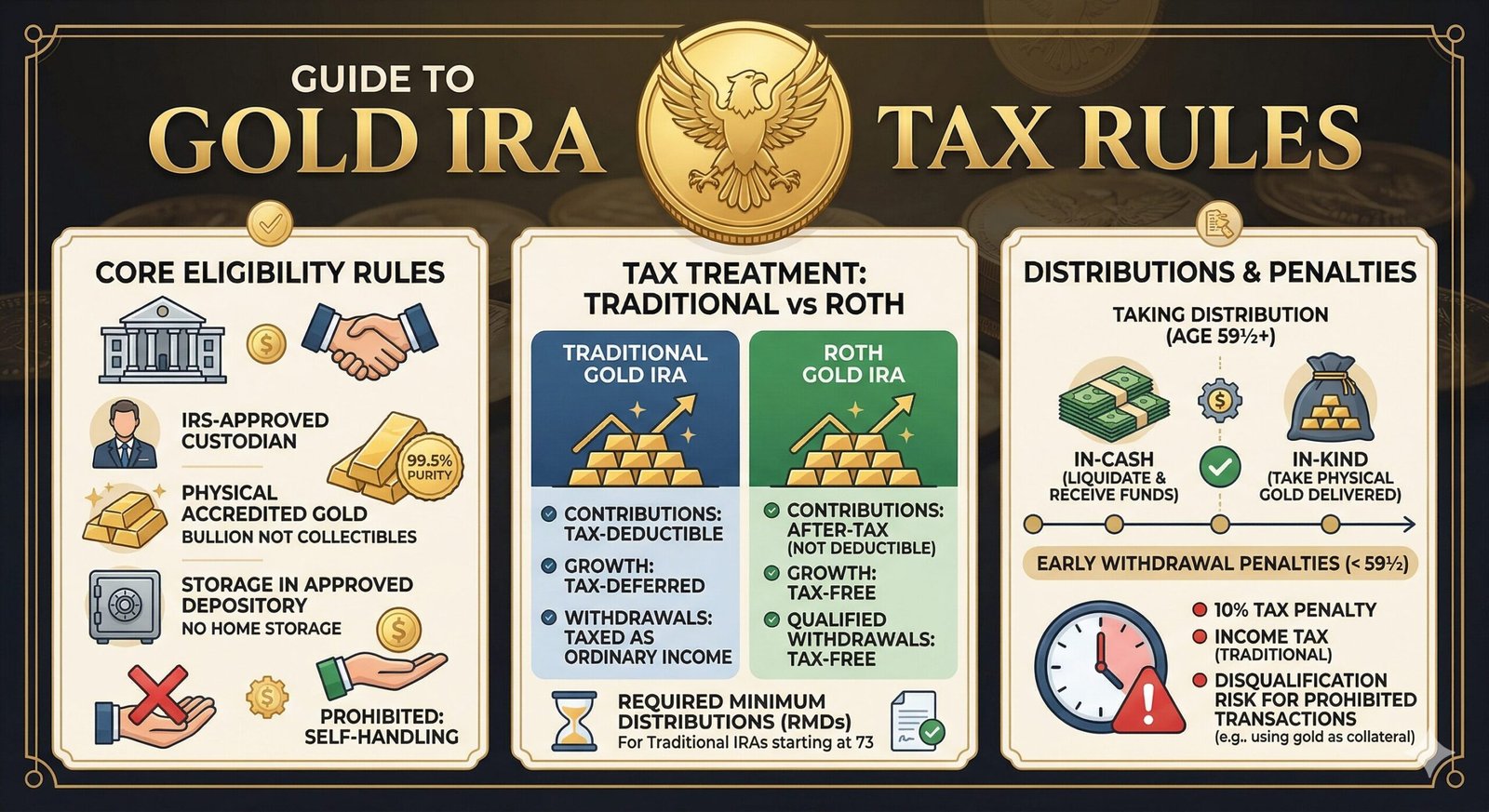
The IRS sets strict purity standards for metals held in a self-directed IRA. Gold must be at least 99.5% pure, silver 99.9%, and platinum and palladium 99.95%. Certain government-minted coins — such as the American Gold Eagle — are exempt from the standard purity requirement by statute, even though they fall just below 99.5% fineness. If you want to understand exactly which coins qualify, our guide to IRA-eligible gold coins covers approved products in detail.
Custodian and Depository Requirements
All self-directed IRAs, including Gold IRAs, must be administered by an IRS-approved custodian — typically a trust company or bank that specializes in alternative assets. The metals themselves must be stored in an approved third-party depository; you cannot store Gold IRA assets at home or in a personal safe. As FINRA’s guidance on self-directed IRAs notes, account holders carry a higher degree of responsibility for due diligence in self-directed structures, which makes custodian selection particularly important.
Contribution Limits
For 2025, the standard IRA contribution limit is $7,000 per year, with a catch-up contribution of $1,000 available to account holders aged 50 and older — bringing the maximum to $8,000. These limits are set annually by the IRS and apply to all IRA types combined, not per account. You can find the current figures at the IRS contribution limits page.
Required Minimum Distributions
If you hold a traditional Gold IRA, you will be subject to Required Minimum Distributions (RMDs) beginning at age 73. Because your assets are physical metals rather than cash, you have two options when an RMD is due: you can liquidate a portion of the metals and take the distribution in cash, or you can take an in-kind distribution of the actual metal itself. Either way, the distribution is a taxable event for a traditional IRA. The IRS RMD FAQ provides complete guidance on how these rules work.
Rolling Over an Existing Retirement Account
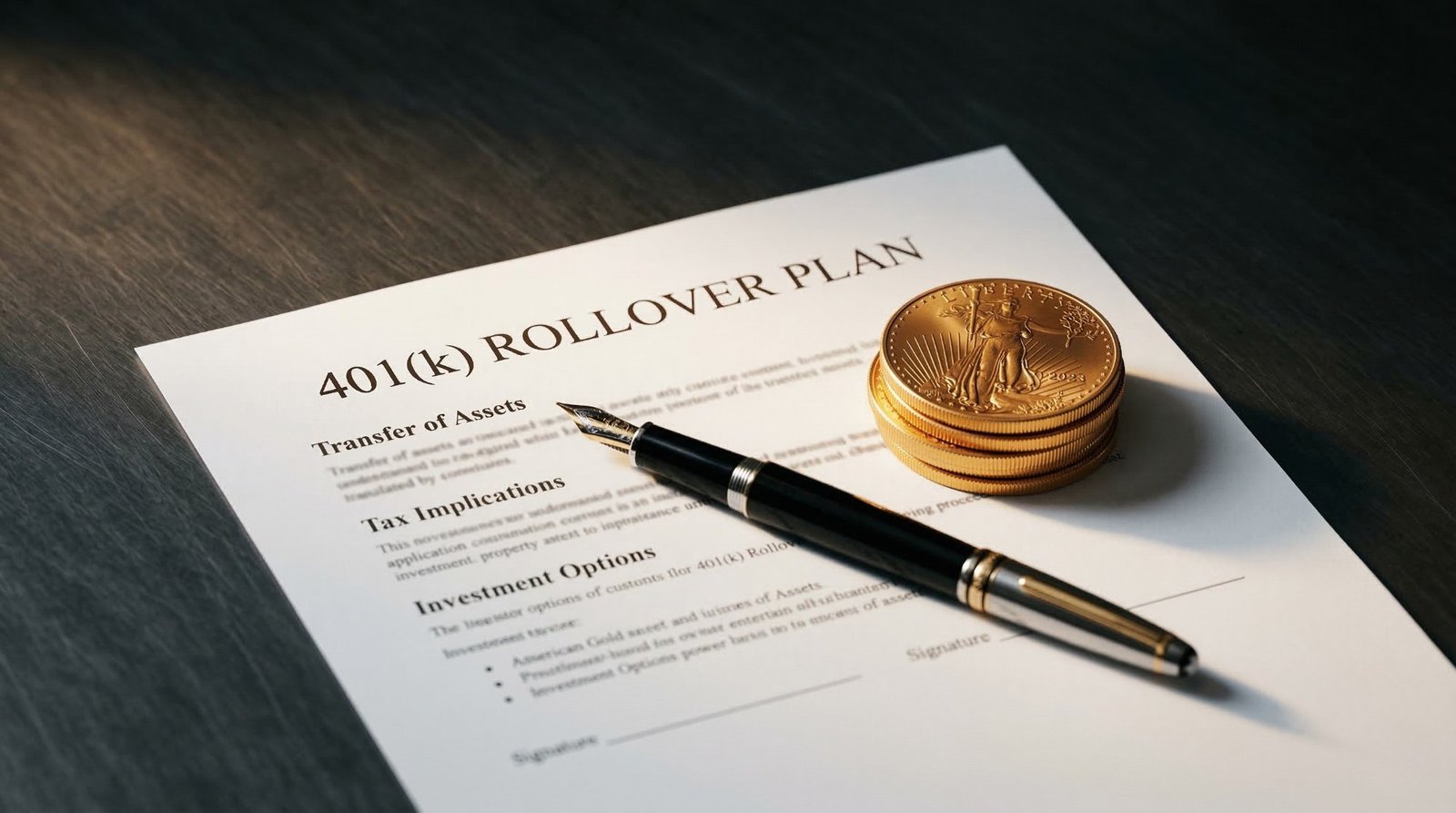
Many Delaware residents who open a Gold IRA do so by rolling over funds from an existing 401(k), 403(b), or traditional IRA. A rollover can be an effective way to fund a Gold IRA without making a new contribution from your personal savings — and it is one of the most frequently searched topics in this space.
There are two main rollover methods:
Direct Rollover: Your existing plan administrator transfers the funds directly to your new Gold IRA custodian. This is the cleaner option, as the money never passes through your hands and there is no withholding requirement.
Indirect Rollover: The funds are distributed to you personally, and you have 60 days to deposit them into the new IRA. Your existing administrator will withhold 20% for taxes — which you must replace out of pocket to avoid a partial taxable distribution. If you miss the 60-day window, the IRS treats the undistributed amount as a taxable withdrawal, potentially with penalties if you are under 59½.
Our 401(k) to Gold IRA rollover guide walks through both processes step by step. You should also review the complete Gold IRA rollover rules before initiating any transfer.
Understanding the Costs Involved
Cost transparency is one of the most important factors to evaluate when selecting a Gold IRA provider. Unlike a standard brokerage account, a Gold IRA typically involves several distinct fee categories that can vary meaningfully between providers.
Some providers charge a flat annual fee regardless of account size, while others use a scaled model tied to the value of metals held. Neither structure is inherently superior — it depends on your account size and expected activity. For a complete breakdown of what to look for, our Gold IRA fees guide covers every category in detail.
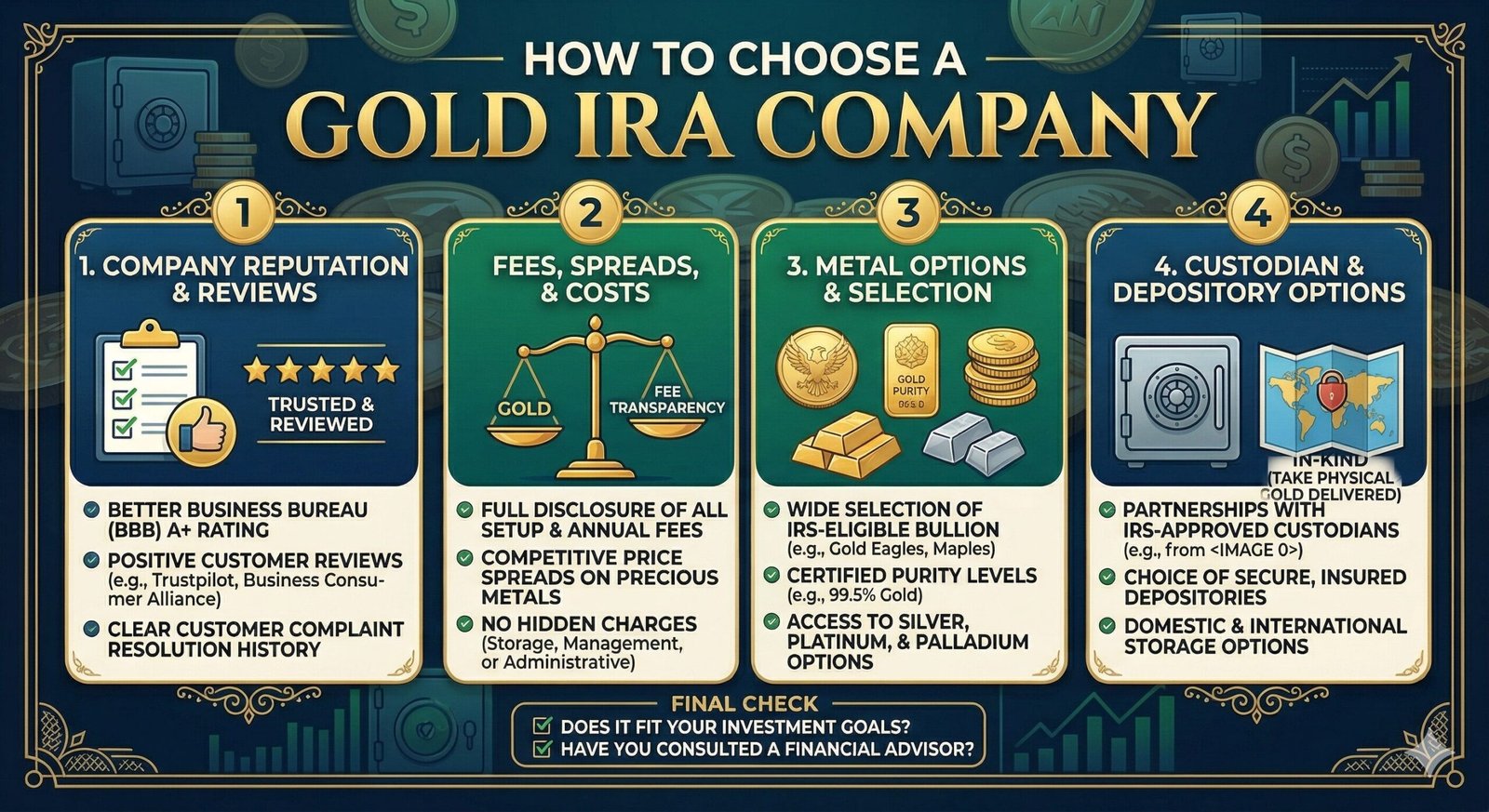
Choosing a Provider as a Delaware Resident
Delaware residents are not restricted to providers physically located in the state. Gold IRA custodians operate nationally under federal oversight, which means you can work with any IRS-approved custodian in the country. Your chosen depository may be located in a state such as Texas, Delaware, Utah, or South Dakota — all of which are home to well-regarded precious metals vaulting facilities.
When evaluating providers, look for:
- Regulatory standing: Verify custodians through the SEC investor resources portal, and check any affiliated dealers on FINRA BrokerCheck
- BBB accreditation and rating: A strong, long-standing record at bbb.org is a meaningful indicator of a company’s commitment to customer resolution
- Fee transparency: Reputable providers publish their full fee schedules upfront — be cautious of any company that requires a phone call before disclosing costs
- Storage options: Understand whether your metals will be held in segregated storage (your metals kept separate) or commingled storage (pooled with other clients’ metals), as this affects both cost and how your specific metals are tracked
- Customer education resources: Companies that invest in educating clients before making a sale tend to attract more informed investors and generate fewer complaints
If you’re concerned about distinguishing legitimate providers from bad actors, our Gold IRA scams guide outlines the red flags to watch for during the selection process.
Gold IRA vs. Traditional IRA: Key Differences
Delaware investors who are deciding between a conventional IRA and a self-directed Gold IRA should understand the structural differences clearly. A comparison of the two approaches is available in our Gold IRA vs Traditional IRA guide, but the core distinction comes down to asset type and complexity.
A traditional IRA typically holds stocks, bonds, mutual funds, and ETFs — assets that are priced and liquidated with a single click. A Gold IRA holds physical metal that must be purchased through a dealer, stored by a custodian-approved vault, and liquidated through a separate process when the time comes. This means a Gold IRA generally involves more parties, more paperwork, and more ongoing fees than a standard account.
That additional complexity is not necessarily a drawback — for investors who have a clear reason for wanting physical metals in their retirement structure, it may be entirely appropriate. But it is essential to understand before committing.
If you’re also weighing a Gold IRA against your workplace plan, the Gold IRA vs 401(k) comparison page explores the structural and tax differences between the two account types.
How to Open a Gold IRA in Delaware: A Step-by-Step Overview
Opening a Gold IRA involves more steps than a conventional IRA, but the process is well-defined once you know what to expect.
1. Select a custodian that specializes in self-directed precious metals IRAs and verify their credentials through the SEC, IRS, and BBB.
2. Open your account by completing the custodian’s application and funding the account — either via direct contribution, rollover, or transfer from an existing IRA.
3. Choose your metals from the custodian’s approved product list, ensuring all selections meet IRS purity standards.
4. Arrange storage at an IRS-approved depository — your custodian will typically facilitate this step.
5. Review your account periodically, noting that any RMDs or early withdrawals will require coordination between your custodian, the depository, and potentially a dealer.
Before taking the first step, it is worth reviewing the Gold IRA minimum investment requirements, as many providers set account minimums that may influence which custodian is the right fit for your situation.
Frequently Asked Questions
Can I open a Gold IRA if I live in Delaware?
Yes. Gold IRAs are governed by federal IRS rules, not by individual state law. Delaware residents are free to open a self-directed Gold IRA with any IRS-approved custodian operating in the United States.
Do I have to use a Delaware-based depository for a Gold IRA opened in Delaware?
No. Your physical metals can be stored at any IRS-approved depository in the country, regardless of where you live. Common depository locations include states such as Delaware, Texas, Utah, and Nevada.
What happens to my Gold IRA when I reach RMD age?
At age 73, traditional Gold IRA holders must begin taking Required Minimum Distributions. You can satisfy your RMD by liquidating a portion of your metals for cash or by taking an in-kind distribution of the physical metal itself. Both options have tax implications, and you should consult a qualified tax professional before making this decision. Refer to the IRS RMD FAQ for the official framework.
Is a Gold IRA a good idea for a Delaware retirement investor?
That depends entirely on your personal financial situation, goals, and circumstances. Our article on is a Gold IRA a good idea explores the considerations involved in making that determination, but we strongly encourage you to speak with a qualified, independent financial advisor before making any retirement account decisions.
How do I know if a Gold IRA provider is legitimate?
Check the custodian’s standing with the IRS, review their BBB profile at bbb.org, verify any affiliated dealers through FINRA BrokerCheck, and read third-party reviews from multiple independent sources. Transparency around fees and a willingness to educate before selling are strong positive indicators. You should also review the IRS Publication 590-A to understand your rights and responsibilities as an IRA account holder.
Ready to Take the Next Step?
If you’re a Delaware resident who has done your research and you’re ready to compare providers, our independently reviewed list of the Best Gold IRA Companies of 2026 is a useful starting point. We evaluate providers based on fee transparency, regulatory standing, customer service, and educational resources — not on sales volume.
This article is for informational purposes only and does not constitute financial or tax advice. Investing in precious metals involves risk including possible loss of principal.
Related guides
- Gold IRA Consumer Affairs Reviews: What to Look For
- Gold IRA Trustpilot Reviews: What Real Customers Say
- Gold IRA BBB Complaints: What Consumer Reports Reveal
- Is a Gold IRA Worth the Fees? A Cost-Benefit Analysis
- Are Gold IRA Fees Too High? Breaking Down the Real Costs
- Gold IRA Mistakes to Avoid: 10 Common Errors Investors Make