Why Is the Gold Price Rising? Key Factors Driving 2026 Gains
Gold has been commanding significant attention in 2026, and for good reason. Whether you’ve noticed it on financial news channels, in retirement planning conversations, or simply through the rising premiums on coins and bars, the yellow metal has been moving in ways that are prompting a lot of questions. Chief among them: why is the gold price rising, and what does it mean for everyday investors?
This article won’t predict where gold goes from here — no one can do that reliably, and anyone who claims otherwise deserves skepticism. What we can do is walk through the documented economic and geopolitical forces that analysts and institutions broadly agree are contributing to elevated gold prices in 2026. Understanding these forces helps you make more informed decisions, whatever path you ultimately choose.
The Big Picture: What Moves Gold Prices?
Gold is not a company that reports earnings, pays dividends, or grows a customer base. It doesn’t have a balance sheet you can analyze. Instead, gold prices respond to a broader set of macroeconomic and geopolitical signals — the kind of signals that are particularly relevant for retirement investors thinking carefully about the years ahead.
Several overlapping forces are currently at work. None of them operates in isolation, and that’s part of what makes the current environment unusually complex.
Central Bank Buying Has Reached Historic Levels
One of the most consequential developments in recent years — and a force that continues to shape gold prices in 2026 — is the scale of central bank gold purchases. Institutions from China and India to Poland, Turkey, and several Gulf states have been accumulating gold reserves at rates not seen in decades.
Central banks hold gold as a reserve asset, and when they buy in volume, they absorb significant supply from the global market. This sustained institutional demand creates a structural floor that many market observers believe has fundamentally altered the supply-demand dynamic.
The motivations vary by country. Some central banks are actively working to reduce their dependence on U.S. dollar-denominated reserves — a trend often described as “de-dollarization.” Others are responding to geopolitical uncertainty or simply rebalancing their reserve holdings. Whatever the specific reason, the net effect on gold markets is the same: large, ongoing demand from buyers who are not sensitive to short-term price movements.
The U.S. Dollar and Interest Rate Environment
Gold and the U.S. dollar have historically shared an inverse relationship. When the dollar weakens, gold — which is priced in dollars globally — tends to become more affordable for international buyers, often increasing demand and pushing prices upward. That relationship is not absolute, and there have been periods where both moved in the same direction, but dollar weakness remains one of the most-watched signals in gold markets.
The Federal Reserve’s interest rate posture also plays a central role. When rates are high, yield-bearing assets like Treasury bonds become relatively more attractive, which can reduce interest in gold. Conversely, when rates plateau or begin to fall, the opportunity cost of holding gold — which pays no interest or dividend — decreases. The Fed’s policy decisions in 2025 and 2026 have been a consistent topic of debate among analysts, with implications that extend directly to gold pricing.
It’s worth noting that even when rates have been elevated, gold has continued to perform in ways that surprised many traditional models. That’s partly because central bank demand and geopolitical factors have been strong enough to counteract what would normally be suppressive rate pressures.
Geopolitical Uncertainty and Global Instability
Ongoing conflicts, strained diplomatic relationships, and shifting global alliances have added to the case that many investors — both institutional and individual — are reassessing their exposure to assets that are sensitive to political risk. Gold, which has no counterparty (it doesn’t depend on any government or corporation to honor an obligation), tends to attract interest during periods of elevated geopolitical tension.
This isn’t a new phenomenon. Gold’s appeal during uncertain times is well-documented throughout modern financial history. What’s notable in 2026 is the breadth and simultaneity of the tensions involved — multiple regional conflicts, fractures in trade relationships, and significant elections across major economies have all contributed to an environment where investors are looking more carefully at the assets on their books. As always, past performance is not a guarantee of future results, and no one can predict how these dynamics will resolve or what their lasting effect on gold prices will be.
Inflation, Purchasing Power, and the Appeal of Real Assets
Inflation has been a defining financial story of recent years. While headline inflation figures in the U.S. have moderated from their peaks, many Americans — particularly those nearing or in retirement — remain acutely aware of how rising costs erode purchasing power over time.
Gold is often discussed in the context of purchasing power preservation over very long time horizons. It’s important to be precise here: gold does not “guarantee” anything, and it can and does decline in price over shorter periods. But the longer-term historical record — appropriately qualified, since past performance is not a guarantee of future results — shows gold has maintained real value across centuries in ways that paper currencies have not.
For retirement investors specifically, the question of purchasing power over a 20-30 year horizon is not abstract. That’s why many financial educators point to real assets like gold as part of a broader conversation about long-term wealth preservation, even if no single asset is a cure-all.
What This Means for Retirement Investors
If you’re between 45 and 70 and thinking about how gold fits into your retirement strategy, the factors above are worth understanding — not as reasons to act impulsively, but as context for conversations with your financial advisor.
One vehicle that’s attracted growing interest in this environment is the Gold IRA. A Gold IRA is a self-directed individual retirement account that holds physical precious metals rather than (or in addition to) conventional paper assets. If you’re new to the concept, our Gold IRA guide covers the fundamentals in plain English.
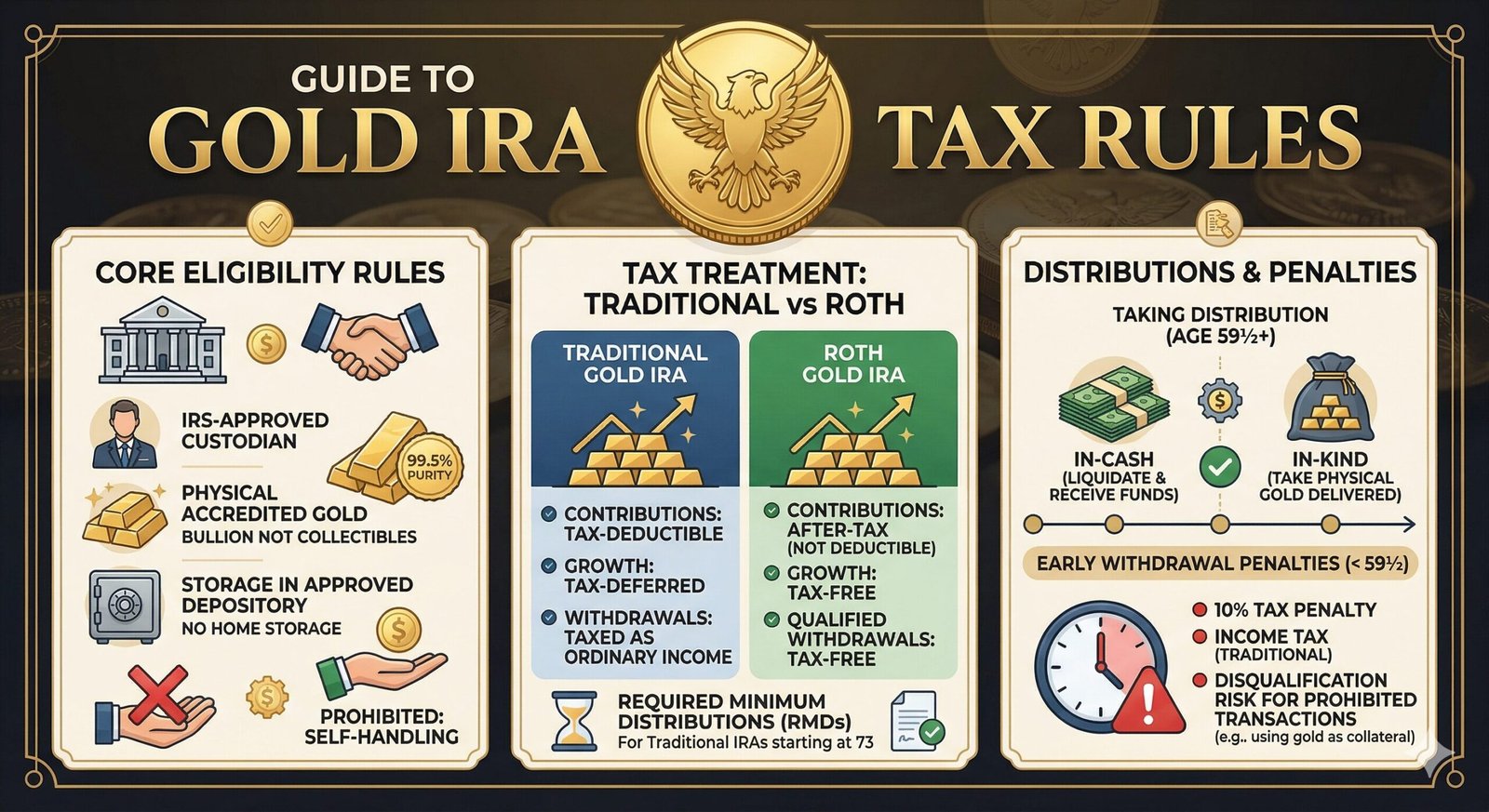
For a deeper dive into how these accounts actually work — including custodian requirements, storage rules, and contribution limits — Gold IRAs Explained in Detail is a good starting point. You may also want to review the IRS IRA investment FAQ and FINRA’s guidance on self-directed IRAs before making any decisions.
Key Factors at a Glance
The table below summarizes the main forces currently cited by analysts as contributing to elevated gold prices in 2026.
How to Think About Gold in Your Retirement Planning
Understanding why gold prices are rising is useful context, but it shouldn’t be confused with a signal to buy or sell anything. Gold prices can and do move in both directions, sometimes sharply and without obvious warning. Anyone considering a Gold IRA or a physical gold purchase should do so as part of a well-considered plan developed with a qualified financial professional.
If you’re considering moving funds from an existing retirement account, our 401(k) to Gold IRA rollover guide walks through the process step by step. You should also familiarize yourself with the Gold IRA rollover rules before initiating any transfer, as mistakes can trigger taxes and penalties.
Costs matter too. Gold IRAs carry specific fees — including custodian fees, storage fees, and sometimes setup charges — that don’t apply to conventional IRAs. Our Gold IRA fees guide explains what to expect and what questions to ask. And if you’re weighing whether a Gold IRA is the right structure for you at all, the Gold IRA vs Traditional IRA comparison may be helpful.
Finally, if you’re beginning your search for a reputable Gold IRA provider, take the time to read our Gold IRA scams guide first. The precious metals industry attracts its share of bad actors, and knowing what red flags to look for — before you engage with any company — is essential. Cross-referencing companies against bbb.org and checking representatives through FINRA BrokerCheck are simple steps that can save you significant trouble.
Frequently Asked Questions
Why is the gold price rising in 2026?
Multiple factors are contributing simultaneously: record levels of central bank gold purchases, a complex U.S. interest rate environment, ongoing geopolitical tensions, and sustained concerns about inflation and purchasing power. No single cause fully explains the move, and analysts continue to debate the relative weight of each factor.
Does a rising gold price mean I should buy gold?
Not necessarily. Rising prices reflect current market conditions, not a guarantee of future returns. Gold prices can fall as well as rise. Any decision about whether gold belongs in your retirement plan should be made in consultation with a qualified financial advisor, based on your individual circumstances.
What is a Gold IRA and how does it relate to gold prices?
A Gold IRA is a self-directed retirement account that holds physical gold and other IRS-approved precious metals. Its value is directly tied to the spot price of the metals it holds, which means it will fluctuate with market conditions. For more detail, visit our Gold IRA guide or review IRS Publication 590-A for the tax framework governing IRAs.
Are there specific gold coins eligible for a Gold IRA?
Yes. The IRS sets strict purity standards for metals held in a Gold IRA. Not all gold coins or bars qualify. Our guide to IRA-eligible gold coins covers which products meet the IRS requirements and what to look for when evaluating options.
How do I start comparing Gold IRA companies?
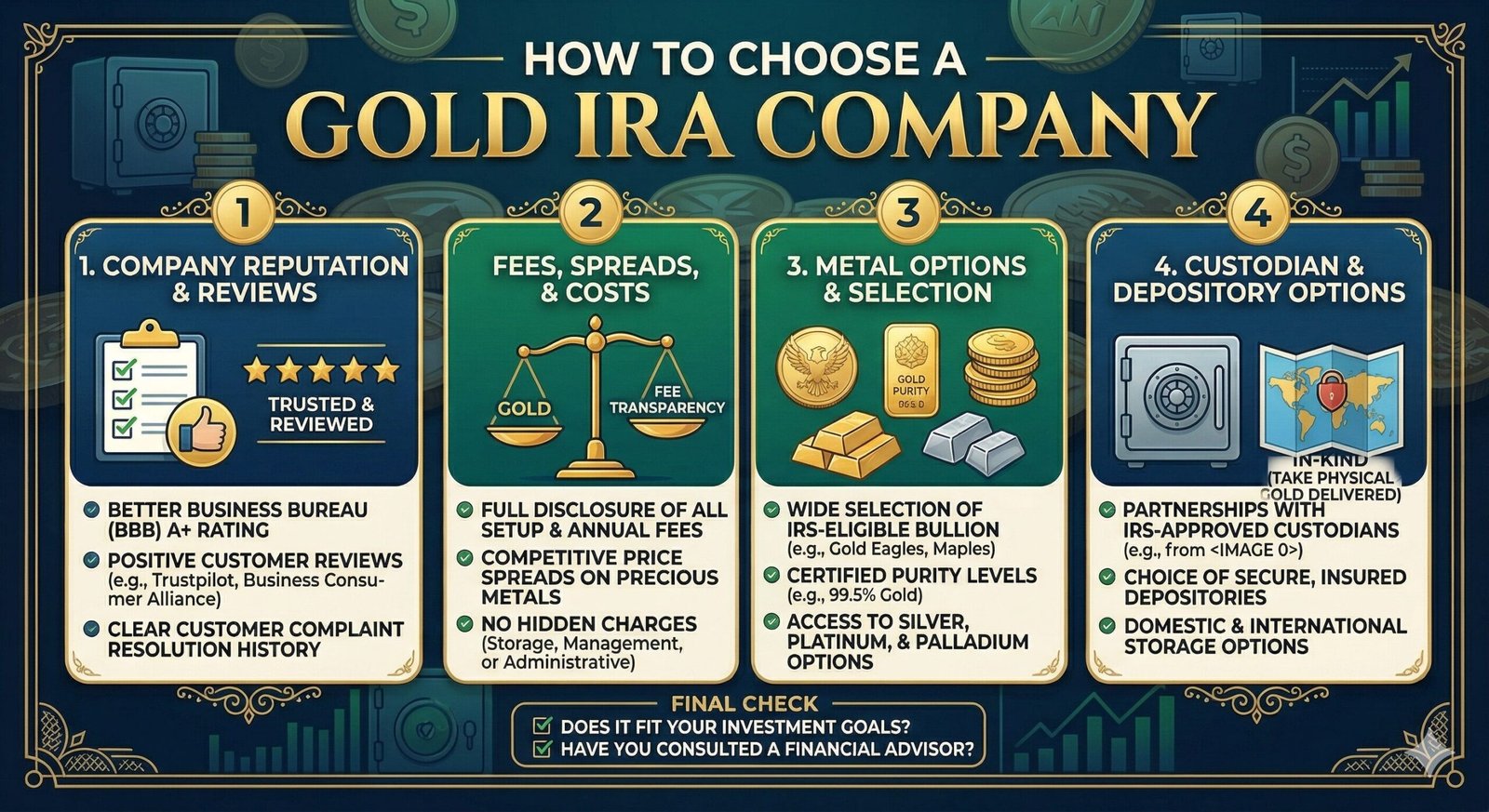
Start by reviewing company credentials, fee structures, storage arrangements, and customer service track records. Look for companies with transparent pricing and strong third-party reviews. Our Best Gold IRA Companies of 2026 guide provides a structured comparison to help you evaluate your options.
Ready to Learn More?
Whether you’re just beginning to explore gold as part of your retirement thinking or you’re already familiar with the basics and want to compare specific providers, our independently researched guide is the logical next step. Visit our Best Gold IRA Companies of 2026 to see our current ratings, fee comparisons, and what to look for when choosing a custodian.
This article is for informational purposes only and does not constitute financial or tax advice. Investing in precious metals involves risk including possible loss of principal.
Related guides
- Gold Price Record 2025: Understanding the All-Time High
- Highest Gold Price Ever: All-Time Highs and What Caused Them
- Gold Price in 2025: Year in Review and Key Events
- Gold Price in 2024: Record Highs and What Drove Them
- Gold Price in 2023: Year in Review
- Gold Price in 2022: How War and Inflation Moved Markets