
How to Choose a Gold IRA Depository: Key Criteria
When you open a Gold IRA, you quickly discover that the metals you purchase cannot simply be stored in your home safe or a local bank’s safe deposit box. The IRS requires that all physical precious metals held inside a self-directed IRA be stored at an approved depository — a specialized, highly secure vault facility that meets strict federal standards. The depository you select is not a minor administrative detail. It directly affects the security of your metals, the fees you pay, and your overall experience as an account holder.
This guide walks through exactly how to choose a gold IRA depository, covering the criteria that matter most for retirement investors who want to make an informed decision rather than simply accepting whichever facility a dealer happens to recommend.
Why the Depository Choice Matters More Than Most Investors Realize
Most first-time Gold IRA investors focus their research on gold dealers or custodians. The depository tends to receive far less attention — yet it is the institution physically holding your assets for potentially decades.
A depository’s quality affects you in several practical ways: how thoroughly your metals are insured, whether your specific coins and bars are tracked individually or pooled with others, what annual fees you pay, and how smoothly distributions or transfers are processed when the time comes. For a deeper grounding in how these pieces fit together, visit our Gold IRA hub before diving into the depository comparison.
It is also worth noting that the IRS does not publish a simple list of “approved” depositories in the way it does with IRA contribution rules. Instead, approval flows through your custodian — the financial institution that administers your IRA. The custodian is legally responsible for ensuring metals are stored correctly under IRS Publication 590-A and related regulations. In practice, well-established custodians work with a shortlist of vetted depository partners, and you will typically choose from among those options.
The Core Criteria for Evaluating a Gold IRA Depository
IRS and Custodian Approval
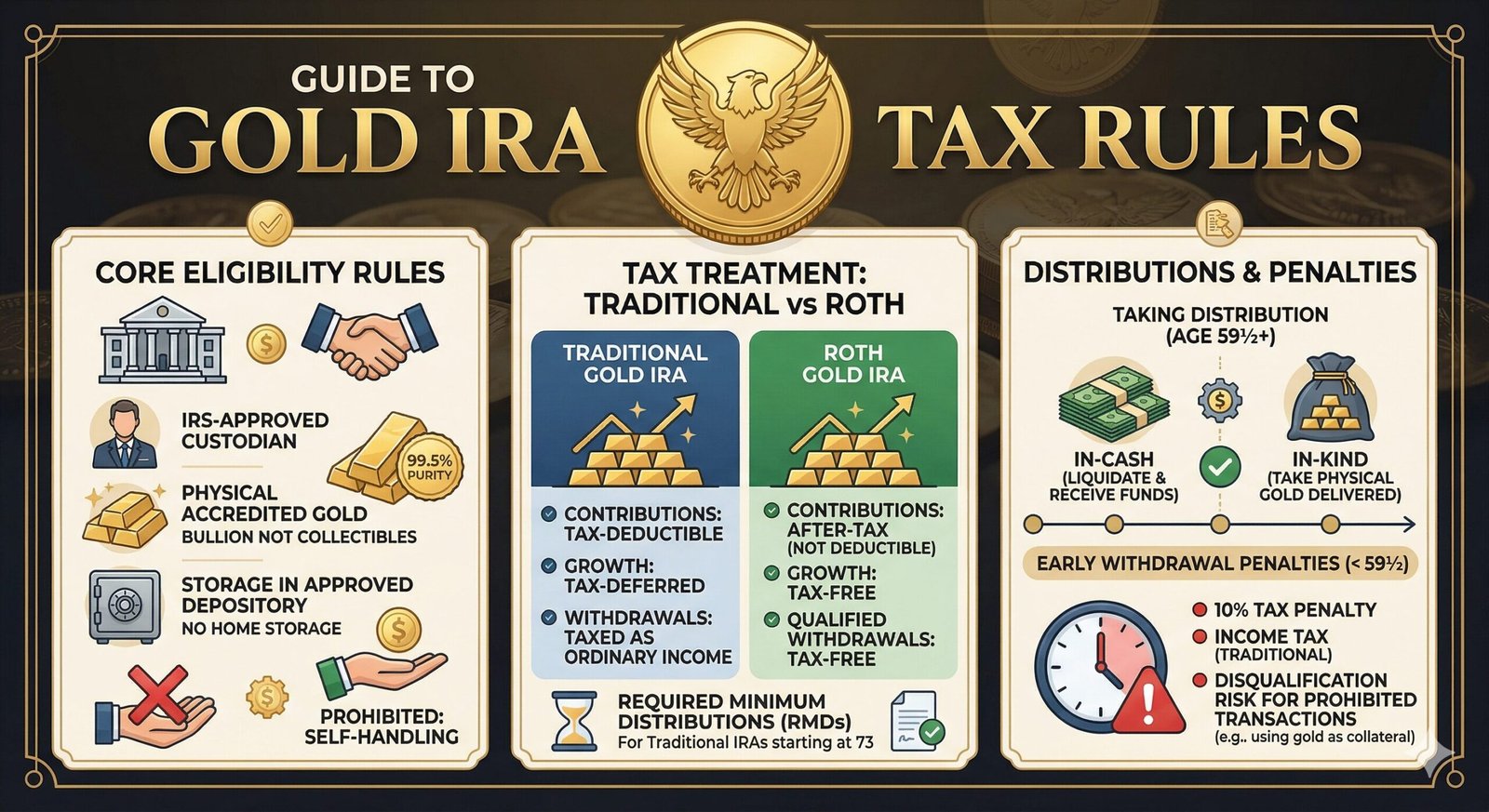
The most fundamental requirement is that the depository must be accepted by your IRA custodian and compliant with IRS regulations. Under IRS rules, the trustee or custodian — not the account holder — must maintain possession of IRA-held metals. Storing metals yourself, even temporarily, is treated as a distribution and triggers taxes and potential penalties. The IRS IRA investment FAQ addresses this point directly and is worth reviewing.
When evaluating a depository, ask your custodian directly: “Is this facility on your approved list?” If a depository is not accepted by your custodian, it is not an option regardless of how impressive its facility looks on paper.
Physical Security Infrastructure
Reputable depositories invest heavily in physical and electronic security. When researching a facility, look for the following elements — ideally confirmed through publicly available documentation or direct inquiry:
24/7 monitoring and armed guards. Top-tier facilities operate around the clock with on-site security personnel and surveillance systems.
Time-lock vaults and multiple access controls. High-quality depositories use layered entry protocols, including biometric identification, that prevent unauthorized access even by facility employees acting alone.
Geographic risk considerations. Some investors prefer a depository located away from major population centers, areas with high seismic activity, or regions prone to flooding. While no facility is entirely immune to natural disasters, location is a reasonable factor to weigh.
Insurance Coverage
Insurance is one of the most important and least-scrutinized aspects of depository selection. Every established depository carries insurance, but the details vary significantly.
The key questions to ask are:
- What is the total insured value of assets the facility can hold?
- Is the insurance underwritten by a recognized, financially strong carrier (Lloyd’s of London is common among top depositories)?
- Does the policy cover full replacement value in the event of theft, fire, or natural disaster?
- Is your account insured individually, or does coverage apply to the facility as a whole?
Request written confirmation of insurance details. A reputable depository will provide this without hesitation.
Segregated vs. Commingled Storage
This is a distinction that retirement investors should understand clearly before selecting a depository.
Segregated storage means your specific coins and bars are stored separately from other customers’ metals, identified by your account number, and returned to you specifically when you request a distribution. You own identifiable, specific items.
Commingled storage (sometimes called allocated but non-segregated) means your metals are stored alongside other customers’ metals of the same type and purity. You own a specific quantity and type of metal, but not specific pieces. When you take a distribution, you receive equivalent metals — not the exact coins or bars originally deposited.
Both arrangements are IRS-permissible, but segregated storage provides a higher degree of individual accountability. It also typically costs more. Neither arrangement is inherently superior for every investor — the right choice depends on your priorities, the types of metals you hold, and your fee sensitivity.
Comparing Storage Options: A Practical Overview
Fees and Transparency
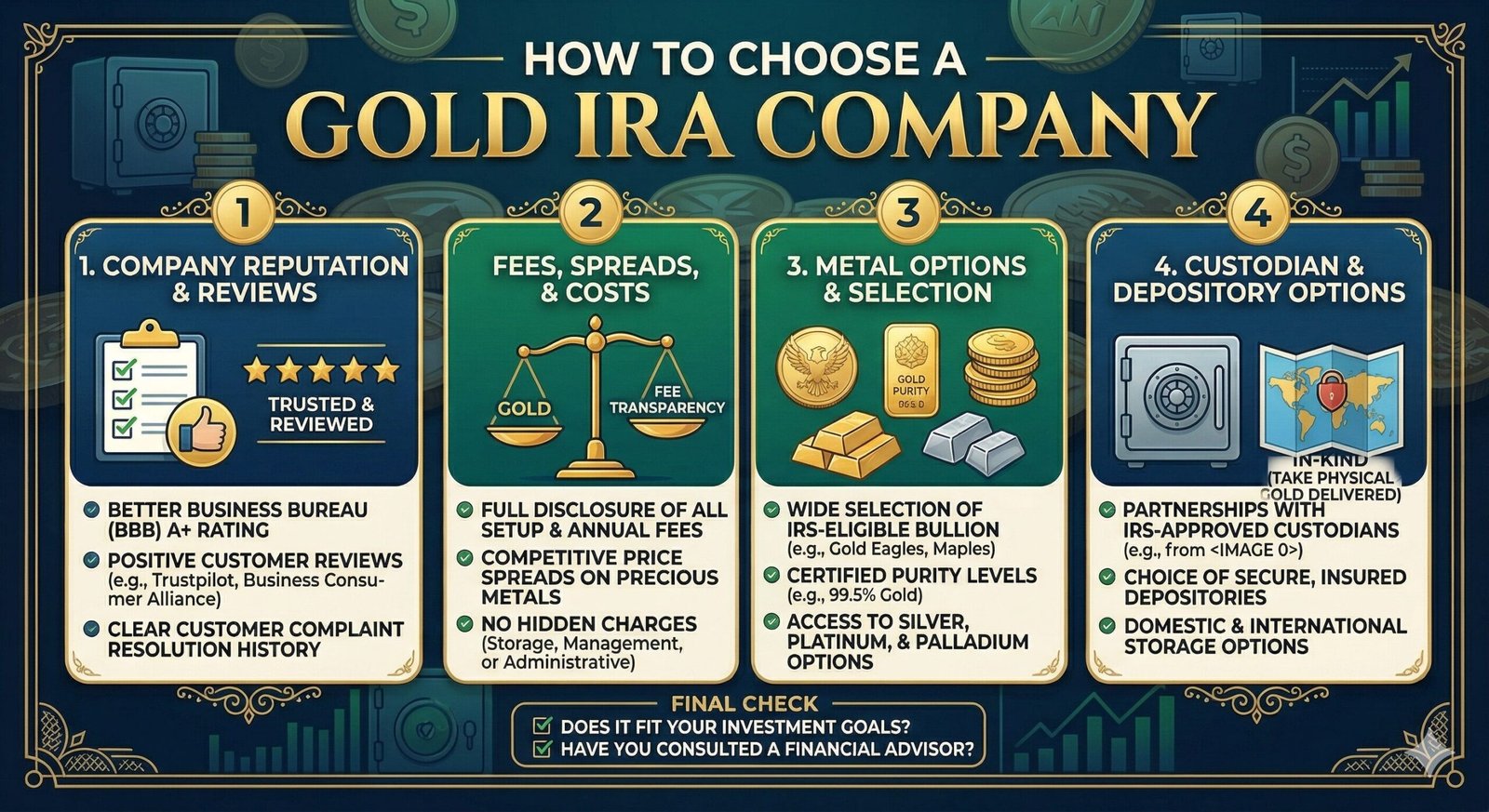
Storage fees are an ongoing cost of holding a Gold IRA, and they vary meaningfully between depositories. Our Gold IRA fees guide covers the full fee landscape in detail, but for depositories specifically, here is what to evaluate.
Most depositories charge either a flat annual fee or a percentage of the value of metals held. Flat fees favor investors with larger accounts; percentage-based fees favor those with smaller balances. Some custodians bundle depository fees into a single annual charge, while others bill them separately.
The right approach is to request a complete, written fee schedule before committing to any depository. Ask specifically about:
- Annual storage fees (flat or percentage)
- Set-up or onboarding fees
- Fees for in-kind distributions (taking physical delivery)
- Any fees for audits or account statements
Transparency is itself a useful signal. Depositories that hesitate to provide written fee disclosures warrant caution.
Reputation and Regulatory Standing
Before placing decades of retirement savings with any institution, independent verification of its standing is sensible. For depositories that operate in conjunction with custodians, you can check FINRA’s guidance on self-directed IRAs for broader context on oversight in this space.
Check bbb.org for complaint history and ratings. While BBB ratings are not definitive, a long pattern of unresolved complaints is a meaningful warning sign.
Ask your custodian how long it has worked with a given depository and whether there have been any disputes or operational issues. Custodians have a direct stake in depository quality and will generally steer clients away from facilities that have caused problems.
For more on screening the broader Gold IRA ecosystem for bad actors, our Gold IRA scams guide offers practical guidance.
How Location and Accessibility Affect Your Decision
Most Gold IRA investors never visit their depository — metals are purchased, stored, and eventually distributed without the account holder setting foot in the facility. Even so, location matters for a few reasons.
First, some investors prefer to hold metals in a state with strong property rights laws or no state income tax on precious metals. Second, if you ever request an in-kind distribution (physical delivery of your metals), proximity can reduce shipping costs and transit risk. Third, some investors value being able to conduct an in-person audit of their holdings, which is more practical with a depository within reasonable travel distance.
Major depositories are located across the U.S. — Delaware, Texas, Nevada, and Utah are among the most common locations for precious metals storage facilities. If geographic preference matters to you, confirm with your custodian which of their approved facilities are located in your preferred state.
The Relationship Between Custodian and Depository
It is important to understand that your custodian and your depository are separate entities with distinct roles. The custodian administers the IRA, handles paperwork, processes contributions and distributions, and maintains records for IRS reporting. The depository physically stores your metals and maintains the vault infrastructure.
You will work primarily with your custodian for day-to-day account management. The depository operates largely behind the scenes. This is why custodian selection and depository selection are intertwined — a custodian with a limited network of depository partners gives you fewer choices.
For a fuller picture of how the account setup process works, our Gold IRAs Explained in Detail page covers the mechanics from account opening through distribution.
If you are rolling over an existing retirement account to fund your Gold IRA, our 401(k) to Gold IRA rollover guide and Gold IRA rollover rules pages will walk you through the procedural requirements.
A Note on IRA-Eligible Metals and Storage Compatibility
Not all gold coins and bars qualify for IRA inclusion. The IRS sets purity standards — gold must generally be at least 0.995 fine — and has specific rules about which coins are eligible. When evaluating a depository, confirm it accepts the specific types of metals you plan to hold. For a breakdown of which coins qualify, see our guide to IRA-eligible gold coins.
Some depositories specialize in bullion bars and common coins; others are better equipped to handle a wider range of eligible products. Matching your intended holdings to a depository’s capabilities is a practical step that is easy to overlook during the account setup process.
Frequently Asked Questions
Can I choose any depository for my Gold IRA?
No. The depository must be approved by your IRA custodian, and custodians typically work with a fixed list of vetted facilities. Your custodian is legally responsible for ensuring IRS storage requirements are met, so they maintain control over which depositories they partner with. Always confirm your preferred facility is on your custodian’s approved list before proceeding.
What is the difference between segregated and commingled storage, and which should I choose?
Segregated storage means your specific metals are kept separate and identifiable; commingled storage means your metals are pooled with other customers’ equivalent metals. Segregated storage generally costs more but provides a more detailed audit trail. The right choice depends on the types of metals you hold, your fee sensitivity, and your personal preference for individual accountability. Neither is automatically superior.
How do I verify that a depository is properly insured?
Request written documentation of the depository’s insurance policy, including the carrier name, coverage limits, and what events are covered. Reputable facilities will provide this readily. You can also ask your custodian to confirm insurance details, since they typically vet their depository partners on this point.
Are there fees specifically for the depository, or are they included in my custodian’s fees?
This varies by custodian and account structure. Some custodians bundle all fees into a single annual charge; others bill depository storage fees separately. Always request a full, itemized fee schedule in writing before opening an account. Our Gold IRA fees guide explains the full range of charges you may encounter.
What happens to my metals at a depository if I decide to close my Gold IRA?
When you close or liquidate a Gold IRA, your custodian coordinates with the depository to either sell your metals (with proceeds distributed per IRS rules) or arrange an in-kind distribution of physical metals to you. The logistics, fees, and timelines for this process vary by custodian and depository, so it is worth understanding the exit process before you open an account.
Choosing the right depository is one of the more consequential — and underappreciated — decisions in the Gold IRA setup process. Taking the time to evaluate security infrastructure, insurance terms, storage type, fees, and reputation before you commit can make a meaningful difference to your experience over the long term. To continue your research, explore our complete comparison of the Best Gold IRA Companies of 2026 and see how leading providers approach depository selection for their clients.
This article is for informational purposes only and does not constitute financial or tax advice. Investing in precious metals involves risk including possible loss of principal.
Related guides
- Gold IRA Consumer Affairs Reviews: What to Look For
- Gold IRA Trustpilot Reviews: What Real Customers Say
- Gold IRA BBB Complaints: What Consumer Reports Reveal
- Is a Gold IRA Worth the Fees? A Cost-Benefit Analysis
- Are Gold IRA Fees Too High? Breaking Down the Real Costs
- Gold IRA Mistakes to Avoid: 10 Common Errors Investors Make