
Can I Hold Physical Gold in My Roth IRA?
If you’ve been researching ways to add physical gold to your retirement savings, you’ve probably wondered whether a Roth IRA is the right vehicle to do it. The short answer is yes — but not through your standard brokerage Roth IRA. Holding physical gold inside a Roth IRA requires a specific account structure, a specialist custodian, and a clear understanding of IRS rules that govern what qualifies and what doesn’t.
This guide walks you through everything you need to know: how a gold-backed Roth IRA works, which types of gold are permitted, what the setup process looks like, and what costs you should expect before getting started. If you’re already familiar with how these accounts work at a basic level, our Gold IRA vs Traditional IRA comparison may also help frame your thinking.
What the IRS Actually Says About Gold in an IRA
The IRS does not prohibit physical precious metals inside an Individual Retirement Account — but it does set firm conditions on which metals qualify and how they must be held. The rules are primarily found in IRS Publication 590-A and expanded upon in related IRS IRA investment FAQs.
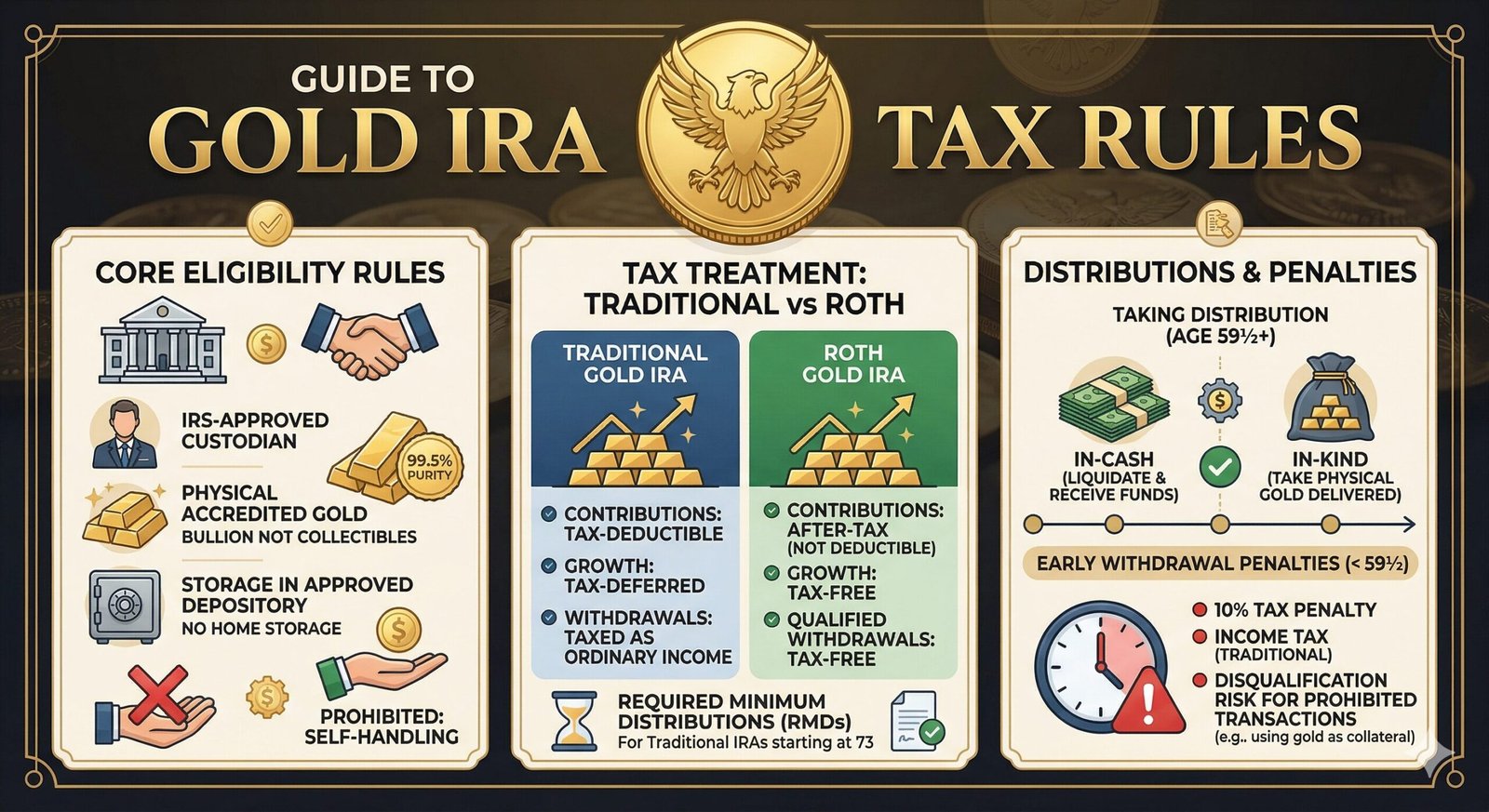
Under IRS rules, gold held inside any IRA — including a Roth — must meet a minimum fineness standard of .995 (99.5% pure). There are a small number of exceptions to this, most notably the American Gold Eagle coin, which is explicitly approved by statute even though its purity is slightly below .9999. Beyond purity, the physical metal must be held by an IRS-approved custodian in an approved depository. You cannot store it at home, in a personal safe, or in a bank safety deposit box that you control directly.
This is a critical distinction. The IRS considers any physical possession of IRA-owned metals by the account holder to be a distribution — meaning it becomes taxable immediately, and if you’re under 59½, it may also attract a 10% early withdrawal penalty.
For a deeper breakdown of these requirements, visit our Gold IRAs Explained in Detail page.
Roth IRA vs. Traditional Gold IRA: The Tax Structure Difference
When people ask whether they can hold gold in a Roth IRA, it’s worth understanding that the underlying tax treatment is what sets a Roth apart — not the rules around the gold itself. Those rules are largely the same across both account types.
With a traditional Gold IRA, contributions may be tax-deductible depending on your income and other retirement plan participation. Withdrawals in retirement are taxed as ordinary income. With a Roth Gold IRA, contributions are made with after-tax dollars, but qualified withdrawals in retirement — including any growth on your account — are generally tax-free under current law.
That tax-free withdrawal feature is one of the reasons Roth accounts are particularly attractive to investors who expect their tax rate to be higher in retirement than it is today, or who simply want predictability in their retirement income. However, Roth IRAs come with income eligibility limits. For 2024, the ability to contribute directly to a Roth IRA phases out at $146,000 for single filers and $230,000 for married couples filing jointly, according to the IRS contribution limits page.
The annual contribution limit for both Roth and traditional IRAs combined is $7,000 in 2024, or $8,000 if you’re aged 50 or older.
One additional advantage worth noting: Roth IRAs are not subject to Required Minimum Distributions (RMDs) during the account holder’s lifetime — unlike traditional IRAs, which require withdrawals beginning at age 73. This means gold held inside a Roth IRA can remain in place longer without being forced out. You can review how RMDs apply to traditional accounts in the IRS RMD FAQ.
Which Types of Gold Can You Hold?
Not all gold products qualify for IRA inclusion. The IRS specifies that eligible gold must meet the .995 fineness standard and be produced by a national government mint or an accredited refiner or assayer. Common eligible products include:
Gold coins approved for IRA inclusion typically include the American Gold Eagle (in all four denominations), the American Gold Buffalo, the Canadian Gold Maple Leaf, the Australian Gold Kangaroo, and the Austrian Gold Philharmonic. For a more complete breakdown, see our guide to IRA-eligible gold coins.
Gold bars and rounds are also eligible provided they meet the .995 standard and are produced by a recognized manufacturer. Common eligible bars include those produced by PAMP Suisse, Credit Suisse, and the Perth Mint, among others.
What is NOT eligible includes collectible coins, numismatic coins, jewelry, gold certificates, or gold ETFs held inside a self-directed physical account. Gold ETFs or mutual funds can be held inside a standard Roth IRA through a brokerage, but those represent paper exposure to gold prices — not ownership of physical metal.
How to Set Up a Roth Gold IRA: Step by Step
Setting up an account to hold physical gold in a Roth IRA is more involved than opening a standard brokerage account, but the process is well-established and straightforward when you work with a reputable provider.
Step 1: Choose a Self-Directed IRA Custodian
A standard Roth IRA at a brokerage like Fidelity or Vanguard does not permit physical gold. To hold physical precious metals, you need what the IRS classifies as a self-directed IRA (SDIRA). These are administered by specialist custodians who are authorized to hold alternative assets. FINRA’s guidance on self-directed IRAs is worth reading before you begin your search, as it outlines some of the risks involved with this account type.
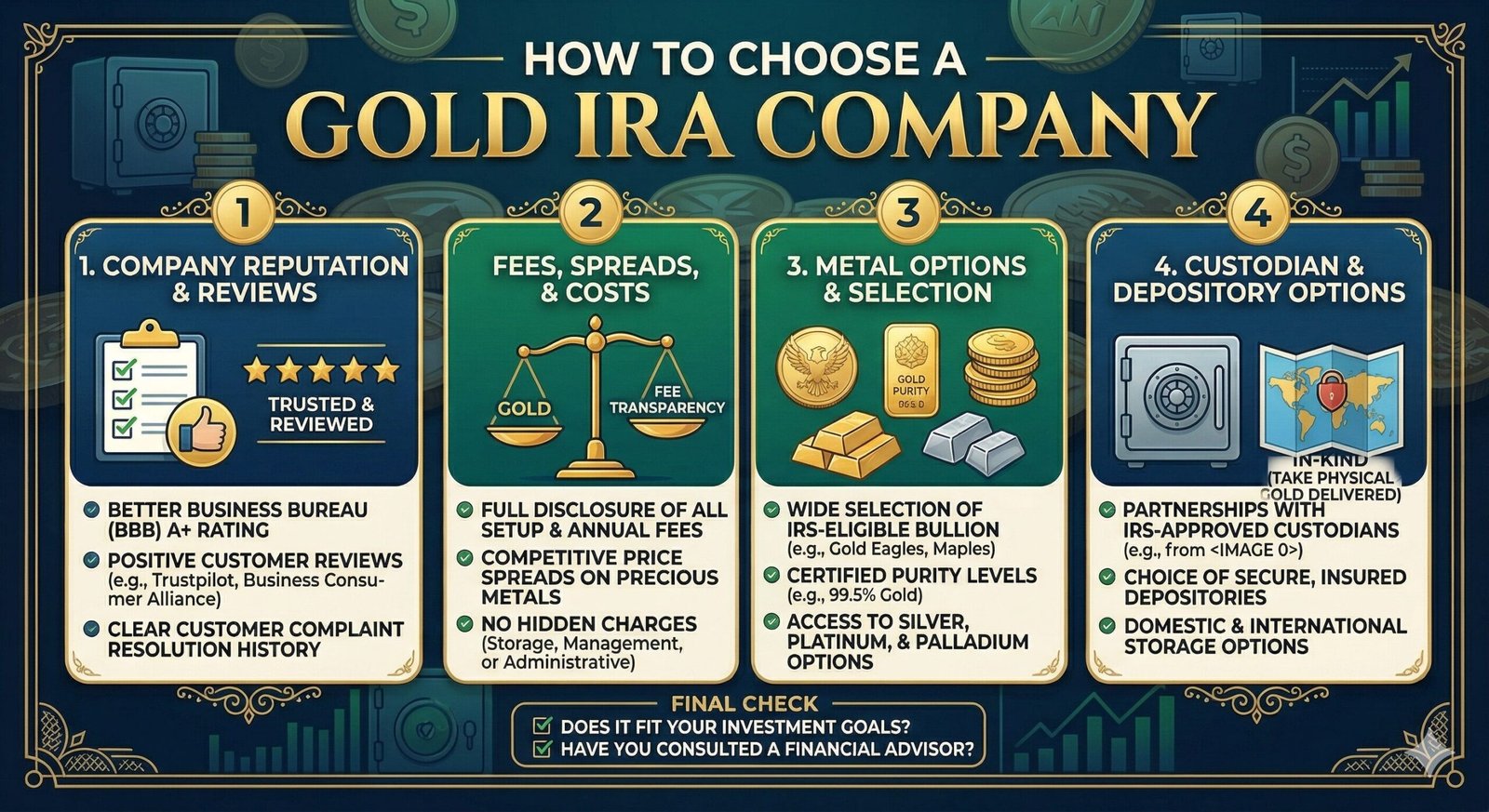
Look for custodians with a clean regulatory record, transparent fee structures, and a clear process for purchasing and storing IRS-approved metals. Checking the company’s rating at bbb.org is a sensible starting point.
Step 2: Fund Your Account
You can fund a Roth Gold IRA in several ways: through a direct Roth IRA contribution (subject to income and contribution limits), through a Roth IRA rollover from another Roth IRA, or through a Roth conversion from a traditional IRA or 401(k) — which does involve a taxable event in the year of conversion. If you’re rolling over from an existing 401(k), our 401(k) to Gold IRA rollover guide covers the mechanics in detail.
Step 3: Select Your Metals and Dealer
Once your account is funded, your custodian will work with you — or with a precious metals dealer of your choice — to purchase eligible gold on behalf of your IRA. The metals are purchased in the name of your IRA, not in your personal name.
Step 4: Arrange Secure Storage
Your custodian will facilitate storage of your gold at an IRS-approved depository. These are purpose-built, insured, third-party vaulting facilities — not storage units or bank branches. You’ll typically have a choice between segregated storage (your metals stored separately from other clients’ metals) and commingled storage (stored together but tracked by weight and type). Segregated storage generally costs more.
Costs to Expect
Physical gold inside a Roth IRA carries costs that standard Roth accounts do not. Before committing, it’s important to understand the full fee picture. Our dedicated Gold IRA fees guide goes into this in depth, but here’s a general summary:
These fees are separate from any markup a precious metals dealer charges over the spot price of gold. Over time, custodian and storage costs can meaningfully affect your net returns, so comparing providers carefully is important. You can review vetted providers on our Best Gold IRA Companies of 2026 page.
What to Watch Out For
The self-directed IRA space attracts a disproportionate number of unscrupulous operators. The SEC investor resources page offers useful general guidance, and we’ve also put together a practical Gold IRA scams guide that covers the most common tactics used against retirement investors — including inflated markups, pressure selling, and misleading “home storage gold IRA” arrangements (which the IRS does not permit).
Always verify a company’s credentials and check for any regulatory actions using FINRA BrokerCheck where applicable.
Frequently Asked Questions
Can I roll an existing Roth IRA into a gold-backed Roth IRA?
Yes. A direct rollover from one Roth IRA to a self-directed Roth IRA that holds physical gold is generally a non-taxable event, provided the funds are transferred directly between custodians. You should review the Gold IRA rollover rules to make sure the transfer is structured correctly.
Is there a minimum investment required to open a Roth Gold IRA?
Most specialist custodians and precious metals companies do set a minimum to open an account — commonly in the range of $5,000 to $25,000, though this varies considerably. Our Gold IRA minimum investment page covers what different providers typically require.
Can I add gold to my existing Roth IRA at Fidelity or Schwab?
Not physical gold, no. Mainstream brokerages do not permit physical precious metals inside their IRA accounts. However, you may be able to purchase gold-related securities — such as ETFs or mining company shares — through those platforms. If you want physical metal, you’ll need a self-directed IRA through a specialist custodian.
What happens when I take a distribution from a Roth Gold IRA?
For qualified distributions (generally after age 59½ and after the account has been open for at least five years), withdrawals from a Roth IRA are tax-free under current law. You can take the distribution as cash — the custodian will liquidate the metal on your behalf — or, in some cases, as an in-kind distribution of the physical metal itself, which may trigger tax differently. Consult a qualified tax professional before making any distribution decisions.
Is a Roth Gold IRA a good idea for everyone?
That depends entirely on your personal financial situation, goals, and timeline — and it’s a question only you and a qualified financial advisor can properly answer. To explore the considerations involved, our guide on is a Gold IRA a good idea provides a balanced overview of the factors worth thinking through.
Ready to Learn More?
If you’re considering a gold-backed Roth IRA, the most important next step is understanding which companies operate with genuine transparency and fair fee structures. Our independent research team has evaluated dozens of providers across the U.S. market — you can see the results on our Best Gold IRA Companies of 2026 page, which is updated regularly to reflect current offerings and verified customer feedback.
For a broader foundation on how these accounts work, start with our Gold IRA hub and work your way through the resources from there.
This article is for informational purposes only and does not constitute financial or tax advice. Investing in precious metals involves risk including possible loss of principal.
Related guides
- Gold IRA Consumer Affairs Reviews: What to Look For
- Gold IRA Trustpilot Reviews: What Real Customers Say
- Gold IRA BBB Complaints: What Consumer Reports Reveal
- Is a Gold IRA Worth the Fees? A Cost-Benefit Analysis
- Are Gold IRA Fees Too High? Breaking Down the Real Costs
- Gold IRA Mistakes to Avoid: 10 Common Errors Investors Make