
Can I Add Gold to My Existing IRA? What the IRS Allows
If you’ve spent years building up a traditional IRA or 401(k), the idea of adding physical gold to that account is appealing to many retirement investors. Gold has been a recognized store of value for centuries, and it’s natural to wonder whether your existing retirement account can simply accommodate it. The short answer is: not directly — but there is a clear, IRS-sanctioned path that allows you to hold physical gold within a retirement account structure. Understanding exactly how that works, and what rules govern it, is what this article is here to explain.
Why You Can’t Just Add Gold to a Standard IRA
Most traditional IRAs are held through banks, brokerage firms, or mutual fund companies. These custodians typically offer stocks, bonds, mutual funds, ETFs, and certificates of deposit — but not physical precious metals. Even if you wanted to, your existing custodian almost certainly doesn’t have the infrastructure to purchase, store, and account for physical gold bullion on your behalf.
There’s also a firm legal reason: the IRS prohibits account holders from taking personal possession of IRA-held precious metals. Under IRS Publication 590-A, collectibles — including most forms of physical gold — are generally not permitted in a standard IRA. The exceptions exist only under specific conditions, and they require a specialized account structure.
This doesn’t mean the door is closed. It means you need the right kind of account to walk through it.
The Account You Actually Need: A Self-Directed IRA
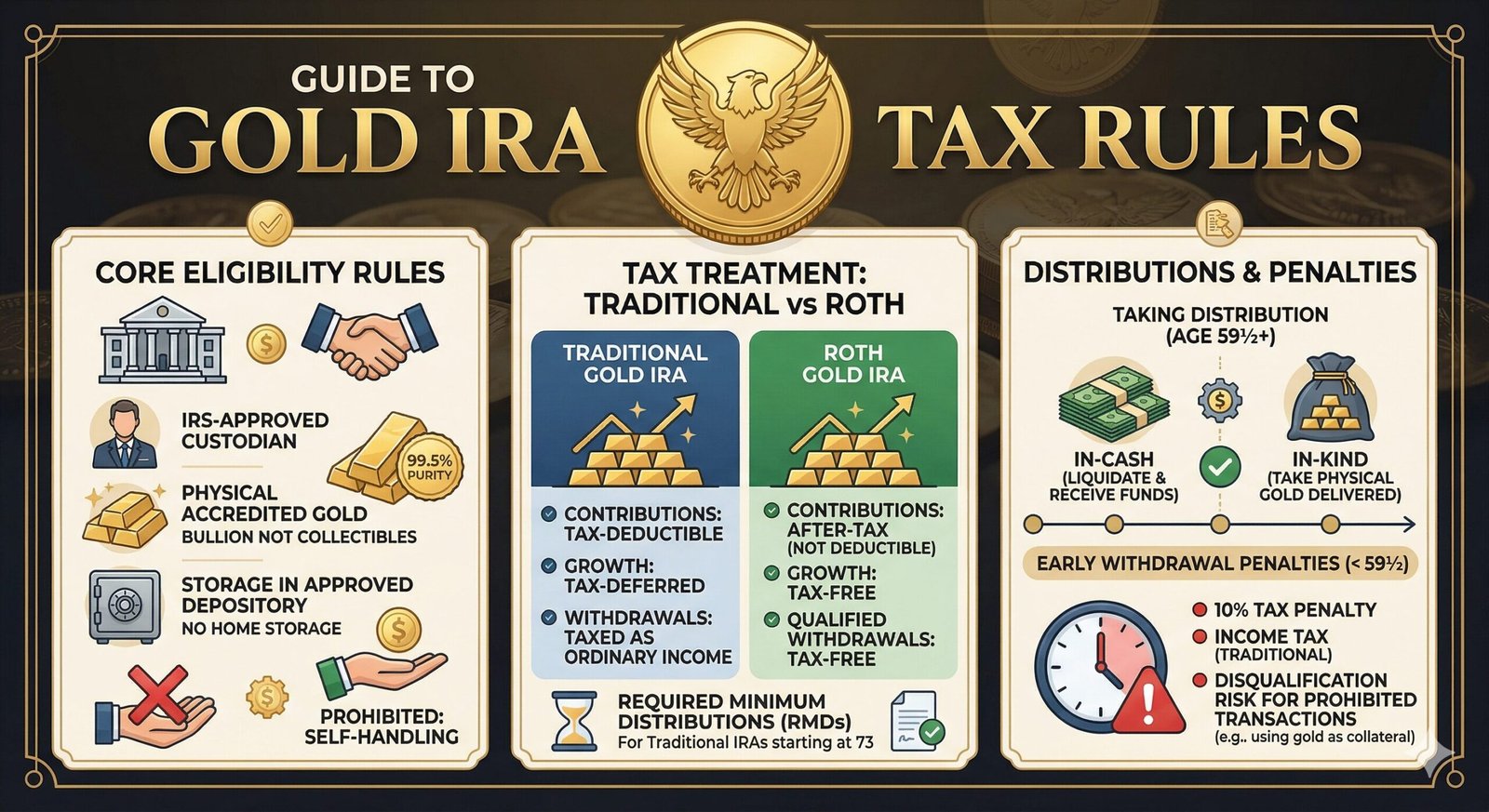
To hold physical gold within a retirement account, you need what’s known as a self-directed IRA (SDIRA). A self-directed IRA operates under the same fundamental IRS rules as a traditional or Roth IRA — the same contribution limits, the same tax treatment, the same required minimum distribution rules — but it allows a far broader range of investment assets, including IRS-approved precious metals.
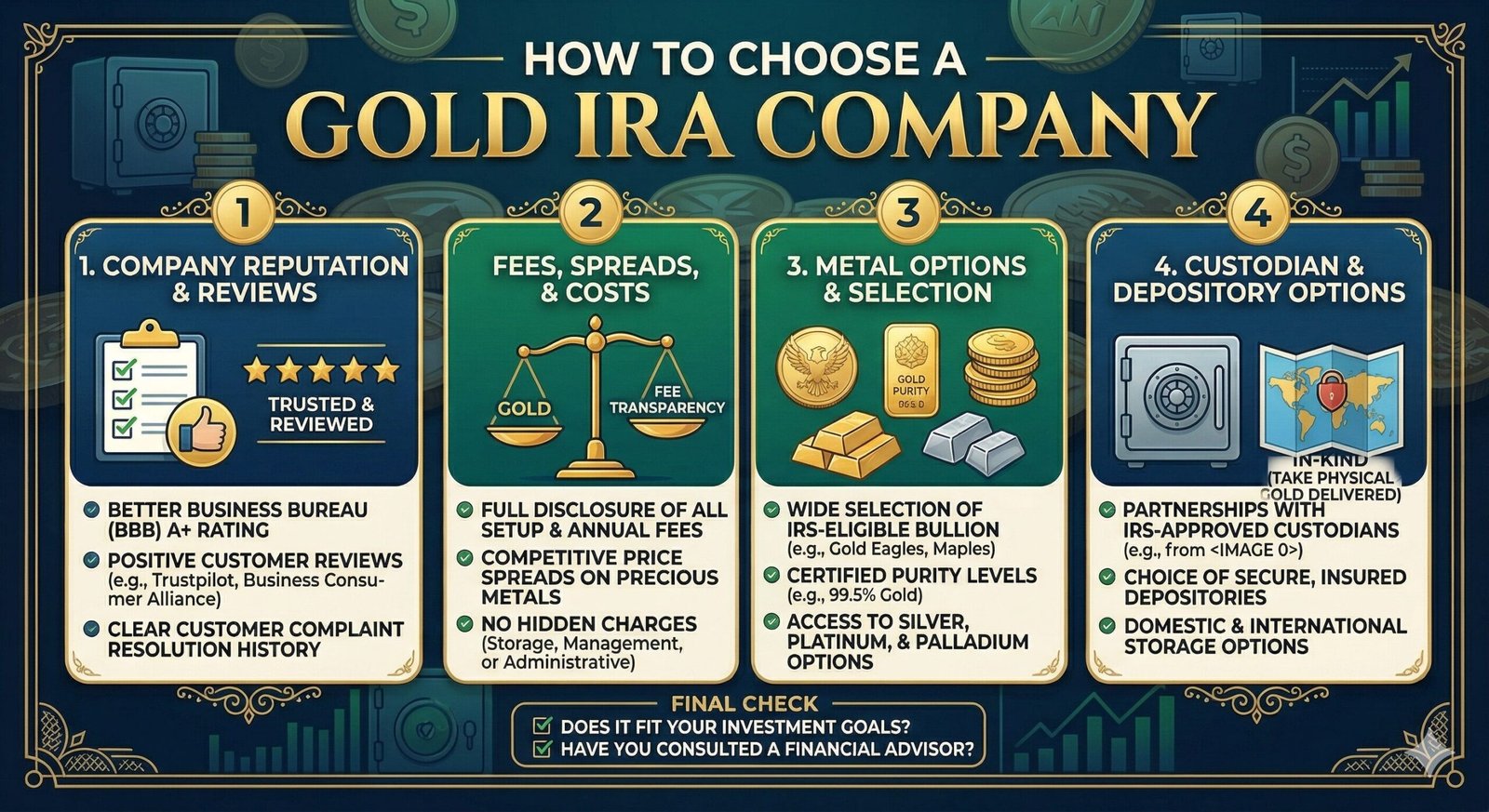
FINRA’s guidance on self-directed IRAs notes that these accounts place greater responsibility on the account holder, since custodians of SDIRAs typically don’t evaluate the quality or legitimacy of the assets held inside them. That’s an important caveat: doing your due diligence on the companies you work with is essential. Checking ratings on bbb.org and reviewing credentials through FINRA BrokerCheck are useful starting points.
A self-directed IRA that specifically holds precious metals is commonly called a Gold IRA. You can visit our Gold IRA hub for a thorough overview of how these accounts are structured and what distinguishes them from conventional retirement accounts.
How the Process Works: Moving Existing Funds Into a Gold IRA
Since you can’t simply instruct your current custodian to purchase gold on your behalf, the process of adding gold to your retirement savings involves transitioning some or all of your existing IRA funds into a new self-directed IRA. There are two primary mechanisms for doing this:
IRA Rollover
A rollover involves distributing funds from your existing IRA and depositing them into a new self-directed IRA within 60 days. The IRS allows one rollover per 12-month period per IRA account. If the 60-day deadline is missed, the distribution may be treated as taxable income — and potentially subject to an early withdrawal penalty if you’re under age 59½.
IRA Transfer (Trustee-to-Trustee)
A direct transfer is the more commonly recommended approach. In a transfer, funds move directly from one IRA custodian to another without ever passing through your hands. Because you never receive the funds personally, there’s no 60-day deadline and no risk of the distribution being treated as a taxable event. There’s also no limit on how many trustee-to-trustee transfers you can complete in a year.
For a full breakdown of how these mechanisms work in practice, our Gold IRA rollover rules page covers the IRS requirements in detail. If your retirement savings are currently in a 401(k) rather than an IRA, our 401(k) to Gold IRA rollover guide walks through that specific process step by step.
What Gold the IRS Actually Permits
Not all gold qualifies for inclusion in a self-directed IRA. The IRS sets specific purity standards that must be met. Under the IRS IRA investment FAQ, gold held in an IRA must meet a minimum fineness of 99.5% pure (0.995 fineness). Common examples of qualifying gold products include:
- American Gold Eagle coins (an exception — these qualify despite being 91.67% gold, due to a specific legislative carve-out)
- American Gold Buffalo coins (24 karat, 99.99% pure)
- Canadian Gold Maple Leaf coins
- Austrian Gold Philharmonic coins
- Gold bars and rounds from approved refiners meeting the 0.995 standard
Collectible coins, rare numismatic coins, and gold jewelry do not qualify, regardless of their market value or gold content. For more guidance on which coins meet IRS requirements, see our page on IRA-eligible gold coins.
The Three Parties Involved in a Gold IRA
Understanding who does what is important before you begin. A functioning Gold IRA involves three distinct roles:
The IRS requires that physical gold held in a self-directed IRA be stored at an approved depository — not in a home safe, a bank safe deposit box, or anywhere else under your personal control. Commingled or segregated storage options are typically available at these facilities, with segregated storage (where your metals are stored separately from other clients’ holdings) usually carrying a higher annual fee.
Our Gold IRA fees guide provides a detailed look at what costs to expect across each of these categories, from account setup through annual custody and storage fees.
Contribution Limits Still Apply
Opening a Gold IRA through a rollover or transfer doesn’t bypass IRS contribution limits — it simply moves existing pre-tax dollars (in the case of a traditional IRA rollover) into a new account structure. However, if you want to make new annual contributions to your Gold IRA going forward, those are subject to the same limits as any other IRA.
For 2026, the IRS contribution limits allow up to $7,000 per year across all your IRAs combined, or $8,000 if you’re 50 or older (the catch-up contribution). These limits apply regardless of whether the IRA holds stocks, bonds, gold, or other permitted assets.
Required Minimum Distributions and Physical Gold
Once you reach age 73, the IRS requires you to begin taking required minimum distributions (RMDs) from traditional IRAs, including Gold IRAs. The challenge with physical gold is that RMDs must be taken in U.S. dollars, which means you either need to liquidate a portion of your gold holdings or have other IRA assets from which to satisfy the distribution requirement.
The IRS RMD FAQ outlines the rules in full. It’s a good idea to understand how RMDs will interact with a gold-heavy account well before you approach that age threshold.
How a Gold IRA Compares to a Traditional IRA
For a more thorough side-by-side comparison, see our Gold IRA vs Traditional IRA page.
Minimum Investment Considerations
Many Gold IRA custodians and dealers set minimum investment thresholds that are higher than those of a standard brokerage IRA. These minimums vary widely — some providers start as low as $5,000, while others require $25,000 or more to open an account. Our Gold IRA minimum investment page compares what leading providers currently require so you can assess whether a Gold IRA is practical for your situation.
Protecting Yourself from Misleading Offers
The Gold IRA space has attracted some operators who use high-pressure tactics, misleading fee structures, or exaggerated claims about precious metals. Before working with any company, verify their standing through third-party resources and look for transparent, upfront fee disclosures. Our Gold IRA scams guide covers the most common red flags and how to avoid them. The SEC investor resources page also provides useful general guidance on evaluating retirement account providers.
Frequently Asked Questions
Can I hold gold in my existing traditional IRA without opening a new account?
No. Standard traditional IRAs held through banks or brokerage firms are not structured to hold physical precious metals. To hold IRS-approved gold within an IRA, you need to establish a self-directed IRA with a custodian that specializes in alternative assets. Funds from an existing IRA can be transferred or rolled over into the new account.
Will moving money from my IRA to a Gold IRA trigger taxes?
Not if the transfer is handled correctly. A direct trustee-to-trustee transfer between IRAs is not a taxable event. A rollover is also non-taxable if the funds are deposited into the new account within 60 days. If the 60-day deadline is missed or proper procedures aren’t followed, the IRS may treat the distribution as taxable income.
Can I store the gold from my Gold IRA at home?
No. The IRS requires that precious metals held in a self-directed IRA be stored at an approved depository. Taking personal possession of IRA-held gold — including storing it at home or in a personal safe deposit box — is treated as a distribution, which may trigger taxes and penalties.
Is a Gold IRA the same as buying gold ETFs in my IRA?
No. Gold ETFs and gold mining stocks can be held in a standard brokerage IRA. A Gold IRA specifically refers to an account that holds physical gold bullion or coins. The two are distinct products with different cost structures, storage requirements, and exposure characteristics. For a broader look at the considerations involved, our Gold IRAs Explained in Detail page is a helpful resource.
What happens to my Gold IRA when I retire and need income?
When you need to take distributions, you have two options: you can liquidate some of your gold holdings and receive cash, or in some cases request an in-kind distribution of the physical metal itself (which is then treated as a taxable distribution at the market value at the time). Planning ahead — particularly around RMDs — is important for anyone holding a significant portion of their retirement savings in physical metals.
Ready to Learn More?
Understanding what the IRS permits is the essential first step, but choosing the right custodian, dealer, and depository matters just as much. If you’re ready to compare the companies most frequently used by retirement investors in 2026, our guide to the Best Gold IRA Companies of 2026 provides an objective, side-by-side look at what leading providers offer, how their fees compare, and what to look for before opening an account.
This article is for informational purposes only and does not constitute financial or tax advice. Investing in precious metals involves risk including possible loss of principal.
Related guides
- Gold IRA Consumer Affairs Reviews: What to Look For
- Gold IRA Trustpilot Reviews: What Real Customers Say
- Gold IRA BBB Complaints: What Consumer Reports Reveal
- Is a Gold IRA Worth the Fees? A Cost-Benefit Analysis
- Are Gold IRA Fees Too High? Breaking Down the Real Costs
- Gold IRA Mistakes to Avoid: 10 Common Errors Investors Make