
Gold IRA in Virginia: Complete Guide for Investors
Virginia has long been home to a financially engaged population — from federal employees and military veterans to private-sector professionals preparing for retirement in one of the country’s more affluent states. If you’re a Virginia resident exploring ways to add physical gold to your retirement savings, a Gold IRA is one of the most structured and IRS-recognized ways to do so.
This guide walks through everything Virginia investors need to understand about Gold IRAs: what they are, how they work, what they cost, and what the rules require. It is written for information purposes only and is not financial advice.
What Is a Gold IRA?
A Gold IRA is a self-directed individual retirement account that holds physical precious metals — most commonly gold bullion or coins — rather than the stocks, bonds, and mutual funds found in a conventional IRA. To understand the full mechanics, our Gold IRA guide covers the structure in depth.
The key distinction is in the account type. While a standard IRA is typically administered by a brokerage or mutual fund company, a Gold IRA requires a specialized custodian authorized to hold alternative assets. That custodian works alongside an IRS-approved depository, where your physical metals are stored on your behalf.
For a thorough breakdown of account types, tax treatment, and eligibility rules, see Gold IRAs Explained in Detail.
Traditional vs. Roth Gold IRA
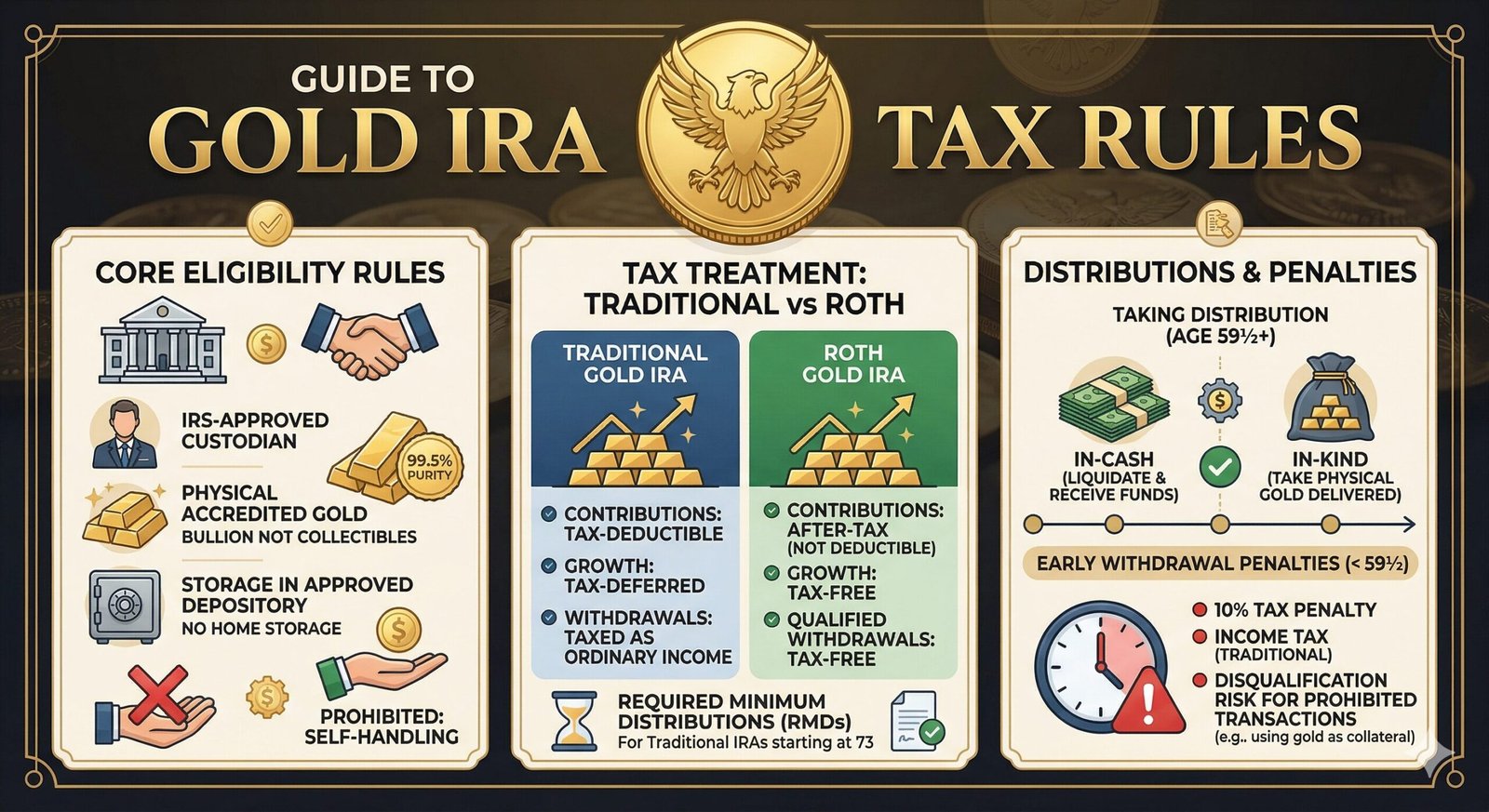
Gold IRAs come in two main forms: Traditional and Roth. A Traditional Gold IRA is funded with pre-tax dollars, meaning contributions may be tax-deductible and taxes are deferred until you take distributions in retirement. A Roth Gold IRA is funded with after-tax dollars, with qualifying withdrawals in retirement potentially tax-free.
The choice between them depends on your current tax situation and retirement goals — a licensed tax professional familiar with your circumstances can help clarify which structure makes sense for you. For more context on how these accounts compare to conventional retirement accounts, the Gold IRA vs Traditional IRA page offers a useful side-by-side overview.
Is a Gold IRA Available to Virginia Residents?
Yes. There is nothing state-specific about eligibility for a Gold IRA. The rules are set at the federal level by the IRS, and they apply uniformly across all 50 states. Virginia residents are subject to the same contribution limits, age rules, and distribution requirements as investors anywhere else in the country.
Virginia does not impose any additional state-level regulations specific to precious metals IRAs. From a practical standpoint, setting up a Gold IRA in Virginia follows the same process as it would in any other state — you work with a custodian and depository that may be based anywhere in the U.S.
If you’re asking yourself is a Gold IRA a good idea for your situation, the honest answer is: it depends on your individual financial circumstances, time horizon, and retirement goals. That’s a conversation best had with a qualified financial advisor.
How Gold IRAs Work: A Step-by-Step Overview
1. Choose a Custodian
Every Gold IRA must be administered by an IRS-approved custodian — typically a trust company or specialty financial institution. Not all custodians accept precious metals, so you’ll need to find one that specifically supports self-directed IRAs with alternative assets. FINRA’s guidance on self-directed IRAs is worth reading before you begin, as it outlines the additional responsibilities account holders take on with this type of account.
2. Fund Your Account
You can fund a Gold IRA in three primary ways:
- New contribution: Subject to annual IRS contribution limits (currently $7,000 per year for those under 50, or $8,000 for those 50 and older, as updated by the IRS — always verify current figures at the IRS contribution limits page).
- IRA-to-IRA transfer: Moving funds from an existing Traditional or Roth IRA into a Gold IRA without triggering a taxable event.
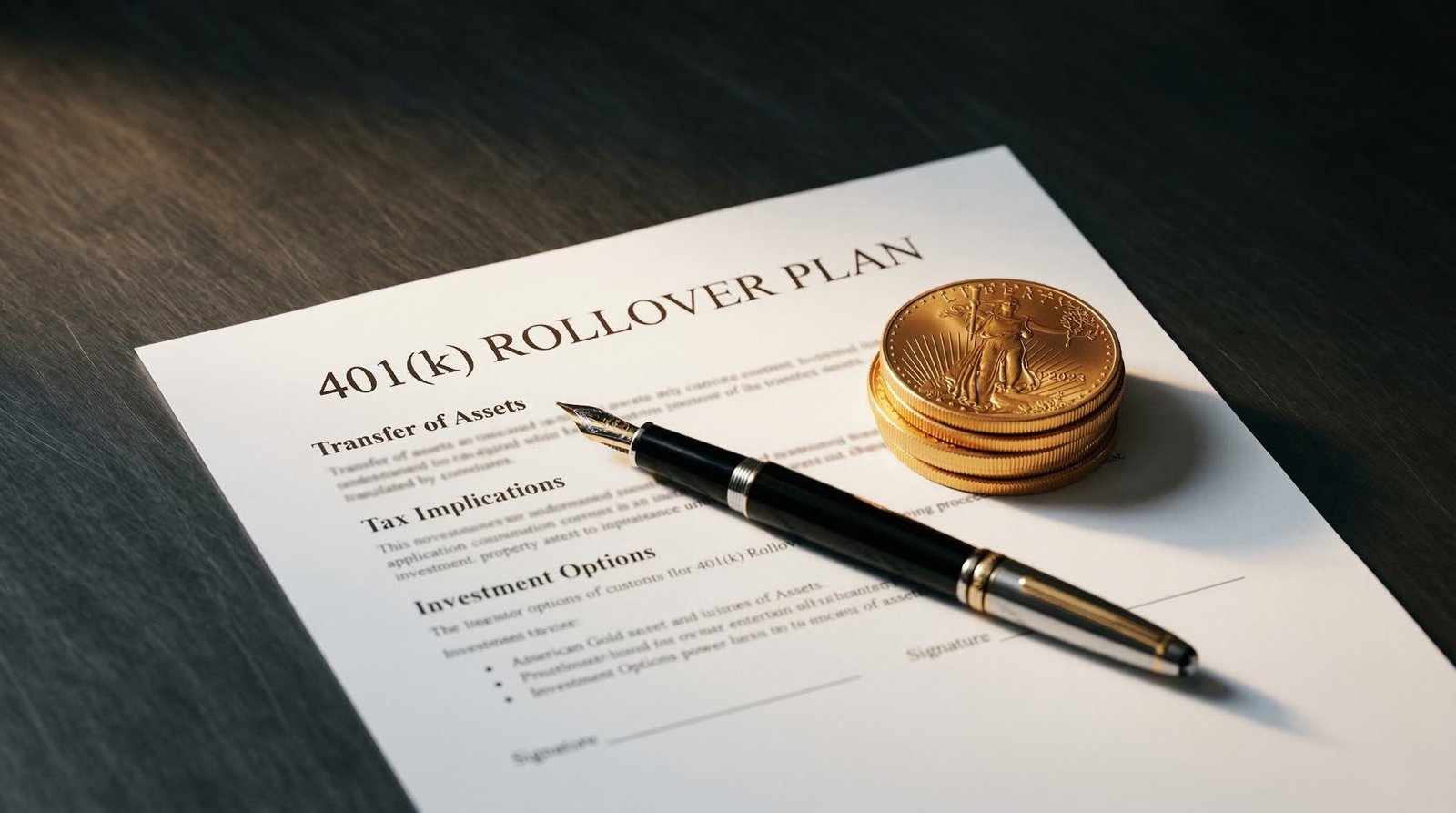
- Rollover from a 401(k) or other employer plan: If you’ve left an employer or have an eligible plan, you may be able to roll retirement funds into a Gold IRA. See our 401(k) to Gold IRA rollover guide for a detailed walkthrough, and review the Gold IRA rollover rules to understand timing and compliance requirements.
3. Select Your Metals
Not every gold product qualifies for an IRA. The IRS requires that gold held in a retirement account meet a minimum purity of 99.5% (with a narrow exception for American Gold Eagle coins). For a full list of qualifying products, our guide to IRA-eligible gold coins is a helpful starting point. Per IRS Publication 590-A, coins must also be produced by an accredited refiner, assayer, or manufacturer.
4. Arrange for Secure Storage
IRS regulations prohibit account holders from taking personal possession of IRA-held metals. All physical gold must be stored in an IRS-approved depository. Virginia residents commonly use depositories located in Delaware, Texas, or Utah — all of which are recognized nationally. Your custodian will typically have preferred depository partners.
Gold IRA Fees: What Virginia Investors Should Expect
Fees are an important part of the Gold IRA decision. Unlike conventional brokerage IRAs, which often have minimal account maintenance costs, Gold IRAs involve a layered fee structure. Our full Gold IRA fees guide breaks this down in detail, but here is a general overview.
These fees vary significantly between providers, and over a 10- or 20-year holding period, even small annual differences can compound meaningfully. Before committing to any provider, ask for a full written fee schedule.
Minimum Investment Requirements
Gold IRAs generally require a higher starting balance than conventional IRAs. Most reputable custodians set a minimum initial investment in the $5,000–$25,000 range, though some set the bar considerably higher. For a broader look at entry-level requirements across leading providers, see our Gold IRA minimum investment page.
Virginia investors who have accumulated substantial retirement savings through federal employment, military service, or private-sector careers are often well-positioned to meet these minimums — though that alone should not be the deciding factor in whether a Gold IRA is appropriate for you.
Required Minimum Distributions and Gold IRAs
If you hold a Traditional Gold IRA, you will be subject to Required Minimum Distributions (RMDs) beginning at age 73, in line with current IRS rules. The challenge with a Gold IRA is that your assets are physical metals, not cash. When an RMD is due, you have two options: liquidate enough metal to satisfy the distribution requirement, or take the distribution as an in-kind distribution of physical metal (though the latter has additional complexity).
The IRS RMD FAQ is the authoritative reference for RMD rules. Roth Gold IRAs, by contrast, are not subject to RMDs during the account holder’s lifetime, which is one reason some investors prefer the Roth structure for long-term holdings.
Choosing a Trustworthy Gold IRA Company
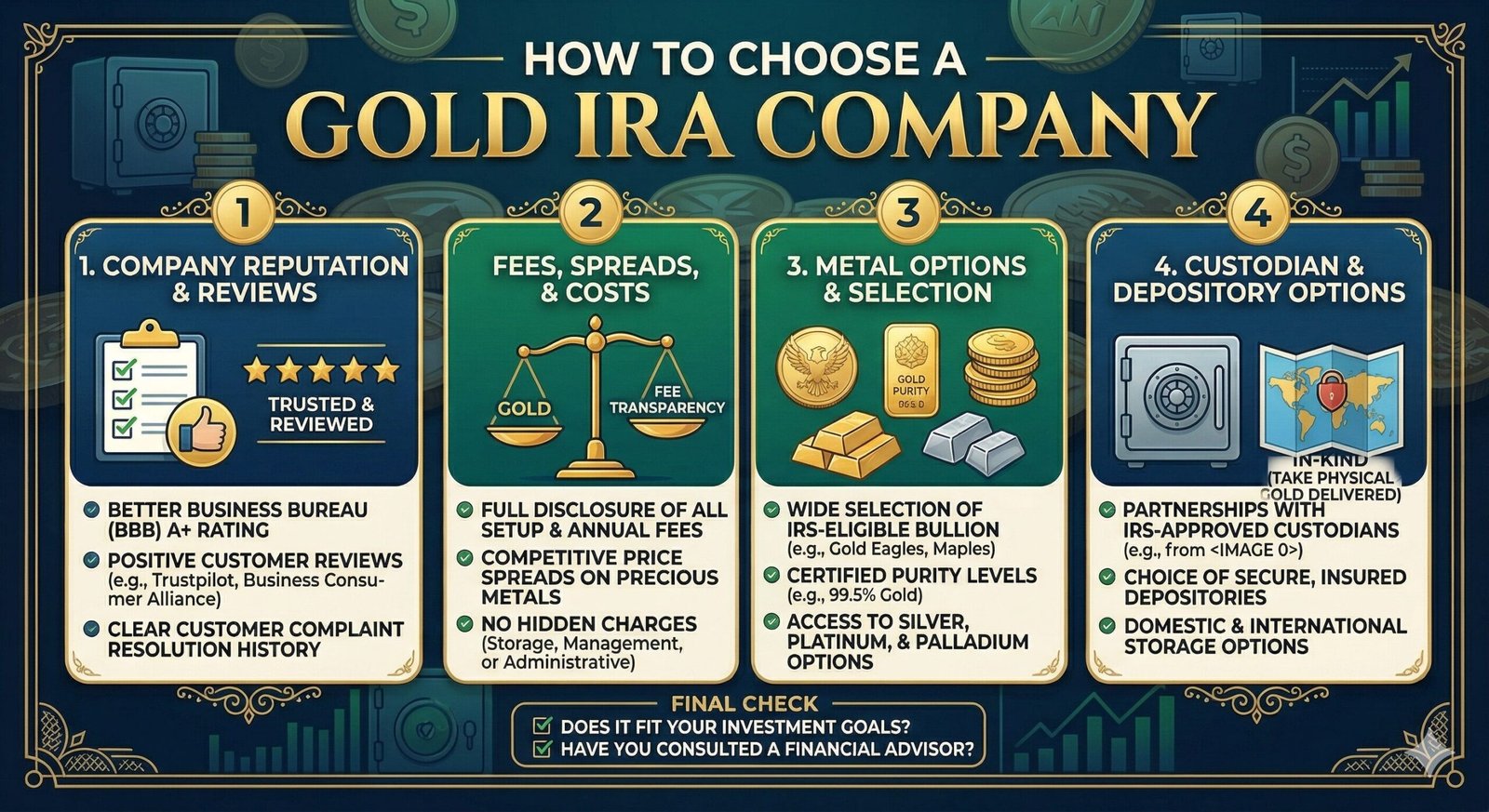
The Gold IRA industry includes reputable companies and, unfortunately, some that are not. Virginia investors should conduct thorough due diligence before committing to any provider. Our Gold IRA scams guide outlines the most common warning signs and how to steer clear of problematic companies.
When evaluating providers, consider the following:
Regulatory standing. Verify that any company you consider is properly registered and has a clean regulatory history. You can research custodians through FINRA BrokerCheck and check complaint histories at bbb.org.
Transparency. A credible company will provide a full, written fee schedule without hesitation. Vague pricing or pressure to act quickly are warning signs.
Education-first approach. The best Gold IRA companies invest in helping their customers understand how the account works before any transaction takes place. High-pressure sales tactics are not consistent with a company operating in your best interests.
Third-party custody. Confirm that any company you work with uses an independent, IRS-approved custodian and depository — not one they own or control entirely themselves.
The SEC investor resources page also provides straightforward, unbiased guidance on retirement account structures that can help frame your research.
Gold IRA vs. 401(k): A Note for Virginia Federal Employees
Virginia is home to a large number of federal government and military personnel, many of whom participate in the Thrift Savings Plan (TSP) or other employer-sponsored retirement plans. These plan types have their own rollover rules and eligibility windows.
Before initiating any rollover, it is critical to understand the distinctions between account types and the IRS rules governing transfers. Our Gold IRA vs 401(k) page offers a clear overview of how these structures differ and what investors should understand before making any changes to their retirement accounts.
Frequently Asked Questions
Can Virginia residents open a Gold IRA with any national provider?
Yes. Gold IRA companies typically operate nationally and are not restricted to investors in specific states. Virginia residents have access to the same range of providers as investors in any other state.
Does Virginia tax IRA distributions?
Virginia generally follows federal tax treatment for IRA distributions, meaning Traditional IRA withdrawals are typically subject to Virginia income tax. However, Virginia does offer a retirement income deduction for residents over certain age thresholds. This article does not constitute tax advice — consult a Virginia-licensed tax professional for guidance specific to your situation.
Do I need to store my gold in Virginia?
No. IRS rules require that Gold IRA assets be held in an approved depository, but that depository can be located anywhere in the United States. Virginia residents most commonly use national depositories in other states.
What happens to my Gold IRA if I move out of Virginia?
Nothing changes structurally. A Gold IRA is a federal account type governed by IRS rules. Relocating to another state does not affect your account, though your state tax obligations may change.
Can I add gold I already own to a Gold IRA?
No. IRS rules prohibit account holders from contributing physical gold they already possess to an IRA. All metals held in a Gold IRA must be purchased through the account after funding, using new contributions or rollover funds — not transferred from personal holdings.
Ready to Take the Next Step?
If you’re a Virginia investor researching Gold IRAs, the most important thing you can do is take your time, read carefully, and compare providers thoroughly before making any decisions. Our independent review of the Best Gold IRA Companies of 2026 is a useful starting point for comparing fees, minimums, customer service records, and more — all in one place.
This article is for informational purposes only and does not constitute financial or tax advice. Investing in precious metals involves risk including possible loss of principal.
Related guides
- Gold IRA Consumer Affairs Reviews: What to Look For
- Gold IRA Trustpilot Reviews: What Real Customers Say
- Gold IRA BBB Complaints: What Consumer Reports Reveal
- Is a Gold IRA Worth the Fees? A Cost-Benefit Analysis
- Are Gold IRA Fees Too High? Breaking Down the Real Costs
- Gold IRA Mistakes to Avoid: 10 Common Errors Investors Make