
Gold IRA in Oregon: Complete Guide for Investors
Oregon has long attracted residents who think carefully about their financial futures — from the tech professionals of Portland to the ranchers and small business owners spread across the high desert. If you’re an Oregon-based investor exploring ways to add physical precious metals to your retirement account, a Gold IRA is worth understanding in detail. This guide walks you through how Gold IRAs work, what the IRS requires, how storage functions, and what to look for when choosing a custodian — all tailored to the questions Oregon investors tend to ask.
What Is a Gold IRA?
A Gold IRA is a self-directed individual retirement account that holds physical precious metals — typically gold, silver, platinum, or palladium — rather than the paper-based assets found in conventional IRAs. The account functions under the same broad IRS framework as a Traditional or Roth IRA, meaning the same contribution limits, rollover rules, and required minimum distribution (RMD) requirements apply.
What makes it different is what it holds. Instead of mutual funds or equities, your IRA owns physical metal that must be stored in an IRS-approved depository. You cannot take personal possession of the metal while it remains in the account. If you’d like a thorough foundation before going further, visit our Gold IRA hub for a comprehensive overview, or read Gold IRAs Explained in Detail for a deeper look at the mechanics.
It’s also worth noting upfront: because Gold IRAs are self-directed accounts, they come with more personal responsibility than conventional IRAs. FINRA’s guidance on self-directed IRAs is a useful starting point for understanding the additional due diligence this structure requires.
Is There Anything Oregon-Specific About a Gold IRA?
This is one of the most common questions from Oregon investors, and the short answer is: not much — but a few details are worth knowing.
Gold IRAs are governed by federal law, specifically the Internal Revenue Code and related IRS guidance. Oregon does not impose additional state-level regulations on how IRA accounts are structured or what they can hold. Oregon does have its own income tax rules, and the state generally conforms to federal treatment of IRA distributions, but this article does not provide tax advice — for guidance on how distributions may affect your Oregon state tax return, consult a licensed tax professional or CPA in the state.
What Oregon investors do need to think about is custodian selection and storage location, both of which we’ll cover in detail below.
How a Gold IRA Works: The Core Structure
The Three-Party Arrangement
A Gold IRA always involves three separate entities: you (the account holder), a custodian, and a depository. Understanding how these three parties interact is essential before opening an account.
Your custodian is an IRS-approved trustee — typically a bank, credit union, or specialty financial institution — responsible for holding the account, executing transactions, and filing required paperwork with the IRS. They do not typically provide investment advice, and their role is administrative.
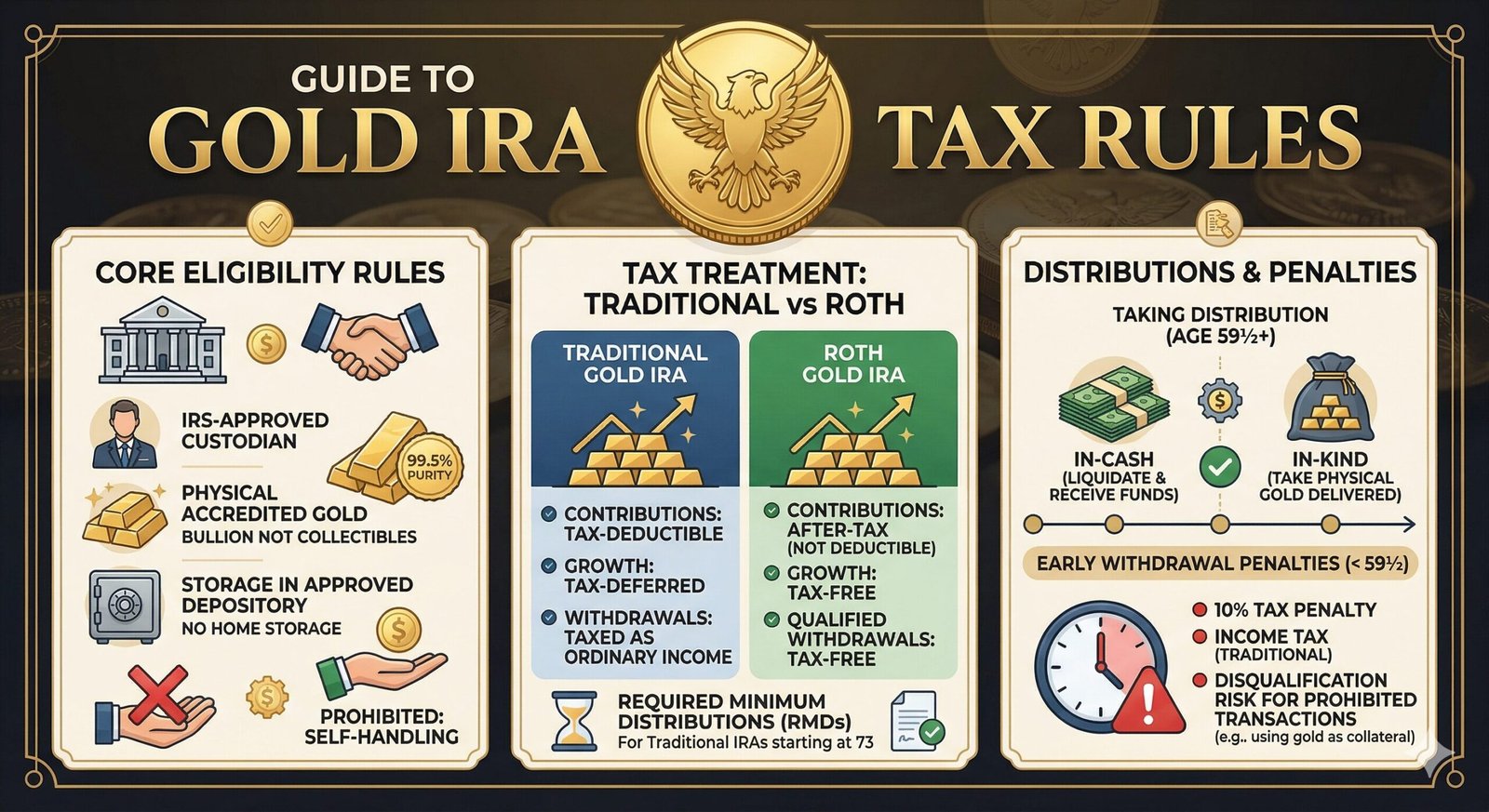
Your depository is the physical facility where your metal is stored. The IRS requires that metal held in an IRA be kept at an approved depository — you cannot store it in a home safe, a bank safety deposit box in your own name, or any location you personally control.
Your dealer is the company from which you purchase the metal. Some companies bundle custodial and dealer services under one brand, while others keep them separate.
Oregon Investors and Depository Location
There are no IRS-approved precious metals depositories currently operating in Oregon. This is not unusual — most states don’t have one. Approved facilities are concentrated in states like Texas, Delaware, and Utah. This means that if you open a Gold IRA, your physical metal will be stored out of state.
This is entirely legal and standard practice. The metal is still yours — it’s held in your name (or your IRA’s name) within a segregated or commingled vault, depending on what your depository offers. Oregon investors should simply be comfortable with the understanding that they will not be able to physically visit their holdings at a local facility.
IRS Rules Every Oregon Gold IRA Investor Must Know
Purity Requirements
The IRS sets strict standards for what metals are eligible to be held in an IRA. Gold must be at least 99.5% pure, with some exceptions — the American Gold Eagle coin, for example, is 91.67% pure but is specifically approved by the IRS. For a full breakdown of approved coins and bars, our guide to IRA-eligible gold coins covers this in detail.
Contribution Limits
For 2025, the IRS allows annual contributions of up to $7,000 to an IRA, or $8,000 if you are aged 50 or older. These limits apply across all your IRAs combined — you cannot contribute $7,000 to a Gold IRA and another $7,000 to a Traditional IRA in the same year. The IRS contribution limits page is updated annually and is the authoritative reference.
Rollovers and Transfers
Many Oregon investors fund a Gold IRA not through fresh contributions but by rolling over funds from an existing 401(k), 403(b), or Traditional IRA. This is a common approach, particularly for those approaching retirement who have accumulated assets in employer-sponsored plans.
The IRS allows both direct rollovers (where funds move custodian-to-custodian without passing through your hands) and indirect rollovers (where you receive the funds and have 60 days to deposit them into the new account). Indirect rollovers carry meaningful risk — if you miss the 60-day window, the IRS treats the amount as a distribution, which may trigger income tax and penalties. Our 401(k) to Gold IRA rollover guide walks through both approaches step by step, and our Gold IRA rollover rules page covers the IRS requirements in full.
For authoritative IRS guidance, IRS Publication 590-A covers contributions and rollovers in detail.
Required Minimum Distributions
Once you reach age 73, the IRS requires you to begin taking required minimum distributions (RMDs) from your Traditional Gold IRA each year. Because your IRA holds physical metal rather than cash, satisfying an RMD typically means either selling enough metal to cover the required amount or taking an in-kind distribution of physical metal — which then has a taxable value based on the metal’s market price at the time. The IRS RMD FAQ explains how these distributions are calculated.
Gold IRA Fees: What Oregon Investors Should Expect
Fees in the Gold IRA space vary more than in conventional IRA accounts, and understanding the full cost structure before committing is important. The table below outlines the typical fee categories you’ll encounter.
It’s worth reading our dedicated Gold IRA fees guide before choosing a custodian, as fee structures can meaningfully affect your long-term account balance. Some companies advertise “free” storage for an introductory period that later reverts to standard charges, so always read the full fee schedule.
Choosing a Custodian as an Oregon Investor
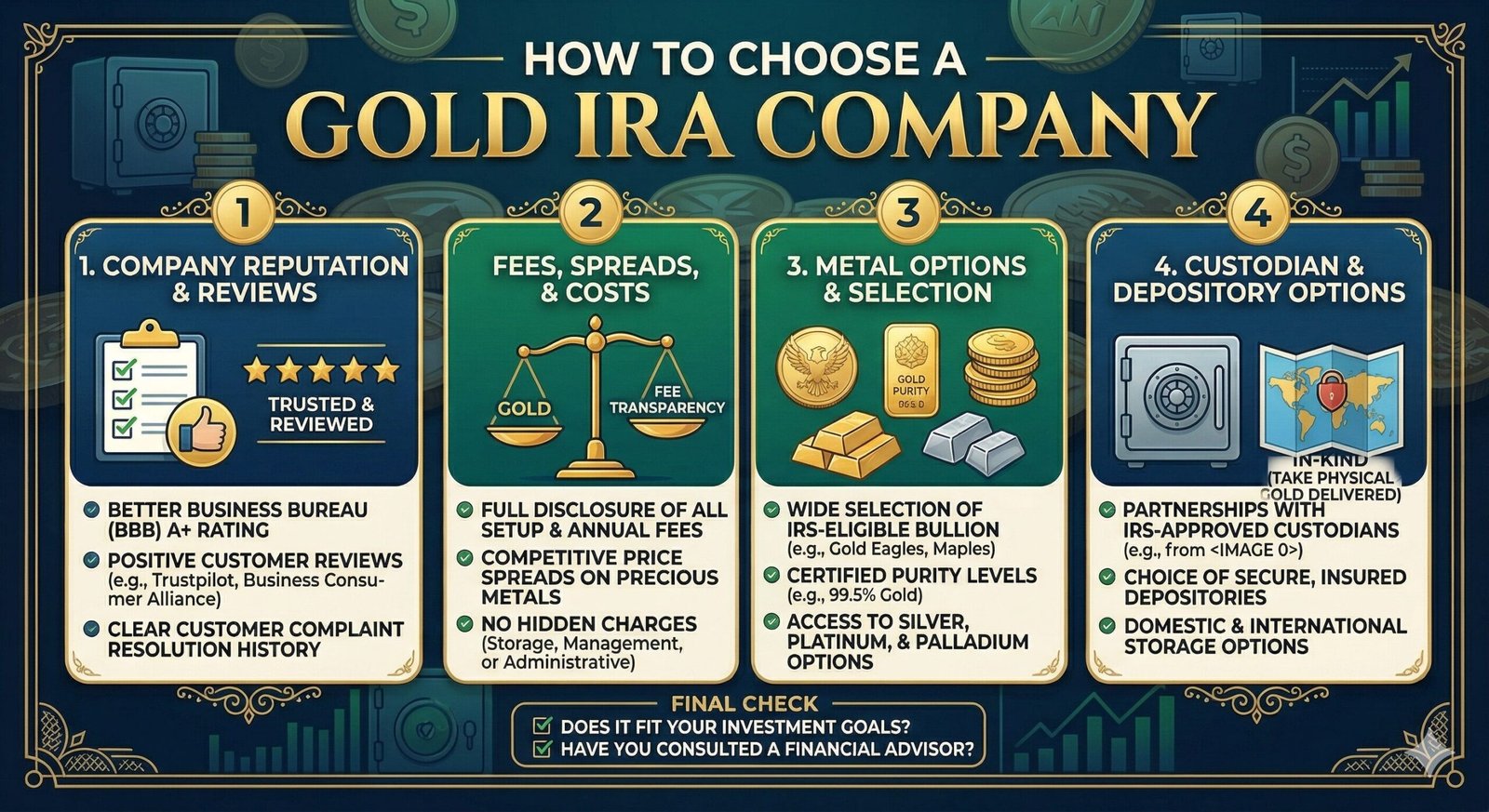
Because no Gold IRA custodians are headquartered in Oregon, you’ll be working with a company remotely — which is the norm for this account type regardless of where you live. Here’s what to evaluate when comparing options:
IRS approval status is non-negotiable. The custodian must be an IRS-approved trustee. You can verify this through the IRS IRA investment FAQ and SEC investor resources.
Reputation and track record matter significantly in this space. Check each company’s rating on bbb.org and look at independent customer review platforms. For broker-dealers, FINRA BrokerCheck allows you to verify registrations and review any disciplinary history.
Transparency of fees is a reliable signal of a company’s overall character. Any reputable custodian will provide a written fee schedule upfront, without requiring you to speak to a salesperson first.
Storage options — specifically whether they offer segregated or commingled storage — should match your preferences. Segregated storage keeps your specific bars or coins separate from other investors’ holdings; commingled storage pools metal of the same type and purity.
Our Best Gold IRA Companies of 2026 page evaluates leading custodians across these criteria and is a useful starting point for Oregon investors conducting their research.
If you’re also comparing this type of account to other retirement vehicles, the Gold IRA vs Traditional IRA and Gold IRA vs 401(k) comparisons may help frame your thinking. And before you commit, our Gold IRA scams guide covers the warning signs that distinguish legitimate custodians from bad actors in this space.
Frequently Asked Questions
Q: Can I store my Gold IRA metals at home in Oregon?
No. IRS rules require that all metals held in a Gold IRA be stored at an IRS-approved depository. Storing metals at home — or anywhere you personally control — would be considered a distribution by the IRS, potentially triggering income tax and a 10% early withdrawal penalty if you’re under age 59½.
Q: Does Oregon tax Gold IRA distributions?
Oregon does impose a state income tax, and distributions from a Traditional IRA are generally treated as ordinary income at the state level, consistent with federal treatment. The specifics of how this applies to your situation depend on your individual circumstances — speak with an Oregon-licensed tax professional for guidance.
Q: Is there a minimum amount required to open a Gold IRA in Oregon?
The IRS itself does not set a minimum. However, most Gold IRA custodians set their own minimums, typically ranging from $5,000 to $50,000 depending on the company. Our Gold IRA minimum investment page breaks down typical thresholds across leading custodians.
Q: Can I roll over my Oregon PERS (Public Employees Retirement System) account into a Gold IRA?
Oregon PERS is a defined benefit pension plan, and rollovers from such plans are subject to specific rules. In most cases, active members cannot roll over funds while still employed. Retired members may have options depending on their plan tier and account type. This is a situation where consulting both a financial professional and your Oregon PERS plan administrator is strongly recommended.
Q: How do I know if a Gold IRA is right for me?
That depends entirely on your financial situation, timeline, and goals. Our article on is a Gold IRA a good idea walks through the key considerations objectively. For personalised guidance, a fee-only financial advisor who is experienced with self-directed IRAs is your most reliable resource.
Ready to Learn More?
If you’re an Oregon investor who has worked through this guide and wants to compare the leading custodians in the Gold IRA space side by side, our independently researched Best Gold IRA Companies of 2026 page is the logical next step. It covers fees, storage options, minimum investments, and customer service quality — everything you need to make a confident, informed decision.
This article is for informational purposes only and does not constitute financial or tax advice. Investing in precious metals involves risk including possible loss of principal.
Related guides
- Gold IRA Consumer Affairs Reviews: What to Look For
- Gold IRA Trustpilot Reviews: What Real Customers Say
- Gold IRA BBB Complaints: What Consumer Reports Reveal
- Is a Gold IRA Worth the Fees? A Cost-Benefit Analysis
- Are Gold IRA Fees Too High? Breaking Down the Real Costs
- Gold IRA Mistakes to Avoid: 10 Common Errors Investors Make