Gold IRA in Illinois: Complete Investor Guide 2026
If you live in Illinois and you’re thinking about adding physical gold to your retirement strategy, you’re not alone. Across the state — from Chicago’s North Shore suburbs to Rockford, Springfield, and beyond — retirement investors are exploring what a Gold IRA actually involves, how it works under federal law, and what practical steps are required to open one.
This guide is designed specifically for Illinois residents who want a clear, honest picture of how Gold IRAs function, what the costs look like, and what questions to ask before making any decisions. Nothing here constitutes financial or investment advice — but it does give you the factual foundation you need to have informed conversations with qualified professionals.
What Is a Gold IRA?
A Gold IRA is a self-directed Individual Retirement Account that holds physical precious metals — typically gold, silver, platinum, or palladium — rather than conventional paper assets like mutual funds or stocks. The account operates under the same general IRS framework as a traditional or Roth IRA, but with a significantly expanded investment universe.
For a more thorough introduction, visit our Gold IRA hub or read Gold IRAs Explained in Detail, which walks through the mechanics from account structure to metal delivery at retirement.
The key distinction between a Gold IRA and simply buying gold privately is that a Gold IRA allows your metals to sit inside a tax-advantaged retirement wrapper. That means any growth within the account is either tax-deferred (traditional Gold IRA) or potentially tax-free on qualified distributions (Roth Gold IRA), depending on the account type you choose. For a side-by-side look at how these structures compare, see our Gold IRA vs Traditional IRA breakdown.
Is a Gold IRA Legal in Illinois?
Yes — Gold IRAs are federally governed retirement accounts. Illinois does not impose any state-specific restrictions on owning or holding a Gold IRA. Illinois residents follow the same IRS rules that apply to all Americans, including contribution limits, distribution age requirements, and metal purity standards.
According to IRS Publication 590-A, self-directed IRAs are a legitimate account type provided they are established through a qualified trustee or custodian and comply with all applicable regulations. The IRS IRA investment FAQ also provides useful guidance on what types of assets are — and aren’t — permissible inside these accounts.
One important distinction: while Illinois has no special rules, the state does have its own income tax treatment of retirement distributions. For specifics on how Illinois taxes IRA withdrawals, speak with a licensed Illinois tax professional — this article does not constitute tax advice.
How a Gold IRA Works: The Three-Party Structure
Every Gold IRA involves three separate parties, and understanding this structure is essential before you open an account.
The Custodian
A self-directed IRA custodian is an IRS-approved financial institution responsible for holding the account, processing transactions, and filing the required IRS paperwork. The custodian does not typically provide investment advice — they act as an administrative intermediary. FINRA’s guidance on self-directed IRAs is worth reviewing before selecting a custodian.
The Precious Metals Dealer
You’ll purchase your IRA-eligible metals through a precious metals dealer. The dealer sells the gold or silver to you at market price (plus any dealer markup), and those metals are then transferred directly to the depository — never to your home or personal possession.
The Depository
IRS rules require that all physical metals held inside an IRA be stored at an approved third-party depository. Illinois residents do not need to use an Illinois-based depository. Facilities like Brink’s, Delaware Depository, and CNT Depository operate nationally and are commonly used across the country.
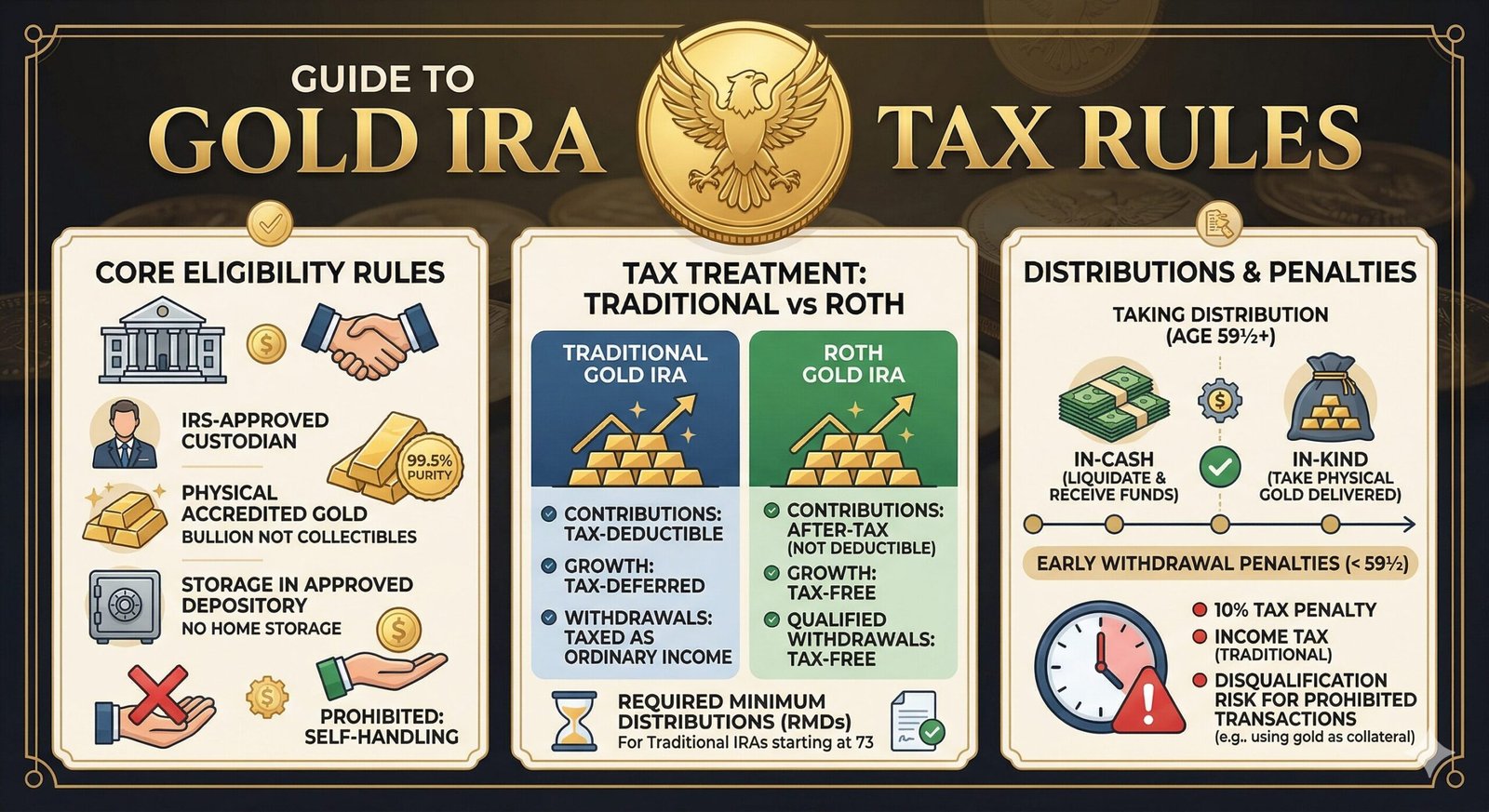
This three-party structure means that even though the gold is yours inside the IRA, you cannot take personal possession of it while it remains in the account. Doing so would trigger immediate distribution taxes and potential penalties under IRS rules.
IRS Rules Illinois Investors Must Know
Gold IRAs are subject to federal IRS rules regardless of which state you live in. Here are the most critical ones for 2026.
Contribution Limits: For 2026, the standard IRA contribution limit is $7,000 per year, or $8,000 if you’re aged 50 or older. This applies whether your IRA holds gold, stocks, or any other asset. You can verify current figures at the IRS contribution limits page.
Metal Purity Requirements: Not all gold qualifies. The IRS requires that gold held in an IRA be at least 99.5% pure. Common qualifying products include American Gold Eagle coins (a statutory exception to the purity rule), American Gold Buffalo coins, and gold bars from approved refiners. For a full overview of what qualifies, see our guide to IRA-eligible gold coins.
Required Minimum Distributions (RMDs): Traditional Gold IRA holders must begin taking RMDs at age 73. Because your IRA holds physical metal rather than cash, satisfying an RMD may require selling a portion of your gold or taking an in-kind distribution. The IRS RMD FAQ explains the mechanics in detail.
Rolling Over an Existing Retirement Account
Many Illinois investors open a Gold IRA not with new contributions but by rolling over funds from an existing 401(k), 403(b), or traditional IRA. If you have retirement savings sitting in an old employer plan, this is a common pathway.
Our 401(k) to Gold IRA rollover guide covers the full process, but the key point is that rollovers must be handled carefully to avoid triggering taxes. A direct rollover — where funds move institution-to-institution without passing through your hands — is generally the safest route. If you take an indirect rollover (funds paid to you first), you have 60 days to redeposit them into an eligible account, or the amount may be treated as a taxable distribution.
For a comprehensive list of the applicable rules, see our Gold IRA rollover rules page.
Gold IRA Fees: What Illinois Investors Pay
Costs in a Gold IRA are meaningfully different from a conventional IRA. Rather than just a brokerage commission, you’re looking at a layered fee structure that covers custodial administration, storage, and transaction charges. Understanding these before you commit is important. Our detailed Gold IRA fees guide breaks this down fully.
Total annual carrying costs typically land between $200 and $600 for most investors, not including any dealer markups on the metals themselves. These costs are a real consideration — not a reason to avoid a Gold IRA, but a factor to evaluate honestly.
Choosing a Gold IRA Custodian as an Illinois Resident
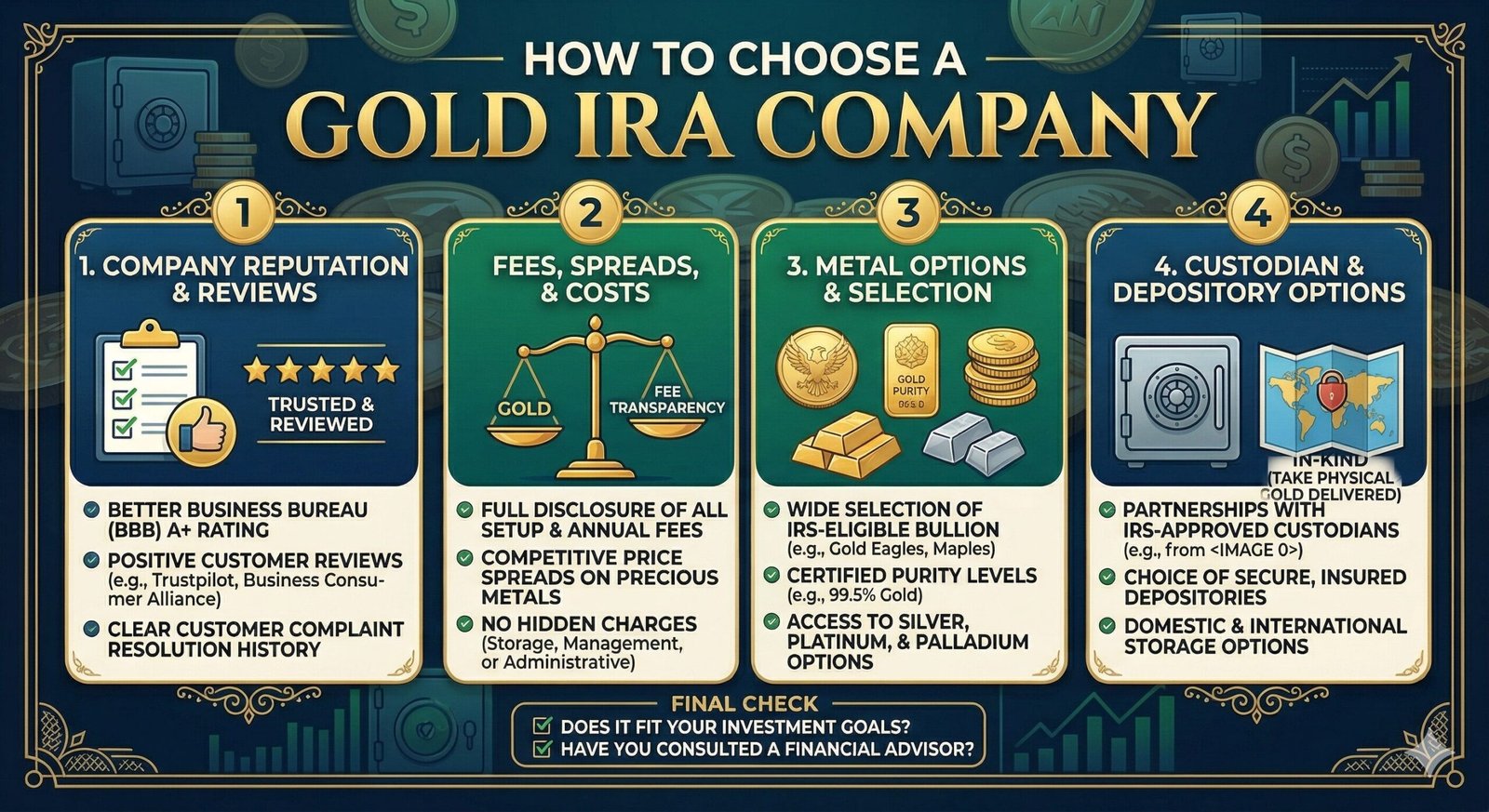
Illinois residents can use any IRS-approved custodian in the country — you’re not limited to Illinois-based institutions. That said, doing proper due diligence is critical.
Start by checking a custodian’s standing with the Better Business Bureau at bbb.org and verifying any associated brokers through FINRA BrokerCheck. Look for custodians with a clear fee schedule, responsive customer service, and a verifiable track record.
Also consider the minimum investment required. Some Gold IRA custodians set minimums as low as $5,000, while others start at $25,000 or more. Our Gold IRA minimum investment page compares current thresholds across leading providers.
One area requiring particular vigilance: the Gold IRA space has attracted its share of bad actors. Our Gold IRA scams guide details the most common red flags to watch for, including unsolicited outreach, pressure tactics, and opaque pricing. The SEC investor resources page also offers useful general guidance.
Is a Gold IRA Right for You?
That’s ultimately a question only you can answer — ideally with the input of a qualified financial advisor or CPA who understands your complete financial picture. Our article is a Gold IRA a good idea offers a balanced look at the considerations involved, covering both the potential appeal and the genuine limitations.
What we can say is that a Gold IRA involves real costs, real complexity, and real regulatory requirements. It’s not a passive set-and-forget retirement vehicle. Illinois investors who find it worth exploring tend to be those who have already reviewed the mechanics carefully and want access to physical assets inside a tax-advantaged structure — not those reacting to headlines or short-term market anxiety.
For those also weighing their options against other account structures, our Gold IRA vs 401(k) comparison is a useful reference point.
Frequently Asked Questions
Q: Can I store my Gold IRA metals at home in Illinois?
No. IRS rules require that metals held inside an IRA be stored at an approved third-party depository. Storing IRA gold at home — or in a personal safe deposit box — is treated as a distribution, which triggers immediate taxes and potentially penalties. This applies to all U.S. investors, including Illinois residents.
Q: Does Illinois tax Gold IRA distributions?
Illinois has its own state income tax structure, and how it treats IRA distributions is a question for a licensed Illinois tax professional. This article does not provide tax advice. For federal tax treatment, refer to IRS Publication 590-A as a starting point.
Q: Can I roll over my Illinois state pension or 457(b) into a Gold IRA?
Governmental 457(b) plans can generally be rolled over into an IRA, including a self-directed Gold IRA, under federal rules. However, specific plan rules and tax considerations apply. Consult your plan administrator and a qualified tax advisor before initiating any rollover from a state or municipal plan.
Q: Are there Illinois-based Gold IRA custodians?
There are financial institutions operating in Illinois that may offer self-directed IRA services, but most Gold IRA investors use nationally operating custodians regardless of their state of residence. There is no requirement to use an in-state custodian.
Q: How long does it take to open a Gold IRA in Illinois?
Account setup typically takes five to fifteen business days, depending on the custodian. Rollovers can take two to four weeks, particularly if they involve transferring funds from an employer-sponsored plan. Some custodians offer expedited timelines — ask about this during your initial inquiry.
Ready to Explore Your Options?
If you’re an Illinois investor looking to take the next step, start by reviewing how the leading providers compare on fees, service, and minimums. Our independently researched guide to the Best Gold IRA Companies of 2026 gives you a structured starting point — and helps you ask better questions before committing to anything.
This article is for informational purposes only and does not constitute financial or tax advice. Investing in precious metals involves risk including possible loss of principal.
Related guides
- Gold IRA Consumer Affairs Reviews: What to Look For
- Gold IRA Trustpilot Reviews: What Real Customers Say
- Gold IRA BBB Complaints: What Consumer Reports Reveal
- Is a Gold IRA Worth the Fees? A Cost-Benefit Analysis
- Are Gold IRA Fees Too High? Breaking Down the Real Costs
- Gold IRA Mistakes to Avoid: 10 Common Errors Investors Make