Gold IRA Withdrawal Rules: Age, Penalties & RMDs (2026)
Understanding Gold IRA withdrawal rules forms a critical component of retirement planning with precious metals. These regulations, established by the IRS, govern when and how you can access funds in your Gold Individual Retirement Account without facing penalties or unexpected tax consequences.
Gold IRAs operate under the same fundamental withdrawal framework as traditional and Roth IRAs, but the physical nature of precious metals creates additional considerations for account holders. Whether you’re planning early retirement, managing required minimum distributions, or considering emergency access to funds, knowing these rules helps you make informed decisions about your retirement strategy.
The complexity of withdrawal regulations often surprises new Gold IRA investors. Unlike stocks or bonds that can be easily liquidated, precious metals require specific procedures for both in-kind distributions and cash withdrawals. This comprehensive guide examines every aspect of Gold IRA withdrawal rules to help you navigate these requirements successfully.
Understanding Gold IRA Withdrawal Basics
Gold IRA withdrawal rules mirror those governing traditional retirement accounts, with specific adaptations for precious metals investments. The IRS treats Gold IRAs as self-directed Individual Retirement Accounts, subjecting them to the same age-based restrictions, penalty structures, and distribution requirements as conventional IRAs.
The fundamental principle underlying these rules centers on encouraging long-term retirement savings. The IRS provides tax advantages for Gold IRA contributions but imposes restrictions on early access to discourage using retirement funds for non-retirement purposes. These restrictions apply regardless of whether you hold gold coins, silver bars, or other approved precious metals in your account.
Two primary types of Gold IRAs exist: traditional Gold IRAs funded with pre-tax dollars and Roth Gold IRAs funded with after-tax contributions. Each type follows different withdrawal rules, particularly regarding taxation of distributions. Understanding which type of Gold IRA you hold becomes essential when planning withdrawals, as the tax implications differ significantly between the two structures.
The physical nature of precious metals adds complexity to withdrawal procedures that doesn’t exist with paper assets. When you request a distribution from your Gold IRA, you can typically choose between receiving the actual precious metals (in-kind distribution) or having the custodian sell the metals and distribute cash proceeds. Each option carries different logistical considerations and potential tax implications.
For more foundational information about these accounts, review our Gold IRA guide which covers the basic structure and benefits of precious metals retirement accounts.
Age-Based Withdrawal Rules and Early Distribution Penalties
The most significant factor determining your withdrawal options involves your age when you request distributions from your Gold IRA. The IRS has established specific age thresholds that dramatically affect both the availability of funds and the penalties you might face for early access.
Before Age 59½
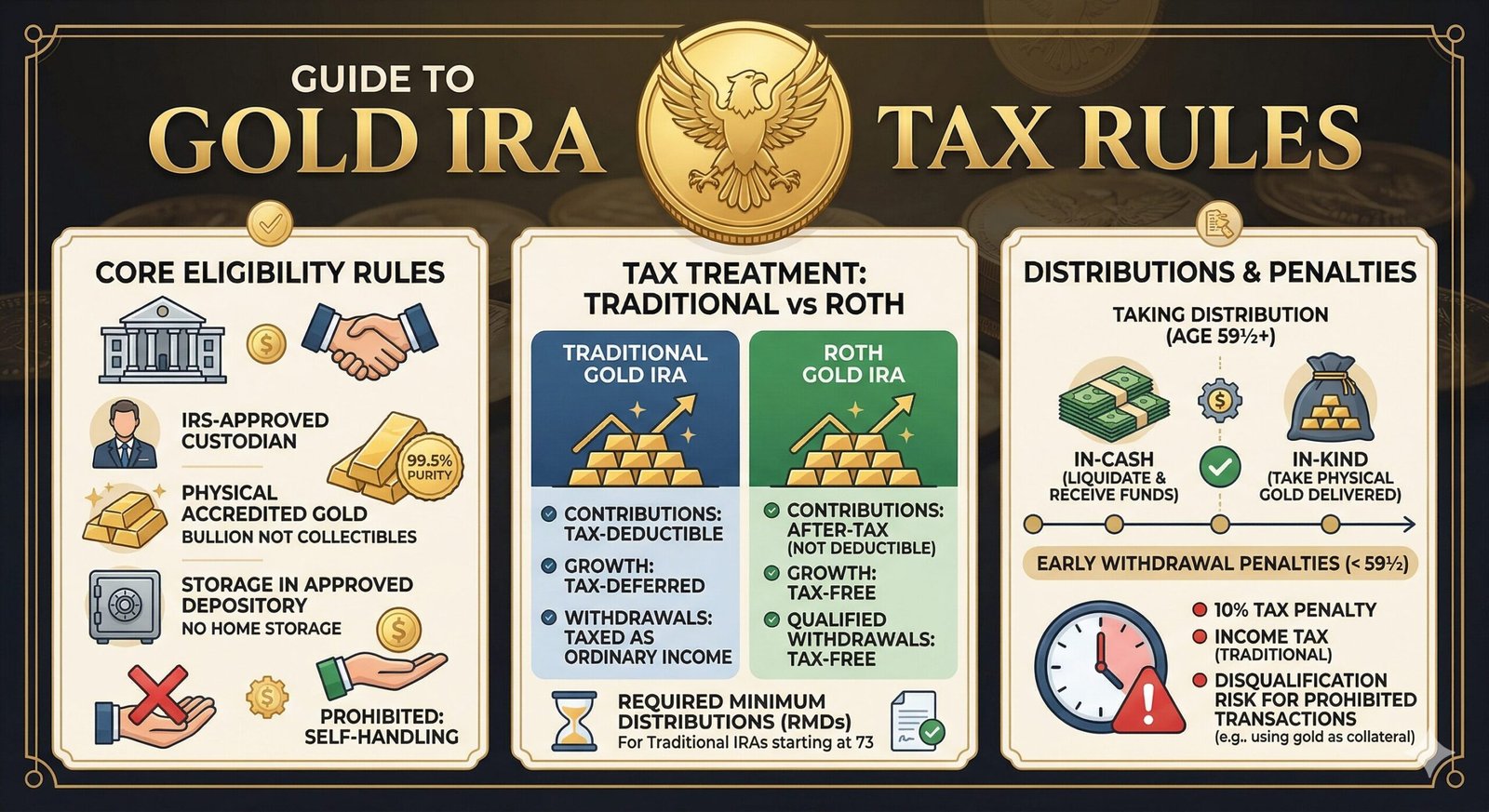
Withdrawals from traditional Gold IRAs before age 59½ typically trigger a 10% early distribution penalty in addition to ordinary income taxes on the withdrawn amount. This penalty applies to the fair market value of any precious metals distributed or cash received from selling metals within the account. The 10% penalty represents one of the most costly aspects of early Gold IRA withdrawals, often making such distributions financially unwise except in specific circumstances.
Several exceptions allow penalty-free early withdrawals from Gold IRAs, though you’ll still owe regular income taxes on distributions from traditional accounts. These exceptions include first-time home purchases (up to $10,000 lifetime maximum), qualified higher education expenses, unreimbursed medical expenses exceeding 7.5% of adjusted gross income, and permanent disability. Military reservists called to active duty may also qualify for penalty-free distributions under specific conditions.
After Age 59½
Once you reach age 59½, the 10% early distribution penalty no longer applies to Gold IRA withdrawals. You can access your funds without penalty restrictions, though traditional Gold IRA distributions still face ordinary income tax treatment. This age milestone represents a significant shift in withdrawal flexibility, allowing you to access precious metals or cash from your account as needed for retirement expenses.
Roth Gold IRA Considerations
Roth Gold IRAs follow different early withdrawal rules due to their after-tax contribution structure. Contributions to Roth accounts can be withdrawn at any time without taxes or penalties, since you already paid taxes on these funds. However, earnings withdrawals before age 59½ may trigger penalties unless they qualify for specific exceptions. Additionally, Roth Gold IRAs must be open for at least five years before earnings can be withdrawn tax-free, regardless of your age.
Understanding these age-based rules helps you plan withdrawal timing to minimize tax consequences and penalties. For detailed guidance on account setup and management, consult Gold IRAs Explained in Detail which covers the operational aspects of these accounts.
Required Minimum Distributions (RMDs)
Required Minimum Distributions represent one of the most important Gold IRA withdrawal rules for retirees. The IRS mandates that traditional Gold IRA holders begin taking minimum distributions starting April 1 of the year after they turn 73, with subsequent RMDs due by December 31 each year thereafter.
The RMD calculation uses your account balance as of December 31 of the previous year, divided by a life expectancy factor from IRS tables. For Gold IRAs, this calculation can become complex when precious metals prices fluctuate significantly, as the account value for RMD purposes reflects current market prices rather than original purchase prices.
RMD Calculation Example
Gold IRA custodians typically handle RMD calculations for account holders, but you remain responsible for ensuring distributions occur on time. Failing to take required distributions results in a substantial penalty: 25% of the amount that should have been distributed. This penalty can be reduced to 10% if the shortfall is corrected within two years, but the financial impact remains severe.
You have flexibility in how RMDs are satisfied from Gold IRAs. You can request cash distributions by having the custodian sell sufficient precious metals to meet the requirement, or you can take in-kind distributions of physical metals equal to the RMD amount. Some investors prefer cash distributions to avoid the complexity of receiving and storing physical precious metals annually.
Roth Gold IRA RMD Rules
Roth Gold IRAs offer a significant advantage regarding required distributions: original account holders face no RMD requirements during their lifetime. This feature allows Roth Gold IRA assets to continue growing tax-free throughout retirement, making these accounts attractive for estate planning purposes. However, inherited Roth Gold IRAs do face RMD requirements for beneficiaries under current regulations.
For comprehensive information about managing RMDs and other distribution requirements, the IRS RMD FAQ provides official guidance on calculation methods and timing requirements.
Tax Implications of Gold IRA Withdrawals
The tax treatment of Gold IRA withdrawals depends heavily on your account type and the nature of your distributions. Understanding these tax implications helps you plan withdrawal timing and amounts to minimize your overall tax burden during retirement.
Traditional Gold IRA Tax Treatment
Distributions from traditional Gold IRAs face ordinary income tax treatment at your current marginal tax rate. Whether you receive physical precious metals or cash from metal sales, the IRS taxes the fair market value of the distribution as regular income. This treatment applies to both the original contributions (which were typically tax-deductible) and any growth in account value over time.
The timing of traditional Gold IRA withdrawals can significantly impact your tax liability. Large distributions might push you into higher tax brackets, while spreading withdrawals across multiple years could keep you in lower brackets. This consideration becomes particularly important when managing RMDs alongside other retirement income sources like Social Security or pension payments.
Roth Gold IRA Tax Treatment
Roth Gold IRA distributions follow different tax rules due to the after-tax contribution structure. Qualified distributions from Roth accounts come out completely tax-free, including both contributions and earnings. To qualify as tax-free, distributions must occur after age 59½ and the account must have been open for at least five years.
The ordering rules for Roth distributions work in your favor: contributions come out first (always tax-free), followed by conversions (tax-free after five years), and finally earnings (tax-free if qualified). This structure provides considerable flexibility for managing tax-free income during retirement.
In-Kind vs. Cash Distributions
The tax implications remain the same whether you take in-kind distributions of physical metals or cash distributions from metal sales. However, in-kind distributions create additional considerations for basis tracking and future sales outside the IRA. When you receive physical metals from your Gold IRA, your basis in those metals equals the fair market value on the distribution date, which becomes important for calculating capital gains if you later sell the metals.
State income tax treatment varies by location, with some states exempting retirement account distributions from state income taxes. Consulting with a tax professional familiar with your state’s regulations helps ensure compliance with all applicable tax requirements.
For official guidance on IRA taxation, review IRS Publication 590-A which covers the tax treatment of various IRA distributions and transactions.
In-Kind Distributions and Physical Metal Withdrawals
One unique aspect of Gold IRAs involves the option to receive actual precious metals as distributions rather than cash proceeds from metal sales. These in-kind distributions allow you to maintain physical possession of gold, silver, or other approved metals while satisfying withdrawal requirements.
In-kind distributions require careful coordination with your Gold IRA custodian and approved depository. The process typically begins with a distribution request specifying the type and amount of metals you want to receive. The custodian must arrange for the metals to be shipped from the depository to your chosen address, following specific security and insurance protocols.
Logistics of Physical Metal Distributions
The practical aspects of receiving physical precious metals involve several considerations that don’t apply to cash distributions. First, you must arrange for secure receipt and storage of potentially valuable shipments. Many investors choose to have metals shipped to bank safe deposit boxes or professional storage facilities rather than residential addresses.
Insurance coverage during shipment represents another important consideration. Most custodians and depositories provide insurance for metals in transit, but understanding coverage limits and claim procedures helps ensure your interests are adequately protected. The value of metals for insurance purposes typically reflects current market prices rather than your original purchase prices.
Valuation and Timing Considerations
The IRS requires in-kind distributions to be valued at fair market value on the distribution date. For precious metals, this valuation typically uses spot prices from recognized exchanges, though numismatic coins might require professional appraisals. The timing of distribution requests can affect the value received, as precious metals prices fluctuate daily.
Some investors time in-kind distributions to coincide with favorable tax situations or market conditions. However, the complexities involved in coordinating shipments and valuations mean that distribution requests often take several days or weeks to complete, limiting your ability to time distributions precisely to market movements.
Storage and Insurance After Distribution
Once you receive physical metals from a Gold IRA distribution, responsibility for storage, insurance, and security transfers to you. This transition requires planning for appropriate storage solutions, whether through bank safe deposit boxes, home safes, or professional precious metals storage services. The ongoing costs and responsibilities of physical metal ownership become important considerations when choosing between in-kind and cash distributions.
For investors considering the rollover process that might lead to future distributions, 401(k) to Gold IRA rollover guide explains how funds typically move into Gold IRAs initially.
Special Circumstances and Exceptions
Several special circumstances allow for penalty-free early withdrawals from Gold IRAs, even before age 59½. Understanding these exceptions helps you plan for unexpected financial needs without incurring unnecessary penalties on your retirement savings.
First-Time Homebuyer Exception
The IRS allows penalty-free early withdrawals up to $10,000 for qualified first-time homebuyer expenses. This exception applies to both you and your spouse, potentially allowing up to $20,000 in combined penalty-free distributions for a home purchase. The funds can be used for down payments, closing costs, or other qualified acquisition expenses, and the property must be your principal residence.
The first-time homebuyer definition requires that neither you nor your spouse owned a principal residence during the two-year period before the home acquisition date. This exception includes a four-month time limit: withdrawn funds must be used within 120 days of the distribution date, or they must be recontributed to the IRA to avoid penalties.
Higher Education Expenses
Qualified higher education expenses for you, your spouse, children, or grandchildren allow penalty-free early Gold IRA withdrawals. These expenses include tuition, fees, books, supplies, equipment, and room and board for students enrolled at least half-time. The expenses must be paid during the tax year of the distribution or within a reasonable time afterward.
This exception covers education costs at eligible institutions that participate in federal student aid programs. However, the withdrawal amount cannot exceed qualified education expenses after reducing them by tax-free assistance like scholarships, grants, or employer-provided educational assistance.
Medical Expense Exception
Unreimbursed medical expenses exceeding 7.5% of your adjusted gross income qualify for penalty-free early withdrawals from Gold IRAs. These expenses can include costs for you, your spouse, or dependents, and they must be deductible medical expenses under IRS guidelines. The medical expenses must be incurred during the year of the distribution.
This exception provides flexibility for handling significant medical costs that exceed insurance coverage. However, careful documentation of medical expenses and income calculations becomes essential to ensure compliance with the percentage threshold requirement.
Unemployment and Health Insurance Premiums
If you become unemployed and meet specific requirements, you can make penalty-free early withdrawals to pay health insurance premiums for yourself, your spouse, and dependents. To qualify, you must have received unemployment compensation for at least 12 consecutive weeks, and the distribution must occur during the unemployment period or within 60 days of returning to work.
This exception recognizes the financial challenges of maintaining health insurance coverage during unemployment periods. The withdrawn funds can only be used for health insurance premiums and cannot exceed the actual premium costs during the qualifying period.
For those concerned about potential fraud when managing these complex transactions, review Gold IRA scams guide which covers red flags and protection strategies for retirement account holders.
Withdrawal Procedures and Documentation
The process of requesting and executing Gold IRA withdrawals involves specific procedures designed to ensure compliance with IRS regulations and maintain proper documentation for tax purposes. Understanding these procedures helps ensure smooth distribution processing and avoid potential complications with your withdrawal requests.
Initiating Withdrawal Requests
Gold IRA withdrawals typically begin with a formal distribution request submitted to your account custodian. This request must specify the type of distribution desired (cash or in-kind), the amount or quantity of metals involved, and the reason for the distribution if seeking penalty exceptions. Most custodians provide standardized distribution request forms that include all required information fields.
The documentation process requires verification of your identity and account ownership, similar to other financial transactions involving retirement accounts. Custodians typically require signed distribution forms, and some may request additional documentation for large distributions or unusual circumstances. Processing times vary by custodian but generally range from several days to two weeks for standard cash distributions.
Required Tax Documentation
All Gold IRA distributions generate tax documentation that must be reported on your annual tax return. Custodians issue Form 1099-R for distributions, which reports the gross distribution amount, any federal income tax withheld, and distribution codes that indicate the type of withdrawal. This form becomes essential for accurate tax filing and helps ensure proper reporting of retirement account distributions.
Early distributions subject to penalties are coded differently on Form 1099-R than penalty-free distributions. Understanding these codes helps you or your tax preparer accurately complete Form 5329 if additional taxes or penalties apply to your distribution. Maintaining copies of all distribution documentation throughout the tax year simplifies the filing process.
Withholding and Estimated Tax Considerations
Traditional Gold IRA distributions are subject to federal income tax withholding unless you elect otherwise. The standard withholding rate is 10% of the distribution amount, though you can request additional withholding or elect no withholding at all. For large distributions that might create significant tax liabilities, considering increased withholding or quarterly estimated tax payments helps avoid underpayment penalties.
Roth Gold IRA distributions generally don’t require withholding since qualified distributions are tax-free. However, if your Roth distribution includes taxable components (such as earnings withdrawn before meeting all qualification requirements), appropriate withholding considerations apply to the taxable portions.
For investors still in the account setup phase, understanding Gold IRA rollover rules helps establish proper procedures that will affect future withdrawal processes.
Frequently Asked Questions
What happens if I miss taking my required minimum distribution from my Gold IRA?
Missing an RMD from your Gold IRA triggers a severe penalty of 25% of the amount that should have been distributed. This penalty can be reduced to 10% if you correct
Related guides
- Gold IRA Consumer Affairs Reviews: What to Look For
- Gold IRA Trustpilot Reviews: What Real Customers Say
- Gold IRA BBB Complaints: What Consumer Reports Reveal
- Is a Gold IRA Worth the Fees? A Cost-Benefit Analysis
- Are Gold IRA Fees Too High? Breaking Down the Real Costs
- Gold IRA Mistakes to Avoid: 10 Common Errors Investors Make