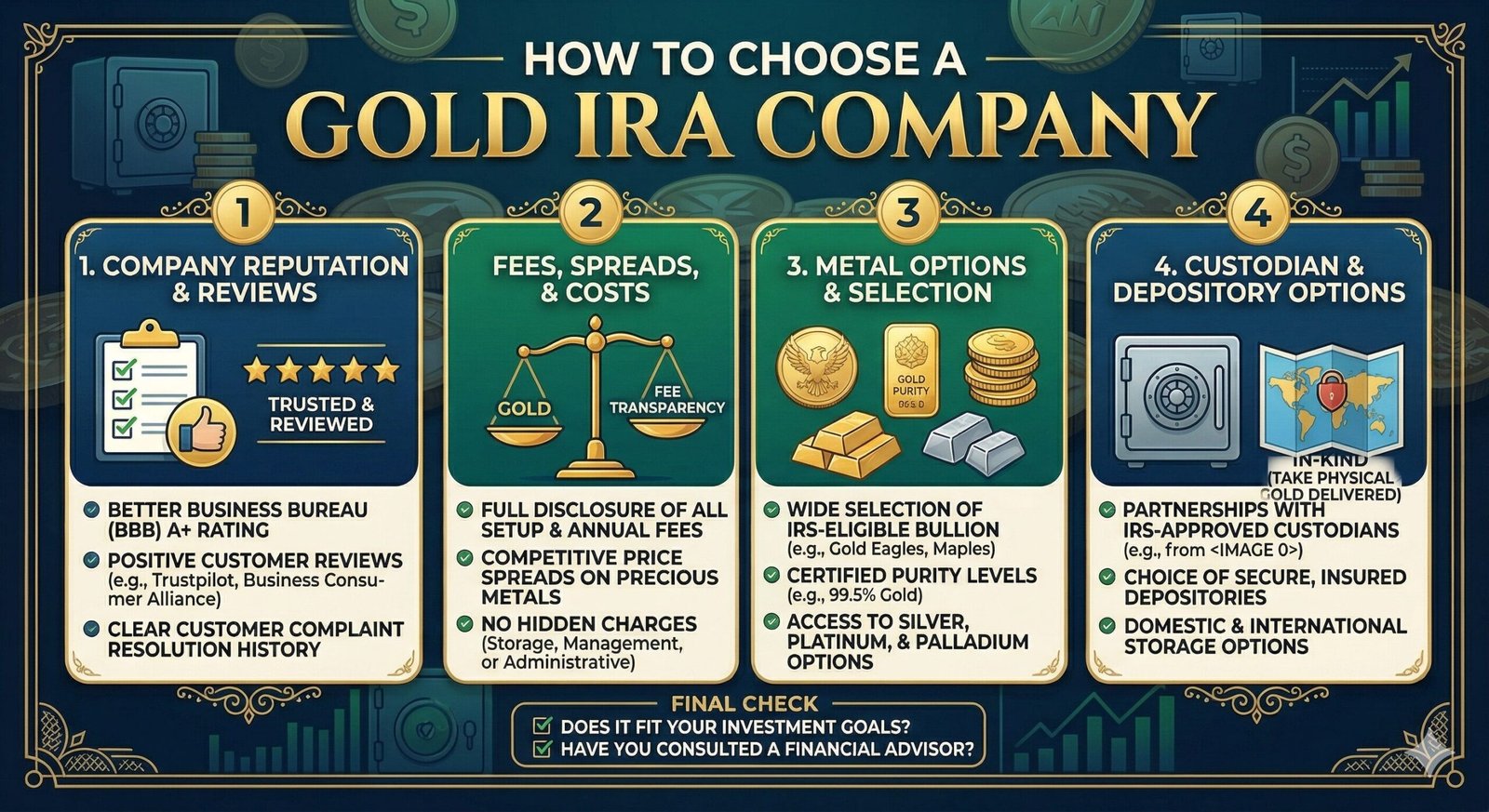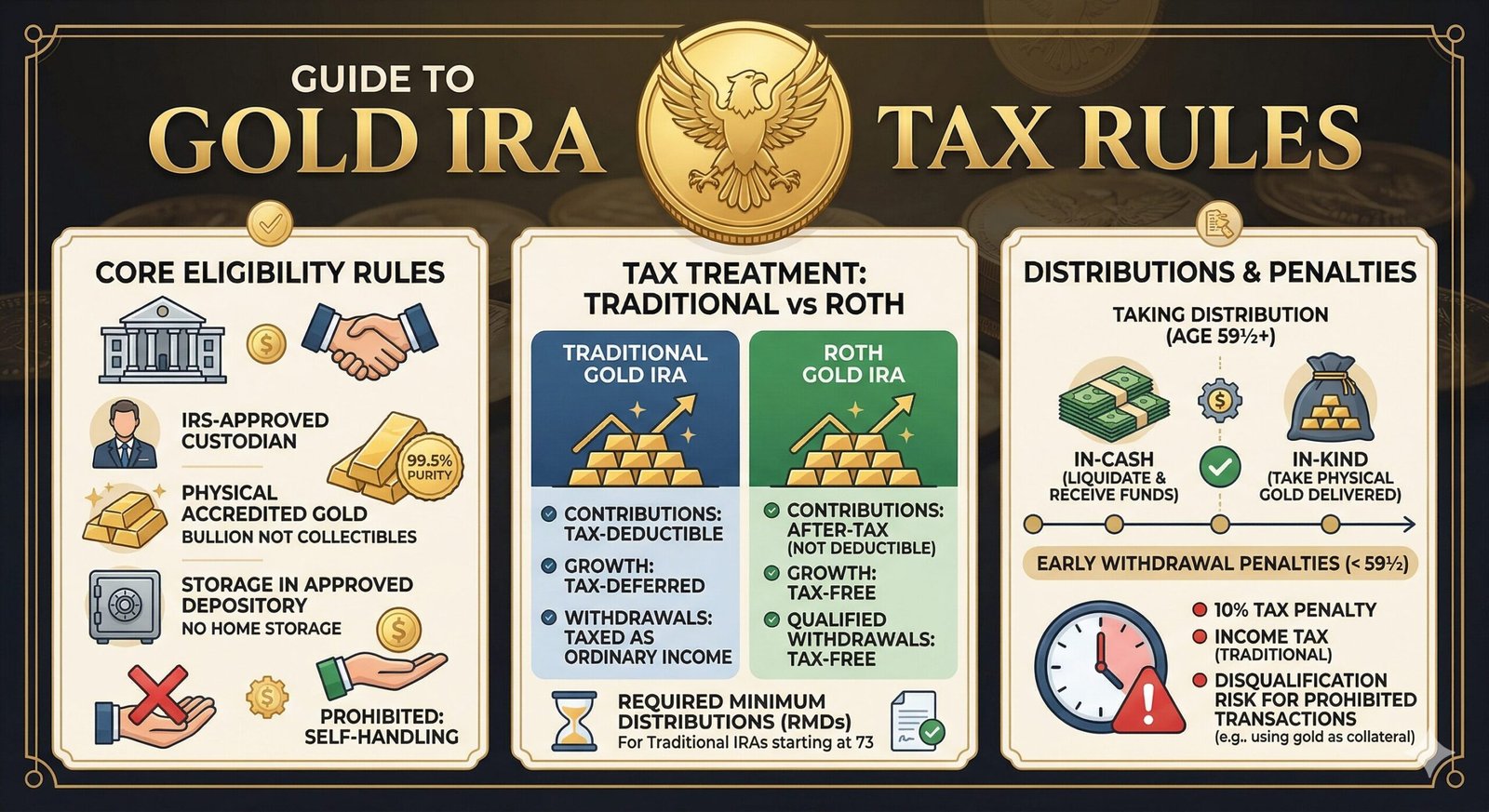

A Gold IRA rollover is a tax-advantaged way to move retirement funds into a self-directed IRA holding physical precious metals. But the IRS has specific rules governing how rollovers must be executed — and breaking them can turn a tax-free transfer into a fully taxable distribution with penalties. Understanding the Gold IRA Rollover Rules is essential for a smooth transition.
This guide covers every rule you need to understand before initiating a Gold IRA rollover. If you want the step-by-step process alongside the rules, see our full 401(k) to Gold IRA rollover guide.
Familiarizing yourself with the Gold IRA Rollover Rules can help ensure that you adhere to IRS guidelines.
Rule 1: The 60-Day Rollover Deadline
If you personally receive retirement funds before depositing them into a new IRA — an “indirect rollover” — you have 60 days from the date of receipt to deposit the full amount into the new account.
Miss the deadline and the IRS treats the entire underfunded amount as a taxable distribution for that calendar year. Under 59½? A 10% early withdrawal penalty applies on top of ordinary income tax.
The IRS can waive the 60-day rule in limited circumstances — documented financial institution error or a serious medical emergency — but waivers require a formal request and are not guaranteed. See the IRS IRA investment FAQ for official guidance.
The simplest solution: Use a direct rollover. Funds transfer between custodians directly; you never receive them; the 60-day rule never applies. Working with an experienced self-directed IRA custodian ensures the transfer is processed correctly as a direct rollover from the outset, removing any risk of an accidental taxable event.
Rule 2: The One-Rollover-Per-Year Limit
You are permitted one indirect IRA-to-IRA rollover per 12-month period, across all your IRAs in aggregate — not per account.
Complete an indirect rollover from IRA A to IRA B in March, and you cannot complete another indirect IRA-to-IRA rollover until the following March — regardless of how many other IRAs you hold.
What this rule does NOT apply to: – Direct trustee-to-trustee transfers (no limit — can be done as many times as you like) – Rollovers from an employer-sponsored plan (401k, 403b, TSP) into an IRA
FINRA’s guidance on self-directed IRAs specifically flags this as a common compliance pitfall for investors managing multiple retirement accounts.
Rule 3: Mandatory 20% Withholding on Employer Plan Distributions
When you request an indirect distribution from a 401(k), 403(b), or other employer-sponsored plan, the employer must withhold 20% for federal income taxes — regardless of your intent to roll the funds over.
On a $100,000 balance: you receive $80,000. To complete a tax-free rollover, you must deposit the full $100,000 into your new Gold IRA within 60 days — which means funding the $20,000 gap yourself.
You’ll recover the withheld $20,000 as a tax refund when you file — but only if you bridged the gap first.Direct rollovers eliminate this entirely. Custodian-to-custodian transfers have no withholding requirement.
Rule 4: You Cannot Roll Over an RMD
Required minimum distributions cannot be rolled over. Starting at age 73, you must take a specific annual minimum withdrawal from your traditional IRA or Gold IRA. That mandatory amount is not eligible for rollover — only amounts above your RMD can be transferred.
Procedure if you’re 73 or older and want to do a rollover: 1. Take your full RMD for the year first 2. Roll over any remaining balance
Attempting to roll over an RMD creates an excess contribution in the receiving IRA, subject to a 6% excise tax for each year it remains. The IRS covers RMD rules in detail at the IRS retirement plans FAQ.
Rule 5: Eligible Account Types
| Account Type | Rollover Eligible? | Notes |
|---|---|---|
| Traditional 401(k) | Yes | Must have left employer, or plan allows in-service |
| Roth 401(k) | Yes | Must roll into a Roth Gold IRA |
| Traditional IRA | Yes | Direct transfer preferred |
| Roth IRA | Yes | Must roll into a Roth Gold IRA |
| 403(b) | Yes | Same rules as 401(k) |
| 457(b) | Yes | Government and qualifying non-profit plans |
| TSP | Yes | Federal employees |
| SIMPLE IRA | Yes* | Must be open at least 2 years |
| SEP IRA | Yes | Straightforward transfer |
| Active employer 401(k) | Usually No | Check plan documents for in-service rollover rules |
Rule 6: IRS-Approved Metals Only
Not all gold qualifies for IRA holding. The IRS specifies minimum purity thresholds for each metal:
| Metal | Minimum Purity |
|---|---|
| Gold | 99.5% (0.9950 fineness) |
| Silver | 99.9% (0.9990 fineness) |
| Platinum | 99.95% (0.9995 fineness) |
| Palladium | 99.95% (0.9995 fineness) |
Approved gold coins include the American Gold Eagle (IRS exception at 91.67% purity), American Gold Buffalo, Canadian Gold Maple Leaf, and Austrian Philharmonic. For a complete breakdown, see our IRA-eligible gold coins guide.
Collectible coins, South African Krugerrands (generally), and gold below the purity threshold are prohibited. Holding prohibited assets creates a disqualified transaction with severe tax consequences.
Rule 7: No Home Storage
All metals held in a Gold IRA must be stored at an IRS-approved depository. Storing metals at home, in a personal safe, or in a bank safe deposit box is not permitted.
Some companies market “home storage Gold IRAs” — typically involving an LLC structure. The IRS has not formally sanctioned this approach, and the Tax Court has ruled against it in documented cases. Taking personal possession of IRA metals is treated as a full distribution.
For more on protecting yourself from bad actors in the Gold IRA space, see our Gold IRA scams guide.
Penalty Summary
| Violation | Consequence |
|---|---|
| Missing the 60-day rollover window | Full amount taxed as income; 10% penalty if under 59½ |
| Second indirect IRA rollover within 12 months | Distribution treated as fully taxable |
| Rolling over an RMD | 6% excise tax on excess contribution per year |
| Home storage of IRA metals | Treated as full distribution; taxes + penalties apply |
| Holding ineligible metals | Prohibited transaction; potential full IRA disqualification |
Compliance Checklist
Before initiating any Gold IRA rollover, confirm:
- Account type is eligible for rollover
- Using direct (trustee-to-trustee) transfer
- If 73 or older: annual RMD has been taken first
- New custodian is IRS-approved
- Selected metals meet IRS purity requirements
- Metals will be stored at an IRS-approved depository
- No indirect IRA-to-IRA rollover completed in the past 12 months
Frequently Asked Questions
No. The one-per-year rule applies only to indirect rollovers. Direct trustee-to-trustee transfers are unlimited.
Yes — the 60-day clock starts when you receive the funds, not when you deposit them in a bank. Deposit the full amount (including any withheld taxes) into a qualified IRA within 60 days.
Yes. Partial rollovers are fully permitted. No requirement to transfer the entire balance.
No IRS cap on rollover amounts. This differs from annual contribution limits — rollovers bypass the $7,000/$8,000 annual IRA contribution ceiling.
Ready to Choose a Provider?
Understanding the rules is step one. Choosing the right Gold IRA company is step two — the provider you work with determines the quality of the entire rollover experience.
Compare the Best Gold IRA Companies for 2026 →
Informational purposes only. Not tax or financial advice. IRS rules are subject to change — verify current rules at IRS.gov or consult a qualified tax professional before initiating any rollover.
Related guides
- Gold IRA Consumer Affairs Reviews: What to Look For
- Gold IRA Trustpilot Reviews: What Real Customers Say
- Gold IRA BBB Complaints: What Consumer Reports Reveal
- Is a Gold IRA Worth the Fees? A Cost-Benefit Analysis
- Are Gold IRA Fees Too High? Breaking Down the Real Costs
- Gold IRA Mistakes to Avoid: 10 Common Errors Investors Make