Gold Price Prediction 2028: Long-Term Outlook
Searching for a reliable gold price prediction for 2028 is understandable. Gold has commanded human attention for thousands of years, and today it remains one of the most closely watched commodities in the global financial system. For retirement investors in particular, understanding what drives gold’s long-term price behavior — and what the analytical community is watching — can be genuinely useful context.
That said, this article won’t tell you where the gold price is going. No one can. What it will do is walk you through the factors that professional analysts examine when forming long-term outlooks, explain what a 2028 time horizon actually means for retirement planning purposes, and help you think clearly about the role gold and gold-backed retirement accounts might play in your overall financial picture.
Before diving in, one principle is worth stating plainly: past performance is not a guarantee of future results. This is not a legal formality — it is a genuine statement of how commodity markets work. Any source that tells you with certainty what gold will be worth in 2028 is telling you more than anyone actually knows.
What “Gold Price Prediction 2028” Actually Means
When analysts publish long-range gold price forecasts, they are not issuing predictions in the way a weather forecast works. They are modeling outcomes based on a set of assumptions — about interest rates, currency movements, geopolitical conditions, mining supply, central bank behavior, and investor sentiment. Change any one of those inputs materially, and the output changes with it.
A 2028 time horizon is particularly interesting because it sits far enough ahead that near-term volatility becomes less meaningful, but close enough that some structural trends — central bank gold accumulation, monetary policy cycles, and global reserve currency dynamics — are at least partially visible from where we stand today.
For retirement investors aged 45 to 70, 2028 also carries personal significance. It may represent a point close to or during retirement, meaning investment decisions made today could affect withdrawals or asset allocation at that time. That context matters when evaluating any long-term gold outlook.
Key Factors Analysts Monitor When Forecasting Gold Prices
Interest Rates and Real Yields
One of the most consistent relationships in gold market analysis is the connection between real interest rates — that is, nominal rates adjusted for inflation — and gold prices. When real yields are low or negative, the opportunity cost of holding gold (which pays no interest or dividends) falls. When real yields rise, that dynamic shifts.
As of the mid-2020s, central banks in the United States and globally have been navigating a complex interest rate environment. Where rates sit by 2028 will depend on inflation trajectories, employment conditions, and policy decisions that haven’t yet been made. Analysts watching these dynamics pay close attention to Federal Reserve statements, bond market signals, and inflation data as inputs to their gold price models.
U.S. Dollar Strength
Gold is priced globally in U.S. dollars, which means the relative strength or weakness of the dollar influences gold’s price in meaningful ways. A weaker dollar generally makes gold less expensive for buyers holding other currencies, which can support demand. A stronger dollar tends to work in the opposite direction.
Factors affecting the dollar’s trajectory toward 2028 include U.S. fiscal deficits, trade policy, and the broader global debate about reserve currency diversification. Several large economies have been expanding bilateral trade agreements that bypass the dollar, a structural trend some analysts view as potentially significant over a multi-year horizon.
Central Bank Demand
Central banks around the world — particularly in emerging markets — have been net buyers of gold for a number of years. According to the World Gold Council, central bank demand has been a meaningful component of overall gold consumption in recent reporting periods. Countries including China, India, Poland, and Turkey have publicly increased their gold reserve holdings.
This demand dynamic is structurally different from retail or investment demand. Central banks typically buy with long-term reserve management objectives rather than short-term price expectations, which means their purchasing behavior tends to be relatively consistent. How central bank demand evolves between now and 2028 is a major variable in long-range price modeling.
Mining Supply Constraints
Gold is a finite resource, and new mine discoveries have become less frequent and less productive over time — a phenomenon sometimes called “peak gold.” The lead time between discovery and production can be a decade or more, and capital investment in new mining projects follows commodity price cycles with significant lag.
Analysts tracking supply-side factors examine exploration budgets, reserve grade quality, production costs in major mining regions, and regulatory environments. Supply constraints don’t move prices overnight, but they can be meaningful contributors to price behavior over a 2028 time frame.
Geopolitical and Macroeconomic Uncertainty
Gold has historically attracted investor interest during periods of elevated uncertainty — though it’s worth being clear that this is an observation about the past, not a prediction about the future. What analysts watch for on a multi-year horizon includes trade tensions, regional conflicts, political transitions in major economies, and systemic financial stress.
By 2028, the global geopolitical map may look meaningfully different from today’s. The composition of major international alliances, trade relationships, and reserve currency arrangements are all in a period of structural transition that makes forecasting particularly complex.
What Analyst Forecasts Typically Look Like — and Their Limitations
Long-range gold price forecasts from professional analysts tend to cluster in wide ranges rather than specific numbers. You will find projections based on bull, base, and bear case scenarios, each with different assumptions about inflation, interest rates, and demand conditions.
It’s worth reading those forecasts critically. Ask what assumptions underpin each scenario. Ask what the analyst’s track record looks like over prior multi-year forecasting periods. And ask whether the forecast carries any material conflicts of interest — a point FINRA’s guidance on self-directed IRAs and investment products emphasizes in the context of evaluating financial information more broadly.
The SEC’s investor resources offer a useful baseline for thinking about how commodity price forecasts should be evaluated: with appropriate skepticism, an awareness of the assumptions involved, and an understanding that forecasting accuracy declines meaningfully as the time horizon extends.
Gold in a Retirement Context: What Matters More Than a Price Target
For most retirement investors, the specific gold price in 2028 is less important than understanding how a gold-based investment vehicle works and whether it suits their situation. One increasingly common option is the Gold IRA — a self-directed individual retirement account that holds physical gold rather than paper assets.
If you’re new to this structure, our Gold IRA guide provides a solid foundation, and Gold IRAs Explained in Detail covers the mechanics thoroughly. For those considering moving existing retirement funds, our 401(k) to Gold IRA rollover guide walks through the process step by step.
Understanding the Structural Rules
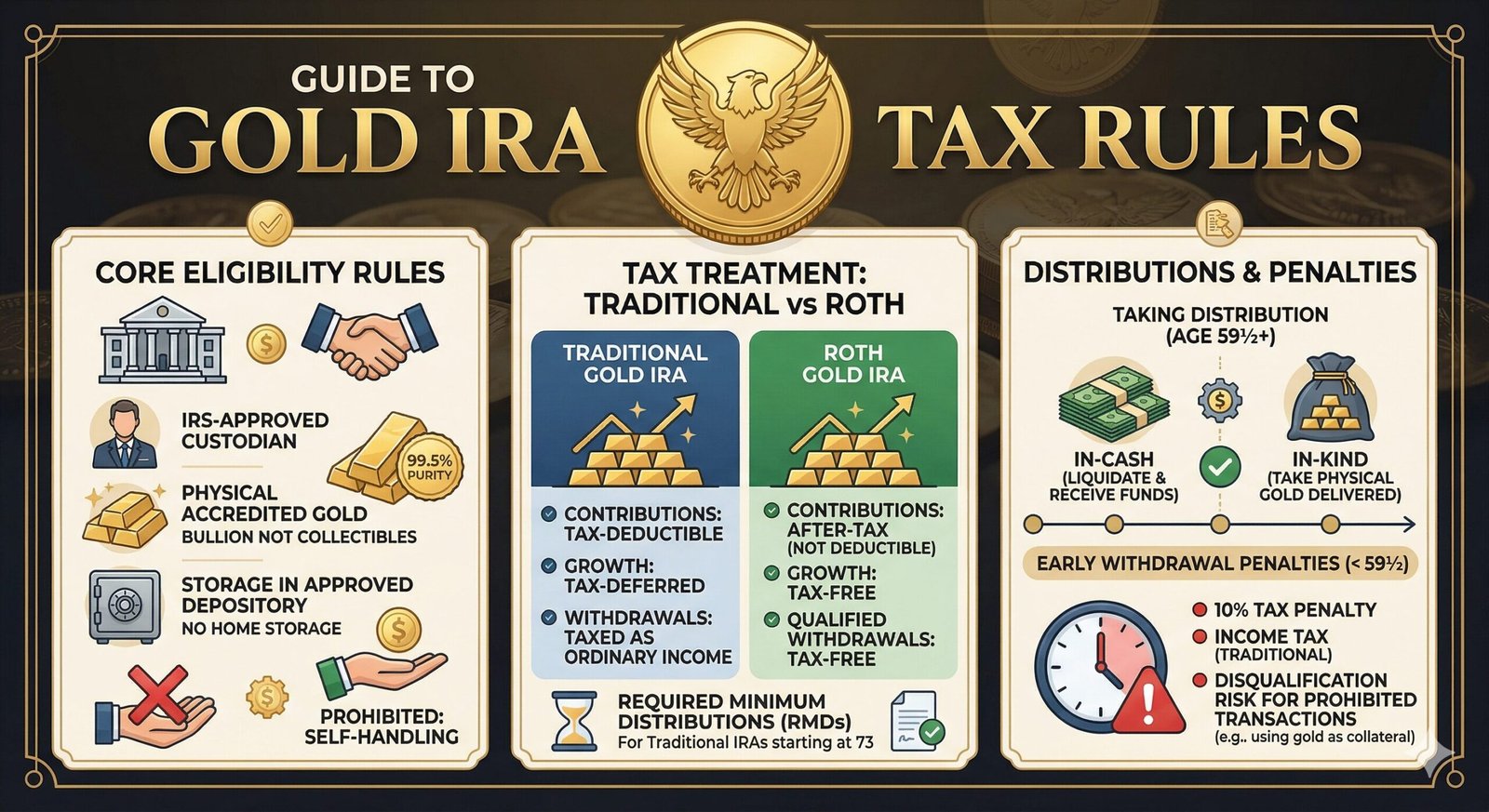
The IRS sets specific rules governing what types of gold can be held in an IRA, how custodians must be structured, and how distributions work. According to IRS Publication 590-A, self-directed IRAs holding physical precious metals must use an approved custodian and an IRS-sanctioned depository — the metals cannot be stored personally by the account holder.
Gold held in an IRA must also meet minimum purity standards. American Gold Eagles, Canadian Maple Leafs, and certain other coins qualify, while collectibles and many foreign coins do not. A full breakdown of IRA-eligible gold coins is available on this site.
Understanding Gold IRA rollover rules matters if you are transferring assets from an existing retirement account. The IRS imposes strict timelines on indirect rollovers — generally 60 days — and violations can result in the distribution being treated as taxable income. The IRS IRA investment FAQ provides authoritative detail on these requirements.
A Comparison of Key Gold IRA Timeline Considerations
For a detailed breakdown of what you can expect to pay, our Gold IRA fees guide covers setup costs, annual custodian fees, and storage charges in plain terms.
Due Diligence Matters More Than Any Price Forecast
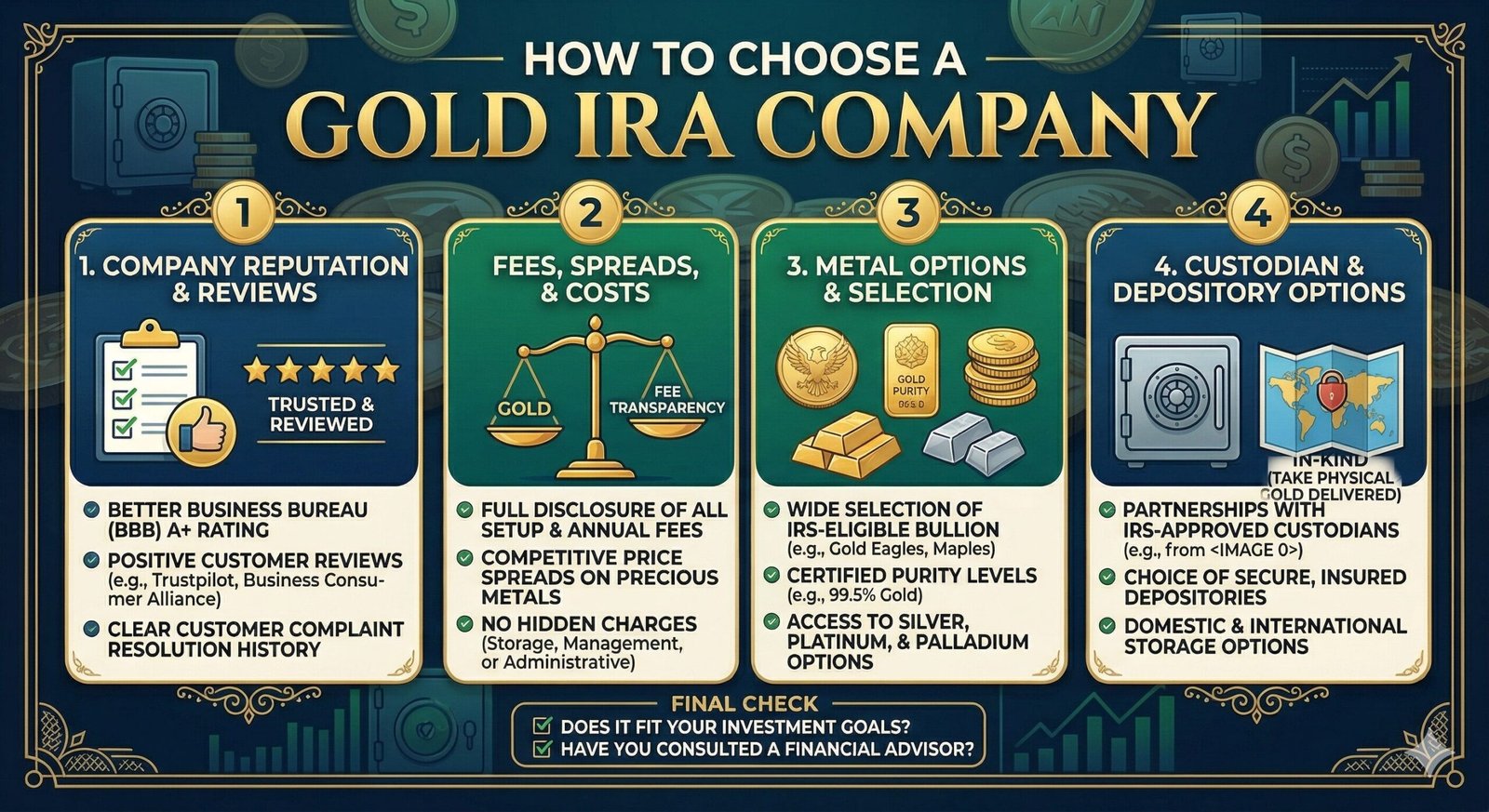
If you are considering a Gold IRA in anticipation of a 2028 retirement timeline, the quality of your research into providers matters far more than any price target. Our Gold IRA scams guide outlines the warning signs to watch for, including high-pressure sales tactics, inflated coin premiums, and custodians without verifiable credentials.
You can verify a company’s complaint history through bbb.org and check the backgrounds of any associated financial professionals through FINRA BrokerCheck. These steps take relatively little time and can prevent significant financial harm.
If you are weighing up your options and want to understand how a Gold IRA compares structurally to conventional alternatives, our Gold IRA vs Traditional IRA and Gold IRA vs 401(k) articles offer a factual, side-by-side look at the key differences — without any attempt to steer you toward a particular outcome.
For a broader look at whether the structure is appropriate for your situation, our article on is a Gold IRA a good idea works through the honest considerations without oversimplifying.
Frequently Asked Questions
Will gold be worth more in 2028 than it is today?
No one can answer this with certainty. Gold prices are influenced by a wide range of economic, political, and market variables that cannot be reliably predicted over a multi-year horizon. Analysts may offer modeled scenarios, but these carry significant uncertainty. Past performance is not a guarantee of future results.
What do most analysts base long-range gold forecasts on?
Analysts typically model gold prices using assumptions about real interest rates, U.S. dollar strength, central bank buying activity, mining supply trends, and macroeconomic conditions. Different assumptions produce very different price projections, which is why forecast ranges tend to be wide.
Is a 2028 outlook relevant to my retirement planning?
It can be useful context, but your financial decisions should be based on your personal situation, goals, and risk tolerance — not on any commodity price forecast. Speak with a qualified financial advisor about what role, if any, physical gold or a Gold IRA might play in your retirement plan.
What is the minimum investment typically required to open a Gold IRA?
Minimums vary by provider, and our Gold IRA minimum investment guide covers what you can expect across the major custodians. Some providers set minimums as low as $5,000, while others require $25,000 or more to open an account.
Where can I find reliable information about Gold IRA providers?
Start with independent sources — look at complaint records through the Better Business Bureau, verify credentials through FINRA BrokerCheck, and review our independently researched Best Gold IRA Companies of 2026 list for a structured comparison of leading providers.
If you’re researching your options and want a clear, unbiased starting point, our Best Gold IRA Companies of 2026 guide compares the leading providers across fees, minimums, customer service ratings, and storage options — giving you the information you need to make a considered decision.
This article is for informational purposes only and does not constitute financial or tax advice. Investing in precious metals involves risk including possible loss of principal.
Related guides
- Gold Price in 2023: Year in Review
- Gold Price in 2022: How War and Inflation Moved Markets
- Gold Price in 2021: Year in Review and Key Drivers
- Gold Price in 2020: How COVID Drove Gold to Record Highs
- Gold Price Prediction 2026: What Analysts Are Forecasting
- Gold Price Today: Live Spot Price and Market Context