
Best Gold IRA Custodian of 2026: Top IRS-Approved Options
If you’re exploring a Gold IRA as part of your retirement planning, one decision will shape nearly every aspect of your experience: choosing your custodian. The custodian is the IRS-approved institution responsible for holding your account, managing your paperwork, and ensuring your precious metals are stored in compliance with federal regulations. Get this choice right, and the administrative side of your Gold IRA runs smoothly. Get it wrong, and you may face avoidable fees, compliance headaches, or worse.
This guide walks you through exactly what a Gold IRA custodian does, what separates a strong custodian from a weak one, and the key criteria you should apply when evaluating your options.
What Is a Gold IRA Custodian and Why Does It Matter?
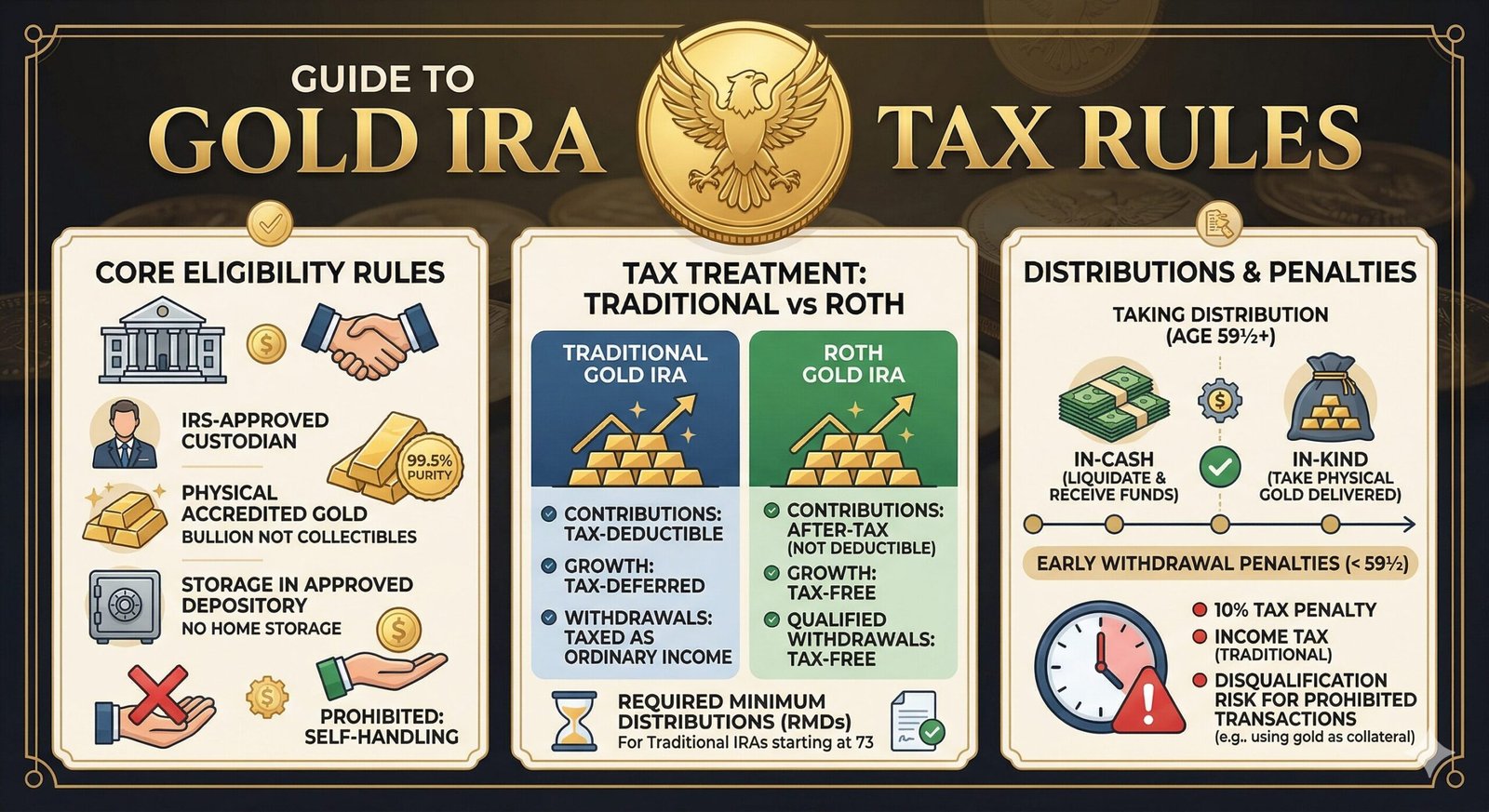
Before comparing custodians, it helps to understand their legal role. Under IRS rules, all Individual Retirement Accounts — including self-directed IRAs that hold physical gold — must be administered by an approved trustee or custodian. You cannot simply buy gold coins, store them in a home safe, and call it an IRA. The IRS requires that a qualified financial institution hold the assets on your behalf.
For a conventional IRA, a custodian might be a bank or brokerage. For a Gold IRA, you need a self-directed IRA (SDIRA) custodian — an institution specifically authorized to hold alternative assets such as physical precious metals. You can review the IRS framework for this in IRS Publication 590-A, which outlines the trustee and custodian requirements for IRAs.
This makes the custodian the cornerstone of your Gold IRA. They handle account opening, annual reporting to the IRS, required minimum distributions (RMDs), and the coordination of metal purchases and storage. For a deeper grounding in how this structure works, our Gold IRAs Explained in Detail resource covers the full picture.
The Three-Party Structure of a Gold IRA
One source of confusion for many investors is that a Gold IRA typically involves three separate companies, not one. Understanding this structure is essential before you start comparing custodians.
The Custodian holds and administers your account. They are the IRS-approved entity responsible for compliance and reporting. They do not sell you gold.
The Precious Metals Dealer is the company from which you purchase your gold or silver. This is often the Gold IRA company you initially contact — they typically facilitate introductions to an approved custodian and depository.
The Depository is the IRS-approved storage facility where your physical metals are held. Your metals cannot be stored at home or in a personal safe deposit box once they are inside an IRA. FINRA’s guidance on self-directed IRAs at FINRA’s guidance on self-directed IRAs is worth reading on this point — it lays out the compliance obligations clearly.
Some Gold IRA companies market themselves as offering all three services under one umbrella, but legally these functions remain separate. Knowing who is responsible for what helps you ask better questions when you’re evaluating providers.
What Makes a Strong Gold IRA Custodian?
Not all custodians are equal. The following criteria give you a practical framework for comparison.
IRS Approval and Regulatory Standing
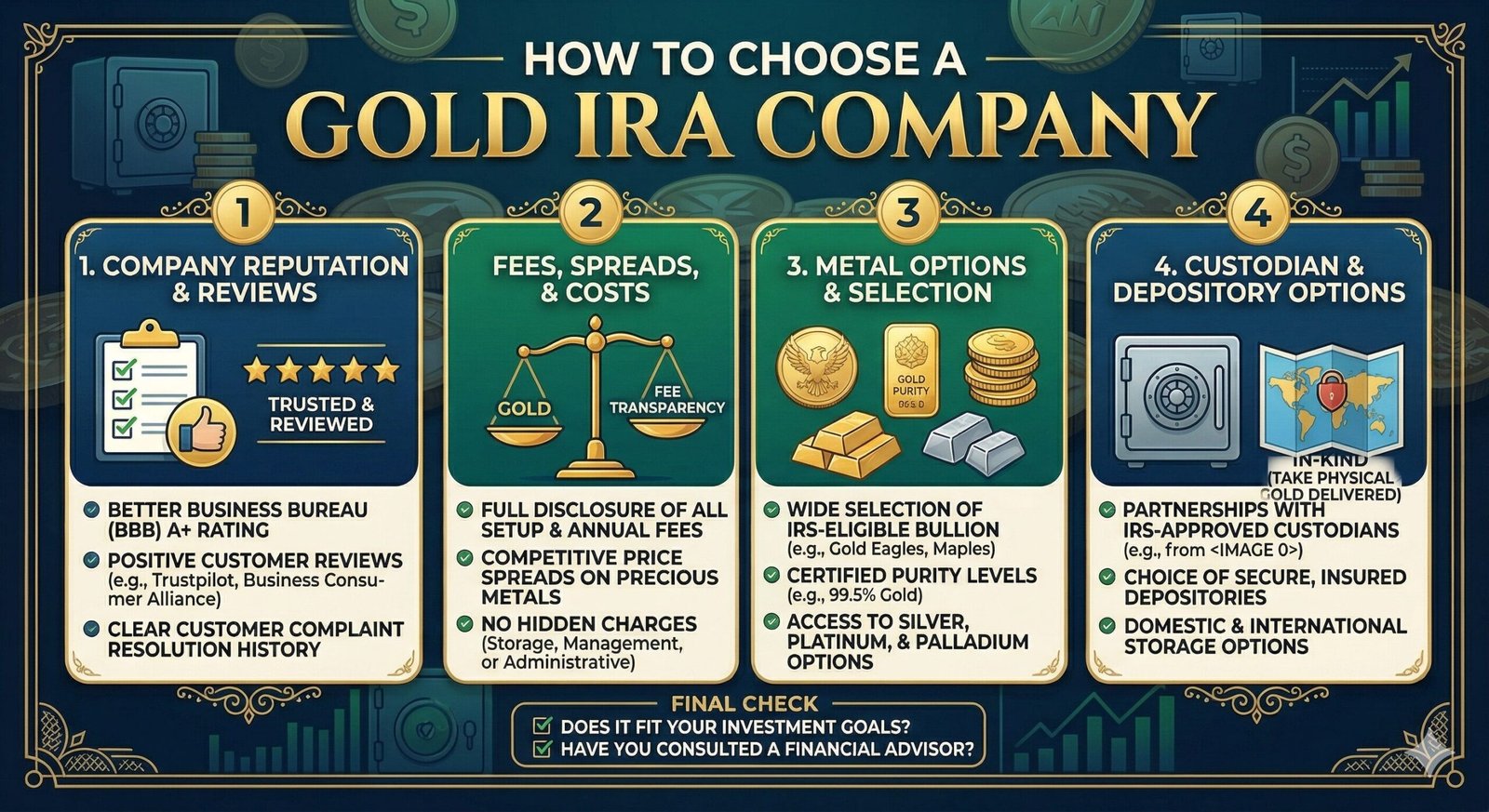
This is non-negotiable. Your custodian must be an IRS-approved trustee under IRC Section 408. Beyond that, look for custodians who are also regulated by state banking authorities or operate under a national charter. You can cross-reference any custodian through FINRA BrokerCheck and check their complaint history at bbb.org.
Fee Transparency
Gold IRA custodians charge a range of fees — account setup, annual maintenance, storage coordination, and sometimes transaction fees when you buy or sell metals. The fees vary considerably between providers and can add up meaningfully over a 10–20 year retirement horizon. Our dedicated Gold IRA fees guide breaks down what these charges typically look like and what questions to ask before you sign anything.
Look for custodians who publish their fee schedules clearly on their websites. Any reluctance to discuss fees upfront is a yellow flag.
Experience with Precious Metals IRAs
Not every SDIRA custodian handles precious metals fluently. Some custodians administer a wide range of alternative assets — real estate, private equity, tax liens — and treat precious metals as just another asset class. Others specialize specifically in metals. A specialist custodian is more likely to have streamlined processes, knowledgeable staff, and established relationships with approved depositories.
Depository Relationships
Your custodian will coordinate storage through an IRS-approved depository. The quality and location of the depository matters — particularly whether they offer segregated storage (your metals stored separately from other clients’ holdings) versus commingled storage. Segregated storage typically costs more but gives you clear title to specific coins or bars.
Customer Service and Responsiveness
Because a Gold IRA involves ongoing administration — annual statements, RMD calculations, potential rollovers — your relationship with your custodian is a long-term one. Responsive, knowledgeable customer service is not a luxury; it’s a practical necessity. Test this before you commit by calling or emailing with questions and observing how quickly and clearly they respond.
Key Custodian Fees: A Comparison Framework
The table below outlines the fee categories you should expect to encounter. Actual amounts vary by custodian, so use this as a checklist when requesting fee schedules.
Custodians vs. Gold IRA Companies: Understanding the Distinction
A point of genuine confusion in this space: when you see companies advertising as “Gold IRA providers,” they are often precious metals dealers who have built a turnkey process around an existing custodian relationship. The dealer markets to you, sells you metals, and coordinates with a custodian on your behalf — but the custodian holds your account.
This means the company whose advertising you respond to and the institution legally holding your IRA may be two different entities. Before you proceed with any Gold IRA company, ask them directly: “Which custodian will hold my account, and can I work with a different one if I choose?” Reputable companies will answer this question without hesitation. For our vetted list of companies that operate transparently in this space, see our guide to the Best Gold IRA Companies of 2026.
Rollovers, Transfers, and What Your Custodian Handles
If you’re funding a Gold IRA through a rollover from an existing 401(k) or traditional IRA, your custodian plays a central role in the process. Rollovers must be handled correctly to avoid triggering taxes or early withdrawal penalties. The IRS mandates that a 60-day indirect rollover be completed within strict timeframes, while a direct trustee-to-trustee transfer avoids that clock entirely.
Our 401(k) to Gold IRA rollover guide explains how the mechanics work in practice, and our Gold IRA rollover rules page covers the IRS requirements in detail. A qualified custodian should be able to walk you through both options and identify which approach makes sense for your situation — though as always, consult a qualified financial or tax professional before making any decisions.
The IRS’s own IRS IRA investment FAQ is also worth reviewing for authoritative information on what your IRA can and cannot hold.
Red Flags to Watch For
Understanding what a strong custodian looks like is only half the picture. You should also know how to spot problematic arrangements. Our Gold IRA scams guide covers this topic in depth, but a few custodian-specific warning signs are worth noting here.
Be cautious of any custodian who encourages home storage of IRA-held metals. Despite what some marketers suggest, storing IRA gold at home is not IRS-compliant under most structures and can result in the IRA being treated as a distribution — triggering taxes and penalties. This has been a recurring issue in IRS enforcement actions.
Also be wary of custodians who are reluctant to provide written fee schedules, cannot clearly explain their relationship with their storage partner, or pressure you to make decisions quickly. These are not the behaviors of a professionally run institution.
Contribution Limits and RMDs: Your Custodian’s Ongoing Role
Once your Gold IRA is established, your custodian handles the annual administration that keeps you compliant. This includes tracking your contributions against IRS limits — for 2025, those are $7,000 per year ($8,000 if you are 50 or older), as published on the IRS contribution limits page. Your custodian will also calculate and process required minimum distributions once you reach the applicable age. The IRS’s IRS RMD FAQ provides useful background on how RMDs work for IRA holders.
For a Gold IRA, RMDs introduce a practical consideration: if your IRA holds physical metal rather than cash, you may need to liquidate a portion of your holdings to satisfy the RMD, or take the distribution in-kind. A competent custodian will explain both options and help you plan accordingly.
Making Your Decision
Choosing the best Gold IRA custodian for your situation comes down to a combination of regulatory compliance, fee transparency, precious metals expertise, and the quality of their customer service and depository relationships. None of these factors can be evaluated from a single website visit — plan to have direct conversations, request written fee schedules, and ask specific questions about how they handle rollovers, RMDs, and storage coordination.
If you’re still building your understanding of the broader framework, our Gold IRA vs Traditional IRA comparison and our Gold IRA hub are good starting points. When you’re ready to evaluate specific companies alongside their custodian arrangements, the Best Gold IRA Companies of 2026 is where we recommend starting your research.
Frequently Asked Questions
Q: Can I choose my own Gold IRA custodian, or does the Gold IRA company assign one?
A: You have the right to choose your own IRS-approved custodian. Many Gold IRA companies have preferred custodian relationships and will suggest a specific provider, but you are not obligated to use their recommendation. Shopping for your custodian independently is entirely permitted and often worthwhile.
Q: What happens to my Gold IRA if my custodian goes out of business?
A: Your assets are held in your name at an IRS-approved depository — they are not assets of the custodian. If a custodian closes, your metals remain yours and you would transfer account administration to a new custodian. This is one reason to favor custodians with strong regulatory standing and a long operating history.
Q: Is there a minimum investment required to open a Gold IRA with a custodian?
A: Custodians themselves often have no set minimum, but the Gold IRA company or dealer you work with typically does. These minimums vary widely. Our Gold IRA minimum investment page covers what to expect across different providers.
Q: Does my custodian provide investment advice about which gold to buy?
A: No. Custodians are administrators, not advisors. Their role is to hold and report on your account — not to recommend specific metals or strategies. Investment decisions are your responsibility, ideally made in consultation with a qualified financial advisor.
Q: What types of gold are eligible to be held in an IRA?
A: The IRS sets purity standards — gold must generally meet a .995 fineness minimum to qualify. Eligible products include certain bullion coins and bars from approved mints. Our page on IRA-eligible gold coins outlines the specific products that meet IRS requirements.
Ready to take the next step? Review our independently researched shortlist of vetted providers at Best Gold IRA Companies of 2026 and compare custodian arrangements, fee structures, and service quality side by side.
This article is for informational purposes only and does not constitute financial or tax advice. Investing in precious metals involves risk including possible loss of principal.