
A Gold IRA and a 401(k) are both tax-advantaged retirement savings accounts, but they differ in structure, investment options, administration, and who controls them. For investors considering a rollover — or simply trying to understand both account types — here is a clear comparison of gold ira vs 401(k).
For a detailed look at how Gold IRAs compare to conventional IRAs specifically, see our Gold IRA vs Traditional IRA breakdown.
What Each Account Is
401(k)
A 401(k) is an employer-sponsored retirement savings plan governed by Section 401(k) of the Internal Revenue Code. It’s offered through your workplace. You contribute a portion of your salary — often with employer matching — and the funds are invested in options selected by your plan administrator: typically a menu of mutual funds, target-date funds, and sometimes company stock.
You choose from the plan’s available options. You do not control the menu.
FINRA’s retirement account resources provide an independent overview of how employer-sponsored plans operate.
Key characteristics: – Employer-sponsored – Higher contribution limits ($23,500 in 2026; $31,000 if 50+) – Often includes employer matching contributions – Investment options set by plan administrator – Portable: can be rolled over when you leave the employer
Gold IRA (Self-Directed IRA)
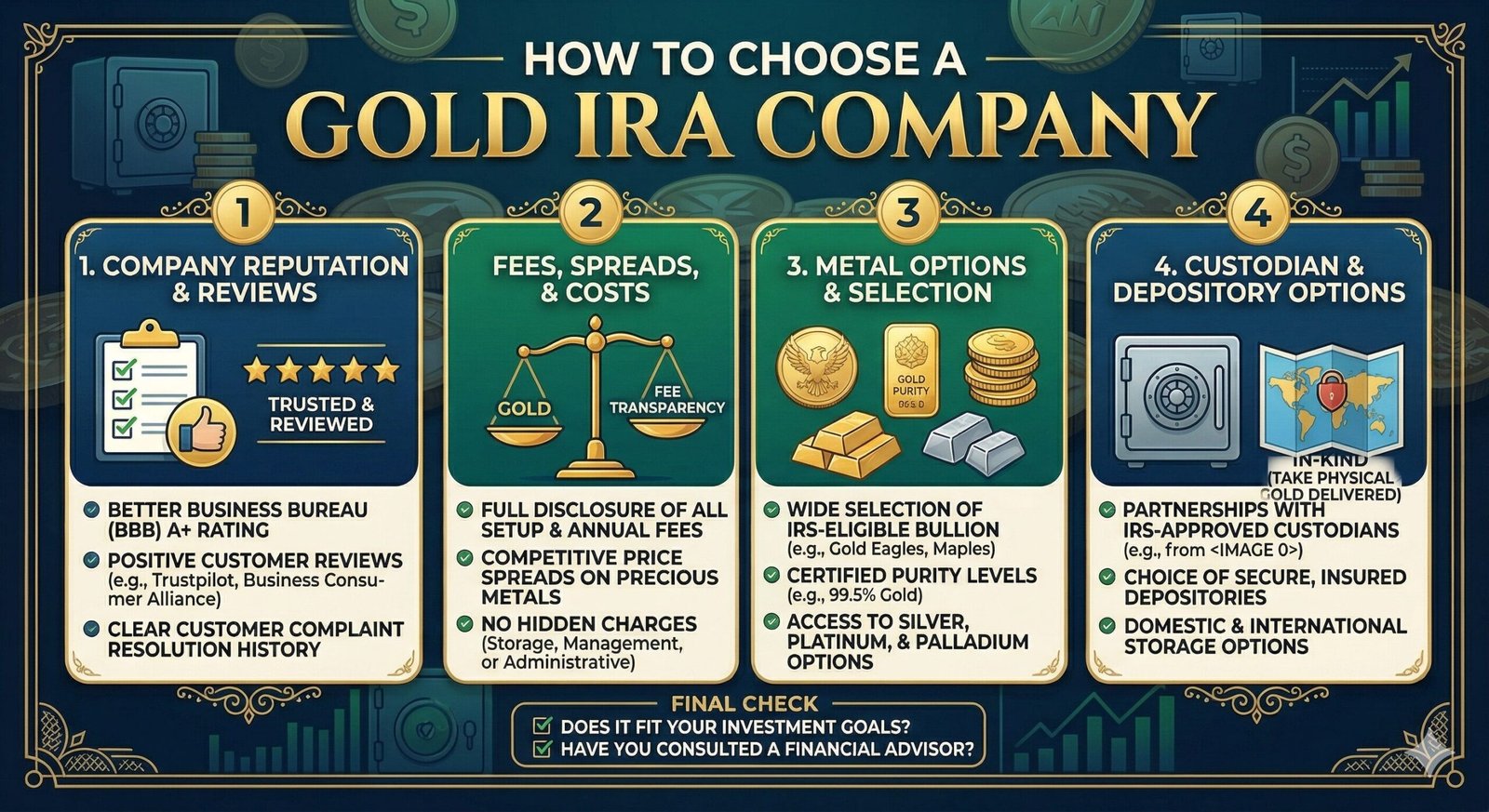
A Gold IRA is a self-directed individual retirement account holding physical precious metals. It is not employer-sponsored — you open it independently through a Gold IRA company, which connects you with an IRS-approved custodian and depository.
You select which IRS-approved metals to hold. The metals are stored in your name at an approved depository. See our Gold IRA overview for the full structural explanation.
Key characteristics: – Individually owned, not employer-sponsored – Lower contribution limits ($7,000 in 2026; $8,000 if 50+) – No employer matching – Physical precious metals as the asset class – Typically funded via rollover from an existing retirement account
Side-by-Side Comparison
| Feature | 401(k) | Gold IRA |
|---|---|---|
| Sponsorship | Employer | Individual |
| Asset types | Mutual funds, ETFs, stocks, bonds | Physical gold, silver, platinum, palladium |
| 2026 contribution limit | $23,500 ($31,000 if 50+) | $7,000 ($8,000 if 50+) |
| Employer matching | Often available | Not available |
| Investment control | Limited to plan menu | You select specific metals |
| Annual fees | Low (embedded in plan) | Higher (custodian + storage) |
| Physical asset ownership | No | Yes |
| IRS-approved custodian required | Yes (plan trustee) | Yes (self-directed IRA custodian) |
| RMD age | 73 | 73 |
| Early withdrawal penalty | 10% before 59½ | 10% before 59½ |
| Portability | Rollover when leaving employer | Fully portable |
Tax Treatment
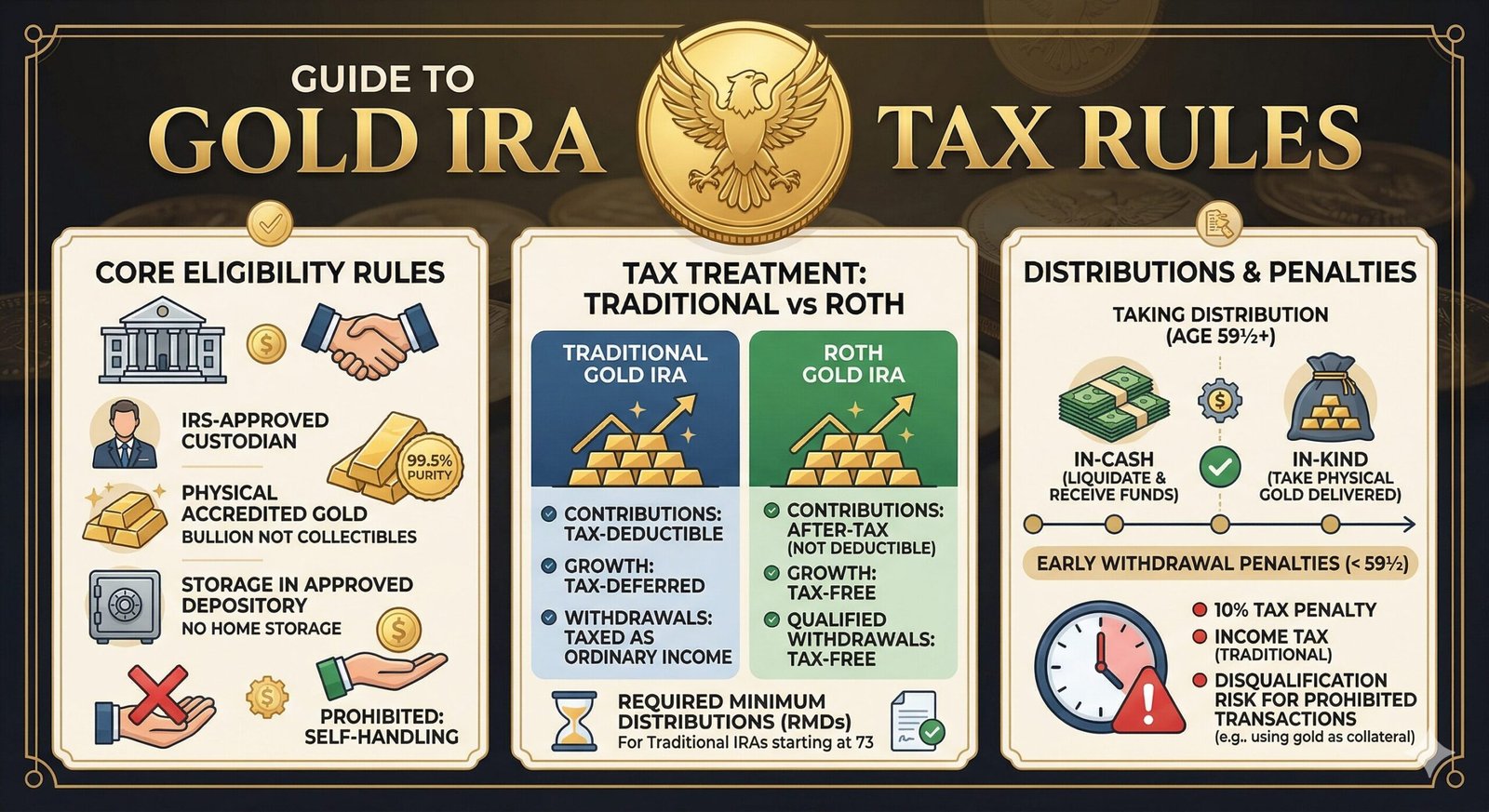
Both traditional 401(k)s and traditional Gold IRAs operate on the same tax basis:
- Pre-tax contributions
- Tax-deferred growth
- Ordinary income tax on distributions
- Required minimum distributions begin at age 73
A Roth 401(k) and Roth Gold IRA both follow the inverse: after-tax contributions, tax-free qualified withdrawals.
Tax treatment is not a distinguishing factor between the two. Both use the same IRS framework — the difference is the asset held inside. See IRS Publication 590-A for the full IRA rules.
Fees: A Meaningful Difference
A 401(k) typically has low visible costs from the participant’s perspective. Most expenses are embedded in the plan’s fund expense ratios or paid by the employer. Many participants pay very little in explicit charges.
A Gold IRA has higher explicit ongoing costs — custodian fees and storage fees — typically $175–$400 per year in total. This is the inherent cost of holding a physical asset in a custodial structure. Full breakdown: Gold IRA Fees Guide.
Investment Control
In a 401(k), your investment options are determined by your employer’s plan administrator. If the plan offers 12 funds, you choose among those 12.
In a Gold IRA, you select which specific IRS-approved metals to hold, within IRS eligibility constraints. You are not confined to a menu created by an employer. For the range of eligible metals, see our IRA-eligible gold coins guide.
Can You Have Both?
Yes. A Gold IRA and a 401(k) have separate contribution limits. Contributing to one does not affect the other. Many investors maintain an active employer 401(k) while also holding a Gold IRA funded via rollover from a prior 401(k).
The rollover does not count as a new annual contribution — it is a transfer of existing retirement savings, not subject to the annual IRA contribution cap.
Rolling a 401(k) Into a Gold IRA
The most common reason investors compare these accounts is because they are considering moving funds from a former employer’s 401(k) into a Gold IRA. This is a direct rollover — a tax-free transfer between retirement accounts.
Full process, timelines, and rules: How to Roll Over a 401(k) to a Gold IRA
Rollover-specific rules including the 60-day window and one-per-year limit: Gold IRA Rollover Rules
Frequently Asked Questions
No. You can roll over funds from a former employer’s 401(k) while keeping your current employer’s 401(k) active. The two accounts operate independently.
They hold different assets and serve different purposes. Whether one is more appropriate for your situation depends on your goals, balance, and timeline — not a universal comparison. Consult a qualified financial advisor for a decision specific to your circumstances.
Yes, within the lower annual IRA limits ($7,000/$8,000 vs. $23,500/$31,000). Most Gold IRA accounts are primarily funded by rollover rather than ongoing contributions.
You have several options: leave it in the former employer’s plan, roll it into a new employer’s plan, roll it into a Gold IRA or conventional IRA, or take a distribution (which triggers taxes and potential penalties). The SEC investor resources page covers your rollover options independently.
Next Step: See Our Provider Comparison
If you’re considering moving funds from a 401(k) into a Gold IRA, start with our provider comparison to understand which companies best match your balance and requirements.
Compare the Best Gold IRA Companies for 2026 →
Informational purposes only. Not financial or tax advice. Consult a qualified professional before making retirement account decisions.