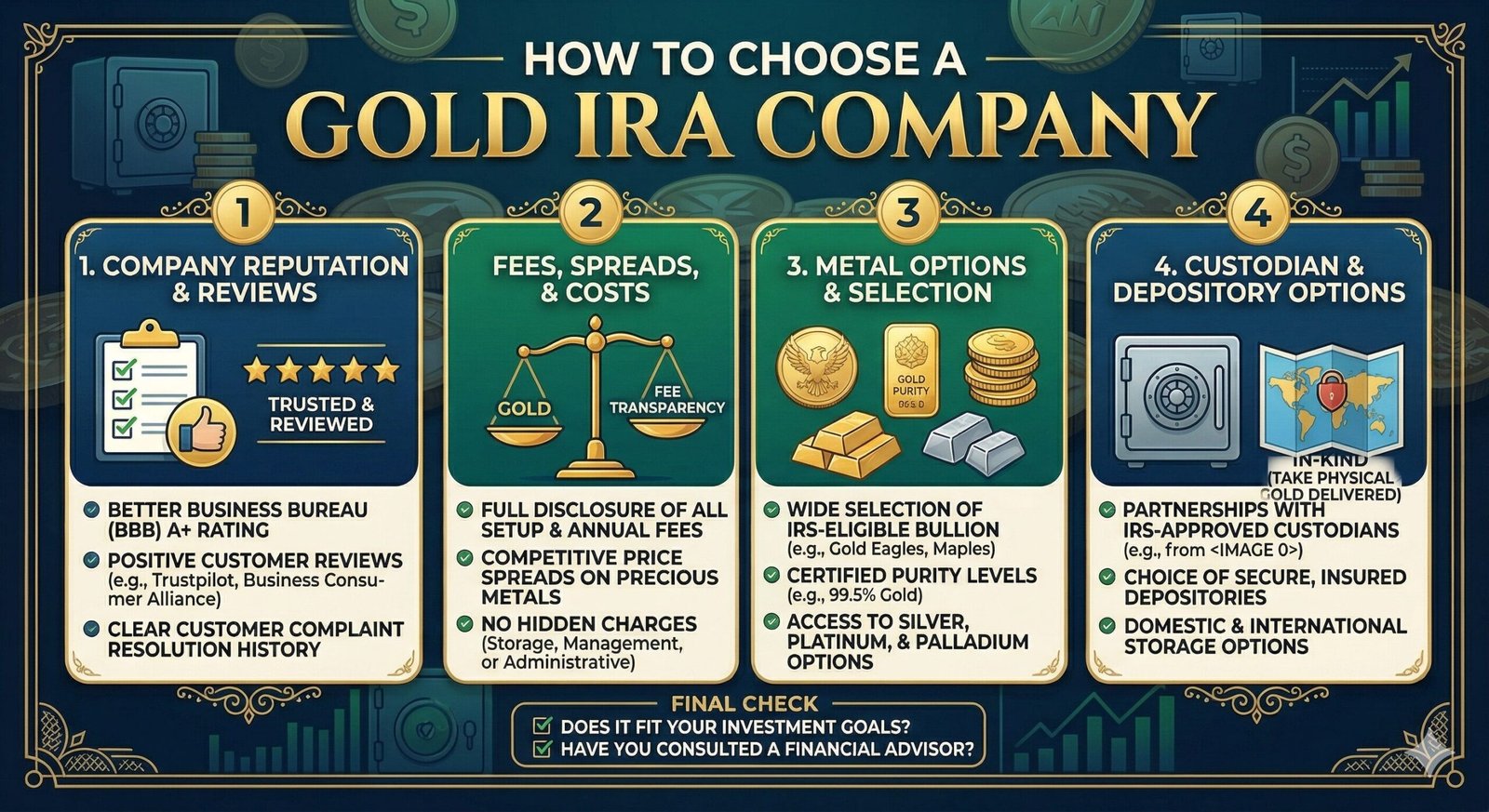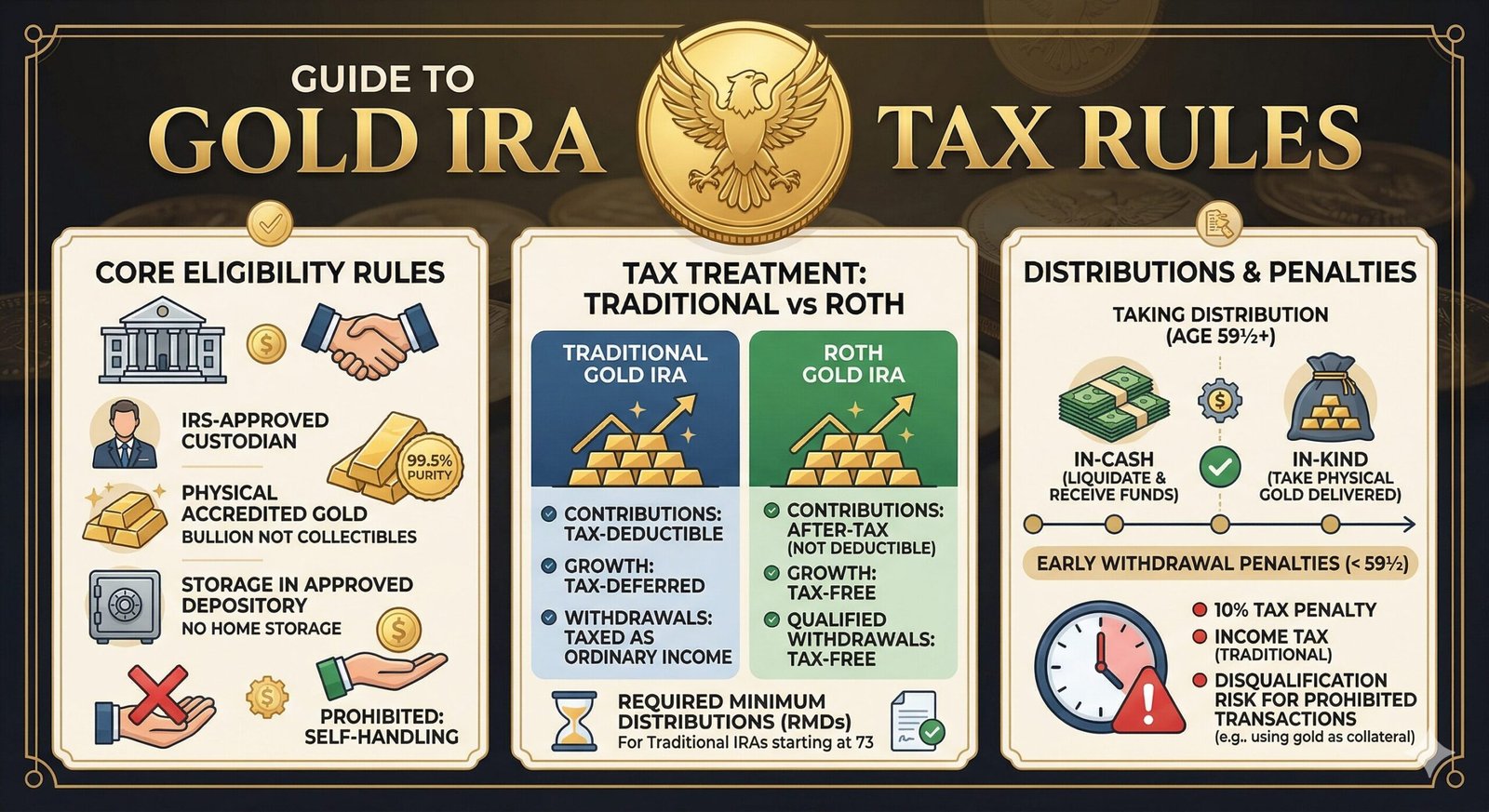

Gold IRA minimum investment requirements vary significantly across providers — from $10,000 at several well-regarded companies to $50,000 at others. The minimum determines which providers you can access, but it also signals something about the service model you’re entering.
This guide explains why minimums exist, what they look like across the market, and — more importantly — what questions to ask alongside the minimum when evaluating any provider.
For a broader look at what a Gold IRA is before evaluating providers, see our Gold IRA hub page.
Why Do Companies Have Gold IRA Minimum Investment?
Unlike a standard brokerage IRA with no minimum, Gold IRAs involve physical metals that must be purchased, insured, transported, and stored. There are genuine fixed costs in that process that make very small accounts economically unworkable.
There’s also a practical cost burden consideration: annual fees (custodian fee + storage fee) typically total $175–$400 per year. On a $5,000 account, that’s an 3.5–8% annual cost drag before any metal price movement — which is rarely in anyone’s interest. Full detail: Gold IRA Fee Explained.
Minimum Ranges Across the Market
Lower Minimum ($2,000–$10,000)
Some providers accept accounts starting at $2,000–$5,000. These are typically smaller or newer operations. The trade-off is often in service quality, educational resources, and depth of custodian/depository relationships. At these balance levels, annual fees as a percentage of account value can be significant.
Mid-Range ($10,000–$25,000)
The most common minimum tier among established Gold IRA companies. Several well-rated providers operate here. At $10,000, the fee-to-balance ratio becomes more manageable, and companies in this tier typically offer better infrastructure and support.
Premium ($25,000–$50,000)
Companies focused on larger rollover clients — investors moving substantial 401(k) or IRA balances — typically set minimums in this range. The higher minimum filters for clients where the service model (dedicated account teams, structured onboarding, long-term support) is economically sustainable.
Our Recommended Providers by Minimum
| Company | Minimum | Best For |
|---|---|---|
| Augusta Precious Metals | $50,000 | Best overall — flat fees, lifetime support |
| Goldco | $25,000 | 401(k) / IRA rollovers |
| American Hartford Gold | $10,000 | Lower minimum entry |
| GoldenCrest Metals | $10,000 | Competitive fee structure |
| Birch Gold Group | $10,000 | Educational approach |
Full comparison with fees, ratings, and features: Best Gold IRA Companies of 2026
The Minimum Is Not the Only Number That Matters
The minimum tells you whether you can open an account. It doesn’t tell you whether the company is the right fit for your balance.
The more important structural question is whether the annual fee is flat or scaled with account value.
At $200,000, a flat $250 annual fee is 0.125% of your account per year. A scaled 0.75% fee on the same balance is $1,500 per year. Over a 15-year retirement horizon, that difference compounded is substantial.
For investors with balances well above a company’s minimum, a flat-fee provider is almost always more cost-efficient at scale — even if their minimum is higher. See the full fee comparison in our Gold IRA Fees guide.
Does the Minimum Apply to Rollovers?
In most cases, yes — the stated minimum applies regardless of how you fund the account, whether through a new cash contribution or a rollover from a 401(k) or IRA.
Some providers at the premium end apply their minimum as a qualification threshold for their service model rather than a hard technical limit. If you’re close to but slightly under a provider’s minimum, it’s worth contacting them directly.
For the rollover process itself, see How to Roll Over a 401(k) to a Gold IRA.
What If You’re Under $10,000?
A self-directed IRA holding physical precious metals is generally not cost-effective at balances below $10,000. The annual fee structure (which exists regardless of account size) becomes disproportionate.
Alternative ways to gain precious metals exposure without the physical Gold IRA structure — such as gold or silver ETFs held in a standard brokerage IRA — don’t carry the same custodian and storage fee burden. Our gold investment methods comparison covers those options alongside the physical IRA approach.
Can You Add to a Gold IRA Over Time?
Yes. After opening above the minimum, you can make additional contributions up to the annual IRA limit ($7,000 in 2026; $8,000 if 50 or older), or roll in additional funds from eligible retirement accounts at any time.
The annual IRA contribution limit applies to new cash contributions only. Rollovers bypass the annual cap and can be done in any amount from eligible accounts. See IRS guidance on IRA contribution limits for the current rules.
Frequently Asked Questions
Yes, with American Hartford Gold, GoldenCrest Metals, and Birch Gold Group — all well-rated options. At $10,000, be conscious of annual fees as a percentage of account value.
Augusta’s $50,000 minimum reflects their service model — it’s a qualification threshold, not an arbitrary number. Their focus is clients rolling over substantial retirement balances. The minimum is generally not waived.
A physical Gold IRA is not typically cost-effective at this level. Gold and silver ETFs in a conventional IRA are a lower-cost alternative for smaller balances.
Yes. If you roll over $30,000 from a $100,000 401(k), the $30,000 counts toward the minimum.
No IRS cap on account balance. The annual contribution limit ($7,000/$8,000) applies to new cash contributions — not to rollover amounts.
Match Your Balance to the Right Provider
Different companies suit different balance levels. Our comparison page shows minimums, fee structures, ratings, and key features for all five recommended providers side by side.
Compare the Best Gold IRA Companies for 2026 →
Informational purposes only. Minimum requirements are subject to change — confirm directly with any provider. See IRS Publication 590-A for current IRA rules.
Related guides
- Gold IRA Consumer Affairs Reviews: What to Look For
- Gold IRA Trustpilot Reviews: What Real Customers Say
- Gold IRA BBB Complaints: What Consumer Reports Reveal
- Is a Gold IRA Worth the Fees? A Cost-Benefit Analysis
- Are Gold IRA Fees Too High? Breaking Down the Real Costs
- Gold IRA Mistakes to Avoid: 10 Common Errors Investors Make