
Gold IRAs cost more to maintain than a standard brokerage IRA. That is the honest starting point. The cost comes from holding a physical asset that requires custodial oversight and secure storage — both real services with real costs.
Understanding the gold ira fee structure is crucial for making informed investment decisions.
Investors should be aware of the gold ira fee implications when comparing different providers.
What varies significantly across providers is how much they charge and how the fee is structured. Those differences compound meaningfully over a retirement horizon. This guide breaks down every fee category and the one structural difference that matters most as your account grows.
For context on what a Gold IRA is and how it works before diving into fees, see our Gold IRA overview.
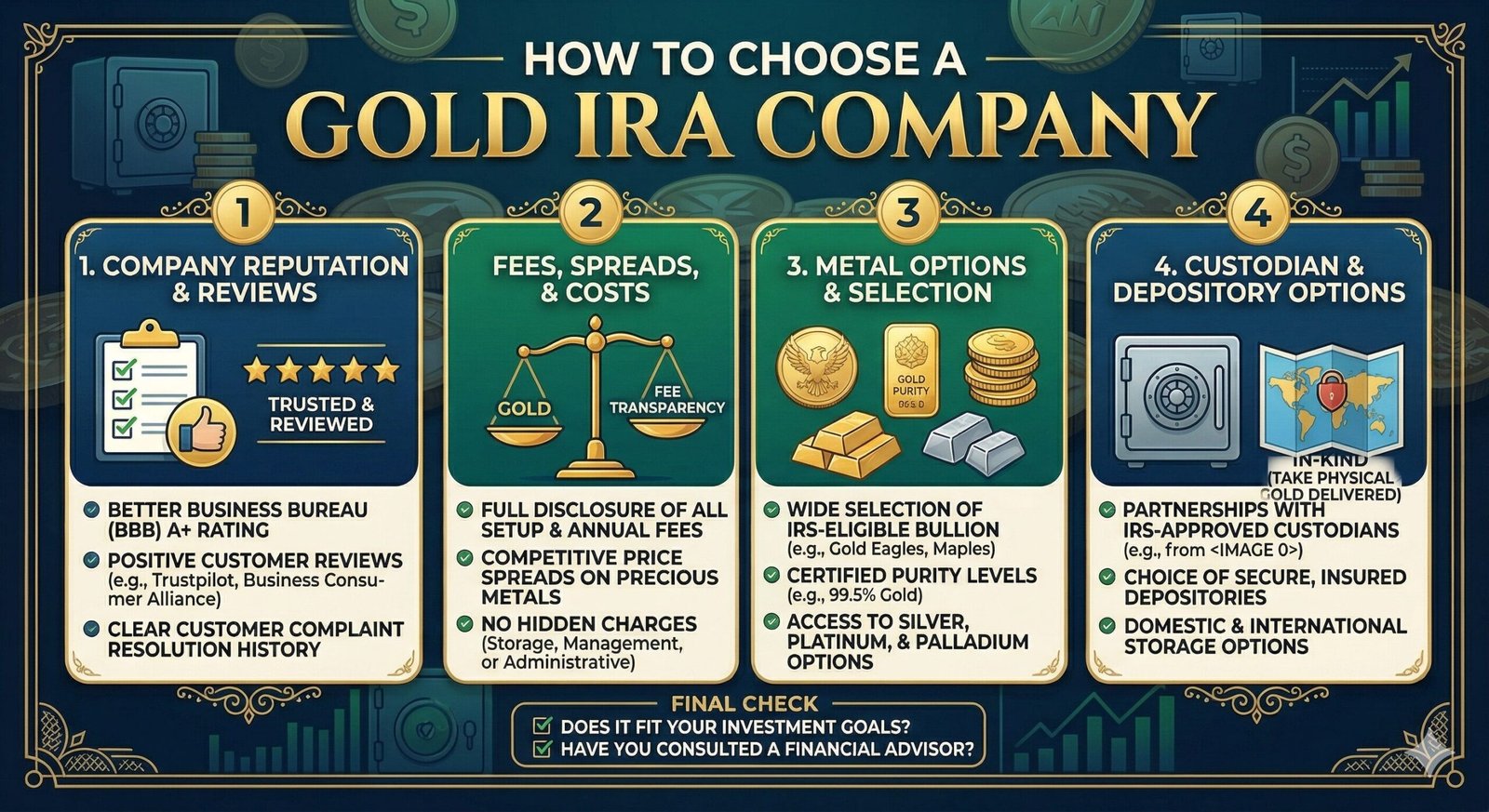
The Four Main Fee Categories
1. Account Setup Fee (One-Time)
A one-time charge to establish your self-directed IRA and process initial paperwork. Typical range: $50–$300. Some companies waive this for larger accounts or as a promotional offer.
2. Annual Custodian / Administration Fee
Charged by the IRS-approved custodian — the financial institution that holds legal title to your metals and handles required IRS reporting (Form 1099-R, Form 5498). Typical range: $75–$300 per year. The SEC’s investor education resource notes that custodian fees are one of the most commonly overlooked cost factors in self-directed retirement accounts.
3. Annual Storage Fee
The depository where your physical metals are held charges an annual storage and insurance fee. Typical range: $100–$300 per year.
Two storage types are available:
Segregated storage: Your specific metals are stored separately and identifiable as yours. Higher cost — often $50–$100 more per year — but you can verify the exact coins or bars belonging to your account
Commingled (non-segregated) storage: Your metals are pooled with other clients’. You own a documented quantity and purity, but not specific physical pieces. Lower cost, still fully insured.
4. Transaction Fees and Metal Markup
When you buy or sell metals, the company typically earns a spread — the markup over spot price. This is not always shown as a line item but is often the largest single cost over the life of an account.
Common markup structures: – Flat fee per transaction (e.g., $40) – Percentage above spot price (typically 1–5%) – Sometimes both
Always ask for a live quote on a specific product and compare to the current spot price before purchasing. The spread is your real transaction cost.
The Number That Matters Most: Flat vs. Scaled
Most investors focus on the dollar amounts of individual fee categories. The more important question is whether the annual fee is flat or scaled with account value.
Flat fee: Same dollar amount regardless of your balance.
Scaled (percentage-based) fee: Annual charge calculated as a percentage of assets under management (AUM). Common rates: 0.5–1% per year.
The difference becomes very significant as balances grow:
| Account Value | Flat Fee ($250/yr) | Scaled (0.75%/yr) | Annual Difference |
|---|---|---|---|
| $50,000 | $250 | $375 | $125 |
| $100,000 | $250 | $750 | $500 |
| $200,000 | $250 | $1,500 | $1,250 |
| $500,000 | $250 | $3,750 | $3,500 |
For investors rolling over a substantial 401(k) or IRA — which is the typical Gold IRA client profile — a flat-fee structure becomes dramatically more cost-efficient at scale.
See our Gold IRA minimum investment guide for how minimums relate to cost efficiency across providers.
Typical Total Annual Cost
| Fee Type | Typical Range |
|---|---|
| Setup fee (one-time) | $0–$300 |
| Annual custodian fee | $75–$200 |
| Annual storage fee | $100–$200 |
| Annual total (ongoing) | $175–$400 |
Transaction costs (metal markups on purchases and sales) are additional and variable.
Questions to Ask Every Provider
Before opening an account, ask these directly:
- Is the annual fee flat or does it scale with account value?
- What is the markup on metals at today’s spot price? (Ask for a live quote)
- Are storage fees for segregated or commingled storage, and what is each?
- What are the fees to sell or liquidate metals?
- Is there an account termination fee?
- Are any fees waived in the first year? (Promotional waivers defer costs, they don’t eliminate them)
How Gold IRA Fees Compare to Standard IRA Fees
In a conventional brokerage IRA holding index funds, visible fees are often close to zero. Most costs are embedded in fund expense ratios — typically 0.03–0.20% annually for passive index funds.
Gold IRAs have higher explicit annual costs because: – Physical metal requires insured, audited storage – A specialised custodian must maintain IRA compliance for a physical asset – Transaction costs for buying and moving physical metal are real
This is not a reason to avoid a Gold IRA — it is a factor to price correctly. A well-structured Gold IRA from a flat-fee provider with competitive metal pricing will have materially lower total cost than a scaled-fee provider with high transaction markups, particularly at larger account sizes.
For a full look at how providers differ on fees and every other key dimension, see our Best Gold IRA Companies comparison.
Frequently Asked Questions
Under current tax law, IRA fees paid from outside the IRA are generally not deductible as investment expenses. Fees paid from within the IRA reduce your invested balance but don’t create a separate deduction. Consult a tax professional for your specific situation.
Yes, most custodians permit this. However, it reduces your invested balance. Some investors pay fees from outside the IRA to preserve the full tax-deferred amount.
They can. If you are on a scaled-fee structure, your annual cost will grow as your account value grows. Review your fee structure if your balance changes significantly.
The metal markup over spot price — the spread charged at purchase — is frequently omitted from fee calculators but can be one of the largest costs over time. Always request a live metal quote before assuming headline fees reflect total cost.
Compare Fee Structures Side by Side
The right Gold IRA company for your balance depends heavily on whether they charge flat or scaled fees. Our comparison covers all five recommended providers.Compare the Best Gold IRA Companies for 2026 →
Informational purposes only. Fee ranges are indicative based on publicly available information as of 2026. Confirm all fees directly with any provider before opening an account. See also SEC investor guidance on retirement account costs.
Related guides
- Gold IRA Consumer Affairs Reviews: What to Look For
- Gold IRA Trustpilot Reviews: What Real Customers Say
- Gold IRA BBB Complaints: What Consumer Reports Reveal
- Is a Gold IRA Worth the Fees? A Cost-Benefit Analysis
- Are Gold IRA Fees Too High? Breaking Down the Real Costs
- Gold IRA Mistakes to Avoid: 10 Common Errors Investors Make