
401(k) to a Gold IRA rollover, also known as a 401(k) to gold ira rollover, is one of the most common ways U.S. retirement investors add physical precious metals to their retirement savings — without triggering taxes or early withdrawal penalties. Done correctly using a direct rollover, the process is straightforward and tax-free. Done incorrectly, it can result in a significant tax bill.
This guide covers the full process from start to finish: IRS rules, what to expect at each stage, and the mistakes that catch investors off guard.
Understanding the 401(k) to gold ira rollover process can help maximize your retirement savings.
If you’re still in the early research stage, start with what a Gold IRA actually is before continuing.
Can You Roll a 401(k) Into a Gold IRA?
Yes — with one important condition. You generally need to have left the employer sponsoring your 401(k). Most 401(k) plans do not allow in-service rollovers for active employees before age 59½.
Eligible accounts include:
- 401(k) from a former employer — rollover at any time
- Current employer 401(k) — check plan documents; some permit in-service rollovers after 59½
- Traditional IRA — direct transfer at any time
- 403(b), 457(b), or TSP — also eligible
The IRS provides full guidance on eligible account types and rollover mechanics in IRS Publication 590-A.
Direct Rollover vs. Indirect Rollover
Direct Rollover (Recommended)
Funds move directly from your old plan custodian to the new Gold IRA custodian — you never personally receive the money. No tax withholding. No 60-day deadline. This is the standard method any reputable Gold IRA company will use.
Indirect Rollover (Use With Caution)
Your old plan sends the funds to you first. Federal law requires the plan to withhold 20% for income taxes from employer-plan distributions. On a $100,000 balance, you receive $80,000. To complete the rollover tax-free, you must deposit the full $100,000 — including the $20,000 withheld — into the new Gold IRA within 60 days.
Miss that window or come up short, and the IRS treats the shortfall as a taxable distribution. Under 59½? A 10% early withdrawal penalty applies on top. For the full ruleset — including the one-rollover-per-year restriction — see our Gold IRA Rollover Rules guide.
Step-by-Step: The Rollover Process
Step 1: Choose a Gold IRA Company
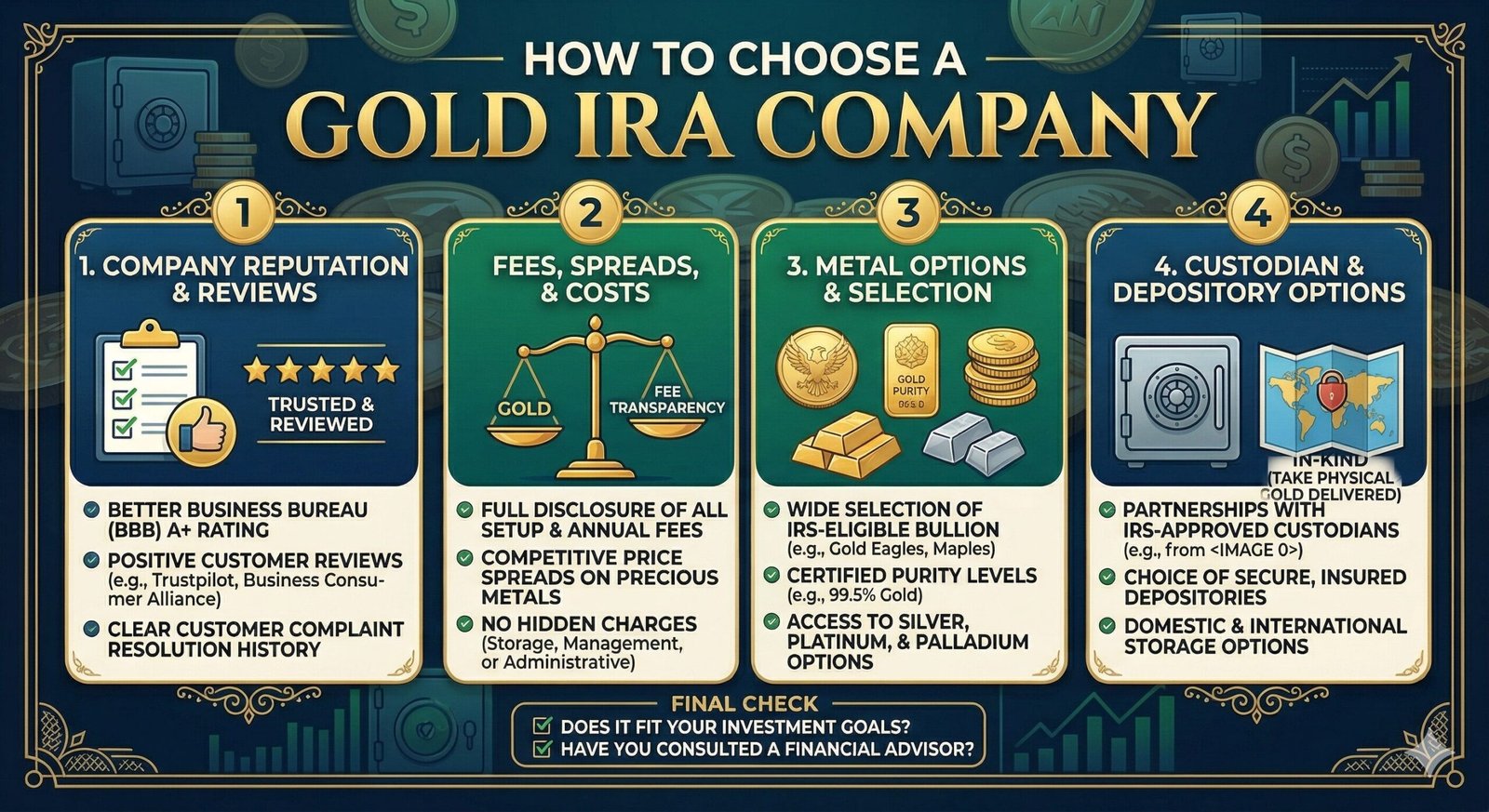
Your Gold IRA company guides the entire process — account setup, rollover paperwork, metal selection, and depository arrangement. Choosing the right one first makes every subsequent step straightforward.
Key factors: annual fee structure (flat vs. scaled), minimum investment, BBB rating and complaint history, custodian and depository quality, and how they handle client education.
Compare all five of our recommended providers: Best Gold IRA Companies of 2026 Understand what you’ll pay annually before committing: Gold IRA Fees Explained
Step 2: Open a Self-Directed IRA
You open a self-directed IRA — the account structure authorised under IRS Publication 590-A that permits physical precious metals. The Gold IRA company handles paperwork and coordinates with the custodian. Typically takes one to three business days.
Step 3: Initiate the Rollover
Contact your 401(k) plan administrator and request a direct rollover to your new self-directed IRA. Provide your new account details and the receiving custodian’s information. Some employers require specific forms — your Gold IRA company’s team can assist.
Step 4: Funds Arrive
Funds typically reach your new self-directed IRA within 7 to 21 business days depending on your former plan’s processing speed. Once cleared, you’re ready to purchase metals.
Step 5: Select IRS-Eligible Metals
IRS purity requirements for metals held in a Gold IRA:
- Gold: 99.5% minimum fineness
- Silver: 99.9% minimum fineness
- Platinum: 99.95% minimum fineness
- Palladium: 99.95% minimum fineness
Common approved gold products include the American Gold Eagle, American Gold Buffalo, and Canadian Gold Maple Leaf. For a full list of eligible coins and bars, see our IRA-eligible gold coins guide.
Step 6: Metals Delivered to an Approved Depository
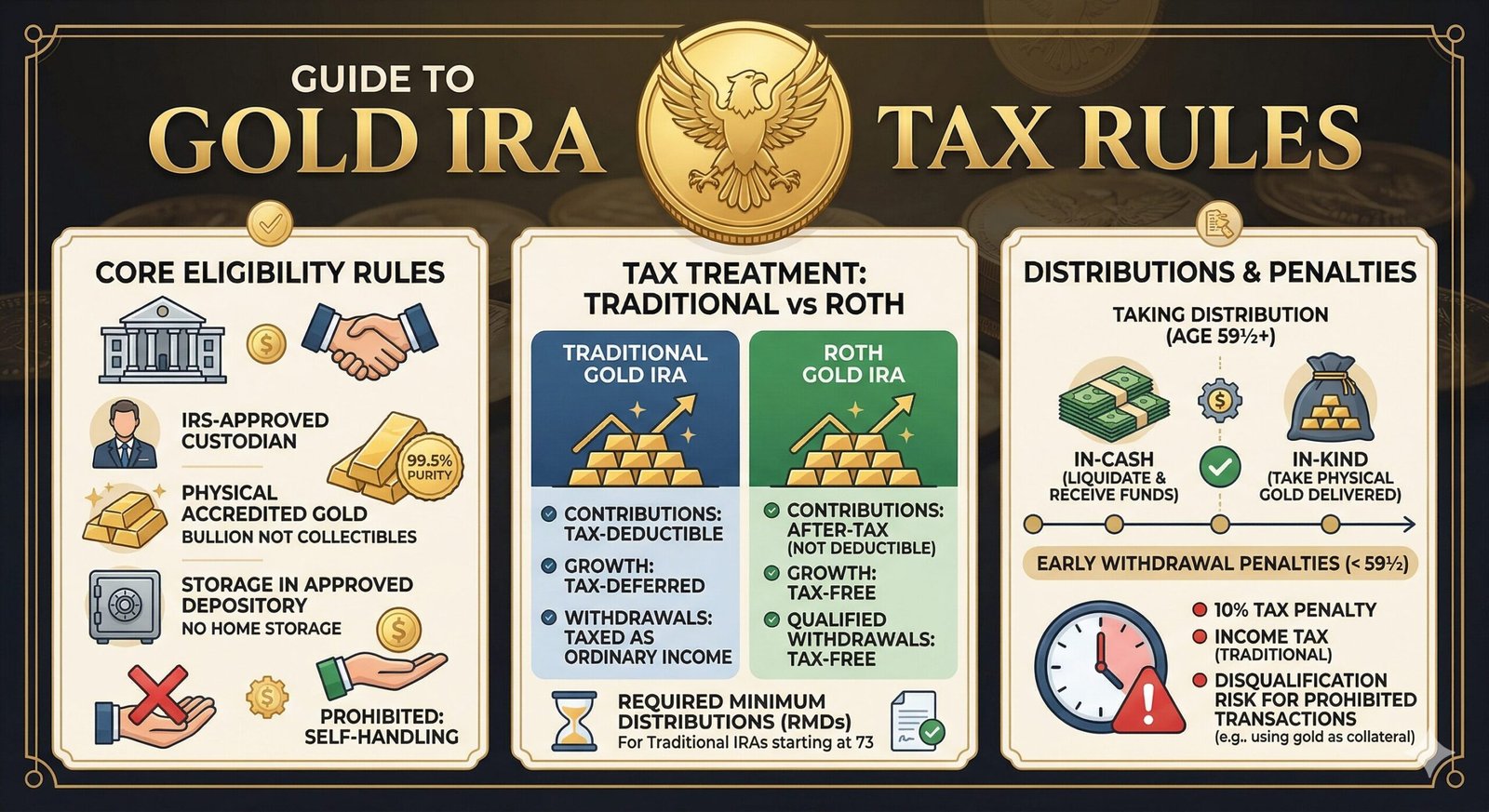
The Gold IRA company purchases metals on your behalf and arranges delivery to an IRS-approved depository. Storing Gold IRA metals at home or in a personal safe deposit box is prohibited — the IRS is explicit on this. See IRS guidance on IRA investments for full storage requirements.
Rollover Timeline
| Stage | Typical Timeframe |
|---|---|
| Open self-directed IRA | 1–3 business days |
| Rollover paperwork submitted | 1–3 business days |
| Funds transferred from old plan | 7–21 business days |
| Metals purchased and shipped to depository | 1–5 business days |
| Total | 2-4 Weeks |
Tax Rules
When executed as a direct rollover:
- No taxable event — funds move between tax-deferred accounts
- No early withdrawal penalty — regardless of age
- No annual contribution limits apply — rollovers are not subject to the $7,000/$8,000 IRA annual cap
- Custodians handle IRS reporting via Form 1099-R and Form 5498
Once the rollover completes, your Gold IRA operates under standard traditional IRA tax rules: tax-deferred growth, ordinary income tax on distributions, and required minimum distributions beginning at age 73. Full details in IRS Publication 590-A.
Common Mistakes to Avoid
Using an indirect rollover unnecessarily. The 20% withholding and 60-day window create avoidable risk. Always request a direct transfer.
Missing the one-IRA-to-IRA rollover per year limit. Indirect IRA-to-IRA rollovers are limited to once per 12-month period across all your IRAs. Direct trustee-to-trustee transfers are unlimited. FINRA’s guide to self-directed IRAs covers the compliance risks of non-standard rollover approaches.
Rolling over an RMD. If you’re 73 or older, you must take your required minimum distribution for the year before rolling over any remaining balance. RMDs themselves cannot be rolled over.
Purchasing ineligible metals. Collectible coins, Krugerrands (generally), and gold below 99.5% purity do not qualify. Confirm IRS eligibility before any purchase.
Not vetting the company. Always check BBB ratings and complaint history at bbb.org before opening an account. Our scam avoidance guide covers the red flags to watch for.
Frequently Asked Questions
No IRS cap on rollover amounts. Transfer your full balance or any portion of it.
Not with a direct rollover. Funds move between tax-deferred accounts with no taxable event.
Yes — roll it into a Roth Gold IRA (self-directed Roth IRA) to preserve the after-tax status and tax-free qualified withdrawals.
Varies by provider: $10,000–$50,000. Full breakdown: Gold IRA minimum investment guide.
A Gold IRA holds physical metals at an approved depository rather than stocks and funds. Full comparison: Gold IRA vs Traditional IRA.
Compare Providers Before You Begin
Compare the Best Gold IRA Companies for 2026 →
Informational purposes only. Not financial or tax advice. Consult a qualified advisor before making retirement account decisions. Investing in precious metals involves risk including possible loss of principal.
Related guides
- Gold IRA Consumer Affairs Reviews: What to Look For
- Gold IRA Trustpilot Reviews: What Real Customers Say
- Gold IRA BBB Complaints: What Consumer Reports Reveal
- Is a Gold IRA Worth the Fees? A Cost-Benefit Analysis
- Are Gold IRA Fees Too High? Breaking Down the Real Costs
- Gold IRA Mistakes to Avoid: 10 Common Errors Investors Make