
When investors decide to add gold to their portfolio, one question comes up almost immediately: should I buy physical gold vs gold ETFs? Both give you exposure to gold prices. Both are legitimate investment vehicles. But the structural differences between them are significant — and for retirement-focused investors with long time horizons, those differences can matter enormously.
This guide breaks down the physical gold vs gold ETFs comparison across eight key factors: ownership structure, counterparty risk, liquidity, costs, tax treatment, IRA eligibility, storage requirements, and long-run suitability. By the end, you will have a clear picture of which approach — or which combination — aligns best with your financial goals.
⚠️ Important Disclaimer
This article is for educational purposes only and does not constitute financial or investment advice.
Always consult a qualified financial advisor before making investment decisions.
The Core Distinction: What You Actually Own
This is the most important starting point in any physical gold vs gold ETFs discussion.
When you buy physical gold — coins, bars, or bullion — you own the metal directly. There is no intermediary standing between you and your investment. No brokerage account required. No counterparty to fail. The gold is yours, with no strings attached.
When you buy shares in a gold ETF — such as SPDR Gold Shares (GLD) or iShares Gold Trust (IAU) — you are purchasing shares in a trust or fund. The trust holds physical gold in custody on your behalf, but you do not own specific bars. You own shares. Your claim to gold value passes through a chain of brokerages, authorised participants, and custodian banks.
Under ordinary market conditions, this distinction does not feel significant. Both track the gold price. Both show gains when gold rises. But the reason most people consider gold in the first place — as a hedge against systemic financial stress, institutional failure, or currency crises — is precisely where this structural difference becomes relevant. As the World Gold Council notes, physical ownership provides direct exposure to gold without reliance on any third-party institution.
Physical Gold vs Gold ETFs: 8-Factor Side-by-Side Comparison
| Factor | 🪙 Physical Gold | 📈 Gold ETFs |
|---|---|---|
| Ownership | Direct — you own the metal | Indirect — you own shares in a trust |
| Counterparty Risk | None — no intermediary required | Present — depends on fund structure, custodians |
| Liquidity | Moderate — sell to dealers or private buyers | High — traded on exchange during market hours |
| Storage Costs | Yes — home safe or paid vault/depository | No — fund handles custody internally |
| Annual Fees | None beyond storage | Expense ratio (GLD: 0.40%, IAU: 0.25%) |
| IRA Eligible | Yes — via self-directed Gold IRA | Yes — in standard brokerage IRA |
| Physical Delivery | Immediate — you already hold it | Generally not available to retail investors |
| Privacy | High — no reporting for most purchases | Low — account and transaction records kept |
Counterparty Risk: The Factor Most Investors Overlook
In the physical gold vs gold ETFs debate, counterparty risk is the factor that most investors underestimate — until they need to think about it.
Physical gold carries zero counterparty risk. Its value is not dependent on any institution honouring a promise. It cannot be frozen, suspended, or restructured. In periods of genuine systemic stress — the 2008 financial crisis, the March 2020 liquidity shock, or extreme currency devaluation scenarios — physical gold continues to function as a store of value because it exists outside the financial system entirely.
Gold ETFs, by contrast, involve counterparty exposure at multiple levels. The fund structure relies on authorised participants to maintain the share price’s alignment with the underlying gold value. The custodian must maintain accurate records. The brokerage through which you hold shares must remain solvent. Under normal conditions, all of these work seamlessly. In truly extreme scenarios, they are potential points of vulnerability.
This does not mean ETFs are unsafe. For the vast majority of investors in normal market environments, they function exactly as intended. The point is that physical gold vs gold ETFs is not just a cost comparison — it is a philosophical distinction about what kind of asset you are actually holding. For a deeper look at how this fits into broader gold investing strategy, see our complete guide to gold investing.
Costs: How Physical Gold vs Gold ETFs Really Compare
Cost comparisons between physical gold vs gold ETFs are often oversimplified. ETFs appear cheaper on the surface because there are no storage fees and transaction costs are minimal. But a complete comparison requires looking at the full picture.
Physical Gold Costs
- Dealer premiums above spot price (typically 2–8% depending on product and quantity)
- Storage: home safe (one-time), bank safe deposit box ($50–$200/year), or private vault ($100–$300+/year)
- Insurance for home or off-site storage
- Bid-ask spread when selling to dealers
- No ongoing management fees or expense ratios
Gold ETF Costs
- Annual expense ratio (SPDR GLD: ~0.40%, iShares IAU: ~0.25%)
- Standard brokerage transaction costs (often $0 for major ETFs at large brokers)
- No storage, insurance, or custody costs to the investor
- Expense ratio compounds over time — on a $100,000 position, GLD’s 0.40% costs $400/year, accumulating to ~$10,000 over 25 years
For long-term retirement investors, the compounding effect of even a modest expense ratio matters. A physical gold holding that costs $200/year to store but carries no ongoing expense ratio may outperform an ETF position on a net-cost basis over a 20-year period, depending on holding size.
Tax Treatment: Key Differences Between Physical Gold and Gold ETFs
The IRS treats both physical gold and gold ETFs as collectibles for capital gains purposes, which means they are subject to a maximum long-term capital gains rate of 28% — higher than the 15–20% rate applied to most stocks. This is an important consideration in the physical gold vs gold ETFs decision that is often missed.
However, there are nuanced differences. The IRS Publication 550 covers investment income and expenses in detail. Key points:
- Physical gold: gains are realised only when you sell. No annual distributions or dividend events.
- Gold ETFs (grantor trust structure like GLD): investors may receive a Schedule K-1 and must report their proportionate share of the fund’s gains/losses annually, even without selling.
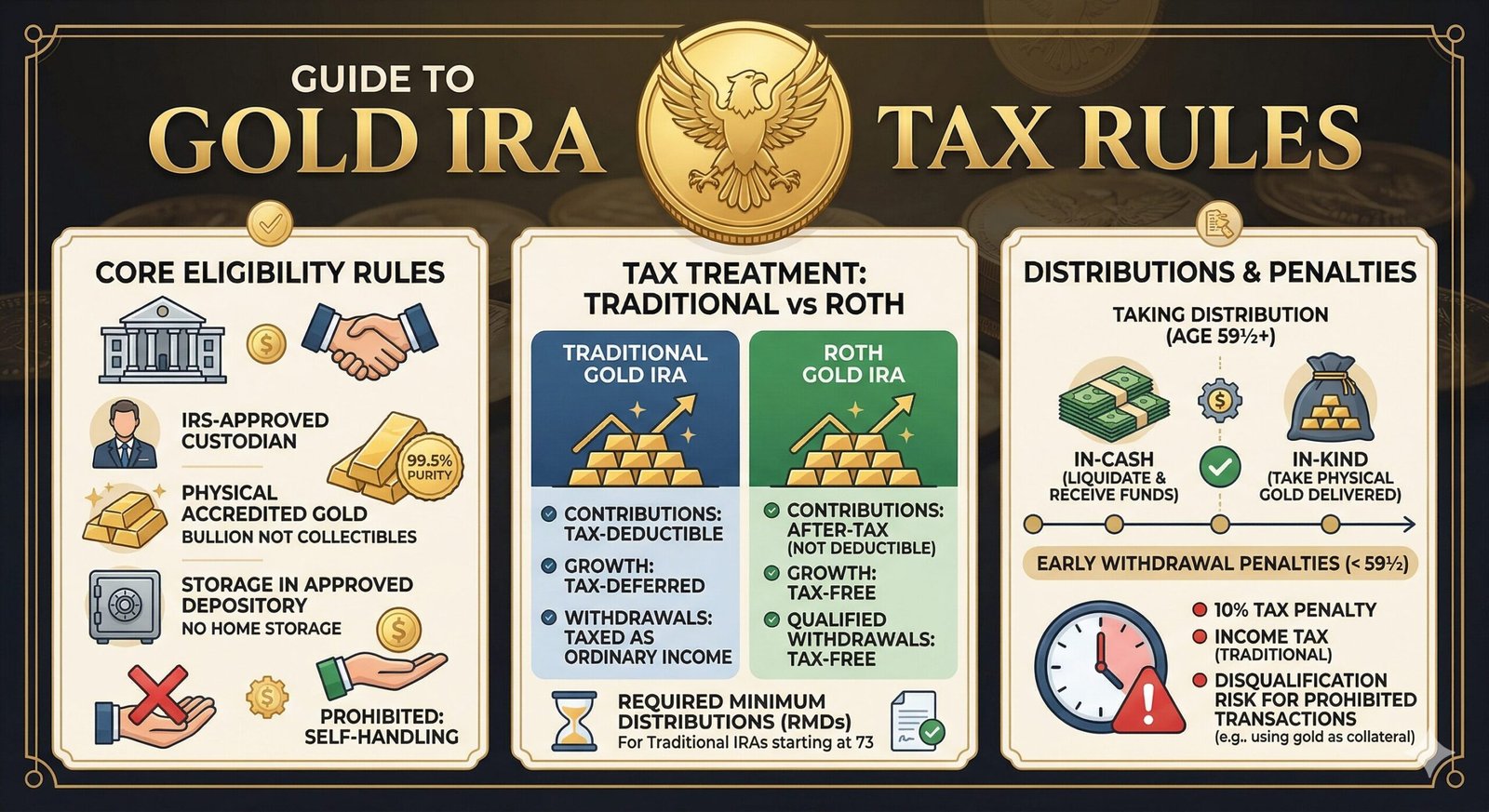
- Gold IRAs: gains inside a tax-advantaged account defer or eliminate the collectibles tax rate depending on account type (Traditional vs. Roth).
For tax-efficient gold exposure, a Gold IRA is often the most advantageous structure for retirement investors — allowing physical gold ownership inside a tax-deferred or tax-free account. Our guide on Gold IRAs explained in detail covers this structure comprehensively.
Can You Hold Physical Gold or Gold ETFs in a Retirement Account?
Yes to both — but through different account structures, and this is where the physical gold vs gold ETFs comparison becomes especially relevant for retirement planning.
Gold ETFs in a Standard IRA
Gold ETFs like GLD and IAU can be held in a standard IRA through any major brokerage — Fidelity, Vanguard, Schwab, etc. — just like any other publicly traded security. This is the simpler option, requiring no special account setup.
Physical Gold in a Self-Directed Gold IRA
Physical gold requires a self-directed IRA — a specialised account structure that allows holdings in IRS-approved alternative assets including precious metals. The IRS requires:
- Gold purity of at least 99.5% (bars) or IRS-approved coins (American Eagle, Canadian Maple Leaf, etc.)
- Storage in an IRS-approved depository — personal possession of IRA-held gold is not permitted
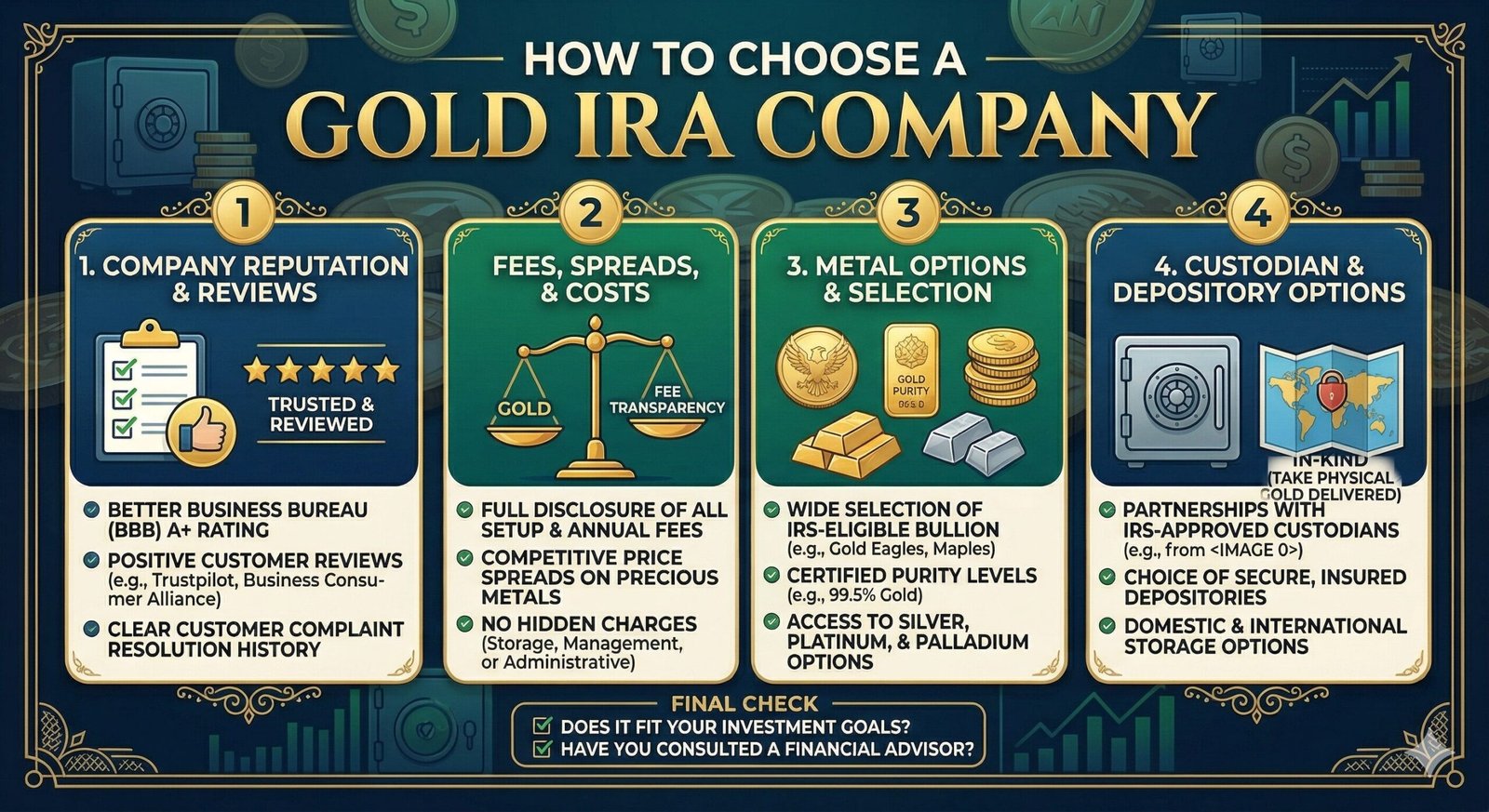
- A qualified custodian to administer the account
Gold IRAs provide the unique benefit of physical metal ownership inside a tax-advantaged structure — combining the counterparty-risk-free characteristics of physical gold with the tax benefits of an IRA. For retirement investors who want direct metal exposure without the collectibles tax rate applying to each gain, this is often the optimal structure. See our Gold IRAs explained in detail article for full guidance.
Liquidity: Which Is Easier to Sell?
Gold ETFs win on liquidity. They trade on major exchanges with tight bid-ask spreads and can be sold instantly during market hours through any brokerage account. For investors who need to access capital quickly, or who trade tactically based on gold price movements, this is a significant advantage.
Physical gold is less liquid but more accessible than most investors assume. Established dealers — such as JM Bullion or APMEX — buy back gold on clear pricing terms. Coins and small bars are particularly easy to sell in partial quantities, which bars you cannot easily split. The sale process typically takes 1–5 business days from ship to payment. For where to buy gold bars in 2026, our guide covers the most reputable dealers and their buyback programs.
For long-term retirement investors who are not trading frequently, the liquidity difference between physical gold vs gold ETFs is less material. The more important question is whether you need the portfolio flexibility of intraday trading, or whether your goal is long-term capital preservation outside the financial system.
Physical Gold vs Gold ETFs: Which Is Right for You?
There is no universal answer — the right choice depends on your investment goals, time horizon, account structure, and philosophy toward financial system risk. Here is a practical framework:
🪙 Choose Physical Gold If:
You want zero counterparty risk and direct ownership of the metal
You are investing for the long term (10+ years) with capital preservation as a primary goal
You want to hold gold inside a self-directed Gold IRA
You prefer privacy and want assets held outside the financial system
You are comfortable with modest storage costs in exchange for structural independence
📈 Choose Gold ETFs If:
You need high liquidity and the ability to buy/sell intraday
You are making tactical portfolio adjustments based on gold price movements
You want simple exposure inside an existing standard IRA or brokerage account
Transaction efficiency and low cost-of-entry are priorities
You are comfortable with the fund structure and counterparty exposure involved
✅ Consider Both If:
You want ETF exposure for liquidity and tactical flexibility, AND
Physical gold for the portion of your wealth you want held outside the banking system entirely
Many experienced gold investors use this hybrid approach — ETFs for trading, physical metal for wealth preservation
The Case for a Hybrid Approach
The most common approach among experienced gold investors is not a binary physical gold vs gold ETFs choice — it is a deliberate combination of both.
ETFs serve the liquid, tactically flexible portion of gold exposure. Physical metal — whether held at home, in a vault, or inside a Gold IRA — serves the structural, long-run wealth preservation role. The two functions are complementary, not competing.
The proportional split depends on individual circumstances. A retiree focused on capital preservation might weight heavily toward physical gold and a Gold IRA. A pre-retiree still accumulating assets and making frequent portfolio adjustments might lean more toward ETFs for now, transitioning toward physical holdings as they approach drawdown. Our analysis of gold investment methods compared explores these trade-offs in the context of broader portfolio strategy.
For context on why institutions and central banks have been increasing physical gold holdings — rather than paper equivalents — our article on why central banks are buying gold again offers relevant perspective on how sophisticated actors approach this same question.
Conclusion
The physical gold vs gold ETFs decision is fundamentally about what kind of asset you want to hold — and why you’re holding gold in the first place.
If your goal is tactical exposure to gold prices with maximum flexibility, ETFs are efficient, cost-effective, and simple. If your goal is direct ownership of a hard asset with no counterparty risk — particularly for long-term retirement wealth preservation — physical gold, and ideally a Gold IRA, provides structural advantages that paper-based instruments cannot replicate.
For most retirement investors, the most thoughtful approach involves understanding both structures clearly, using them deliberately for their respective strengths, and ensuring that at least a portion of their gold exposure carries the characteristics of genuine ownership. That is the starting point for a resilient, inflation-resistant retirement portfolio.
Explore our Gold IRAs explained in detail guide to understand the self-directed IRA structure, or visit our complete guide to gold investing for the full context.